Backenbrecher vs. Kegelbrecher: Ein umfassender Leitfaden zur Auswahl

Backenbrecher vs. Kegelbrecher: Ein umfassender Leitfaden zur Auswahl

Jaw crushers and cone crushers are not mutually alternative equipment but machines with upstream and downstream division of labor. Jaw crushers are mainly used for primary coarse crushing (the first crushing stage), while cone crushers serve secondary and tertiary medium & fine crushing (the second and third crushing processes). Most sand, aggregate and mineral processing production lines adopt the combination of “jaw crusher + cone crusher”. Only under special capacity, material and budget conditions will users choose one of the two devices. Below is a comprehensive analysis of selection criteria from all dimensions.

1. Full Comparison Table of Core Technical Parameters

Comparison ItemBackenbrecherCone Crusher
Process PositionPrimary Coarse Crushing (Essential Primary Crusher)Secondary/ Tertiary Medium & Fine Crushing
Max Feeding Size500~1500mm; large feed opening directly accepts oversized run-of-mine oreNormally 100~400mm; only processes medium and small-sized materials after coarse crushing, unable to handle raw large ore blocks
Discharge SizeCoarse products: 50~150mm; uneven particle size with high flaky & elongated aggregate ratioMedium & fine products: 3~60mm; laminated crushing delivers well-graded cubical aggregates (≥85% cubical content)
FunktionsprinzipIntermittent reciprocating squeezing crushing with idle strokesContinuous gyratory squeezing crushing with 100% feeding & crushing efficiency
Applicable Material HardnessSuitable for soft, medium and extremely hard materials (limestone, granite, iron ore, construction waste, etc.)Only for medium-hard to extremely hard ores (granite, basalt, gold/iron/copper ore); not recommended for soft materials
Performance on Wet & Sticky MaterialsGood adaptability; high-clay, high-moisture ore rarely causes chamber blockingNot recommended; clay and wet materials easily stick to the crushing chamber and lead to frequent shutdowns
Small & medium models: 5~800t/h; max capacity up to 1400t/h (limited by intermittent operation)45~1200t/h; 30%~60% higher throughput than jaw crushers under identical feed specifications, ideal for mass production
Equipment Weight & FootprintCompact structure, low height, light weight with low civil construction investment1.7 times heavier than equivalent-capacity jaw crushers; higher equipment layout requires higher workshop and foundation costs
Initial Purchase CostLow unit price with high cost performance for small & medium models50%~150% higher price than jaw crushers of the same capacity; hydraulic versions require larger capital investment
Maintenance & Wear PartsSimple structure; only jaw plates and toggle plates as key wear parts with low replacement cost; regular electricians and fitters can complete maintenanceComplex structure equipped with hydraulic, lubrication and eccentric assemblies; concave and mantle are high-priced wear parts requiring professional servicing
Energy ConsumptionHigh power consumption per ton due to intermittent operationLaminated continuous crushing reduces unit power consumption by 15%~30%, saving operating costs for long-term mass production
Overload ProtectionMost standard models lack automatic protection; tramp iron easily causes stall and component damageEquipped with hydraulic overload protection; foreign uncrushable objects trigger automatic pressure relief to minimize equipment failure risks

2. Detailed Advantages & Disadvantages

2.1 Jaw Crusher (Preferred for Primary Coarse Crushing)

Kernvorteile

  1. Superior Feeding Capacity: The only primary crushing equipment capable of directly handling blasted oversized raw ore blocks up to 1 meter in diameter, irreplaceable for the first crushing stage.
  2. Strong Environmental Adaptability: Tolerates wet, clay-rich ore and steel-reinforced construction waste with low risk of chamber clogging, ideal for open-pit mines and mobile crushing plants.
  3. Low Entry Investment: Features affordable equipment price, low transportation and civil engineering costs, making it the best choice for small-scale sand quarries and small gold/ore processing plants.
  4. Simple Operation & High Durability: High mechanical reliability with low failure rates; spare parts are globally available and easy to source for remote mining sites lacking professional technicians.

Main Disadvantages

  1. Limited maximum throughput due to intermittent working mode, unable to satisfy ultra-large annual output mines with single-unit configuration.
  2. High flaky aggregate ratio and uneven discharge particle size; additional shaping equipment is required to produce high-grade construction aggregates.
  3. High vibration and noise levels, requiring vibration-damping foundation design.

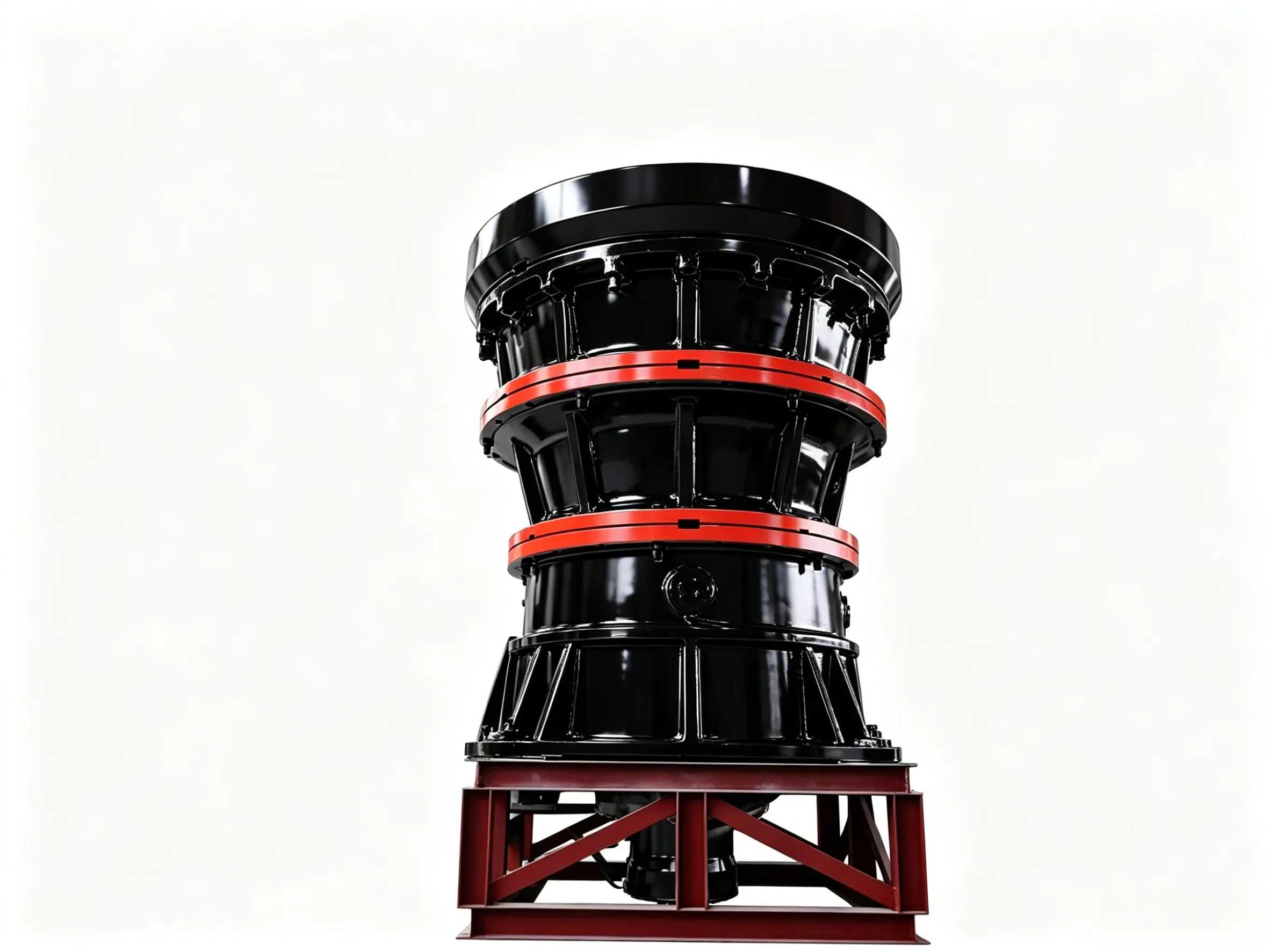
2.2 Cone Crusher (Optimal Medium & Fine Crushing for Hard Rock)

Kernvorteile

  1. High Continuous Throughput & Energy Efficiency: Choke-fed continuous crushing ensures full utilization of the crushing chamber, delivering superior performance for large-scale mines with hourly capacity over 300 tons.
  2. High-Quality Finished Aggregates: Laminated crushing achieves inter-particle compression and abrasion, producing cubical aggregates compliant with expressway, high-speed railway and commercial concrete standards. Uniform discharge also reduces ball mill liner wear in mineral processing plants.
  3. Long Wear Part Service Life for Hard Materials: High-manganese steel liners are wear-resistant for high-abrasion ores such as iron ore and basalt, far outperforming fine jaw crushers in service intervals.
  4. High Automatic Safety Level: Hydraulic cone crushers support remote discharge opening adjustment and real-time load monitoring; automatic pressure protection effectively avoids equipment damage from tramp metal.

Main Disadvantages

  1. Cannot process oversized raw ore directly; must be matched with a primary coarse crusher in the upstream process.
  2. Vulnerable to blockage when handling wet, clay-rich or weathered ore; frequent chamber cleaning causes severe production downtime losses.
  3. High upfront investment and maintenance threshold: heavy equipment increases workshop construction costs, while hydraulic systems require regular lubricating oil and seal replacement, raising operational pressure for small and medium enterprises.

3. Selection Guidance for 5 Typical Application Scenarios

Scenario 1: Primary Coarse Crushing for Run-of-Mine Ore

✅ Choose Jaw Crusher

Only jaw crushers accept large-sized blasted raw ore as the first crushing procedure. Cone crushers have strict feeding size limits and will stall if fed oversized materials.

Typical Process: Jaw Crusher → Belt Conveyor → Cone Crusher / Ball Mill for downstream processing

Scenario 2: Secondary & Tertiary Crushing for Hard Rock with High Aggregate Quality Requirements (Granite, Iron Ore, Basalt)

✅ Prioritize Hydraulic Cone Crusher

  1. Large-scale production lines with hourly throughput ≥200 tons requiring stable high output and low power consumption;
  2. Aggregate production for high-standard infrastructure demanding low flaky particle content and uniform grading;
  3. Mineral processing plants requiring consistent discharge size to reduce grinding energy consumption.

Scenario 3: High-Clay, Wet Weathered Ore or Construction Waste Crushing

✅ Select Fine Jaw Crusher; Avoid Cone Crusher

Clay and damp materials adhere tightly to cone crusher liners and rapidly block the crushing chamber, leading to frequent downtime for cleaning. The reciprocating squeezing mechanism of jaw crushers resists material adhesion and guarantees stable operation under high-moisture, high-clay conditions.

Scenario 4: Small-Capacity Projects, Limited Budget or Temporary Mobile Crushing Works

✅ Choose Jaw Crusher

  1. Small rural aggregate quarries with hourly output below 150 tons producing subbase backfill materials;
  2. Mobile crushing stations requiring lightweight equipment for rapid relocation and commissioning;
  3. New mining projects aiming to control fixed-asset investment with integrated coarse and fine crushing via jaw crushers.

Scenario 5: Fine Crushing Selection (Fine Jaw Crusher vs Cone Crusher)

  • Hourly capacity <100t/h, high material moisture, tight budget → Fine Jaw Crusher
  • Hourly capacity ≥150t/h, hard rock, high aggregate quality requirement and long-term continuous production → Cone Crusher

4. Common Misunderstandings & Optimized Process Configurations

Misunderstanding 1: Cone Crushers Can Replace Jaw Crushers as Primary Crushers

❌ Incorrect. Cone crushers have much smaller feed openings and cannot accept large raw ore blocks. Improper feeding will cause frequent blockage and permanent damage to the eccentric main shaft. No mine adopts cone crushers for primary coarse crushing in industrial practice.

Misunderstanding 2: Cone Crushers Deliver Higher Efficiency for Soft Materials (Limestone, Coal)

❌ Incorrect. Soft rocks generate excessive fine powder under compression, causing chamber clogging and accelerated liner wear. Impact crushers provide better cost performance for medium-fine crushing of soft materials.

Industry Standard Optimal Process Combinations

  1. Conventional Hard Rock Aggregate & Mineral Processing Line (Adopted by 90% of Mines)Jaw Crusher (Primary Coarse Crushing) + Single-cylinder / Multi-cylinder Hydraulic Cone Crusher (Medium & Fine Crushing) Advantages: Compatible with large feeding size, stable high throughput, premium aggregate shape and low long-term energy & maintenance costs, suitable for sustainable large-scale operation.
  2. Low-Cost Small-Scale Production LinePrimary Jaw Crusher + Fine Jaw Crusher for Secondary Crushing Advantages: Minimum initial investment, excellent adaptability to wet & clay-bearing materials, ideal for short-term small-scale mining and rural infrastructure projects.

5. Concise Selection Rules

  1. For oversized raw ore and the first crushing stage: Select jaw crusher.
  2. For hard rock, high throughput, high-quality aggregate and secondary crushing: Select cone crusher.
  3. For muddy, wet materials or small temporary projects: Choose jaw crusher and avoid cone crusher.
  4. For standard large mines: Jaw crusher for coarse crushing + cone crusher for medium & fine crushing is the most efficient matched solution.

Diese Produkte könnten Ihnen ebenfalls gefallen

Kreiselbrecher

Kreiselbrecher

Arten von Kreiselbrechern Kreiselbrecher werden in der Industrie bereits seit… eingesetzt
Drehrohrofen

Drehrohrofen

Produktübersicht: Kernausrüstung für die industrielle Kalzinierung Der Drehrohrofen ist ein…
Copyright © 2026 Oreprocessings. Alle Rechte vorbehalten.