


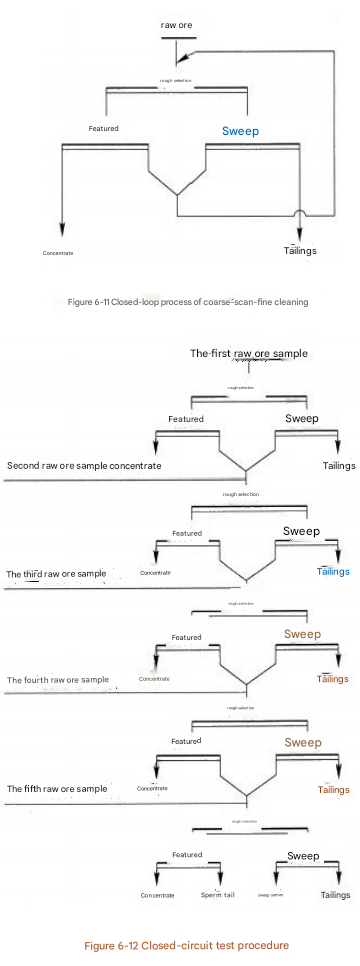
The method involves repeatedly performing several tests under the same conditions and procedures as the open-circuit test. Each time, the intermediate products (refined tailings and scavenged concentrate) are fed into the corresponding operation of the next test, mimicking the continuous closed-circuit production process, until equilibrium is reached. Figure 6-11 shows a roughing-scavenging-cleaning closed-circuit process, and the corresponding laboratory closed-circuit test process is shown in Figure 6-12.
A closed-circuit test requires two or more flotation machines and at least two people. Typically, 5-6 tests are performed consecutively. Ideally, the concentrate product should be rapidly dried during the test to determine if equilibrium has been reached. Rapid product analysis is also beneficial.
If the yield of the intermediate products continuously increases during the test and equilibrium is not reached, it indicates that the middlings were not separated during the flotation process. In future production, this middlings will only be mechanically allocated to the concentrate and tailings, leading to a decrease in concentrate quality and an increase in metal loss in the tailings. Even if there is no obvious continuous increase in middlings, if the chemical analysis of the product shows that the concentrate grade continuously decreases and the tailings grade continuously increases with each subsequent test, and never stabilizes, this indicates that the middlings have not been separated but are merely mechanically distributed into the concentrate and tailings.
In both of these situations, the reason for the lack of middlings separation must be investigated. If the product examination shows that the middlings are mainly composed of intergrowths, the middlings should be regrinded, and the regrinded product should be subjected to separate flotation tests to determine whether the middlings can be returned to the original flotation cycle and whether separate treatment is necessary. If the cause is other, the middlings must also be studied separately before determining its treatment method.
Whether the flotation closed-circuit test has reached equilibrium is indicated by whether the metal content and yield of the flotation products from the last few tests are approximately equal.
The following points should be noted during closed-circuit testing:
(1) The middlings contain a large amount of water. Before returning, the water should be concentrated, i.e., clarified and then partially extracted. This water will be used as replenishment and washing water for subsequent tests.
(2) With the return of the middlings, a large amount of reagents will be introduced. Therefore, the amount of reagents used in subsequent tests should be reduced accordingly.
(3) Special attention should be paid to avoid errors. A test procedure must be prepared in advance, and the labels of each product in each step must be marked to avoid mixing up labels or products. The entire closed-circuit test must be completed continuously without interruption.