


The reasonable proportion of ball diameters has two aspects: first, determining which diameters of balls to use; and second, determining the proportion of each diameter and its actual mass. Theoretically, to achieve good grinding results, the mass ratio of various balls in the mill should be compatible with the particle size distribution of the material being ground. Ball mills in production sites are equipped with various sizes of balls to process mixtures containing different particle sizes. For newly built concentrators, due to a lack of actual data, the actual ball proportions of similar concentrators are generally referenced and appropriately adjusted. The ball proportioning practices for concentrator mills in production can be summarized as follows: (1) First, take a full sample of the mill feed (generally, take samples of new feed and returned sand separately, then mix them according to the proportion) for sieve analysis, divide it into several particle sizes, weigh each particle size, and calculate the mass ratio (yield) of each particle size. (2) Using the upper or lower average values of the particle size limits for each grade, refer to Table 3-10 or use the formula to determine the diameter of the balls to be added for each particle size class.
(3) Based on the principle that the mass ratio of balls of various sizes should be compatible with the particle size composition of the material entering the mill, determine the proportion of balls of various sizes to the total mass of the added balls.
(4) Adjust the calculation results appropriately. Since smaller balls are not added in actual ball distribution, only a few types of balls are selected. Therefore, the calculated small-diameter balls can be proportionally allocated to larger balls to redetermine the mass ratio of balls for each grade.
(5) Calculate the actual mass of balls for each grade, as follows:
1) Calculate the total mass G of the balls according to the formula.
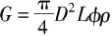
Where:
G—Total mass of balls, t;
D—Inner diameter of the ball mill cylinder, m;
L—Effective length of the ball mill cylinder, m;
φ—Media filling rate, %;
p—Bulk density of balls, t/m³.
2) Calculate the mass of each stage of balls based on the adjusted proportion of each stage.
[Example] A concentrator loads a φ1500mm×3000mm wet grate ball mill with a filling rate of φ=50%, using cast steel balls δ=4.5t/m³, and the mill processes medium-hard ore.
(1) The results of the total feed sieving of the mill are shown in Table 3-11.
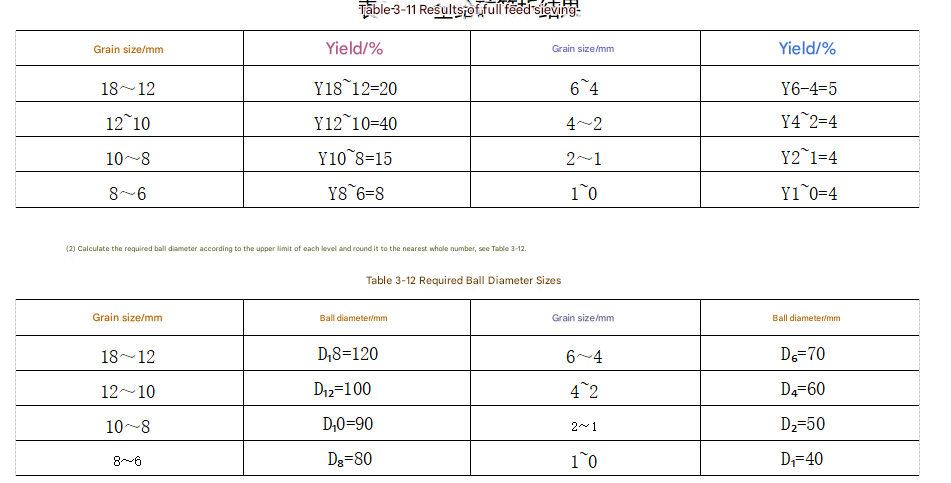
(3) The mass ratios of various balls are shown in Table 3-13.
Table 3-13 Mass Ratios of Various Balls
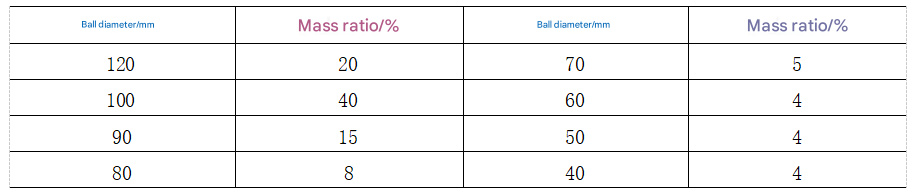
If it is determined that only balls of 120, 100, 80, and 60 g mass will be added, the proportions of balls of 90, 70, 50, and 40 g mass can be appropriately adjusted and added to the other balls. The results after adjustment in this example are shown in Table 3-14.
Table 3-14: Adjusted Mass Proportions of Various Balls

(4) Calculate the total mass G of the added balls:

(5) Calculate the mass to be added for each type of ball:
G120=GY120=11.928×0.3=3.58t
G100=Gy100=11.928×0.45=5.37t
G₈0=Gy80=11.928×0.13=1.55t
G60=Gy60=11.928×0.12=1.43t
(6) Weigh the balls according to the calculation results.