

Newly installed or overhauled grinding mills all have the issue of ball loading capacity. The ball loading capacity of a grinding mill is commonly expressed as the filling rate. The filling rate φ refers to the ratio of the volume of the media (V_balls, including voids) in the grinding mill to the effective volume of the grinding mill (V_mill).
φ = V_balls / V_mill × 100%
V_balls = W / δ

Where W—total mass of media added to the grinding mill, t;
V_balls—volume occupied by the media, m³;
δ—bulk density of the media, t/m³. For example, cast iron balls δ = 4.0~4.3, cast steel balls δ = 4.35~4.65, forged steel balls δ = 4.50~4.80, cast iron balls δ = 4.9, rolled steel balls δ = 6.0~6.5; D—effective inner diameter of the grinding mill, m;
L—effective inner length of the grinding mill, m. Both theoretical analysis and practical experience show that when the specifications (length, diameter) and rotational speed of the grinding mill are constant, within the range of φ < 50%, the production capacity of the grinding mill increases with the increase of φ. Generally, for ball mills, φ = 40%–50% (higher value for grate type, lower value for overflow type), and for rod mills, φ = 35%–45%. For grinding mills currently in operation, a shutdown measurement method can be used: After stopping and cleaning the ore, first measure the vertical distance from the media surface to the highest point of the cylinder, as shown in Figure 3-11.
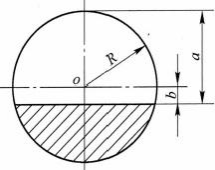
The distance b (mm) from the media surface to the center of the cylinder can be calculated using the following formula:
Where D is the inner diameter of the cylinder, mm.
The actual filling rate is calculated using the following formula.