


The size of the feed particle size has a significant impact on the mill’s productivity and energy consumption. At a given grinding fineness, the finer the feed particle size, the higher the mill’s production capacity and the lower the energy consumption per unit of ore processed. The relationship between feed particle size and mill throughput is as follows:
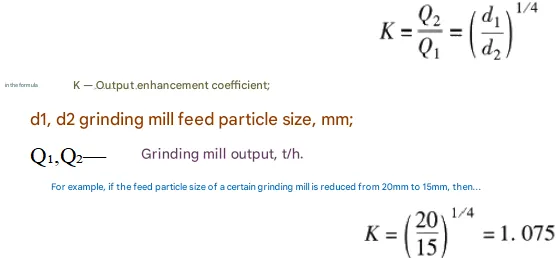
That is, a 7.5% increase in mill output is desirable. Therefore, in production, the mill should be supplied with fine-grained material whenever possible.
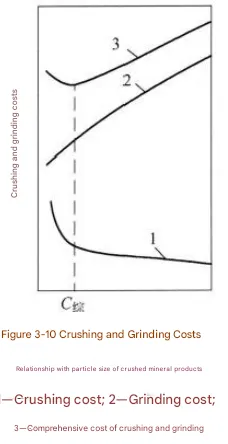
However, in a mineral processing plant, the feed for grinding is the final product of crushing. Reducing the mill feed particle size means that the crushing operation must produce a finer product, inevitably increasing the overall crushing ratio, making the process more complex, and increasing costs. Conversely, increasing the feed particle size reduces crushing costs but increases grinding costs. Therefore, when determining the mill feed particle size, a comprehensive consideration should be taken into account to minimize the total cost of crushing and grinding. Figure 3-10 qualitatively illustrates the relationship between crushing and grinding costs and the particle size of the crushed product. The particle size corresponding to the lowest point of curve 3 in the figure is the suitable feed particle size for the grinding mill.
Generally, when determining the suitable feed particle size for a grinding mill, the scale of the concentrator is the primary consideration, along with factors such as the performance of the equipment used in the crushing operation and the type of crushing process. Table 3-9 lists the suitable grinding feed particle sizes for concentrators of different sizes.
It should be noted that in conventional crushing and grinding processes, crushing consumes less energy than grinding, and the efficiency of crushing is higher than that of grinding. Therefore, in production, when conditions permit, the role of crushing operations should be fully utilized to provide the grinding mill with the finest feed material, thereby increasing the mill’s processing capacity. This is the principle of “more crushing, less grinding.”
