


Slurry concentration is the percentage of ore mass (dry weight) to the total slurry mass (ore + water). Grinding concentration refers to the slurry concentration within the grinding mill. Grinding concentration is a crucial factor affecting grinding mill productivity, determining the friction between the grinding media and the ground material, slurry fluidity, and the effective density of the grinding media (the density difference between the media and the slurry). In grinding mill operation, a higher grinding concentration is generally used, allowing a layer of slurry to adhere to the media surface, thus enhancing the beneficial grinding effect. Simultaneously, a larger volume of ore per unit volume is discharged, resulting in a larger discharge volume. However, excessively high slurry concentration increases slurry density, weakening the effective density, fluidity, and impact effect of the grinding media. Furthermore, high slurry concentration leads to high viscosity and poor fluidity, reducing the total discharge volume and consequently lowering grinding mill productivity, potentially even causing “bloating” (a condition where the grinding mill becomes bloated). Therefore, “high concentration” refers to appropriately increasing the grinding concentration within a certain range, which is beneficial for improving grinding efficiency.
Returned sand refers to the coarse particles returned to the mill for further grinding during closed-circuit grinding. The amount of returned ore is often several times that of the original feed. The ratio of returned sand to the original feed is called the returned sand ratio. Practice has shown that the size of the returned sand ratio directly affects the mill’s productivity. A larger returned sand ratio increases the total feed to the mill, thereby accelerating the mill’s discharge speed, shortening the material’s residence time in the mill, and speeding up circulation. Furthermore, although returned sand is coarse-grained ore, it is still finer than the original ore, thus resulting in a finer overall feed particle size distribution, which, combined with the above, is beneficial for improving the mill’s productivity. Figure 3-12 illustrates the relationship between the returned sand ratio and the relative productivity of the mill.
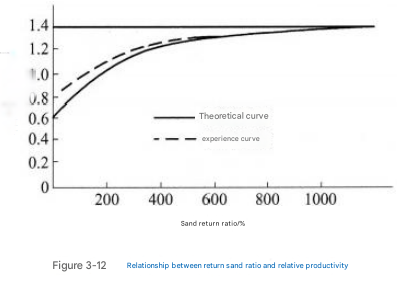
This indicates that within a certain range (e.g., 100%–500%), the mill productivity increases with the increase in the return sand ratio. However, when a certain value is reached, the increase in productivity becomes very small, and the mill’s total feed approaches its maximum throughput capacity, easily causing the mill to “bulge.” Therefore, the return sand ratio should be kept stable, close to a constant value.
Uniform feeding has two main meanings: first, the feed rate (the amount of ore fed into the mill per unit time) should be constant; second, the particle size distribution of the feed should be uniform. To improve grinding efficiency, the feed rate should be continuous, uniform, and stable at a relatively high level. Fluctuations in feed rate will cause frequent fluctuations in the slurry concentration within the mill, which is detrimental to the grinding process. Particle size segregation often occurs in the feed hopper—fine in the center and coarse around the edges—easily causing uneven feed composition. If the operation is not adjusted in time according to particle size, “bulging” will occur. Therefore, the feed hopper should adopt multi-point discharge feeding as much as possible.