
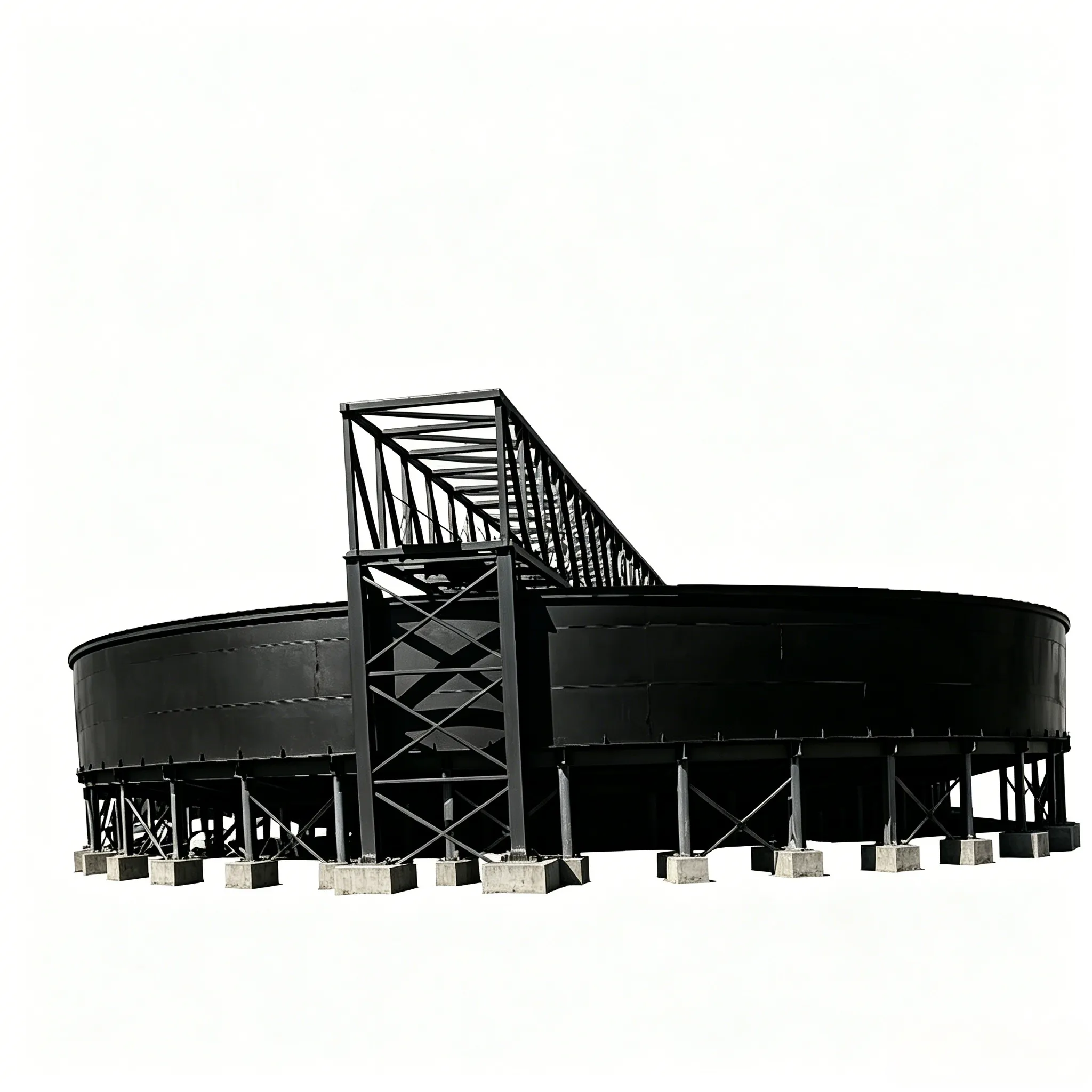
Currently, the peripheral drive thickeners produced in China generally have diameters ranging from 15 to 53 m. In 1991, a φ100 m thickener was developed, filling the gap in the domestic production of large thickeners. Peripheral drive thickeners are generally classified into two types
Currently, the peripheral drive thickeners produced in China generally have diameters ranging from 15 to 53 m. In 1991, a φ100 m thickener was developed, filling the gap in the domestic production of large thickeners. Peripheral drive thickeners are generally classified into two types: roller drive type and rack drive type. However, the roller drive type has disadvantages such as low adhesion coefficient, susceptibility to slipping, and limited torque transmission. The rack drive type has disadvantages including heavy structure, high steel consumption, and high installation and maintenance costs. To address these issues, the NJ-38 pneumatic rubber-tired drive thickener was developed in 1987, incorporating an automatic rake lifting device, which is extremely rare for peripheral drive thickeners both domestically and internationally. This device, adopted for the first time in China, features a simple structure, ease of manufacture, reliable operation, and the ability to automatically lift the rake mechanism when overloaded, thereby achieving self-protection.
In a peripheral drive thickener (Figure 14-3), the thickening tank is generally made of concrete, with a reinforced concrete central pier at its center. One end of the rake mechanism is placed on the central pier by means of a special bearing, while the other end is connected to a drive carriage. The carriage is supported by rollers on a steel rail laid along the circumference of the thickening tank. The rollers are driven by an electric motor mounted on the drive carriage via a reducer and a rack-and-pinion drive, causing the rollers to move along the rail and rotate the rake mechanism to scrape and collect the settled solids.
To supply power to the electric motor, a slip ring assembly is installed on the central pier. Collector contacts that slide along the slip ring are connected to the rake mechanism, and cables laid on the rake mechanism carry current from these contacts to the motor.
When the thickener is of the roller drive type, if the scraper resistance exceeds a certain limit or if ice forms on the rail in winter, the rollers may slip and the rake may stop rotating. Therefore, no special safety device may be required. However, this type of thickener is not suitable for handling large throughputs or very high underflow concentrations. In such cases, the rack drive type is more reliable. In the rack drive type, a fixed rack is installed on the periphery of the tank wall parallel to the rail, and the gear on the output shaft of the reducer on the carriage meshes with the rack to propel the rake mechanism forward. This type of thickener often uses a thermal relay to protect the motor. Currently, domestic research has been conducted and automatic rake lifting devices have begun to be adopted as safety measures.
Figure 14-3 shows a rack drive thickener; without the rack and pinion, it would be a roller drive thickener.
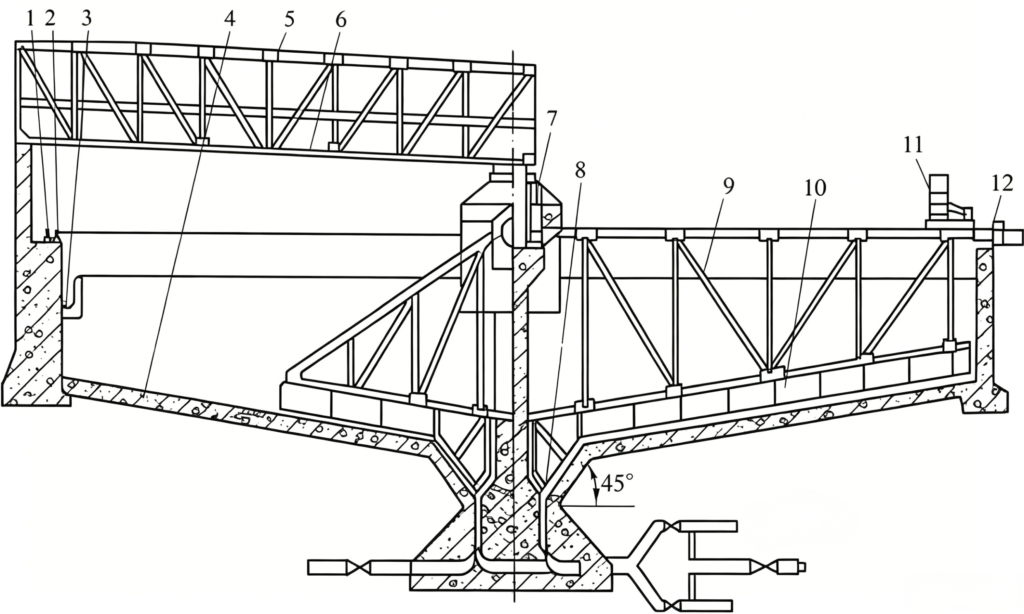
Figure 14-3 Schematic diagram of a peripheral drive thickener
1—Rack; 2—Rail; 3—Overflow launder; 4—Thickening tank; 5—Support bracket; 6—Feed chute; 7—Collector gear (slip ring assembly); 8—Discharge opening; 9—Rake mechanism; 10—Scraper blade; 11—Drive carriage; 12—Roller; 13—Gear
Peripheral drive thickeners are large in size and suitable for high-capacity applications. They are mainly used for thickening concentrates and dewatering tailings in mineral processing plants, and can be widely applied in the coal, chemical, building materials, water treatment, and wastewater treatment industries for the thickening and clarification of liquids containing solid particles. Their technical specifications are listed in Table 14-2.
The meaning of the model and size designation is illustrated by the following examples:
Table 14-2 Technical Parameters of NG and NT Type Peripheral Drive Thickeners
| модель | thickener | Rake frame rotation time per minute | productionability/t ·d-¹ | Roller track, center circle, diameter (m) | Rack track Center circle Diameter/m | electric motor | Total weight/t | ||||
| diameter/m | depth/m | precipitateArea / m² | модель | Мощность/кВт | Rotational speed /r ·min⁻¹ | ||||||
| NG-15 | 15 | 3.5 | 177 | 8.4 | 390 | 15.36 | one | Y132M₂-6 | 5.5 | 960 | 9.12 |
| NT-15 | one | 15.56 | 11 | ||||||||
| NG-18 | 18 | 3.5 | 255 | 10 | 560 | 18.36 | one | 10 | |||
| NT-18 | one | 18.57 | 12.1 | ||||||||
| NG-24 | 24 | 3.4 | 452 | 12.7 | 1000 | 24.36 | one | Y160M-6 | 7.5 | 970 | 23.3 |
| NT-24 | one | 24.88 | 28.3 | ||||||||
| NG-30 | 30 | 3.6 | 707 | 16 | 1570 | 30.36 | one | 26.4 | |||
| NT-30 | one | 30.88 | 31.3 | ||||||||
| NT-38 | 38 | 5.064.9 | 1134 | 24.310~2513.4-32 | 1600 | 38.38338.3 | 38.629 | Y160L-8 | 7.5 | 59.82 | |
| NT-38 | JZl₂52-4 | 11 | 55.26 | ||||||||
| NT-38A | YCT225-4 | 11 | 55.72 | ||||||||
| NT-45 | 45 | 5.06 | 1590 | 19.3 | 24004300 | 45.383 | 45.62 | Y160L-6 | 11 | 970 | 58.64 |
| NTJ-45 | Y180L-6 | 15 | 71.69 | ||||||||
| NT-50 | 50 | 5.054.503 | 1964 | 21.720 | 3000 | 51.77950.2 | 52.02550.439 | Y160L-6 | 11 | 970 | 65.92 |
| NTJ-50 | Y180L-6 | 15 | 109 | ||||||||
| NT-53 | 53 | 5.07 | 2202 | 23.18 | 34006250 | 55.16 | 55.406 | Y160L-6 | 11 | 69.44 | |
| NTJ-53 | Y180L-6 | 15 | 79.8 | ||||||||
| NT-100 | 100 | 5.65 | 7846 | 43 | 3030 | 100.5 | 100.77 | Y180L-6 | 15 | 970 | 198.08 |