


Grinding mill “bulging” can be divided into two types: “dry bulging” and “wet bulging.” Besides the properties of the ore (hardness) and the ball replenishment system, the main cause of bulging is improper operation.
(1) Excessive feed rate. Regardless of the grinding method used, to achieve a stable grinding process, the principle of material balance must be followed: the total feed rate of the grinding mill (Qfeed, including the original feed rate Qoriginal and the return feed rate Qreturn) equals the discharge rate (Qdischarge), i.e., Qfeed = Qoriginal + Qreturn = Qdischarge. For any grinding mill with an effective volume of V, its maximum allowable total feed rate (i.e., maximum throughput) is fixed, i.e.,
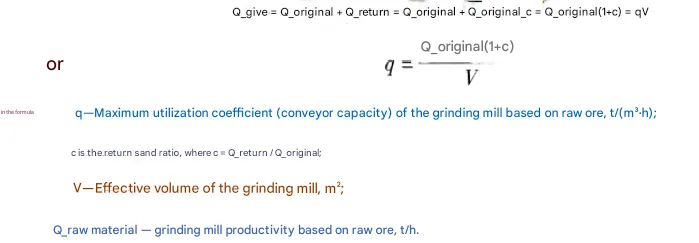
Qoriginal—grinding mill productivity based on raw ore, t/h.
In other words, under certain conditions, the throughput capacity of the grinding mill (Vq), i.e., Qdischarge, is a constant. Therefore, the necessary condition for maintaining stable production of the grinding mill without “bloating” is that Qoriginal(1+c)≤Qdischarge. Disruption of this balance condition will cause the grinding mill to malfunction—”bloating.”
(2) Increased feed particle size. When the particle size distribution of the feed to a stable grinding mill changes, with an increase in the coarse particle content, failure to adjust the feed rate in time will disrupt the mill’s stability and cause “bloating.” Because coarse particles remain in the mill for a longer time after being ground to the specified fineness, if the feed rate is not reduced promptly, coarse particles will accumulate in the mill until “bloating” occurs.
(3) Excessive return sand. During closed-circuit grinding, unqualified coarse particles will continuously separate from the classifier and return to the grinding mill for further grinding (the returned coarse particles are called return sand). Although increasing the amount of returned sand within a certain range can improve the grinding mill’s capacity, improper operation can disrupt the balance of Q_discharge = Q_original(1+c) when the amount of returned sand is too large, resulting in Q_discharge < Q_original(1+c) and causing “overflow”.
(4) Changes in water replenishment. In the grinding-classification loop, water replenishment consists of “front water” (mill discharge flushing water) and “back water” (return sand flushing water and mill feed water). Changes in “front water” will lead to changes in the fineness of the classification overflow and the amount of returned sand, thus affecting the total feed rate of the mill. “Back water” directly affects the grinding concentration. Therefore, if the amount of replenished water is reduced due to certain reasons (lower water pressure, blocked water pipes, etc.), the grinding concentration will be too high and unable to be discharged, also causing the mill to “overflow”. In short, grinding operators must be conscientious, observe frequently, and adjust in a timely manner to ensure the mill operates evenly and stably.