


The final products of flotation are concentrate and tailings. The intermediate products produced during flotation (i.e., finely selected tailings and scavenged concentrate) are conventionally called middlings. The processing methods for middlings depend on the content of intergrowths, the floatability of valuable minerals, and the requirements for concentrate quality. Common processing schemes include the following four:
(1) Returning to an appropriate location before flotation. This method can be used to process middlings mainly composed of liberated mineral particles. The most common method is sequential return, where middlings from the later operation are returned to the previous operation, as shown in Figure 6-8. When the floatability of the minerals is generally low, but the recovery rate is emphasized, sequential return is often used. In this case, the middlings have fewer opportunities for re-selection, thus avoiding losses.
If the floatability of the middlings is good, and the requirements for concentrate are high, the number of re-selection times for the middlings must be increased. A combined middlings return can be used, where the middlings are combined and returned to an appropriate upstream operation, as shown in Figure 6-9. After the merger of mining companies, the concentrate is often required before being returned to the source.
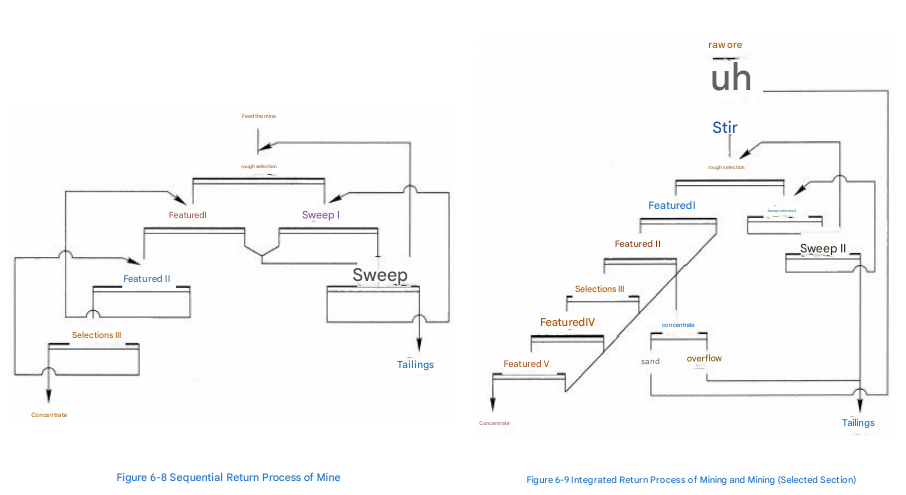
The return of middlings can take many forms, and sometimes the return location is determined by testing. A general rule for middlings return is that they should be returned to operations with similar mineral composition, floatability, and grade.
(2) Regrinding of middlings. For middlings with a high proportion of intergrowths, regrinding is necessary. Regrinding can be done alone or returned to the first grinding stage. When some liberated particles remain in the middlings, they can be returned to the classification operation. When the surface of the middlings requires mechanical scrubbing, they can also be returned to the mill.
(3) Separate flotation of middlings. Sometimes, although middlings are not intergrowths, their properties are unique (e.g., complex dissemination, many difficult-to-float particles, high mud content, significant difference in floatability from the original ore, etc.), making return to previous operations unsuitable. In such cases, middlings can be floated separately.
(4) Other treatment methods. If flotation alone is ineffective for treating middlings, chemical beneficiation methods can be used.