


The shape of the cylinder liner has a significant impact on the operation of the ball mill. Commonly used types include overlapping, corrugated, convex, smooth, stepped, and strip-shaped liners, as shown in Figure 3-9.
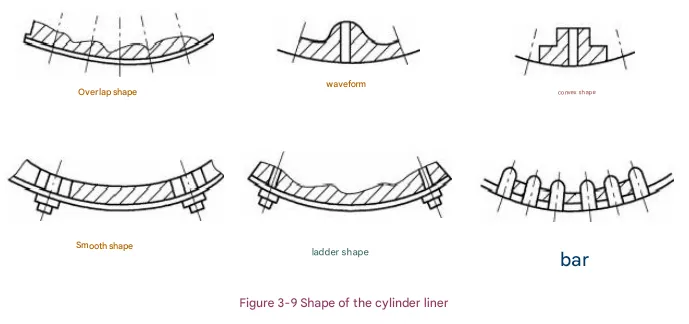
When the ball mill processes coarse materials, undulating (such as overlapping, convex, or corrugated) liners should be used. In recent years, some processing plants have promoted the use of strip-shaped liners. Undulated liners can raise the grinding media to a higher height, thereby enhancing the impact force of the media and increasing the production capacity of the ball mill. They are commonly used in the first stage of grinding and are suitable for processing coarse materials. Smooth liners are suitable for fine grinding (often referring to the second stage). Because smooth liners facilitate the rolling of steel balls, the abrasive action is strong, making them suitable for processing fine materials.
The thickness of the liner is usually determined based on the diameter of the mill, generally between 50 and 150 mm.