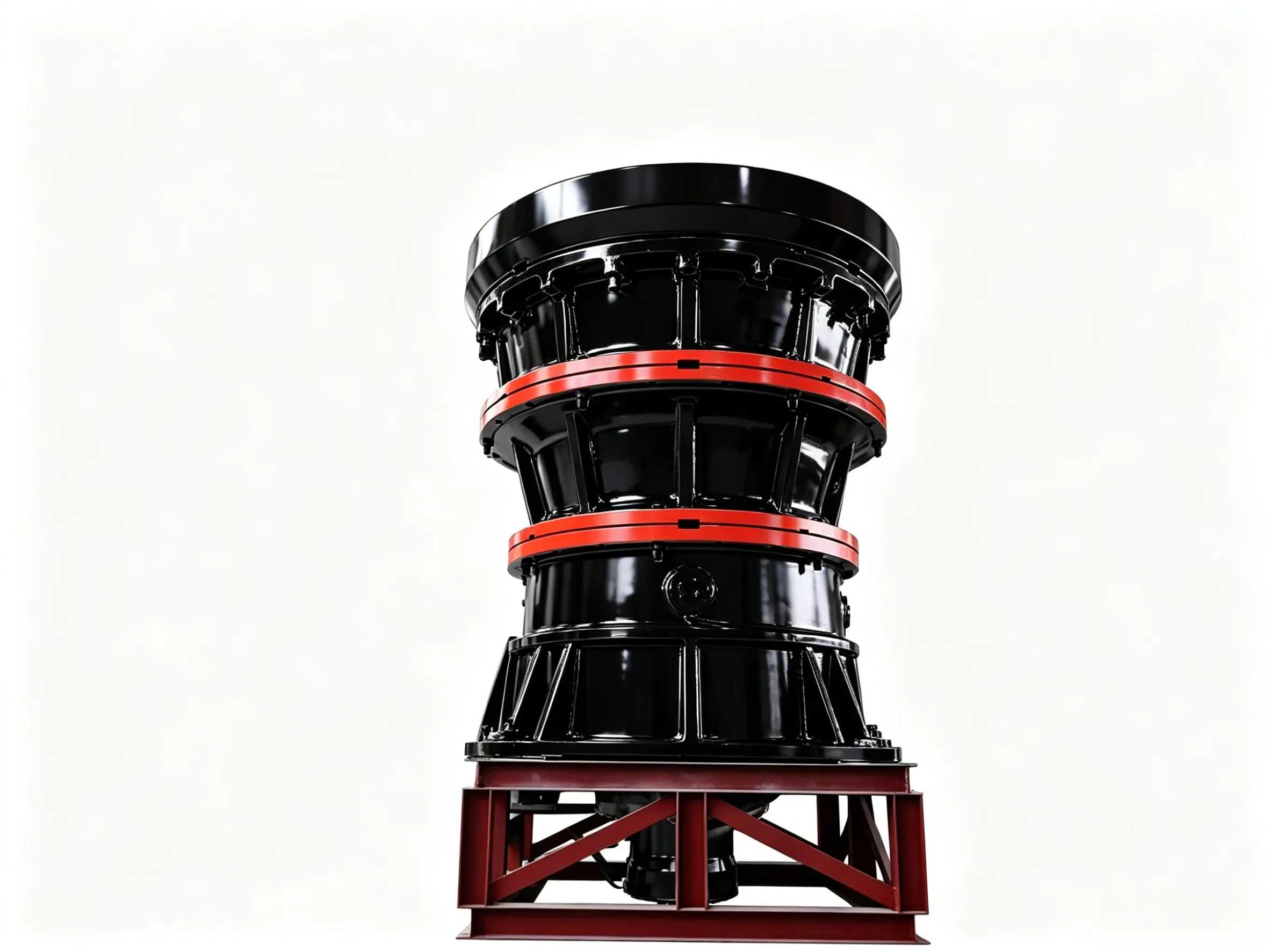
Kreiselbrecher
Arten von Kreiselbrechern Kreiselbrecher werden in der Industrie bereits seit… eingesetzt

1. A full‑flotation beneficiation method for high‑phosphorus‑sulfur siderite ore, characterized in that it is carried out by the following steps:
(1) crushing and grinding the raw material to obtain a pulp;
(2) roughing: the pulp is conditioned with sodium hexametaphosphate as a regulator to improve pulp dispersion at a dosage of 300–600 g/t, with stirring for 3–6 min; sulfuric acid is used to adjust pH to 5–6, with stirring for 3–6 min; starch is added as a depressant at a dosage of 500–800 g/t, with stirring for 3–6 min; an SP‑type collector is added at a dosage of 400–800 g/t, with stirring for 3–6 min; No. 2 oil is added as a frother at a dosage of 10–40 g/t, with stirring for 3–6 min; air is introduced and froth is scraped to obtain a froth product, which proceeds to the next stage of reverse flotation for sulfur and phosphorus reduction;
(3) reverse flotation for sulfur and phosphorus reduction: one stage of roughing and one stage of scavenging are used.
(4) cleaning: three cleaning stages are carried out.
2. The full‑flotation beneficiation method for high‑phosphorus‑sulfur siderite ore according to claim 1, characterized in that said crushing and grinding comprises crushing the siderite feed to below 3 mm, homogenizing it, and grinding it in a ball mill at a liquid‑to‑solid weight ratio of 1:2 to a fineness such that the –0.074 mm fraction accounts for 75%–95% and the –0.100 mm fraction accounts for 100%.
3. The full‑flotation beneficiation method for high‑phosphorus‑sulfur siderite ore according to claim 1, characterized in that the preparation method of said DP combined collector comprises: first mixing oleic acid with a concentration greater than 95% by weight and sulfuric acid with a concentration greater than 95% by weight at a weight ratio of 3:1, and then mixing the resulting mixture with powdered sodium hydroxide at a weight ratio of 4:1 to obtain the DP combined collector.
I. Technical Field
The present invention relates to a full‑flotation beneficiation method for high‑phosphorus‑sulfur siderite ore, belonging to the technical field of mineral processing engineering for iron ores. It is particularly applicable to the beneficiation of ores in which siderite is the main mineral, associated with hematite–limonite, pyrrhotite, pyrite, etc.
II. Background Art
Among proven iron ore reserves, although siderite (including simple siderite, hematite, limonite, siderite–limonite associations, etc.) accounts for less than 10% of the world’s reserves, forecasts indicate that in potential world iron ore resources, siderite accounts for more than 40%. China has relatively abundant siderite resources, with reserves ranking among the top in the world, totalling about 1.834 billion tonnes. Because siderite has a very fine dissemination size, complex composition, and low grade, iron mainly occurs in carbonate form. Part of the siderite, due to the substitution of Fe²⁺ by Mg²⁺ and Mn²⁺, forms magnesium–manganese siderite as isomorphous mixtures, and is hosted in hematite–limonite and magnetite. Limonite has low grade and is complex and refractory, making it difficult to improve iron grade and recovery; moreover, it tends to produce slime during grinding, which affects the beneficiation index. At present, siderite, limonite, and associated complex low‑grade iron ores are widely recognized as difficult beneficiation challenges. To fully develop low‑grade siderite resources dominated by siderite, abroad, conventional physical beneficiation processes such as gravity separation, high‑intensity magnetic separation, flotation, roasting, etc., either singly or in combination, are often used. In the 1950s and 1960s, several Eastern European countries built semi‑industrial siderite concentrators, but all suffered from generally low techno‑economic indices. For example, the Bakal concentrator in Ukraine, which used a roasting process, could only achieve a concentrate grade of up to 53%; another example is the Czech Děčín concentrator, which used a magnetic–flotation combined flowsheet and produced an iron concentrate grade of only about 35%. In Germany, the Siegerland plant treated manganese‑bearing siderite and obtained an iron concentrate grade of 50% with a recovery of 62.8% (see “Beneficiation technology for carbonate iron ores containing magnesium oxide,” Foreign Metal Ore Dressing, 1975, 7: 4652). To date, there is no industrial practice for simple siderite ores either domestically or internationally. Even though some associated siderite can be comprehensively recovered in iron ore processing flowsheets at Daye Iron Mine and Jiuquan Iron Mine, the siderite concentrate obtained contains only about 35% iron.
Siderite is a carbonate‑type mineral, and after roasting its iron grade increases significantly. Although the roasting process can yield an iron concentrate with a relatively high grade, it involves two roasting stages (one magnetizing roasting and one sintering), resulting in very high costs. If conventional physical beneficiation methods can enrich the iron grade to about 39%, and then the product is pelletized and sintered, the iron grade can be raised to about 55%, thereby eliminating one roasting step and reducing roasting costs, with correspondingly improved economic benefits. Similarly, high‑intensity magnetic separation consumes large amounts of electricity and water, has high costs, and is difficult to industrialize. At present, there is no successful practical experience with full‑flotation for siderite, mainly due to difficulties in selecting effective siderite collectors. Additionally, the relatively high content of harmful elements sulfur and phosphorus tends to be incorporated into the siderite concentrate during flotation, making it difficult to reduce them to levels meeting smelting requirements.
III. Summary of the Invention
The object of the present invention is to provide a full‑flotation beneficiation method for high‑phosphorus‑sulfur siderite ore. For siderite ores with high sulfur and phosphorus contents, along with small amounts of associated hematite–limonite, pyrrhotite, pyrite, etc., a full‑flotation flowsheet is adopted, which can yield a siderite concentrate with a grade of TFe ≥ 38% and an iron recovery of 75–86%. The present invention uses a specialized siderite collector that causes physicochemical adsorption on the siderite surface, and employs a combined collector for reverse flotation to reduce sulfur and phosphorus, so that both sulfur and phosphorus contents in the concentrate are below 0.20%. This achieves effective separation of siderite from other non‑target minerals.
The present invention is carried out by the following steps:
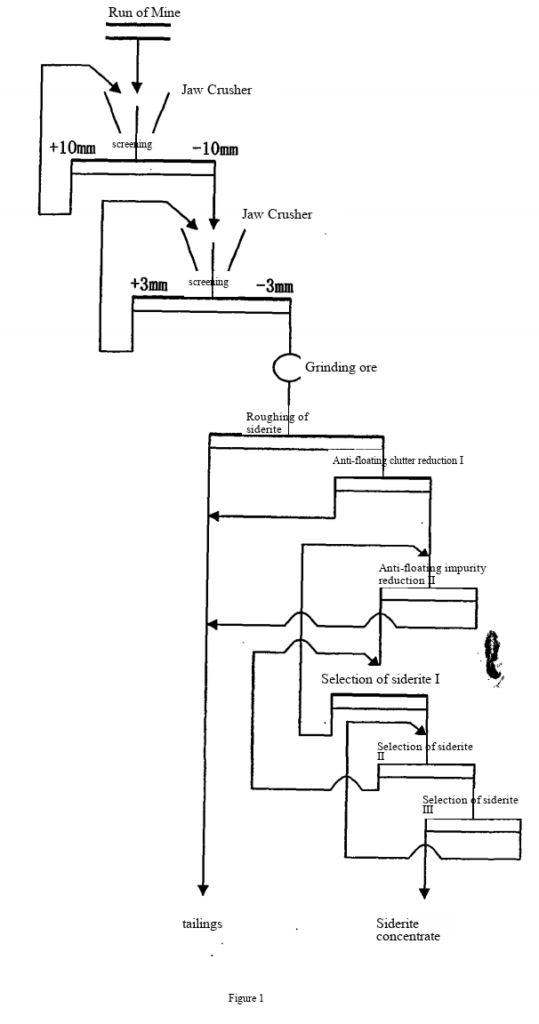
(1) Crushing and grinding of feed: The siderite feed is crushed to below 3 mm, homogenized, and ground in a ball mill at a liquid‑to‑solid weight ratio of 1:2 to a fineness such that the –0.074 mm fraction accounts for 75–95% and the –0.100 mm fraction accounts for 100%, to obtain a pulp.
(2) Schruppbearbeitung: Sodium hexametaphosphate is added as a regulator at 300–600 g/t to improve pulp dispersion, with stirring for 3–6 min; sulfuric acid is used to adjust pH to 5–6, with stirring for 3–6 min; starch is added as a depressant at 500–800 g/t, with stirring for 3–6 min; the SP‑type collector is added at 400–800 g/t, with stirring for 3–6 min; No. 2 oil is added as a frother at 10–40 g/t, with stirring for 3–6 min; then air is introduced and froth is scraped to obtain a froth product, which proceeds to the next stage for reverse flotation to reduce sulfur and phosphorus.
(3) Reverse flotation to reduce sulfur and phosphorus: One stage of roughing and one stage of scavenging are used for reverse flotation.
(4) Cleaning: Three cleaning stages.
The SP‑type collector has been disclosed in patent application No. 200810058134.3, and its formulation and preparation process are as follows:
Raw materials:
Weight ratios:
The purity of dodecylamine is ≥96%, mixed amine ≥95%, hydrochloric acid concentration ≥35% by weight; sulfuric acid concentration ≥95% by weight, caustic soda purity ≥96%, ether amine purity ≥98%, naphthenic acid purity ≥98%.
The SP collector is prepared according to the above formulation by the following method:
The preparation method of the DP combined collector is as follows: oleic acid with a concentration >95% by weight and sulfuric acid with a concentration >95% by weight are first mixed at a weight ratio of 3:1, and then the mixture is mixed with powdered sodium hydroxide at a weight ratio of 4:1 to obtain the DP combined collector.
Compared with known technologies, the present invention has the following advantages and positive effects: For siderite ores with high sulfur and phosphorus contents, along with small amounts of associated hematite–limonite, pyrrhotite, pyrite, etc., the full‑flotation flowsheet can yield a siderite concentrate with TFe ≥ 38%, iron recovery of 75–86%, and both sulfur and phosphorus contents below 0.20%. The present invention uses a specialized siderite collector that allows strong physicochemical adsorption on the siderite surface, and employs the DP combined collector in reverse flotation to reduce sulfur and phosphorus, thereby achieving effective separation of siderite from other non‑target minerals.
IV. Brief Description of the Drawings
Abbildung 1 zeigt das Prozessschema der vorliegenden Erfindung.
V. Detailed Description of the Embodiments
Beispiel 1
The feed came from the Huamian siderite mine in Yunnan Province. Siderite ores from this area generally have relatively high sulfur and phosphorus contents. To obtain a siderite concentrate meeting smelting requirements, it is necessary not only to increase the iron grade but also to reduce the sulfur and phosphorus levels. The mineral composition and chemical analysis of the raw ore are shown in Tables 1 and 2, respectively. The siderite feed was crushed to below 3 mm, homogenized, and ground in a ball mill at a liquid‑to‑solid ratio of 1:2 to a fineness of –0.074 mm occupying 75–95% and –0.100 mm occupying 100%, to obtain a pulp.
Flotation reagent scheme:
(1) Roughing: sulfuric acid to pH 5–6, stirring for 3–6 min; sodium hexametaphosphate 500 g/t, stirring for 3–6 min; starch 800 g/t, stirring for 3–6 min; SP collector 600 g/t, stirring for 3–6 min; No. 2 oil 40 g/t, stirring for 3 min; aeration and froth scraping for 3–6 min.
(2) Reverse flotation for S/P reduction – roughing: activated carbon 300 g/t for reagent removal, stirring for 10–15 min; sodium silicate 800 g/t, stirring for 3–5 min; DP combined collector 400 g/t, aeration and froth scraping for 3–5 min.
(3) Scavenging: sodium silicate 400 g/t, stirring for 3–6 min; DP collector 200 g/t, stirring for 5–10 min; aeration and froth scraping.
(4) Cleaning I: sulfuric acid to pH 5–6, stirring for 3–6 min; starch 400 g/t, stirring for 3–6 min; SP collector 300 g/t, stirring for 3–5 min; No. 2 oil 10 g/t, stirring for 3–6 min; aeration and froth scraping.
(5) Cleaning II: sulfuric acid to pH 5–6, stirring for 3–6 min; starch 300 g/t, stirring for 3–6 min; No. 2 oil 10 g/t, stirring for 3–6 min.
(6) Cleaning III: sulfuric acid to pH 5–6, stirring for 3–6 min; starch 200 g/t, stirring for 3–6 min; No. 2 oil 5 g/t.
The froth product was dewatered and dried to a moisture content below 5% by weight to obtain the siderite concentrate. The beneficiation indices are shown in Table 3.
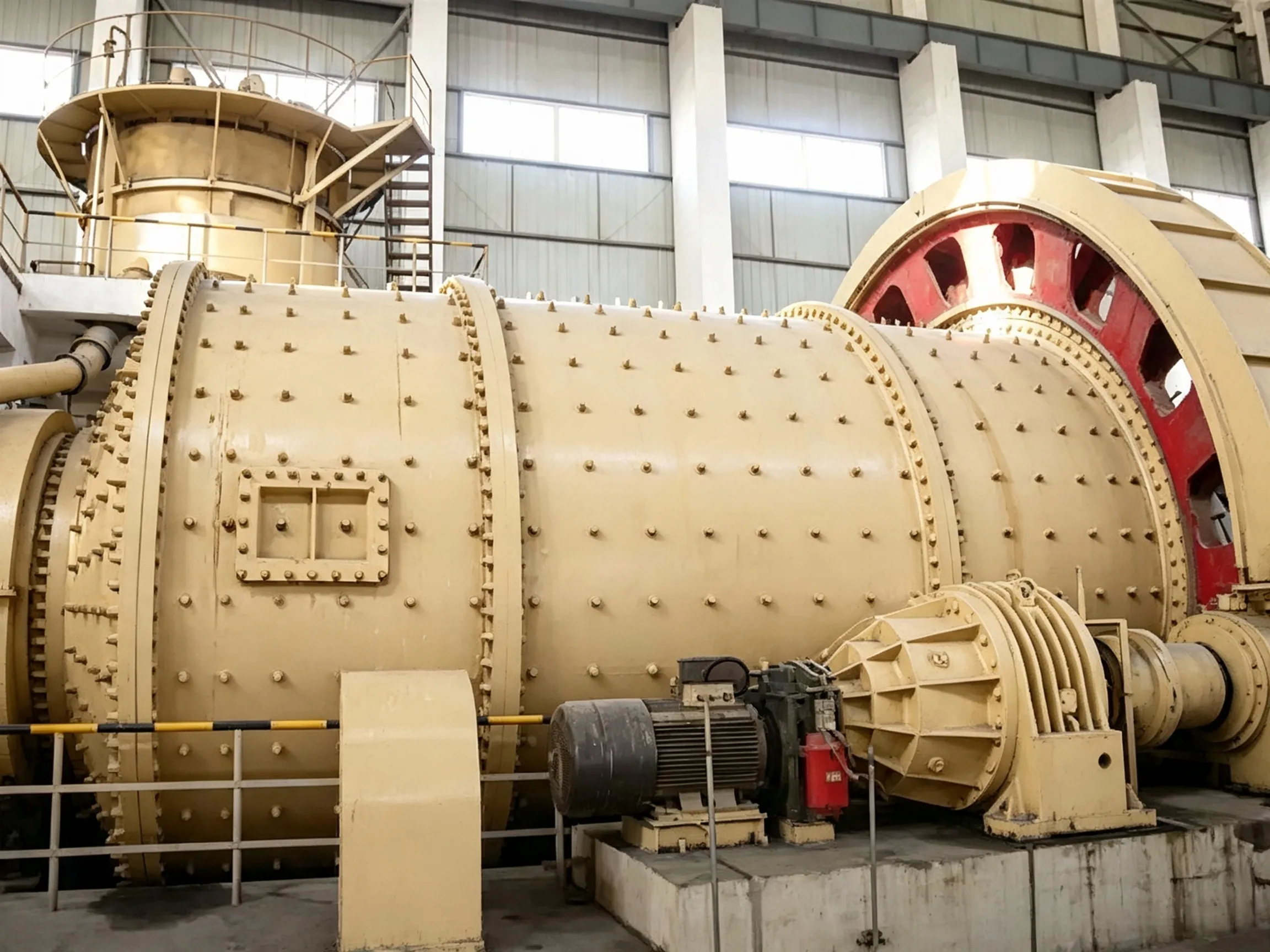
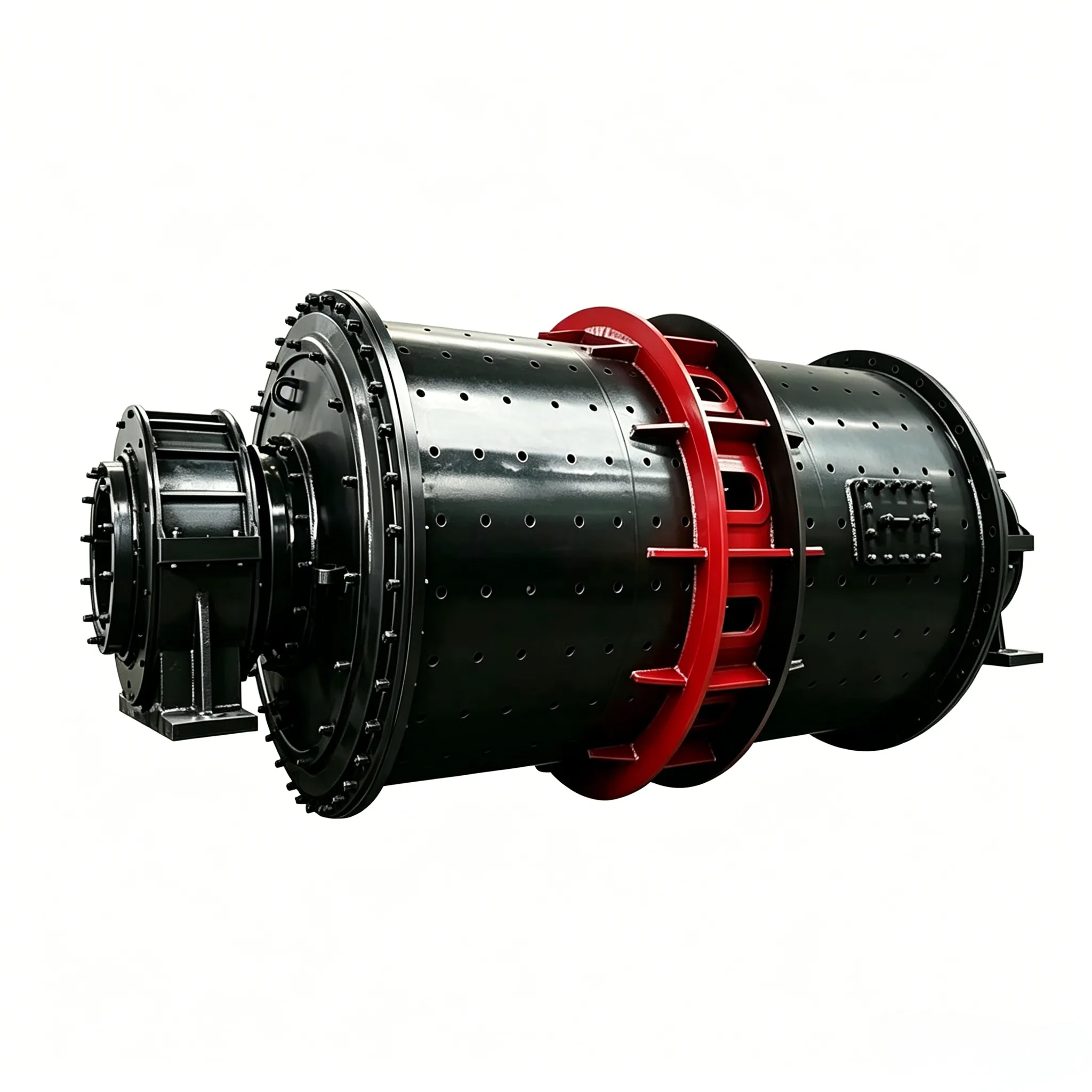
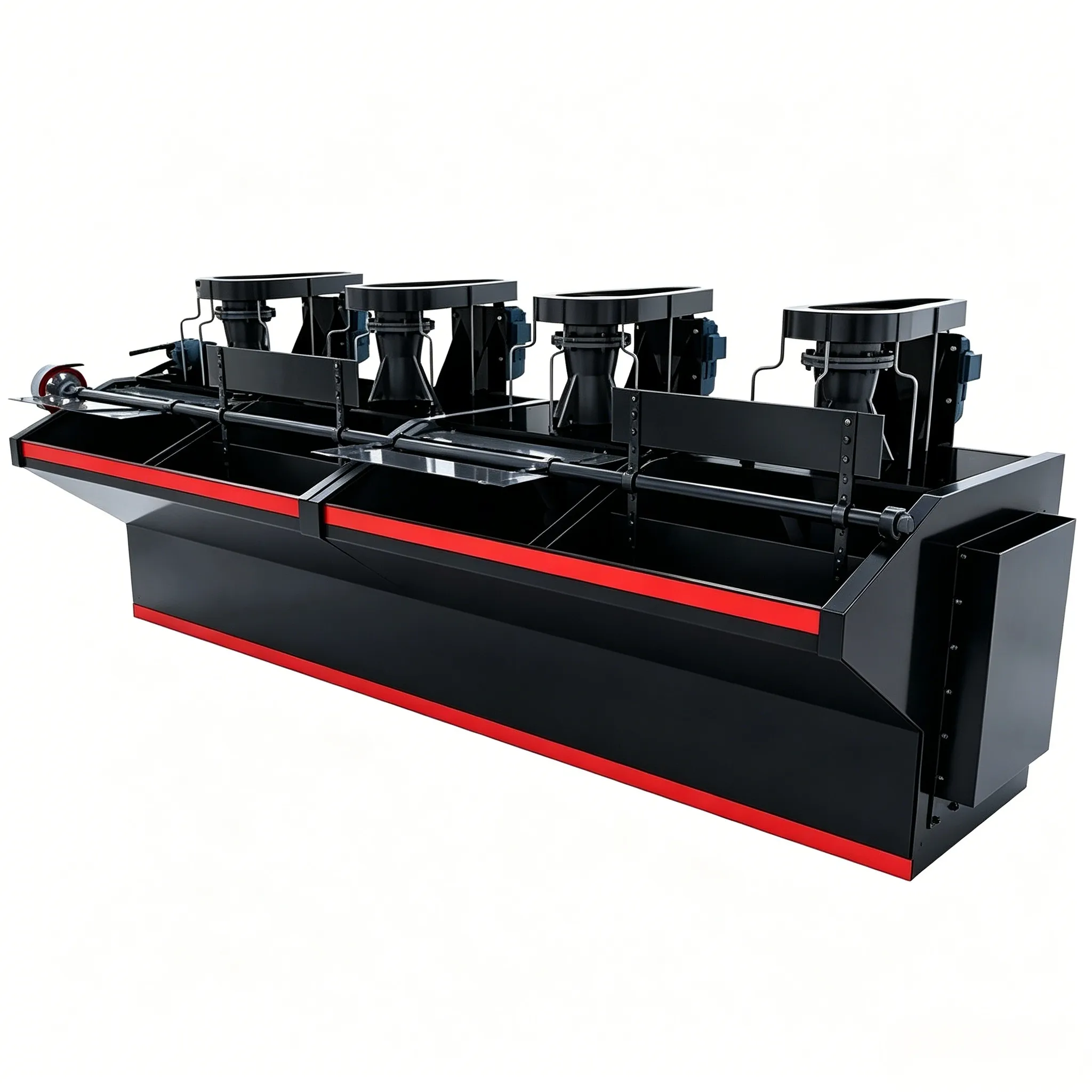
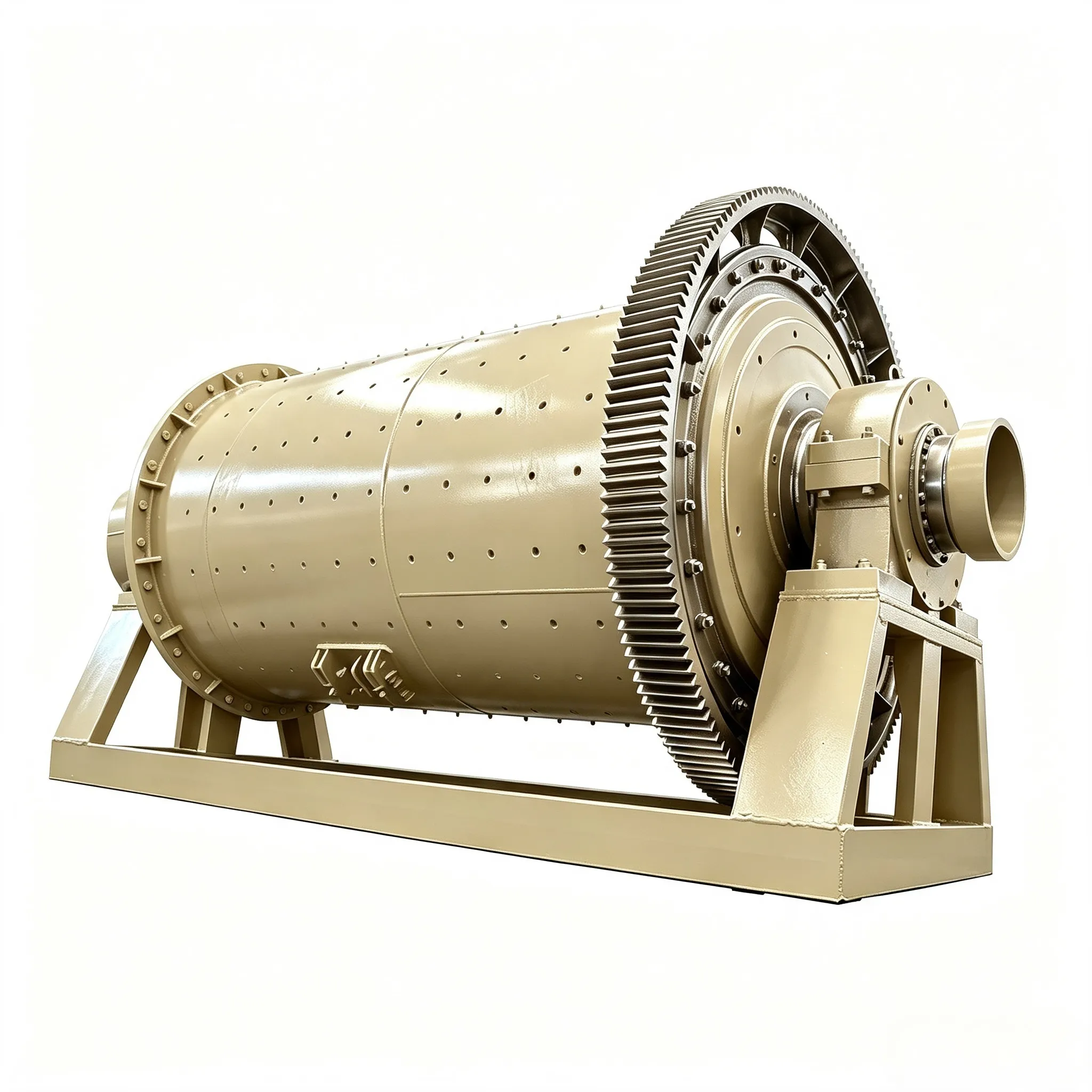
Equipment used: ball mill Φ900×1800 mm, jaw crushers Φ10×50 mm and Φ3×30 mm, self‑aeration flotation cells (single cell volume 3 m³) manufactured by Kunming Ciba Mining Machinery Factory, spiral classifier Φ2000 mm, hydrocyclone Φ150 mm.
Table 1 Mineral composition of the raw ore
| Mineral | Siderite | Hematite–limonite | Magnetite | Iron silicate | Gangue and others |
|---|---|---|---|---|---|
| Content (%) | 53.22 | 1.22 | 0.46 | 5.92 | 39.18 |
Table 2 Chemical analysis of the raw ore
| Komponente | Fe | S | P | Da | SiO₂ |
|---|---|---|---|---|---|
| Content (%) | 30.12 | 0.469 | 0.456 | 0.003 | 18.12 |
Tabelle 3 Beneficiation indices of the flowsheet
| Produkt | Yield (%) | Klasse (%) | Klasse (%) | Klasse (%) | Wiederherstellung (%) | Wiederherstellung (%) | Wiederherstellung (%) |
|---|---|---|---|---|---|---|---|
| Fe | P | S | Fe | P | S | ||
| Siderite conc. | 58.46 | 41.22 | 0.16 | 0.15 | 80.01 | 20.56 | 18.66 |
| Tailings | 41.54 | 14.49 | 0.87 | 0.92 | 19.99 | 79.44 | 81.34 |
| Feed | 100.00 | 30.12 | 0.455 | 0.469 | 100.00 | 100.00 | 100.00 |
Beispiel 2
The feed came from a siderite mine in a certain area of Yunnan Province. Siderite ores from this area also generally have relatively high sulfur and phosphorus contents. To obtain a concentrate meeting smelting requirements, it is necessary to increase iron grade while reducing sulfur and phosphorus. The mineral composition and chemical analysis of the raw ore are shown in Tables 4 and 5, respectively. Flotation reagent scheme:
(1) Roughing: sulfuric acid to pH 5–6; sodium hexametaphosphate 400 g/t; starch 700 g/t; SP collector 700 g/t; No. 2 oil 40 g/t; aeration and froth scraping.
(2) Reverse flotation for impurity reduction – roughing: activated carbon 400 g/t for reagent removal; sodium silicate 600 g/t; DP combined collector 400 g/t; No. 2 oil 20 g/t; aeration and froth scraping.
(3) Reverse flotation scavenging: sodium silicate 300 g/t; DP collector 200 g/t; aeration and froth scraping.
(4) Cleaning I: sulfuric acid to pH 5–6; starch 400 g/t; SP collector 200 g/t; No. 2 oil 20 g/t; aeration and froth scraping.
(5) Cleaning II: sulfuric acid to pH 5–6; starch 300 g/t; No. 2 oil 15 g/t; aeration and froth scraping.
(6) Cleaning III: sulfuric acid to pH 5–6; starch 150 g/t; No. 2 oil 10 g/t; aeration and froth scraping.
The froth product was dewatered and dried to a moisture content below 5% to obtain the siderite concentrate. The beneficiation indices are shown in Table 6.
Table 4 Mineral composition of the raw ore
| Mineral | Siderite | Hematite–limonite | Magnetite | Iron silicate | Gangue and others |
|---|---|---|---|---|---|
| Content (%) | 50.68 | 1.08 | 0.52 | 4.48 | 43.24 |
Table 5 Chemical analysis of the raw ore
| Komponente | Fe | S | P | Da | SiO₂ |
|---|---|---|---|---|---|
| Content (%) | 29.08 | 0.513 | 0.472 | 0.002 | 17.94 |
Tabelle 6 Beneficiation indices of the flowsheet
| Produkt | Yield (%) | Klasse (%) | Klasse (%) | Klasse (%) | Wiederherstellung (%) | Wiederherstellung (%) | Wiederherstellung (%) |
|---|---|---|---|---|---|---|---|
| Fe | P | S | Fe | P | S | ||
| Siderite conc. | 57.21 | 40.68 | 0.15 | 0.15 | 80.00 | 18.82 | 18.29 |
| Tailings | 42.79 | 13.59 | 0.865 | 0.896 | 20.00 | 81.18 | 81.71 |
| Feed | 100.00 | 29.09 | 0.456 | 0.469 | 100.00 | 100.00 | 100.00 |
Beispiel 3
The feed came from a siderite mine in a certain area of Shaanxi Province. Siderite ores from this area also generally have relatively high sulfur and phosphorus contents. To obtain a concentrate meeting smelting requirements, it is necessary to increase iron grade while reducing sulfur and phosphorus. The mineral composition and chemical analysis of the raw ore are shown in Tables 7 and 8, respectively. Flotation reagent scheme:
(1) Siderite roughing: sulfuric acid to pH 5–6; sodium hexametaphosphate 400 g/t; starch 800 g/t; SP collector 800 g/t; No. 2 oil 40 g/t; aeration and froth scraping.
(2) Reverse flotation for impurity reduction I: activated carbon 400 g/t for reagent removal, stirring for 10 min; sodium silicate 600 g/t; DP combined collector 300 g/t; No. 2 oil 30 g/t; aeration and froth scraping.
(3) Reverse flotation for impurity reduction II: sodium silicate 300 g/t; DP collector 150 g/t; No. 2 oil 20 g/t; aeration and froth scraping.
(4) Siderite cleaning I: sulfuric acid to pH 5–6; starch 600 g/t; SP collector 300 g/t; No. 2 oil 15 g/t; aeration and froth scraping.
(5) Siderite cleaning II: sulfuric acid to pH 5–6; starch 200 g/t; No. 2 oil 10 g/t; aeration and froth scraping for 3 min.
(6) Siderite cleaning III: sulfuric acid to pH 5–6; starch 200 g/t; No. 2 oil 10 g/t; aeration and froth scraping.
The siderite concentrate product was obtained. The beneficiation indices are shown in Table 9.
Tabelle 7 Mineral composition of the raw ore
| Mineral | Siderite | Hematite–limonite | Magnetite | Iron silicate | Gangue and others |
|---|---|---|---|---|---|
| Content (%) | 52.68 | 2.08 | 1.52 | 2.48 | 41.24 |
Tabelle 8 Chemical analysis of the raw ore
| Komponente | Fe | S | P | Da | SiO₂ |
|---|---|---|---|---|---|
| Content (%) | 31.12 | 0.368 | 0.501 | 0.004 | 16.94 |
Tabelle 9 Beneficiation indices of the flowsheet
| Produkt | Yield (%) | Klasse (%) | Klasse (%) | Klasse (%) | Wiederherstellung (%) | Wiederherstellung (%) | Wiederherstellung (%) |
|---|---|---|---|---|---|---|---|
| Fe | P | S | Fe | P | S | ||
| Siderite conc. | 60.93 | 41.38 | 0.12 | 0.11 | 80.99 | 19.82 | 13.39 |
| Tailings | 39.07 | 15.14 | 0.757 | 1.11 | 20.00 | 80.18 | 86.61 |
| Feed | 100.00 | 31.13 | 0.369 | 0.501 | 100.00 | 100.00 | 100.00 |

 English English
 Spanish
 Russian
 Arabic
 Swahili
 French
 Turkish
 Portuguese
 Korean
 Japanese
 German
 Italian