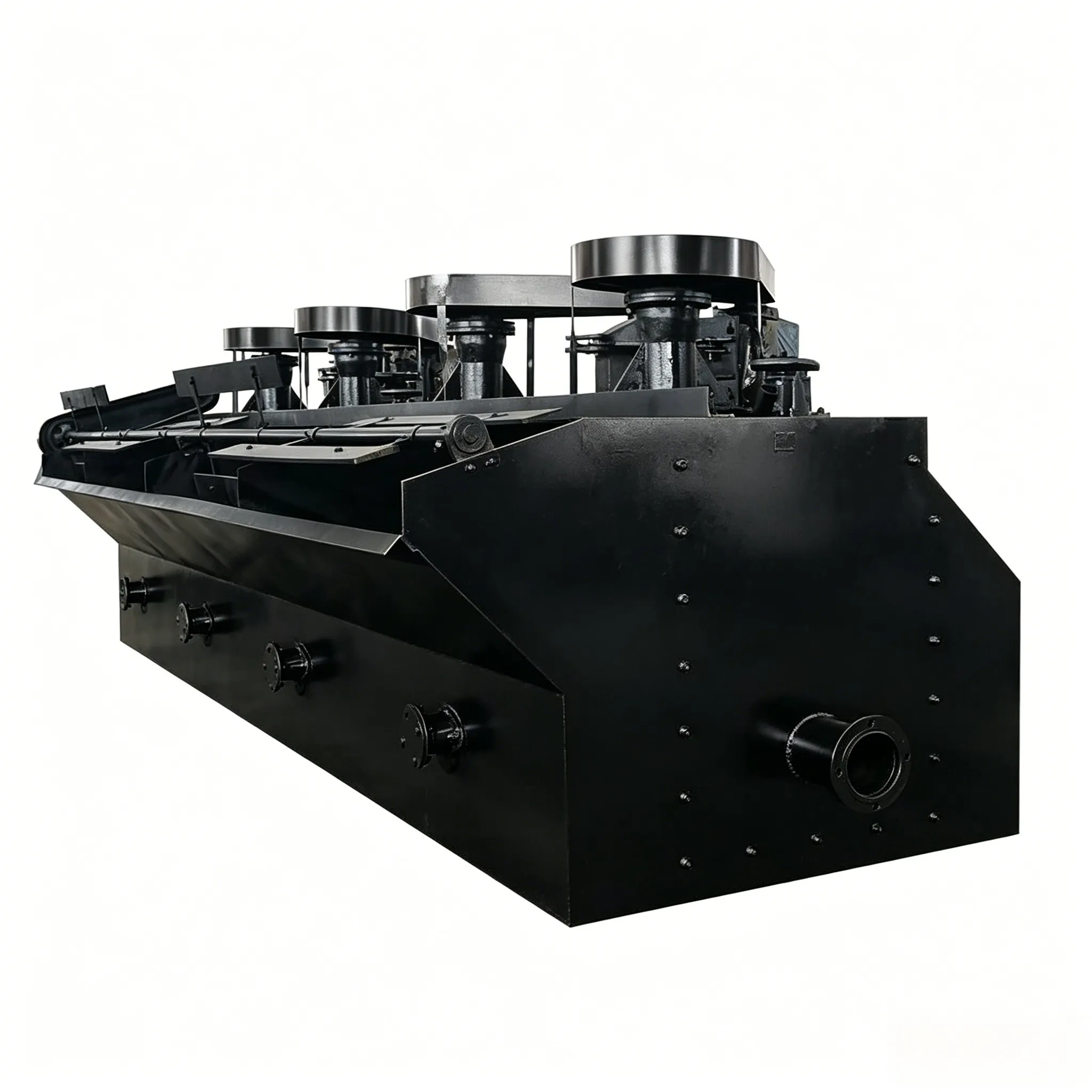
XJZ-Flotationsmaschine
XJZ-Flotationsmaschine Es gibt Tausende von XJ-Flotationsmaschinen älterer Bauart in…


The term “ordinary ball mill” usually refers to a continuous ball mill. The core difference lies in their working mode: one operates in batches, the other runs continuously.
| Aspect | Intermittent (Batch) Ball Mill | Continuous Ball Mill |
|---|---|---|
| Operating Mode | Batch operation: charging, grinding, and discharging are separate steps; the mill must stop for each cycle. | Continuous operation: material is fed and discharged simultaneously without stopping. |
| Inlet/Outlet | Often the same opening – after grinding, the finished product is discharged, then new material is loaded. | Separate feed and discharge ports – raw material enters constantly while finished product exits. |
| Discharge Basis | Time‑based – all contents are discharged after a preset grinding time. | Particle‑size‑based – material is discharged only when it reaches the required fineness. |
| Production Efficiency | Nach unten – significant non‑productive time for loading and unloading. | Very high – ideal for large‑scale, continuous production. |
| Energy Consumption | Higher – greater electricity consumption per unit of product. | Notably energy‑saving – total power consumption is much lower for the same output. |
| Product Quality | Product fineness is uniform but prone to over‑grinding. | Particle size is stable and controllable; over‑grinding is rare. |
| Equipment & Footprint | Simple structure, fewer auxiliary devices, smaller footprint. | Complex system requiring supporting equipment, larger footprint. |
| Betrieb und Wartung | Relatively simple to operate, but labour‑intensive. | Highly automated, requires fewer operators. |
| Anwendung | Suitable for small batches, multiple product types, or materials with extremely high fineness requirements. | Suitable for large‑volume, single‑product continuous production with stable raw materials. |
| Initial Investment | Nach unten capital cost. | Higher civil engineering and equipment investment. |
This is the most fundamental distinction.
In long‑term operating costs, the continuous mill shows clear advantages.
Choose based on your production needs:
 English English
 Spanish
 Russian
 Arabic
 Swahili
 French
 Turkish
 Portuguese
 Korean
 Japanese
 German
 Italian