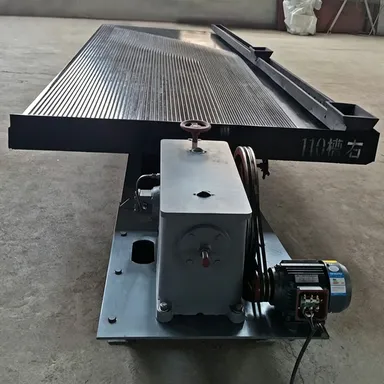
Tavolo vibrante
Shaking Table – High-Precision Gravity Concentrator Product Overview The shaking table (also…

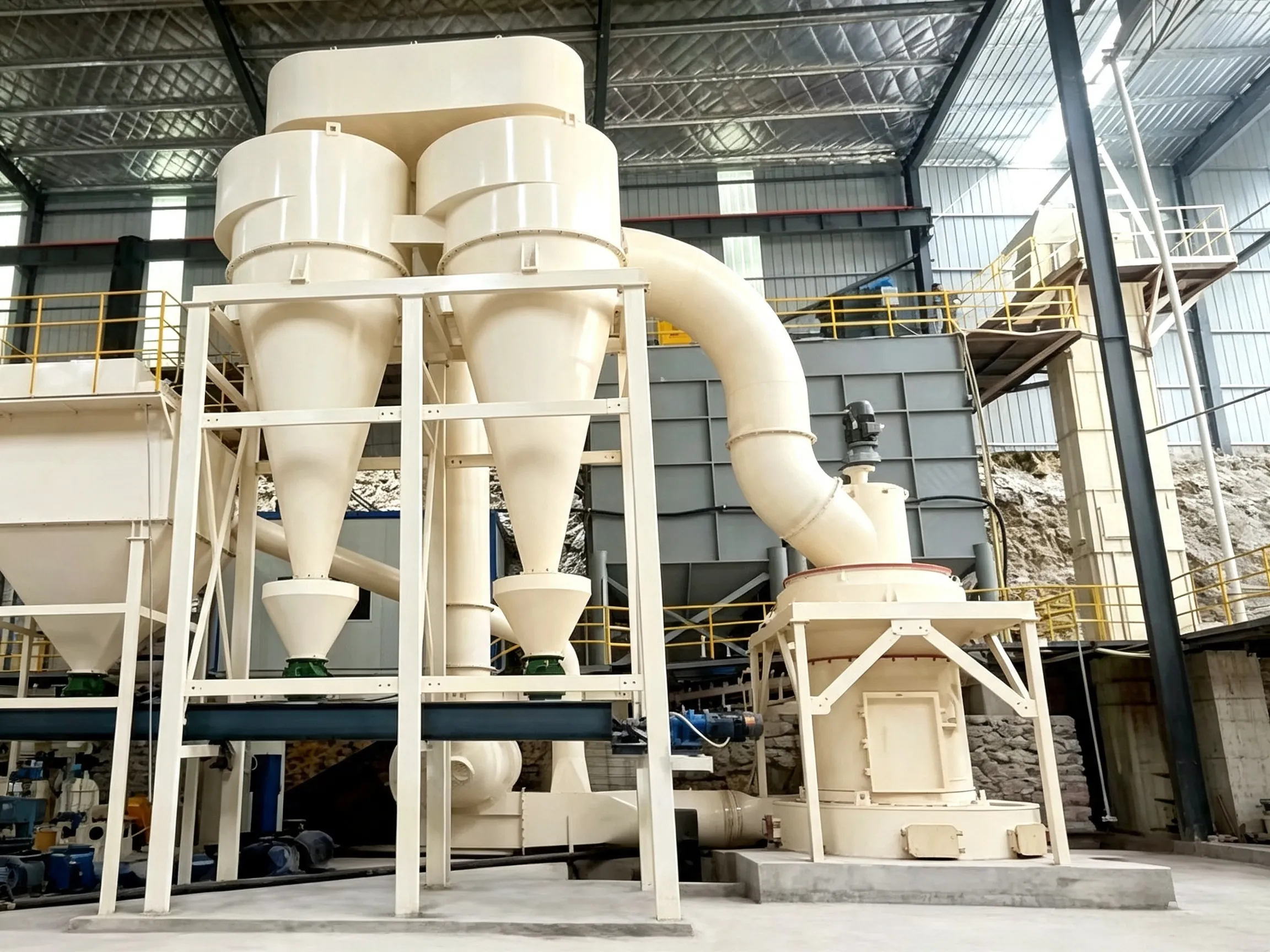
Carbon materials are essential industrial raw materials, widely used in lithium‑ion battery anodes, metallurgy, refractories, conductive agents, and many other fields. With the rapid growth of the new energy industry, the demand for fine carbon processing has increased significantly, placing higher requirements on grinding equipment. The Mulino Raymond, as a mature and reliable grinding machine, has become the core equipment in fine carbon processing due to its high efficiency, stability, and controllable particle size.
So, how exactly does the Raymond mill perform in fine carbon processing? What irreplaceable advantages does it offer? This article will provide a comprehensive analysis covering principles, process flows, application scenarios, and selection guidelines.
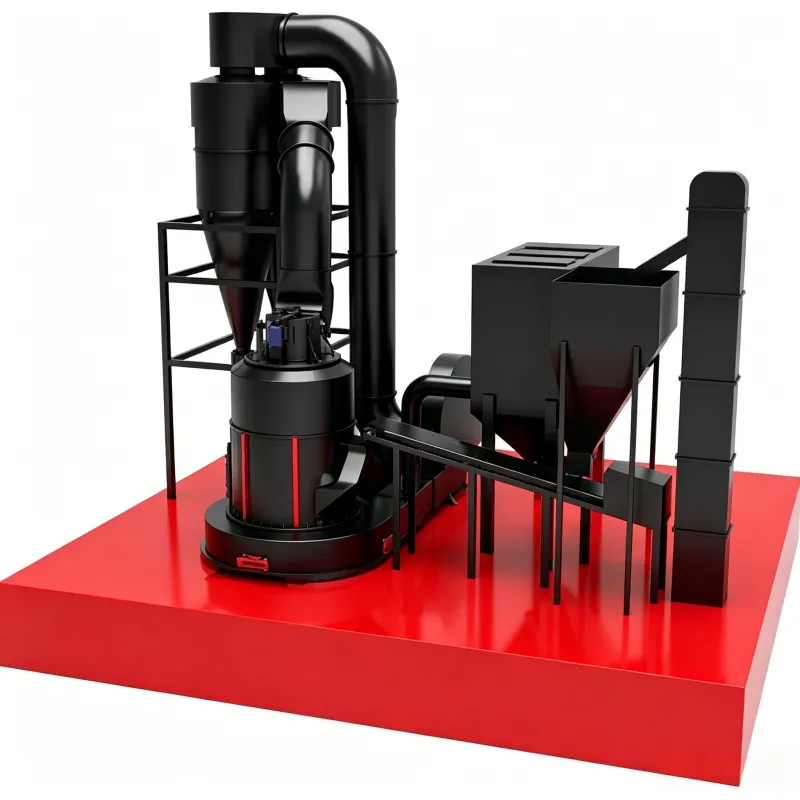
The core operating principle of the Raymond mill (suspension roller mill) is roll‑compression grinding. Material enters the grinding chamber, where the grinding rollers are pressed tightly against the grinding ring under centrifugal force. At the same time, a shovel blade lifts the material and feeds it between the rollers and the ring, where it is crushed and ground by rolling and shearing action. The ground material is carried upward by airflow to the classifier. After classification, qualified fine powder enters the collection system, while coarse particles are returned to the grinding chamber for further processing.
Carbon raw materials come in various types, commonly including petroleum coke, anthracite, metallurgical coke, graphite, carbon black, etc. The Raymond mill dominates fine carbon processing mainly due to the following advantages:
Carbon processing with a Raymond mill is a systematic operation covering multiple stages from raw material to finished product.
Raw material selection: Choose suitable carbon raw materials based on the intended product quality and application. For example, high‑purity carbon products require high‑quality petroleum coke with low impurity content.
Raw material crushing: Bulk carbon materials are too large to feed directly into the Raymond mill. They are typically coarse‑crushed using a jaw crusher, then medium‑fine crushed using an impact crusher or cone crusher to achieve a feed size of approximately 20–30 mm, meeting the mill’s inlet requirement.
Raw material drying: Excessive moisture content can impair grinding efficiency and even cause blockages. For materials with excessive moisture, a rotary dryer should be used to reduce the moisture content to below 1%.
After crushing and drying, the raw material is transported via belt conveyor oppure bucket elevator to the storage hopper above the mill feed port. The hopper capacity should be designed according to production scale and equipment operating conditions to ensure continuous feed.
Material is fed uniformly from the hopper into the grinding chamber via a screw conveyor, where it is pulverised under the rolling pressure of the rollers. The ground material is carried upward by airflow to the classifier, and the finished fineness can be precisely controlled by adjusting the classifier rotor speed.
Qualified fine powder enters a cyclone collector for gas‑solid separation, while very fine dust is further collected by a pulse‑jet bag filter. The collected carbon powder is then packaged by a packing machine in 25 kg, 50 kg, or tonne‑bag specifications.
With the explosive growth of the new energy vehicle industry, the demand for carbon powders for lithium‑battery anodes has surged. Carbon grinding mills are specialised equipment for processing graphite, petroleum coke, carbon black, etc., and are widely used in anode material production. The lithium‑battery industry requires high fineness for graphite powders, typically D50 ≤ 15 μm or even D50 ≤ 20 μm.
In the aluminium electrolysis industry, pre‑baked anode production consumes large quantities of carbon materials. The Raymond mill plays a key role in pre‑baked anode production lines. For example, a well‑known carbon plant in Inner Mongolia uses two sets of HCQ1500 upgraded Raymond mills to process calcined petroleum coke, achieving a product fineness of 65% passing 200 mesh with stable operation and target output.
The production of ultra‑high‑power graphite electrodes requires extremely high purity and uniform particle size of carbon powders. The Raymond mill can stably grind graphite and other raw materials to a fineness range of 80–400 mesh, providing high‑quality feedstock for subsequent forming and graphitisation.
In conductive fillers, carbon black grinding demands high dispersibility; in refractories, coarse carbon particles can be processed by Raymond mills. The mill’s flexible adjustability allows it to meet the differentiated requirements of various applications.
When selecting equipment for fine carbon processing, the Raymond mill and the vertical roller mill (VRM) are the two main options. Understanding their differences helps make a more informed decision.
| Comparison Aspect | Mulino Raymond | Vertical Roller Mill |
|---|---|---|
| Product Fineness | 80–400 mesh (standard); some up to 3000 mesh | 400–3250 mesh |
| Single‑unit Capacity | 3–55 t/h | Up to several hundred t/h |
| Capital Investment | Lower, simple structure | Higher, complex structure |
| Suitable Scale | Small to large | Large‑scale plants |
| Maintenance Difficulty | Simple and convenient | Relatively complex |
Selection advice: For carbon processing projects with conventional fineness requirements (80–400 mesh) , the Raymond mill offers excellent cost‑effectiveness. For ultra‑fine powders (>800 mesh) , equipment such as vertical roller mills or jet mills should be considered.
Inner Mongolia is an important carbon industry cluster in China. A well‑known carbon plant there introduced two sets of Guilin Hongcheng HCQ1500 upgraded Raymond mills for calcined petroleum coke grinding. These mills, built on traditional Raymond mill advantages, have been optimised for the carbon industry. After commissioning, they have operated stably, achieving a single‑unit output of 3.2–4 t/h with a 200‑mesh passing rate consistently above 65%.
A carbon plant in Changsha, Hunan, purchased a 4R3220 Raymond mill production line. After commissioning, it successfully reached a capacity of 2 t/h for 150‑mesh carbon powder. Equipped with a PLC control system, the mill has performed stably for over 20 days of operation.
Carbon powder processing generates dust, and some materials (such as petroleum coke) are combustible. When selecting equipment, ensure it is equipped with efficient dust collection systems such as pulse‑jet bag filters, and can integrate safety features like explosion vents and inert gas purging devices. Additionally, carbon materials can cause wear on internal liners; wear‑resistant materials (e.g., tungsten carbide coatings) are recommended.
With its comprehensive advantages of mature technology, high cost‑effectiveness, adjustable fineness, and stable operation, the Raymond mill has become an indispensable core equipment in fine carbon processing. From petroleum coke to graphite, from pre‑baked anodes to lithium‑battery anode materials, the Raymond mill is providing solid equipment support for the transformation and upgrading of the carbon industry.
As the new energy and advanced materials sectors continue to grow, the quality requirements for carbon powders will keep rising. Choosing a high‑performance, well‑adapted Raymond mill is not only key to improving current production efficiency but also an important step in positioning for future development.

 English English
 Spanish
 Russian
 Arabic
 Swahili
 French
 Turkish
 Portuguese
 Korean
 Japanese
 German
 Italian