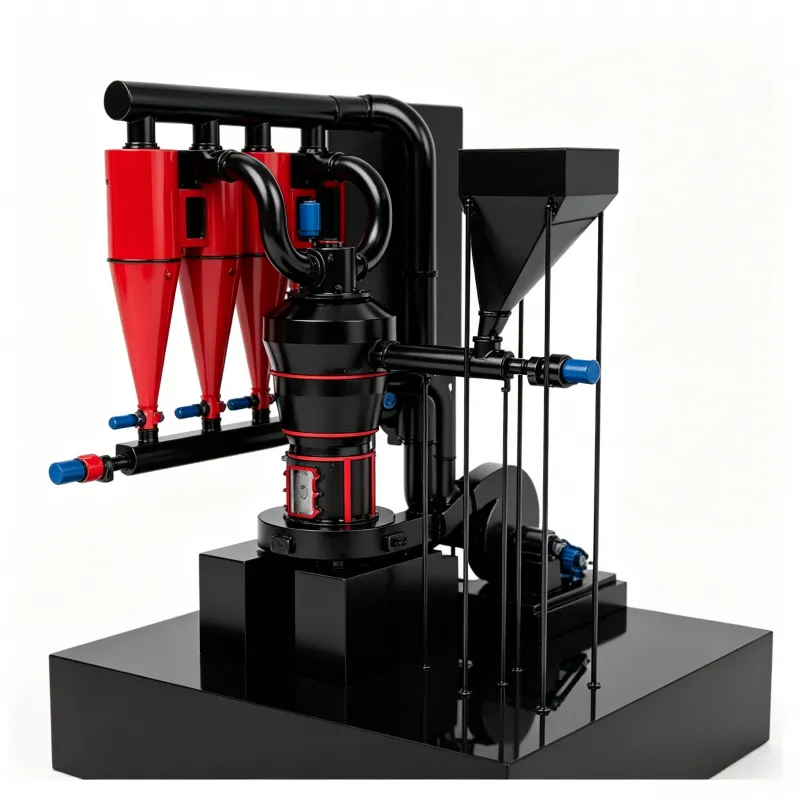
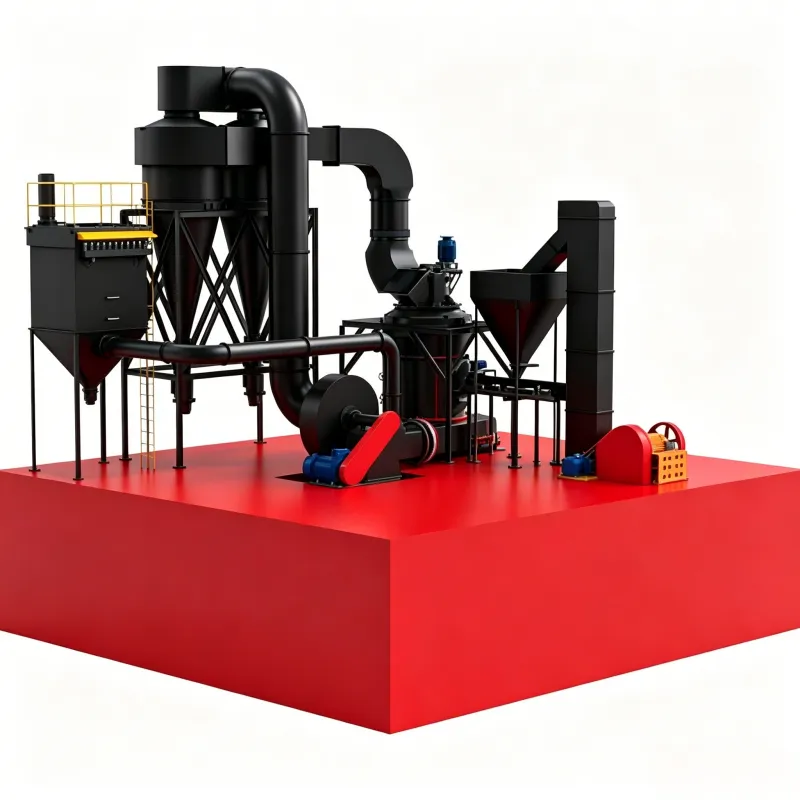
消石灰製造プラント
消石灰ミル(水酸化カルシウムミル)の概要 KX消石灰…


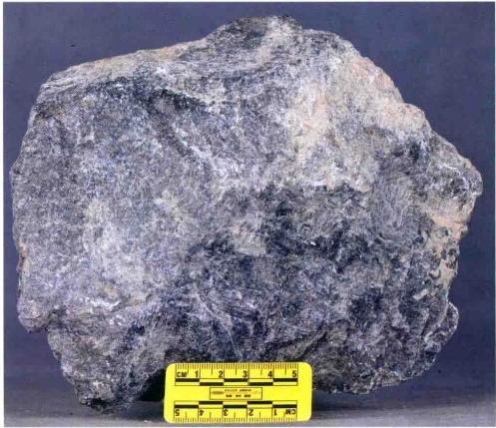
Mg1-B01
Quartz-mica schist. The rock is gray to dark gray, fine-grained, with a scaly texture and schistose structure. The main mineral constituents are quartz, chlorite, and dolomite, with minor amounts of calcite and tourmaline. Chlorite: gray to light grayish-green, with greasy to pearly luster, hardness less than that of a knife blade, occurring as euhedral to subhedral scaly flakes, content >50%, especially more developed and enriched on fracture surfaces of the rock. Dolomite and calcite: white to light grayish-white, fine to very fine granular, powder effervesces weakly with dilute hydrochloric acid, hardness less than that of a knife blade, content 40%–50%.
Mg1-B02
Magnesite ore. The ore is yellowish-white to light grayish-white, with a medium-grained to medium-coarse-grained crystalloblastic texture, massive structure, and streaked to banded structure. The ore mineral is magnesite, predominantly white, with subordinate light flesh-red varieties, vitreous luster, hardness slightly less than that of a knife blade. Some crystals are relatively euhedral, occurring as rhombohedral crystals, with large grains up to 1–2 cm in size; others are medium-grained, subhedral to anhedral, with grain sizes ranging from 1 to 5 mm. Magnesite content is greater than 90%. The gangue minerals are mainly chlorite, occurring as fine scaly flakes or anhedral grains, gray to dark gray. In addition, scattered biotite is present, intergrown with chlorite to form dark bands that alternate with light bands dominated by magnesite, giving rise to the banded structure. Total gangue mineral content is less than 10%. No obvious quartz grains are observed in the ore.

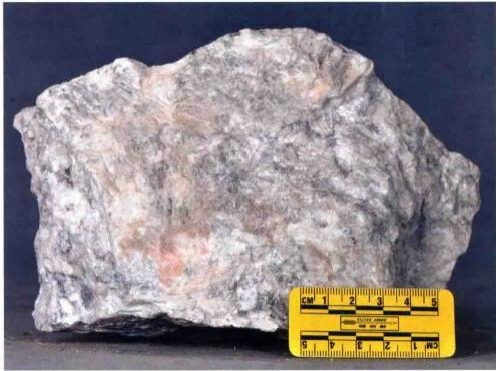
Mg1-B03
Magnesite ore. The ore is white with a slight pinkish tint, with a medium-coarse-grained crystalloblastic texture and a dense massive structure. The ore mineral is magnesite, white to light pink, vitreous luster, hardness slightly less than that of a knife blade, occurring as euhedral to subhedral rhombohedral crystals with well-developed crystal forms. Grain sizes are generally 3–5 mm, with large grains up to 2 cm. Magnesite content is greater than 95%. The gangue minerals are fine to very fine granular chlorite and biotite, distributed in the intercrystalline spaces of magnesite, with a total content of less than 5%. The ore may contain trace amounts of carbonaceous matter, appearing as black spots, and occasional quartz grains are observed.
Mg1-B04
Calcareous phyllite. The rock is light brownish-gray, with a fine-grained lepidoblastic crystalloblastic texture, phyllitic structure, and relict laminated structure. The main mineral constituents are calcite, dolomite, and sericite, with minor amounts of chlorite, biotite, quartz, and pyrite. Calcite and dolomite: grayish-white to white, fine granular, effervesce with dilute hydrochloric acid, often concentrated as streak-like distributions, content about 50%. Sericite: pale yellow, fine scaly, with silky luster, aggregates distributed as bands or streaks, content about 30%, alternating with calcite‑dolomite bands. Chlorite: distributed as fine to very fine granular and scaly forms. Biotite: black to dark gray, occurring as spots. Quartz: present as fine grains within the sericite bands, total content 15%. Pyrite: yellow, anhedral fine granular, occurring as veinlets parallel to the streaks, with a minor disseminated distribution, content 5%. The protolith is possibly calcareous mudstone to calcareous argillaceous siltstone.

Mg1-B05
Magnesite ore. The ore is white with a slight light flesh-red tint, with a medium-coarse-grained crystalloblastic texture and a dense massive structure. The ore mineral is magnesite, white to light flesh-red, vitreous luster, hardness slightly less than that of a knife blade, euhedral to subhedral, with well-developed rhombohedral crystals showing three sets of perfect cleavage. Crystal sizes vary, generally 3–10 mm, with large grains up to 3–4 cm. It does not effervesce with hydrochloric acid. Magnesite content is greater than 95%. The gangue minerals include carbonaceous dolomite, calcite, and trace quartz. Carbonaceous matter: fine to very fine granular, black, distributed as irregular bands and clots/lenses, content 1%–2%. Dolomite, calcite, and quartz: occur as veinlets; they do not effervesce with dilute hydrochloric acid as whole grains, but their powder effervesces weakly with dilute acid. Their total content is 2%–3%.

Mg1-B06
Magnesite ore. The ore is flesh-red, with a medium-grained to medium-coarse-grained crystalloblastic texture and a dense massive structure. It is composed almost entirely of magnesite, which is white to light flesh-red to pinkish, vitreous luster, hardness slightly less than that of a knife blade, occurring as euhedral to subhedral rhombohedral crystals. Crystal sizes are generally 3–10 mm, showing three sets of perfect cleavage. It does not effervesce with dilute hydrochloric acid. No impurities are visible in the ore, making it a pure magnesite ore.

Mg1-B07
Magnesite ore. The ore is light grayish-white, with a medium- to medium-coarse-grained crystalloblastic texture and a dense massive structure. The ore mineral is magnesite, mostly white to light grayish-white, occasionally light flesh-red, vitreous luster, hardness slightly less than that of a knife blade, does not effervesce with dilute hydrochloric acid, euhedral to subhedral rhombohedral crystals, showing three sets of perfect cleavage. Grain size is 3–10 mm, with magnesite content >95%. There are also grains of 0.1–1 mm in size, with a magnesite content of 1–2%. Dark very fine-grained minerals are observed in the ore, possibly chlorite, too fine to identify clearly, with a content of 1–2%.

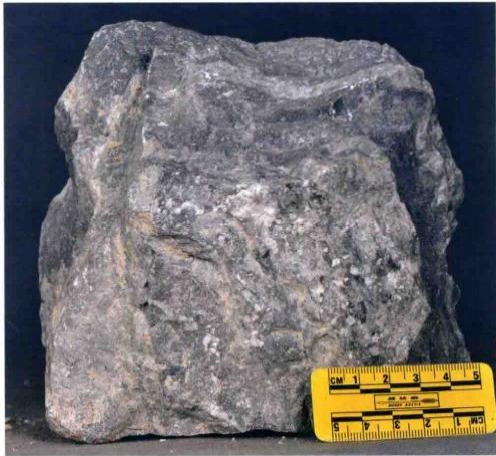
Mg1-B08
Marbleized crystalline dolomite. The rock is light gray, with a micro-fine to fine-grained crystalloblastic texture and a massive structure. The main mineral constituent is dolomite, with minor calcite. Calcite and dolomite: light grayish-white, hardness less than that of a knife blade; the whole grains effervesce weakly with dilute hydrochloric acid, while the powder effervesces vigorously with dilute acid; fine to micro-fine granular; total content greater than 95%. Scattered pyrite is present in the rock, yellow, metallic luster, occurring as euhedral cubic crystals or rounded grains; locally, pyrite is concentrated in veinlet-like distributions, with a content of 1%–2%.
Mg1-B09
Magnesite ore. The ore is light pinkish to light flesh-red, with a medium-coarse to coarse-grained crystalloblastic texture and a dense massive structure. It is composed almost entirely of magnesite, which is light pinkish to light flesh-red, with a few light grayish-white varieties, vitreous luster, hardness slightly less than that of a knife blade, occurring as euhedral to subhedral rhombohedral crystals showing three sets of perfect cleavage, and does not effervesce with dilute hydrochloric acid. The crystals occur in two forms: coarse-crystalline magnesite, light pinkish to light flesh-red, with grain sizes up to 2–3 cm; and light grayish-white magnesite, with smaller grain sizes of 2–5 mm, mostly concentrated as irregular vein-like and clot-like masses distributed in the intercrystalline spaces of the coarse magnesite. The former is dominant, accounting for 85%–90%, while the latter constitutes 10%–15%. The ore is essentially free of impurities, belonging to pure, high-quality magnesite ore, with a relatively high density.

Mg1-B10
Grayish-black dolomitic marble. The rock is grayish-black, with a powder-crystalline (microcrystalline) texture, massive structure, and locally showing laminated structure. The main minerals are calcite and dolomite, light grayish-white, fine to very fine granular; they do not effervesce with dilute hydrochloric acid, but the powder effervesces vigorously with dilute acid. Their total content is greater than 95%. Scattered fine-grained pyrite is visible in the rock, white to yellowish-white, metallic luster, with a content of less than 1%.

Mg1-B11
Magnesite ore. The ore is grayish-white, with a medium- to medium-coarse-grained crystalloblastic texture and a massive structure. The main mineral is magnesite, white to milky-white, vitreous luster, hardness slightly less than that of a knife blade, subhedral to anhedral, with grain sizes mostly ranging from 3 to 5 mm, and large grains up to 1 cm. Magnesite content is greater than 90%. The gangue minerals are dark minerals, chlorite and biotite, brownish-gray to black, anhedral fine scaly, filling the intercrystalline spaces of magnesite. The dark minerals occur as clot-like aggregates and irregular fine streaks, with a total content of less than 10%. The dark minerals may be magnesian carbonates; the original rock was transformed into magnesite ore through metamorphic metasomatism. Due to the relatively high impurity content, the ore quality is relatively poor.

Mg1-B12
Silicified dolomitic marble. The rock is white, with a medium-fine-grained crystalloblastic texture and a massive structure. The main mineral constituents are calcite and dolomite, with minor amounts of quartz and serpentine. Calcite and dolomite: white to milky-white, euhedral to anhedral fine granular, partly medium-grained, hardness less than that of a knife blade; they effervesce weakly with dilute hydrochloric acid, while the powder effervesces vigorously. Their total content is about 90%. Quartz: colorless and transparent, greasy luster, anhedral granular and rounded grains, grain size 1–3 mm, content greater than 5%, mostly associated with calcite veins. Serpentine: light yellowish-green, waxy luster, anhedral granular and clot-like aggregates, hardness less than that of a knife blade, very unevenly distributed, content about 1%.
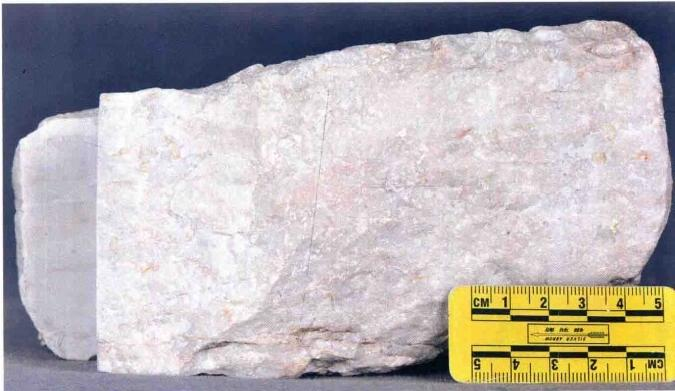
(2) Microscopic identification photographs and descriptions
Mg1-b01
Quartz-mica schist. Lepidoblastic and granoblastic crystalloblastic texture, folded schistose structure. The rock is mainly composed of quartz (Qtz), muscovite (Ms), calcite (Cal), tourmaline (Tur), and metallic minerals.

(2) Microscopic identification photographs and descriptions (continued)
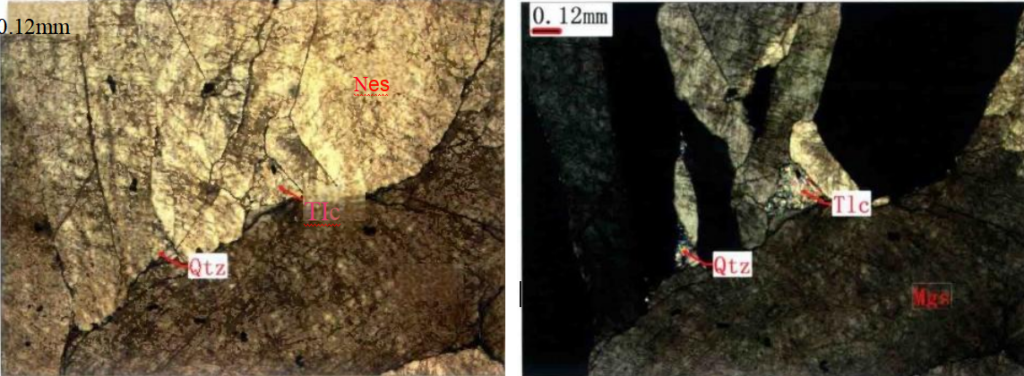
Mg1-b02
Magnesite ore. Lepidoblastic and granoblastic crystalloblastic texture, schistose structure. The rock is mainly composed of magnesite (Mgs), with lesser talc (Tlc) and quartz (Qtz).
(2) Microscopic identification photographs and descriptions (continued)
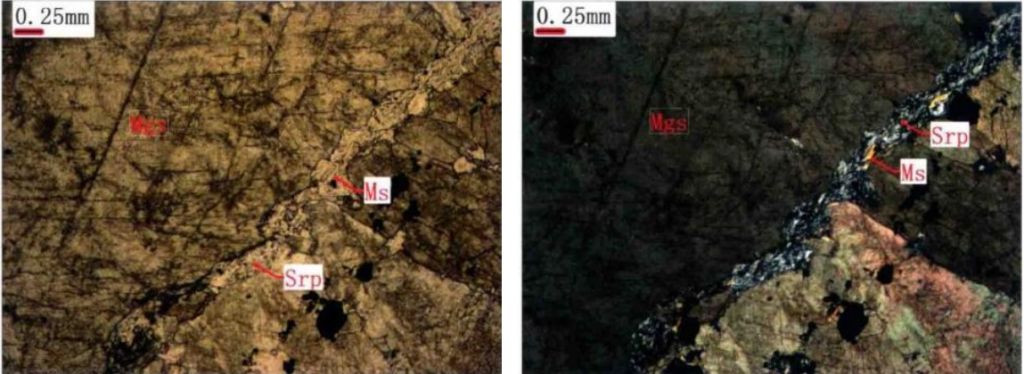
Mg1-b03
Magnesite ore. Lepidoblastic and granoblastic crystalloblastic texture, schistose structure. The rock is mainly composed of magnesite (Mgs), with lesser serpentine (Srp) and muscovite (Ms).
(2) Microscopic identification photographs and descriptions (continued)
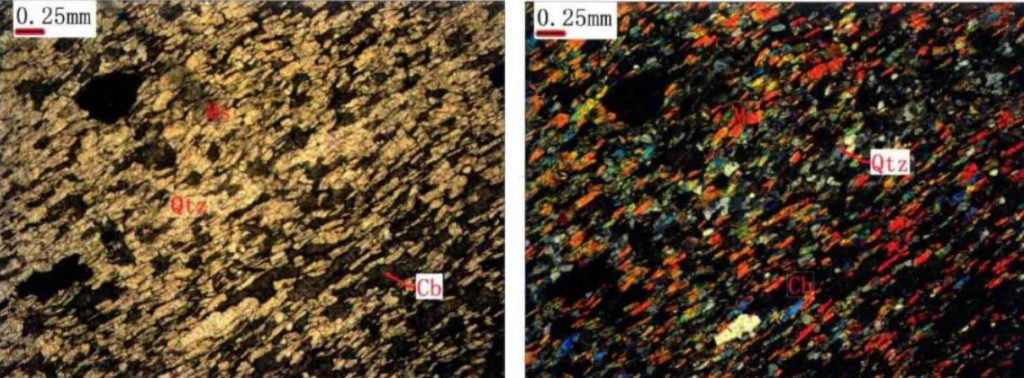
Mg1-b04
モスクワ産石灰質片岩。. Lepidoblastic and granoblastic crystalloblastic texture, schistose structure. The rock is mainly composed of muscovite (Ms), quartz (Qtz), carbonate (Cb), and metallic minerals.
(2) Microscopic identification photographs and descriptions (continued)
Mg1-b05
Magnesite ore. Granoblastic crystalloblastic texture, massive structure. The rock is mainly composed of magnesite (Mgs), quartz (Qtz), and minor metallic minerals.
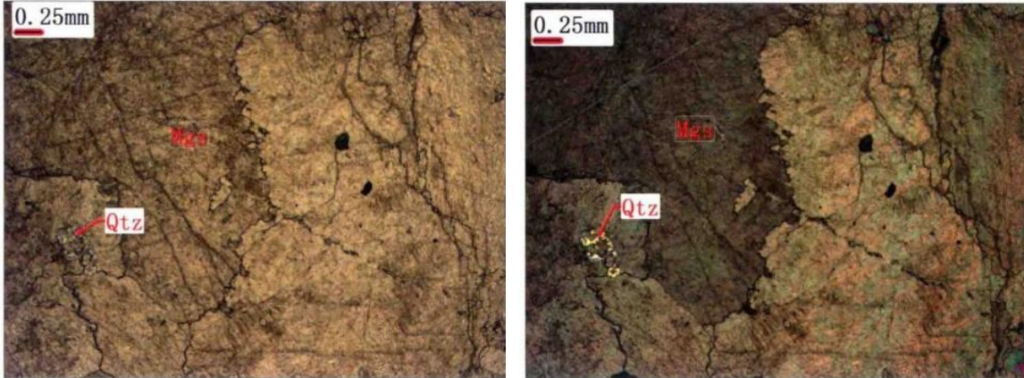
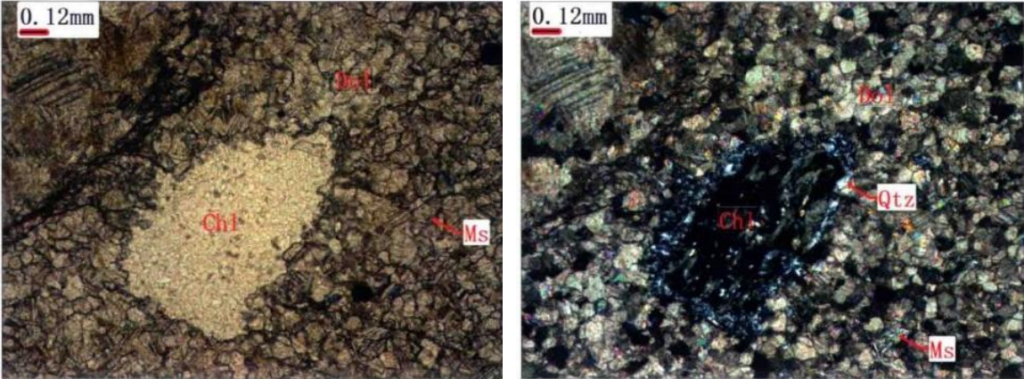
Mg1‑b06
Marbleized crystalline dolomite. Lepidoblastic and granoblastic crystalloblastic texture, massive structure. The rock is mainly composed of dolomite (Dol), with subordinate muscovite (Ms), chlorite (Chl), quartz (Qtz), and metallic minerals.
Mg1‑b07
Magnesite ore. Granoblastic crystalloblastic texture, schistose structure. The rock is mainly composed of magnesite (Mgs) with minor quartz (Qtz) and metallic minerals.

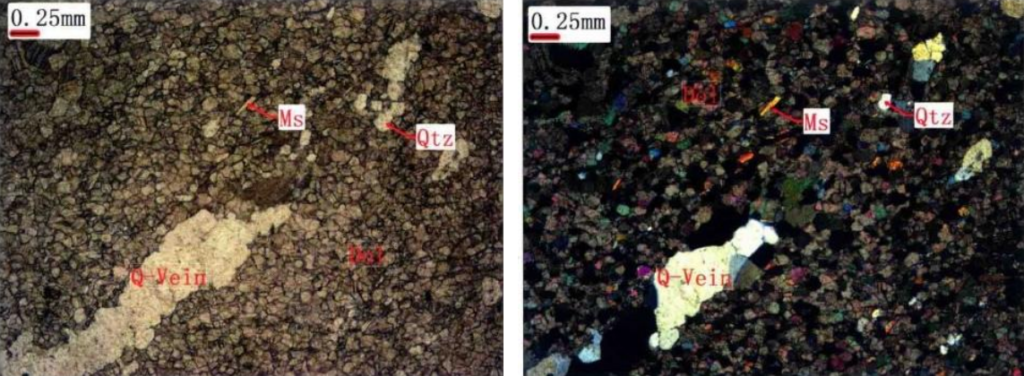
Mg1‑b08
Silicified dolomitic marble. Lepidoblastic and granoblastic crystalloblastic texture, massive structure. The rock is mainly composed of dolomite (Dol), with subordinate quartz (Qtz), muscovite (Ms), and metallic minerals.

 English English
 Spanish
 Russian
 Arabic
 Swahili
 French
 Turkish
 Portuguese
 Korean
 Japanese
 German
 Italian