XJBロッド式浮選機
XJBロッド式浮選機 XJBロッド式浮選機は、…と類似しています。


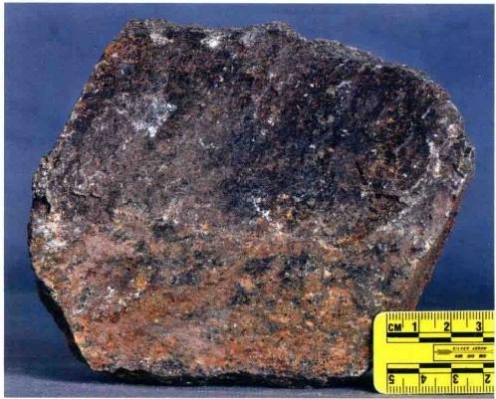
AISi1-B01
Volcanic breccia crystal tuff. The rock is grayish-green in color and exhibits a pyroclastic texture, tuffaceous texture, and massive structure. It is mainly composed of three components: crystal clasts, lithic clasts, and matrix.
Crystal clasts: The primary component is feldspar, which is yellowish-white, with grain sizes ranging from 0.5 to 2 mm, occurring in angular, sub-angular, and irregular shapes. It also contains a minor amount of quartz. The crystal clasts account for about 40% of the rock.
Lithic clasts: The composition is predominantly dark grayish-black tuff, intermingled with gray to light grayish-white tuff. The clasts range in size from 2 to 5 mm, exhibiting angular, rounded, and irregular shapes, with a content of approximately 50%.
On one side of the specimen (on the fracture surface), pyrophyllitization can be observed. The pyrophyllite appears as light yellowish-white to light grayish-white, is cryptocrystalline, and has a soapy/greasy feel. Its hardness is equivalent to that of a fingernail; scratching it with a fingernail produces a white powder.
Dark brownish-black particles are visible in the rock, and dark brownish-black films develop on the rock surface. Effervescence occurs upon the addition of hydrogen peroxide, indicating the presence of manganese. Effervescence also occurs upon the addition of dilute hydrochloric acid, suggesting that the rock contains carbonate minerals; however, due to the fine grain size, these are not visible to the naked eye.
The distribution of clastic particles is uneven, with the grain size gradually fining from one side to the other, displaying sedimentary rhythmicity.
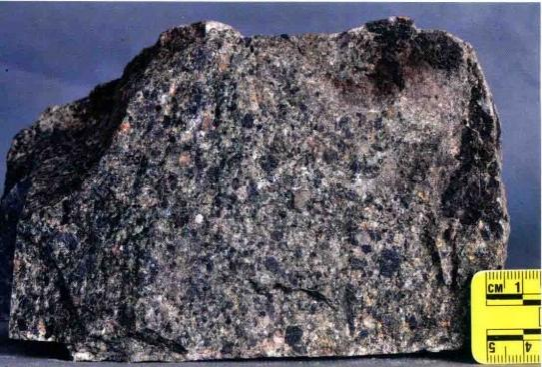
AISi1-B02
Andesitic volcanic breccia crystal tuff. The rock is dark gray in color and exhibits a tuffaceous sandy texture and massive structure. It consists of two parts: sandy clasts and matrix.
Sandy clasts: The sandy fraction is dominated by fine gravel and breccia, with breccia sizes ranging from 5 to 8 mm, supplemented by medium-grained sand with grain sizes of 2–5 mm. The clasts (gravel and sand) are angular to subangular to subrounded, poorly rounded, and unsorted. The clast compositions include siltstone, quartz, chalcedony, quartz sandstone, and carbonate rocks, possibly with a minor amount of andesite. The sand‑sized clasts account for 60%–70% of the rock.
Matrix: The matrix is mainly tuffaceous, cryptocrystalline, and gray to greenish‑gray in color, with subordinate calcareous material (calcite), which effervesces vigorously upon the addition of dilute hydrochloric acid.
Ferromanganese films of grayish‑brown color are commonly seen on joint surfaces, and effervescence is obvious upon the addition of hydrogen peroxide, indicating the presence of manganese oxide (manganese dioxide).
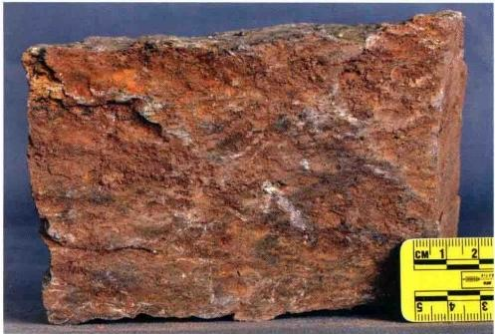
AISi1-B03
Tuff. The rock is light yellowish-gray to light greenish-gray in color and exhibits a tuffaceous texture and massive structure. It is composed almost entirely of cryptocrystalline tuff, with a content exceeding 90%. Minor feldspar crystal clasts and quartz crystal clasts are visible, with a total content of less than 5%.
Brownish ferromanganese spots are present in the rock, and brownish ferromanganese leachates occur on fracture surfaces, which effervesce strongly upon the addition of hydrogen peroxide.
On one side of the specimen, foliated pyrophyllitization is observed, appearing light yellowish-gray to light greenish-gray, which is interpreted as a product of thermal‑dynamic alteration.
AISi1-B04
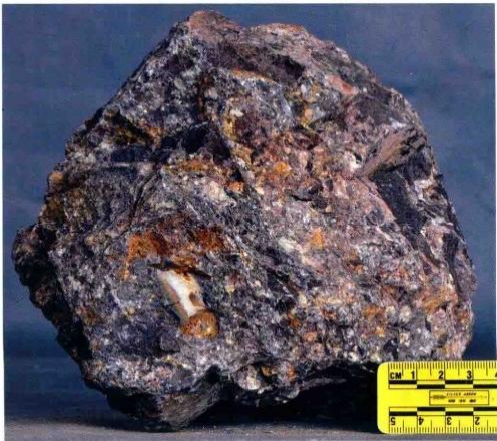
Volcanic breccia. The rock is purplish‑gray in color and exhibits a pyroclastic texture and brecciated structure. The breccia clasts vary considerably in size: the largest ones reach up to 5 cm × 8 cm, attaining block size; generally they are about 3 cm × 5 cm; the smaller ones range from 5 to 10 mm. Most clasts are angular to subangular to subrounded and show a slight directional orientation.
The clasts are predominantly purplish‑gray andesite, accounting for more than 80%, with subordinate siltstone and tuffaceous breccia clasts at about 10%. Some of the tuffaceous breccia clasts have been altered to light grayish‑white pyrophyllite. The cement is volcanic ash, purplish‑gray or gray, micro‑fine cryptocrystalline, constituting about 10% of the rock.
AISi1-B05
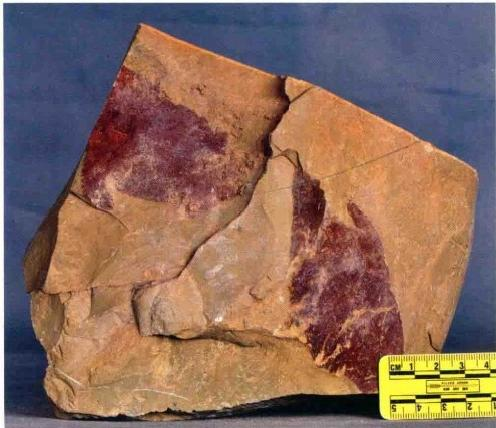
Hydrothermally altered tuff-type pyrophyllite ore. The ore is yellow to light grayish-yellow in color and exhibits a cryptocrystalline texture and dense massive structure. The ore is composed almost entirely of pyrophyllite, which accounts for more than 95%. The pyrophyllite is cream‑yellow to light grayish‑yellow, with a white streak, waxy luster, hardness comparable to that of a fingernail, and a soapy/greasy feel to the touch.
The rock contains minor dark‑colored impurities in the form of small pellet‑like grains, ranging from 1 to 2 mm in size; the grains are fine and not discernible to the naked eye. The overall appearance of the ore is similar to tuff, except for its lower hardness, suggesting that the pyrophyllite is likely a product of hydrothermal alteration of tuff.
AISi1-B06
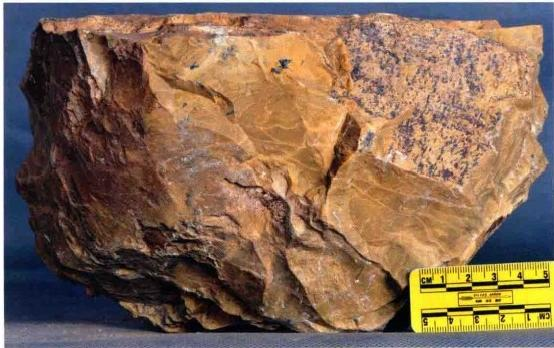
Hydrothermally altered tuff‑type pyrophyllite ore. The ore is light grayish‑yellow to yellowish‑white in color and exhibits a cryptocrystalline texture and dense massive structure. It is composed almost entirely of pyrophyllite, which accounts for more than 90%.
The pyrophyllite is yellow to cream‑yellow, with a white streak, waxy luster, and a distinctly greasy feel to the touch. It shows conchoidal fracture and is very fine‑grained. The ore has low hardness, equivalent to that of a fingernail.
The ore contains minor impurities in the form of brownish pellets, which yield a brownish‑red powder and are interpreted as ferruginous (iron‑muddy) material. The specific mineral composition is not discernible. The pellets range from 2 to 5 mm in size, are rounded to irregular in shape, and constitute about 1%–2% of the rock.
AISi1-B07
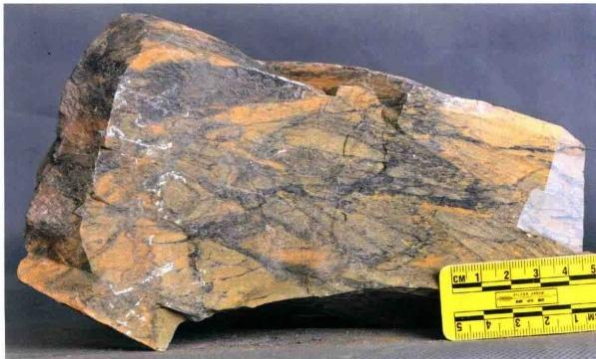
Pyrophyllitized tuff. The rock is cream‑yellow to grayish‑black in alternating bands and exhibits a cryptocrystalline texture and massive to laminated to banded structure. It is composed of pyrophyllite bands and pyrophyllitized tuffaceous bands and laminae.
The pyrophyllite is yellow, cream‑yellow, or yellowish‑gray, with a white streak, waxy luster, and a distinctly greasy feel to the touch. It is compact in texture and soft, occurring as irregularly distributed bands and fine laminae within the rock, accounting for about 60%.
The tuffaceous material is dark grayish‑black, with a brownish‑purple powder streak. It is entirely cryptocrystalline and micro‑fine grained, and may show weak pyrophyllitization, as its powder also has a greasy feel. It constitutes about 40% of the rock.
The tuffaceous bands and laminae vary in thickness, ranging from 2–3 cm for the thicker ones to 1–3 mm for the thinner ones, and are unevenly distributed. The rock surface shows tectonic slickensides, on which brownish‑red ferruginous films are developed.
AISi1-B08
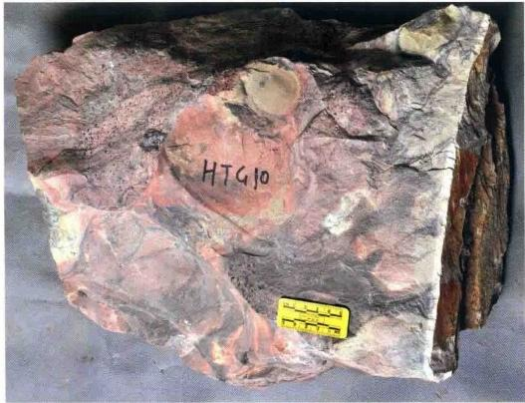
Pyrophyllite ore. The ore is flesh‑red to light gray in color and exhibits a micro‑fine cryptocrystalline texture with reticulate (net‑like) and massive structures. It is mainly composed of micro‑fine cryptocrystalline flesh‑red pyrophyllite and yellowish‑white to light grayish‑white pyrophyllite, with subordinate quartz.
Pyrophyllite: Soft, with a greasy feel to the touch and waxy luster, accounting for about 60%.
Quartz: Micro‑fine granular, constituting 20%–30%.
The pyrophyllite in powder form appears light yellow to light reddish‑brown, possibly related to iron content.
The ore contains dark grayish‑black bands or fine reticulate veins, which may contain ferruginous material and chlorite as well as argillaceous matter.
Kaolin occurs as veinlets distributed within the ore. It is white, cryptocrystalline, and adheres to the tongue when licked. The veinlets are about 5 mm wide and, after weathering, exhibit an earthy luster.
AISi1-B09
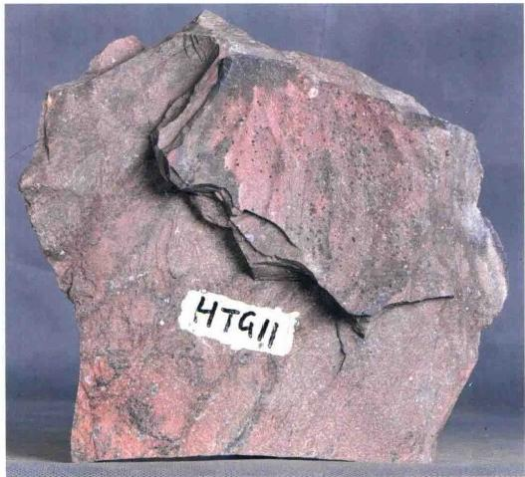
Pyrophyllite ore. The ore is flesh‑red in color and exhibits a micro‑fine cryptocrystalline texture and massive structure. The ore minerals are mainly flesh‑red pyrophyllite, with a minor amount of yellowish‑white pyrophyllite; both occur as micro‑fine cryptocrystalline aggregates in massive form, with a compact texture. The ore is soft, has a distinctly greasy feel to the touch, and displays a weak waxy luster, accounting for about 60%.
The ore contains common brownish‑red ferruginous spots, which are the minerals responsible for the reddish coloration of the rock. The pyrophyllite grains are slightly elongated. The ore also contains black streaks, composed of cryptocrystalline chlorite and ferruginous material, constituting about 10%. The streaks vary in width, ranging from 1 to 10 mm.
AISi1-B10
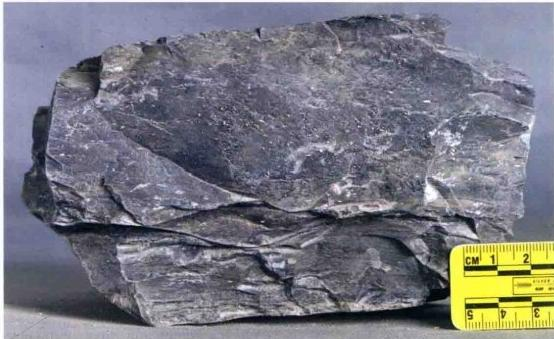
Pyrophyllitized crystal‑bearing welded tuff. The rock is grayish‑black in color and exhibits a tuffaceous‑silty texture, with massive structure and fine laminated structure. The mineral grains are very fine and the rock is dark in color, making it difficult to distinguish mineral constituents with the naked eye. The fracture surface is slightly rough in feel, and the composition is inferred to be argillaceous material, fine silt, and volcanic ash, among others.
The rock contains light yellowish‑green pyrophyllite, which occurs as streaks and small lenticular bodies, accounting for about 10% with an uneven distribution. White kaolin is also commonly present in the rock, showing elongated and oriented distribution on fracture surfaces, with a content of about 1%–2%.
AISi1-B11
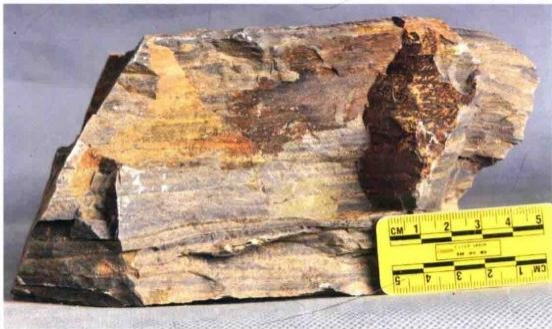
Porphyroblastic tuff. The rock is yellowish‑gray in color and exhibits a silty texture with thin‑bedded to laminated structure. The main mineral constituents are quartz, feldspar, and epidote.
クォーツ: Yellowish‑white, micro‑fine granular, forming yellowish bands or laminae in the rock, accounting for 60%–70%.
長石: Yellowish‑white, micro‑fine granular, also forming yellowish bands or laminae, with a content of about 30%.
エピドート: Light green, micro‑fine granular, closely associated with the light‑colored laminae, formed by alteration of feldspar through epidotization.
The rock consists of alternating dark grayish bands and light‑colored bands, exhibiting a thin‑bedded or laminated structure. The rock is relatively hard.
AISi1-b01
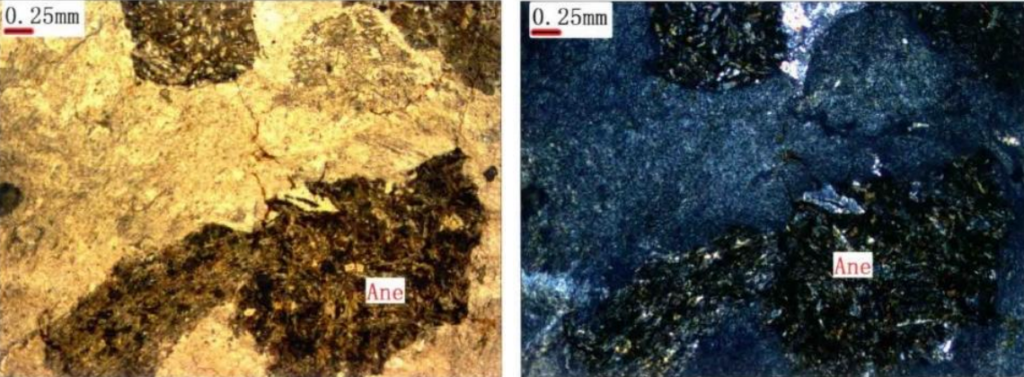
Volcanic breccia crystal tuff. The rock exhibits a volcanic breccia and lithic tuff texture with massive structure. It is composed of volcanic breccia clasts, lithic clasts, and volcanic ash.
Volcanic breccia clasts: The main component is andesite (Ane), with minor diorite and carbonate rock fragments. They are angular to subangular, with grain sizes ranging from 2 to 5 mm, and account for 10%–15%.
Lithic clasts: The principal composition is andesite, with minor diorite and carbonate rock fragments. They are angular to subangular, with grain sizes <2 mm, and constitute 15%–20%.
Volcanic ash: Content is 65%–70%, with slight sericitization. The volcanic breccia clasts are cemented by lithic clasts and volcanic ash.
AISi1-b02
Andesitic volcanic breccia crystal‑lithic tuff. The rock exhibits a volcanic breccia, crystal‑lithic tuff texture with massive structure. It is composed of volcanic breccia clasts (Bre), lithic clasts (Det), crystal clasts (Cry), and volcanic ash.
Volcanic breccia clasts: The main component is andesite, with minor clasts of granite, carbonate rock, and granite porphyry. They are angular to subangular, with grain sizes ranging from 2 to 10 mm, and account for 30%–35%.
Lithic clasts: The principal composition is andesite, with minor clasts of granite, carbonate rock, and granite porphyry. They are angular to subangular, with grain sizes <2 mm, and constitute 20%–25%.
Crystal clasts: Composed of plagioclase and quartz, angular to subangular, with grain sizes <2 mm, and account for 4%–5%.
Volcanic ash: Content is 40%–45%. The volcanic breccia clasts are cemented by lithic clasts, crystal clasts, and volcanic ash.

AISi1-b03
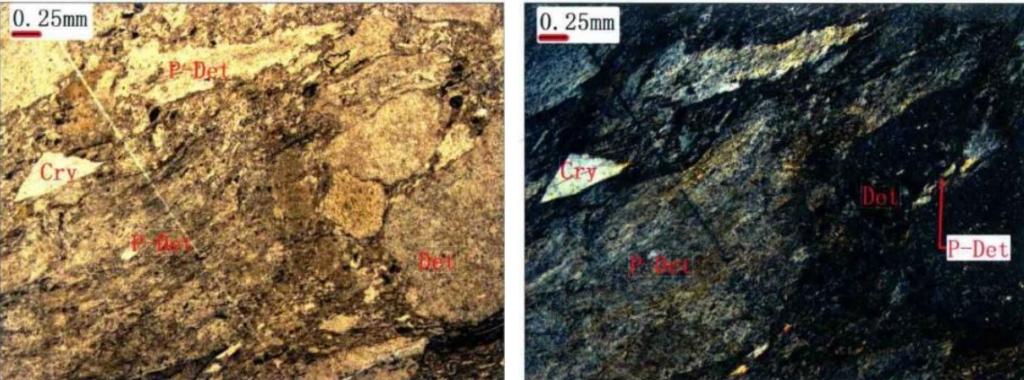
Volcanic breccia. The rock exhibits a microscopic lepidoblastic texture and a relict welded breccia texture, with massive structure. It is composed of volcanic breccia clasts, lithic clasts (Det), crystal clasts (Cry), plastic lithic clasts (P‑Det), and volcanic ash.
Volcanic breccia clasts: The main component is crystal tuff, angular to subangular, with grain sizes ranging from 2 to 5 mm, accounting for 10%–15%.
Plastic lithic clasts: They occur as ribbon‑like, lenticular, and shred‑like forms, and are intensely sericitized. Their predominant grain size is 2–10 mm, with some <2 mm. They serve as cementing material in the rock, constituting 50%–55%.
Lithic clasts: The principal composition is tuff, with minor andesite. They are angular to subangular, <2 mm in size, and account for 8%–10%.
Crystal clasts: Composed of plagioclase, angular to subangular, <2 mm, with a content of 1%–2%.
Volcanic ash: Content is 25%–30%. The volcanic breccia clasts, breccia‑like plastic lithic clasts, lithic clasts, crystal clasts, etc., are cemented by lithic‑like plastic lithic clasts and volcanic ash.
AISi1-b04
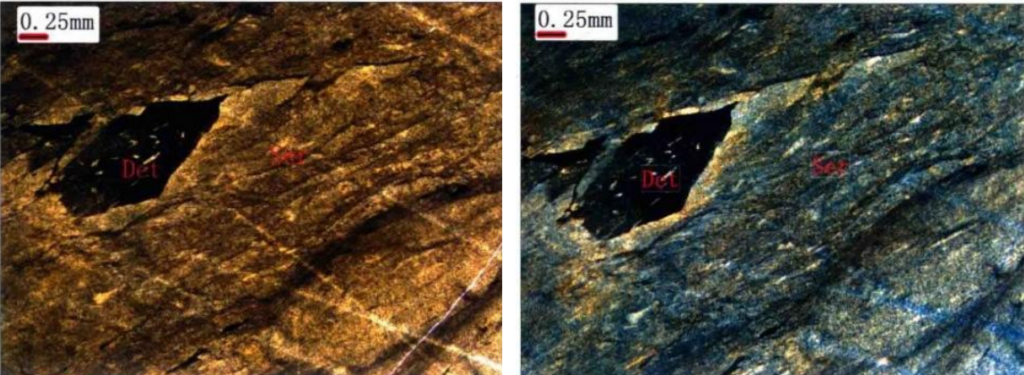
Cataclasized lithic tuff. The rock exhibits a microscopic lepidoblastic texture, a relict lithic tuff texture, a cataclastic fabric, and a phyllitic structure. The protolith of the rock is lithic tuff, composed of lithic clasts (Det) and volcanic ash.
Lithic clasts: The main component is andesite, angular to subangular, with grain sizes <2 mm, accounting for 5%–6%.
Volcanic ash: Intensely sericitized, continuously oriented, displaying a phyllitic structure, with a content of 94%–95%. The lithic clasts are cemented by volcanic ash.
Under early regional metamorphism, the volcanic ash underwent metamorphic recrystallization to sericite (Ser), which is continuously oriented and exhibits a phyllitic structure. Under later dynamic metamorphism, the phyllite was cataclasized, and fissures were filled with its own detrital fragments and iron oxides. Under late hydrothermal alteration, part of the K and Na components were leached from the rock, and it was metamorphically recrystallized to diaspore, kaolinite, and other minerals.
AISi1-b05
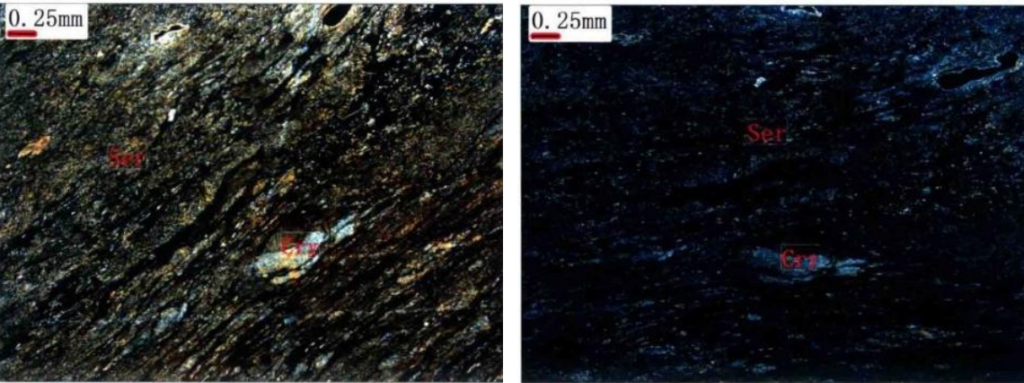
Pyrophyllitized crystal‑bearing welded tuff. The rock exhibits a microscopic lepidoblastic texture, a relict crystal‑bearing welded tuff texture, and a phyllitic structure. The protolith is crystal‑bearing welded tuff, composed of crystal clasts (Cry), plastic vitroclasts, and volcanic ash.
Plastic vitroclasts: They occur as fine stripes, curved and oriented, with crystal clasts pressed into them, causing narrowing and thinning in the middle and resulting in a pseudo‑flow structure; content is 40%–45%.
Crystal clasts: Mainly plagioclase, intensely sericitized, angular to subangular, with grain sizes <2 mm, accounting for 8%–10%.
Volcanic ash: Content is 40%–45%.
The crystal clasts and volcanic ash are cemented by the plastic vitroclasts. Under early regional metamorphism, the plastic vitroclasts underwent devitrification, and the tuffaceous material was sericitized (Ser), becoming continuously oriented to form a phyllitic structure. Under later hydrothermal alteration, part of the K and Na components were leached from the rock, and it was metamorphically recrystallized to diaspore, kaolinite, and other minerals.
AISi1-b06
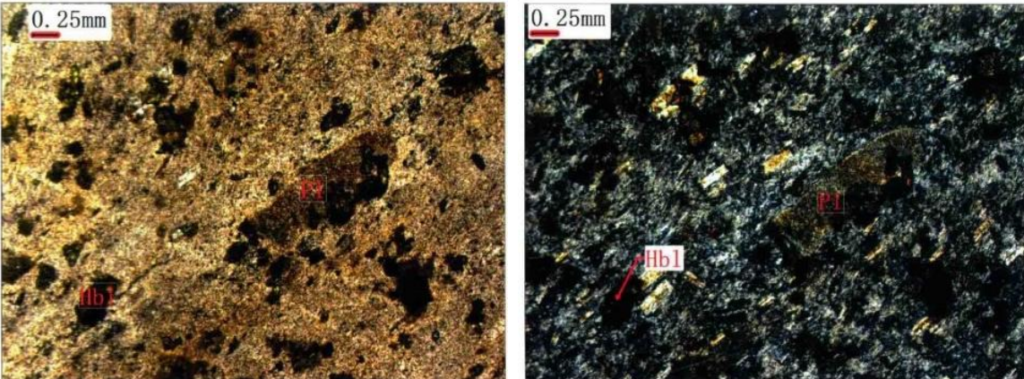
Porphyroblastic tuff. The rock exhibits a porphyroblastic texture, with a matrix showing pilotaxitic texture, and massive structure. It is composed of phenocrysts and matrix.
Phenocrysts: Amphibole (Hbl) and plagioclase (Pl), with a content of 8%–10%.
Matrix: Composed of microcrystalline plagioclase, amphibole, and magnetite. Microlitic plagioclase is continuously oriented, with amphibole and magnetite filling the interstices, exhibiting a pilotaxitic texture. The matrix accounts for 90%–92%.
Accessory mineral: Magnetite.
Alteration minerals: Epidote, argillaceous material, etc.
斜長石: Occurs both as phenocrysts and in the matrix. Phenocrysts are subhedral, prismatic, with polysynthetic twinning, and show varying degrees of argillization. Phenocryst size ranges from 0.5 to 2 mm, with a content of 4%–5%. In the matrix, grain size is <0.2 mm, with a content of 75%–80%.
Amphibole: Occurs both as phenocrysts and in the matrix. Brown in color, euhedral, prismatic, with varying degrees of epidotization. The phenocryst rims are darkened, while the cores are epidotized. Phenocryst size ranges from 0.5 to 2 mm, with a content of 5%–6%. In the matrix, grain size is <0.2 mm, with a content of 8%–10%.
Accessory mineral: Magnetite, euhedral, granular, minor amount.


 English English
 Spanish
 Russian
 Arabic
 Swahili
 French
 Turkish
 Portuguese
 Korean
 Japanese
 German
 Italian