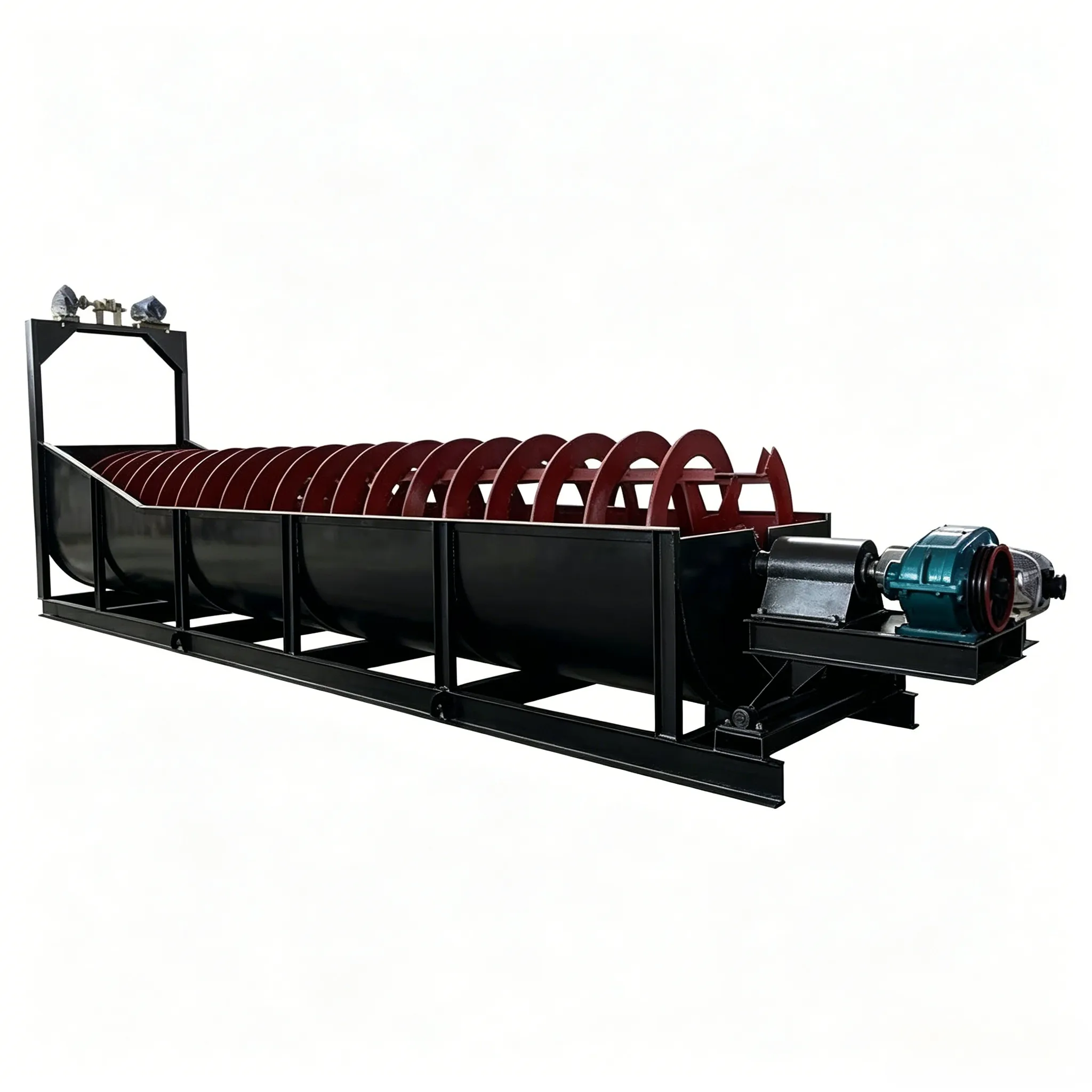
スパイラル分級機
スパイラル分級機の動作原理 粉砕機から排出されたパルプは…


Gold Ore Double-Impeller Leaching Agitation Tank: Working Principle, Core Advantages, and Selection Guide
In the cyanidation process for gold extraction, the leaching agitation tank is one of the core pieces of equipment that determines leaching efficiency and gold recovery. With the rapid development of China’s gold mining and beneficiation industry, the double-impeller leaching agitation tank has gradually replaced traditional single-impeller tanks, thanks to its excellent agitation performance, uniform aeration, and significant energy-saving advantages. It has become the mainstream choice for cyanidation leaching and carbon adsorption operations in gold mines. This article provides a comprehensive analysis of the working principle, structural features, core advantages, and selection considerations for the gold ore double-impeller leaching agitation tank.
The double-impeller leaching agitation tank, also known as the SJ-type double-impeller leaching tank, is a piece of equipment specifically designed for the cyanidation gold extraction process, used for leaching and adsorption. The equipment features a double-layer impeller structure, with the motor, reducer, bearing housing, and agitation tank mounted concentrically on the same vertical axis, resulting in a compact design and small footprint. Compared with traditional single-impeller tanks, the double-layer impeller design provides more uniform pulp agitation, lower energy consumption, longer impeller service life due to rubber‑lined technology, and a multi‑direction aeration system that ensures uniform gas distribution.
This equipment is suitable for gold leaching, adsorption, and other mixing operations where the material has low specific gravity, low viscosity, slow settling speed, particle size of 90% passing 200 mesh, and pulp concentration below 45%.
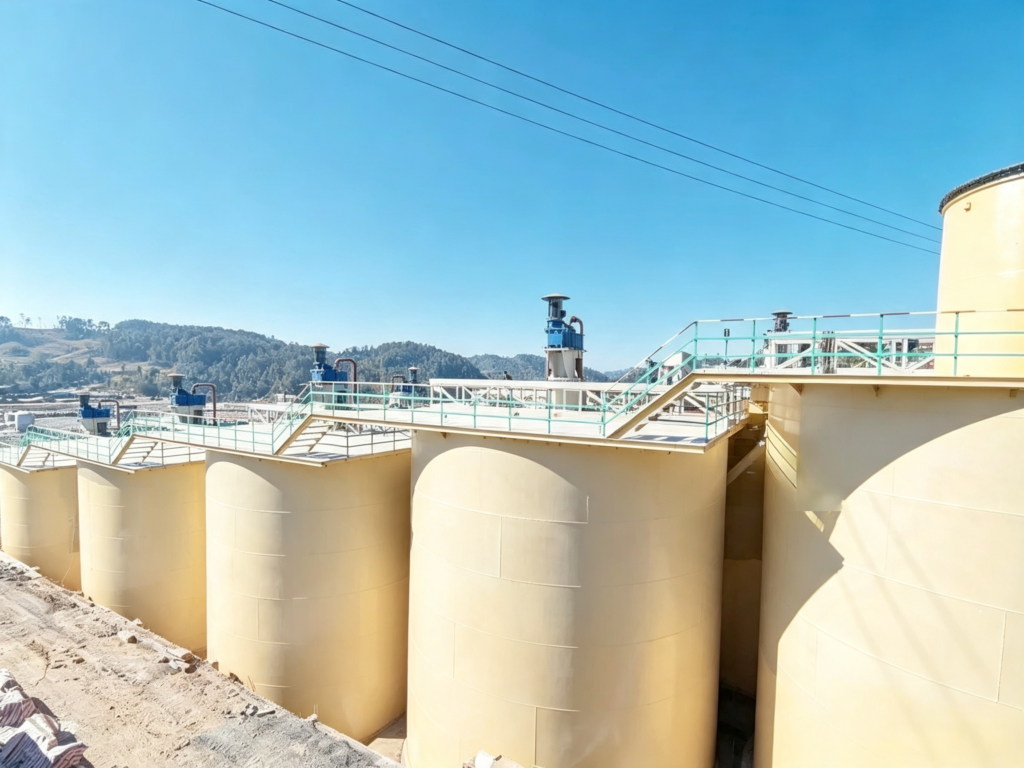
2. Equipment Structure and Components
The double-impeller leaching agitation tank mainly consists of the following parts:
The two impellers are arranged vertically on the same main shaft, each consisting of four blades, with the upper blades offset by 45° from the lower ones. The impellers are rubber‑lined for excellent wear resistance and long service life. The main shaft is divided into upper and lower sections connected by positioning flanges, reducing the lifting height required and facilitating installation and maintenance.
3. Working Principle in Detail
The operation of the double-impeller leaching agitation tank proceeds as follows:
This unique working flow ensures thorough mixing and reaction of pulp, reagents, and air within the tank, providing a strong guarantee for achieving high leaching rates.
4. Core Advantages and Features
Compared with traditional single-impeller leaching tanks, the double-impeller design offers the following significant advantages:
1. More uniform agitation and higher leaching recovery
The double-layer impeller creates stable pulp flow and homogeneous mixing, with consistent pulp density and particle size distribution throughout the tank, significantly improving cyanidation leaching efficiency and activated carbon adsorption rates.
2. Lower energy consumption and more economical operation
The large impeller diameter and low rotational speed reduce agitation power consumption. Compared with conventional tanks of the same size, power requirements are noticeably lower, enabling energy-saving operation.
3. More uniform aeration and better reaction
Air enters through the hollow transmission shaft and is evenly dispersed by the impeller blades, producing fine bubbles. The multi‑directional aeration scheme ensures uniform oxygen distribution in the pulp, providing an ample oxygen source for the cyanidation reaction.
4. Long service life and low maintenance costs
The impellers are lined with wear‑resistant rubber, and the low rotational speed results in minimal wear, extending service life. The compact structure also makes maintenance convenient.
5. Reduced carbon attrition and higher adsorption efficiency
The low shear speed of the impellers minimises the breakage and abrasion of activated carbon, improving carbon adsorption rates and gold recovery.
6. Compact structure and small footprint
The motor, reducer, bearing housing, and tank are mounted concentrically on the same vertical axis, saving plant floor space.
5. Wide Application Fields
The double-impeller leaching agitation tank is mainly used in the following areas:
In CIP/CIL circuits, the carbon adsorption tank is usually equipped with auxiliary equipment such as carbon retention screens and carbon lifting pumps.
6. Technical Parameters Reference
The following table shows typical technical parameters for some common models of the double-impeller leaching agitation tank:
| モデル | Tank Size (Diameter × Height, mm) | Effective Volume (m³) | Impeller Speed (rpm) | モーター出力(kW) |
|---|---|---|---|---|
| SJ2.0×2.5 | 2000×2500 | 6 | 52 | 2.2 |
| SJ2.5×2.5 | 2500×2500 | 9.82 | 43 | 4 |
| SJ3.0×3.0 | 3000×3000 | 18 | 40.85 | 4 |
| SJ3.5×3.5 | 3500×3500 | 30 | 52 | 5.5 |
| SJ4.0×4.5 | 4000×4500 | 48 | 35 | 7.5 |
| SJ4.0×6.0 | 4000×6000 | 68 | — | 11 |
Note: Effective volumes can range from 6 m³ up to 1740 m³; specific parameters vary by manufacturer and model.
7. Selection Guidelines
When selecting a double-impeller leaching agitation tank, users should consider the following factors:
8. Maintenance and Care Recommendations
To ensure long‑term stable operation of the double-impeller leaching agitation tank, users are advised to follow these maintenance practices:
The gold ore double-impeller leaching agitation tank, with its remarkable advantages of uniform agitation, low energy consumption, uniform aeration, and long service life, has become a key piece of equipment in the cyanidation leaching process for gold mines. Whether for new concentrator construction or retrofitting existing plants, proper selection, standardised operation, and regular maintenance will maximise the agitation and leaching efficiency of the equipment, helping mining enterprises improve gold recovery, reduce production costs, and achieve both economic and environmental benefits. As equipment continues to scale up and become more intelligent, the double-impeller leaching agitation tank will undoubtedly play an even more important role in China’s gold and non‑ferrous metals hydrometallurgical industry.

 English English
 Spanish
 Russian
 Arabic
 Swahili
 French
 Turkish
 Portuguese
 Korean
 Japanese
 German
 Italian