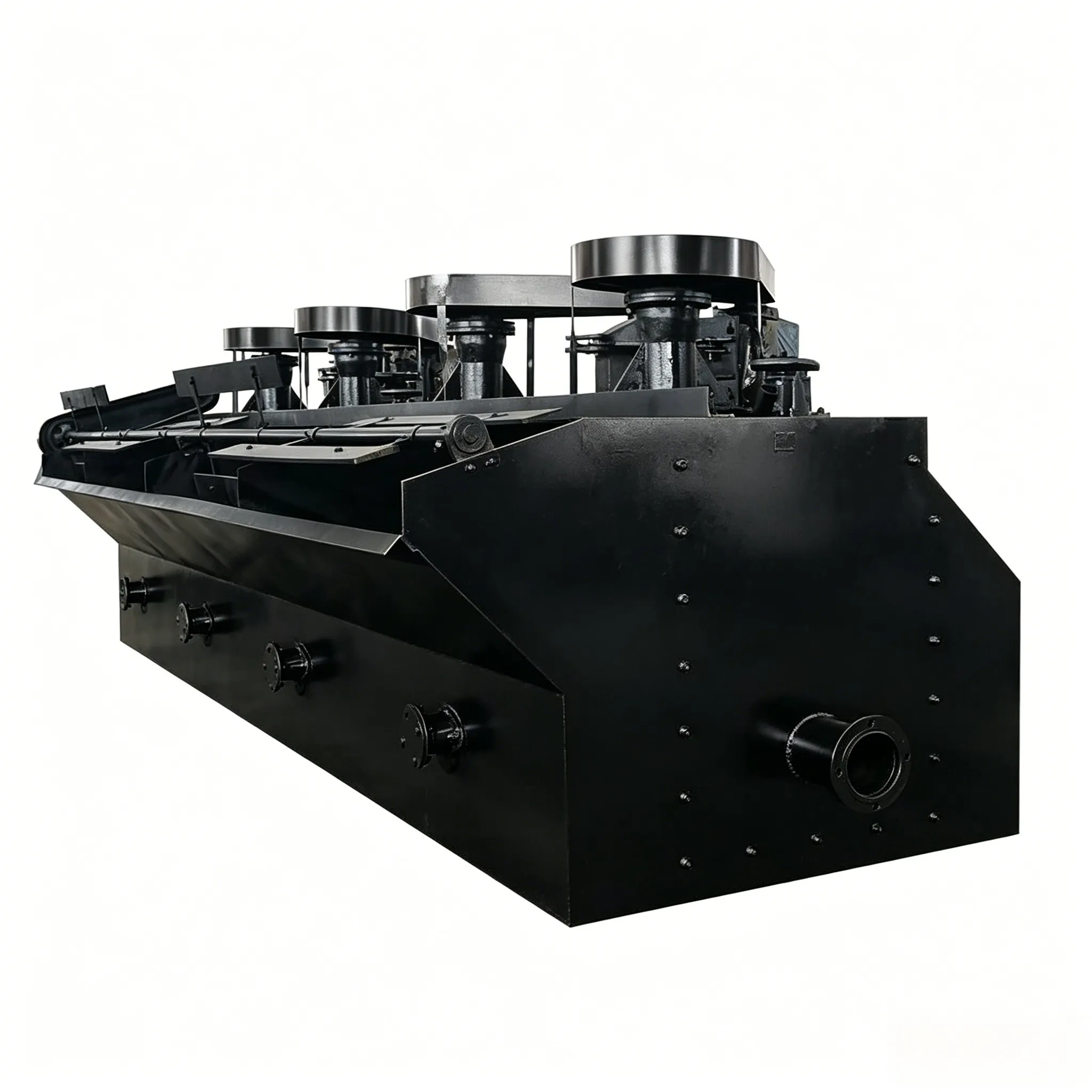
XJZ浮選機
XJZ型浮選機 には、何千台もの旧式のXJ型浮選機が……


Why Does Flotation Froth Fluctuate? Don’t Rush to Adjust Reagents—Find the Real Cause First
In the flotation operation of a mineral processing plant, fluctuating froth is a fairly common phenomenon. Sometimes the froth layer suddenly becomes thick, and sometimes it rapidly thins out; some flotation cells have abundant froth, while others appear sparse. Operators often react by immediately adjusting the dosage of collectors, frothers, or changing the air input.
However, changes in froth are not necessarily a reagent problem. Flotation froth is the result of the combined effects of pulp properties, aeration conditions, the reagent regime, and equipment status. If the cause is not accurately identified, blind adjustments may actually cause further fluctuations in production indices.
1. First, Distinguish: Higher Froth Does Not Mean Better Flotation Performance
Froth height is affected by multiple factors, including air input, pulp level, frother dosage, pulp properties, and froth discharge conditions.
For example, after the air input is increased, the froth may become abundant; however, if there are too many bubbles, the bubbles are too large, or the froth layer is overly stable, it is not necessarily beneficial to the concentrate grade and recovery rate.
Similarly, a thinner froth layer does not necessarily mean insufficient reagents. A drop in pulp level, abnormal aeration, or changes in ore properties can all cause similar phenomena.
Therefore, one cannot judge whether flotation is good or bad simply by the froth height; a comprehensive analysis must also be made in combination with froth color, bubble size, viscosity, degree of mineralization, as well as concentrate grade and recovery rate.
2. Why Does Froth Suddenly Change?
1. Changes in pulp level.
Changes in liquid level directly affect the formation and discharge of the froth layer. When the level is too low, the froth layer may become thin; when the level is too high, the froth may increase, and there may even be a risk of overflowing the cell (froth overflow).
If the level control is unstable, it is necessary to check whether the level detection is accurate, whether the control valve or actuator is functioning properly, and whether the upstream and downstream pulp flow rates have changed.
2. Unstable air input.
Air input affects the number and distribution of bubbles. When aeration is insufficient, the number of bubbles may decrease; when aeration is too high or unevenly distributed, it may also lead to abnormal froth conditions.
At this time, the air valves, supply pressure, pipeline blockages, and aeration devices should be checked, rather than directly increasing the frother dosage.
3. Changes in the reagent regime.
Collectors affect the hydrophobicity of mineral surfaces, while frothers affect bubble formation and froth stability. Changes in reagent dosage, concentration, or addition points may all affect the froth state.
However, the reagent effect is also related to ore properties, pulp pH, grinding fineness, and reagent preparation conditions. One cannot judge which reagent to increase based solely on froth height.
4. Unstable upstream grinding and classification.
If grinding fineness, pulp density, or classification performance changes, the mineral particle size composition and pulp properties entering the flotation will also change accordingly, further affecting mineral attachment to bubbles, froth mineralization, and concentrate quality.
Therefore, abnormal flotation froth sometimes requires tracing back to the grinding and classification stage, rather than just focusing on the flotation cell itself.
3. In What Order Should On-Site Troubleshooting Be Conducted for Fluctuating Froth?
The following sequence is recommended:
First, observe in which flotation cell the anomaly occurs—whether it is an anomaly in a single cell or simultaneous changes in multiple cells.
Second, check key parameters such as liquid level, air input, pulp flow rate, and pH to confirm whether there are obvious fluctuations.
Third, verify the reagent dosage, reagent concentration, and the operating status of the reagent dosing equipment to rule out interruptions in reagent addition or metering abnormalities.
Fourth, check upstream parameters such as grinding fineness, classification pressure, and pulp density to determine whether the anomaly is transmitted from the preceding process.
Fifth, compare the froth state with changes in concentrate grade, tailings grade, and recovery rate to avoid making judgments based solely on appearance.
The key is to identify the parameter that first showed an anomaly before the froth changed. This parameter is often more helpful in locating the cause than the froth itself.
4. How Can Automation Systems Help Stabilize Flotation Froth?
Flotation automation should not remain at the level of liquid level display, equipment start/stop, and alarms; it should also reasonably monitor and control variables such as liquid level, air input, pulp flow rate, pH, and reagent dosage based on on-site conditions.
For example, the pulp level can be stabilized through level detection and control loops, the reagent dosage can be controlled through flow meters and control valves, and trend recording and abnormal alarms can be set for key parameters.
Furthermore, froth image recognition, online analytical instruments, and assay data can be combined to assist in judging the froth state and process changes. However, image recognition cannot be directly equated with concentrate grade detection, and specific control strategies still need to be verified in combination with ore properties, equipment characteristics, and production data.
Truly effective automation is not about making the system automatically add reagents as soon as it sees the froth thinning, but rather first determining the cause of the anomaly, and then deciding which variable should be adjusted, by how much, and whether manual intervention is needed.
 English English
 Spanish
 Russian
 Arabic
 Swahili
 French
 Turkish
 Portuguese
 Korean
 Japanese
 German
 Italian