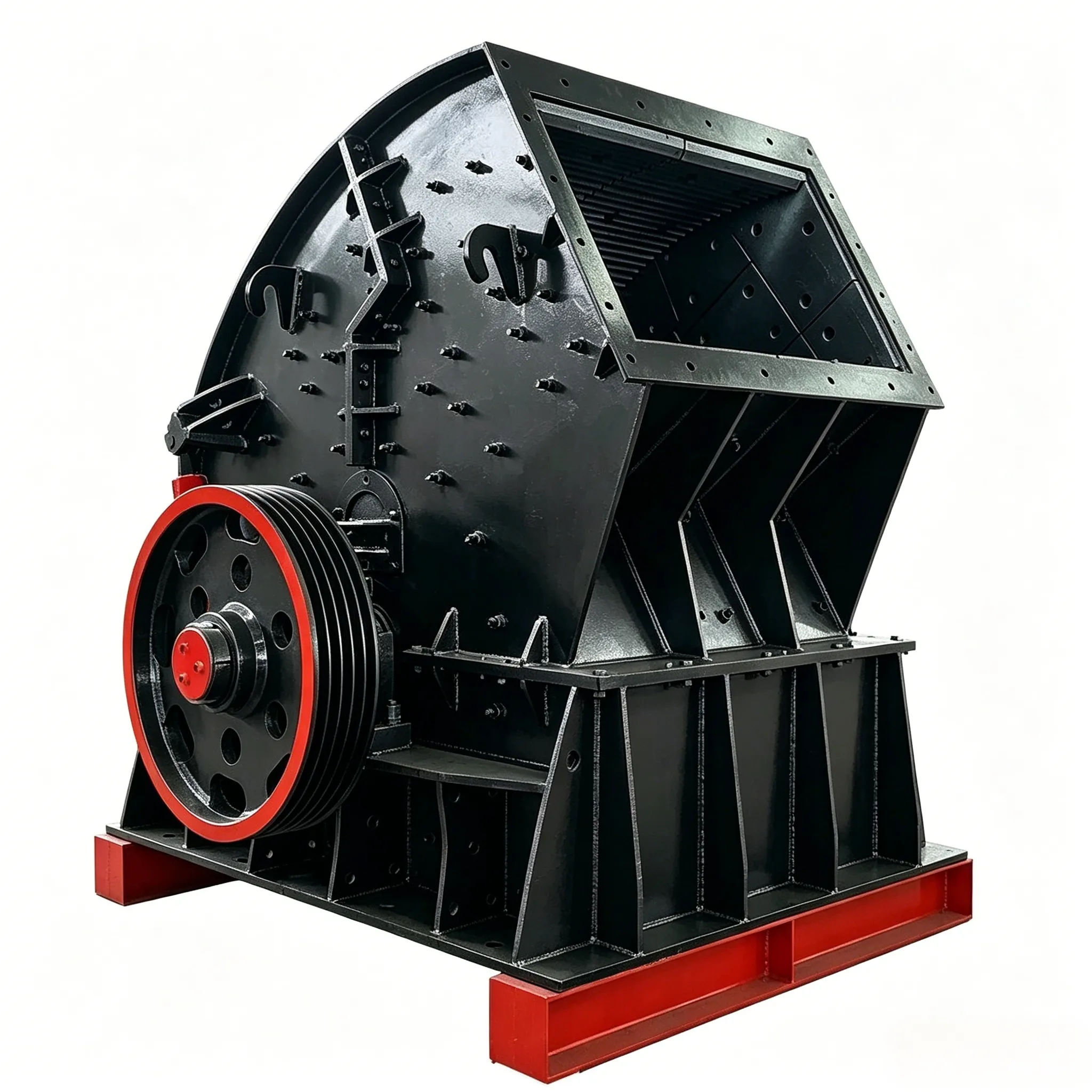
해머 크러셔
해머 크러셔의 종류 1924년 처음 도입된 이래, 해머 크러셔는…

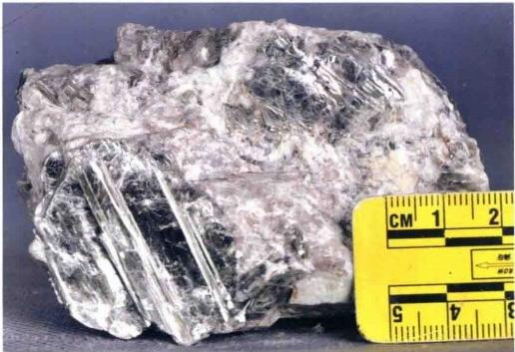
RE1‑B01
Muscovite.
The main ore mineral is muscovite, with a content of about 25%; the associated ore mineral is beryl, with a content of 3%–5%; the gangue minerals include plagioclase, quartz, etc., totalling about 70%.
Muscovite belongs to the monoclinic system and occurs as flaky crystals. It is pale grey, with a vitreous lustre and a pearly lustre on cleavage surfaces. Cleavage {001} is perfect, while {110} and {010} are imperfect. Thin flakes are elastic. Its hardness is 2–3 on the (001) face and 4 perpendicular to (001). Its density ranges from 2.76 to 3.10 g/cm³. It has excellent insulating properties and is insoluble in acids.
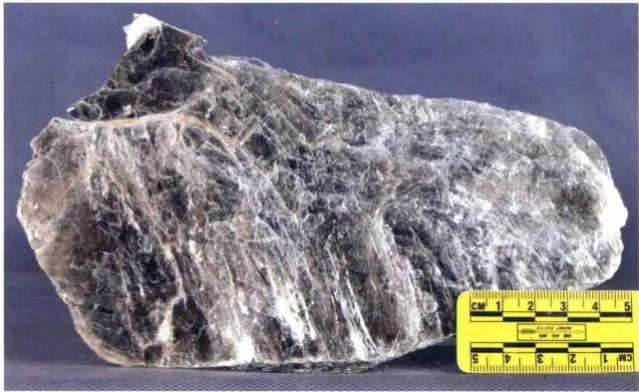
RE1‑B02
Muscovite.
The ore consists entirely of muscovite. It belongs to the monoclinic system and occurs as flaky crystals. It is pale green in colour, with a vitreous lustre and a pearly lustre on cleavage surfaces. Cleavage {001} is perfect, while {110} and {010} are imperfect. Thin flakes are elastic. Its hardness is 2–3 on the (001) face and 4 perpendicular to (001). Its density ranges from 2.76 to 3.10 g/cm³. It has excellent insulating properties and is insoluble in acids.
The specimen is produced in the muscovite‑quartz zone of the No. 3 pegmatite vein at Keketuohai.

RE1‑B03
Muscovite.
The ore consists entirely of muscovite. It belongs to the monoclinic system and occurs as flaky crystals. It is greyish‑white in colour, with a vitreous lustre and a pearly lustre on cleavage surfaces. Cleavage {001} is perfect, while {110} and {010} are imperfect. Thin flakes are elastic. Its hardness is 2–3 on the (001) face and 4 perpendicular to (001). Its density ranges from 2.76 to 3.10 g/cm³. It has excellent insulating properties and is insoluble in acids.
RE1‑B04
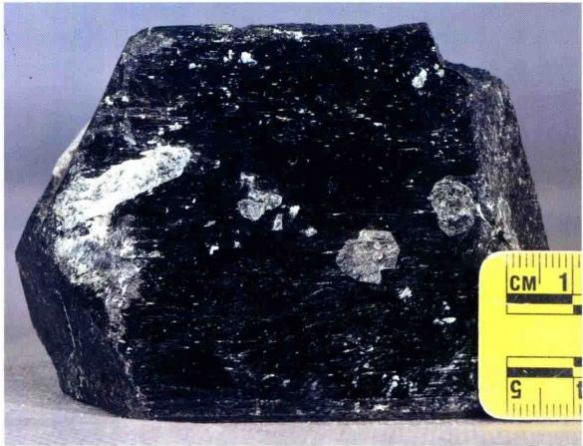
Tourmaline (tourmaline single crystal).
The tourmaline is black in colour, with a vitreous lustre and a hardness greater than that of a knife. It belongs to the trigonal system and exhibits a high degree of euhedralism. The crystals occur as trigonal prisms, with prism heights up to 9 cm and prism face widths of 6 cm; the three prism faces are equal in width. At both the top and bottom ends of the prism, three triangular faces are developed, intersecting at angles of 120° each. Vertical striations are well developed on the prism faces.
RE1‑B05
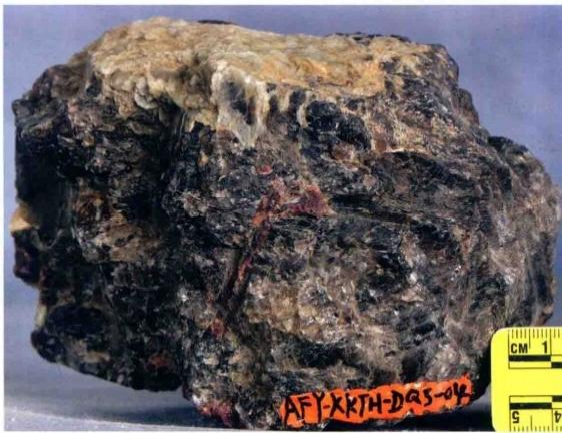
Albite‑tourmaline‑quartz pegmatite.
The rock is brownish‑grey with a slight purplish tint, with a microcrystalline texture and a massive structure. The main mineral is quartz, followed by tourmaline and albite, with minor muscovite.
RE1‑B06
Albite‑tourmaline‑quartz pegmatite.
The rock is pale greyish‑white to green in colour, with a pegmatitic texture and a massive structure. The main mineral is quartz, followed by tourmaline, with minor muscovite.

RE1‑B07
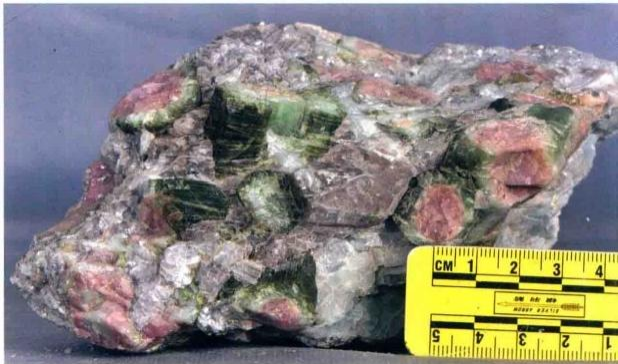
Feldspar‑mica‑elbaite pegmatite.
The rock is yellowish‑white, pink, and pale green in a mottled pattern, with a pegmatitic texture and a massive structure. The main minerals are feldspar, tourmaline, quartz, and minor muscovite.
RE1‑B08
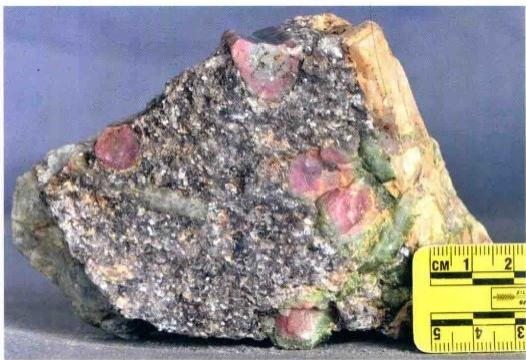
Tourmaline‑bearing pegmatite.
Pegmatitic texture, massive structure. The main minerals are feldspar, tourmaline, quartz, and minor muscovite. The elbaite (lithium tourmaline) content is relatively low, about 15%.
The colour distribution of the elbaite shows green rims (haloes) on the margins, with rose‑red cores in the centre. In addition, some crystals have a rose‑red crust (halo) with a pale bluish‑green core, as well as single‑coloured green or rose‑red tourmaline.
Muscovite and quartz aggregates are relatively fine‑grained, accounting for about 50%. Cleavelandite (leafy albite) content is about 20%, and microcline content is 10%–15%.
RE1‑B09
Tourmaline‑spodumene‑muscovite‑albite pegmatite.
The rock is greyish‑white to pale egg‑shell blue in colour, with a pegmatitic texture and a massive structure. The main mineral is cleavelandite (leafy albite), with minor quartz, muscovite, tourmaline, and spodumene.

RE1‑B10
K‑feldspar‑cleavelandite‑muscovite‑quartz‑tourmaline pegmatite.
The rock is yellowish‑white to black in a mottled pattern, with a pegmatitic texture and a massive structure. The minerals composing the pegmatite are all coarse to microcrystalline K‑feldspar, cleavelandite, muscovite, quartz, and tourmaline.
In the rock, cleavelandite can be seen cutting across schorl, indicating that albitisation post‑dates the tourmaline mineralisation stage.

RE1‑B11
Muscovite‑cleavelandite‑elbaite pegmatite.
The rock is milky‑white to pale egg‑shell blue and greyish‑green in colour, with a pegmatitic texture and a massive structure. The rock consists entirely of pegmatitic cleavelandite, tourmaline, and muscovite.
The rock can be broadly divided into two parts: one part is composed almost entirely of cleavelandite, containing very little tourmaline and muscovite; the other part consists mainly of elbaite and muscovite, with minor cleavelandite. The elbaite and muscovite are closely intergrown, occurring as coarse pegmatitic interlocking crystals. This bimodal distribution results from pegmatite zoning.

RE1‑B12
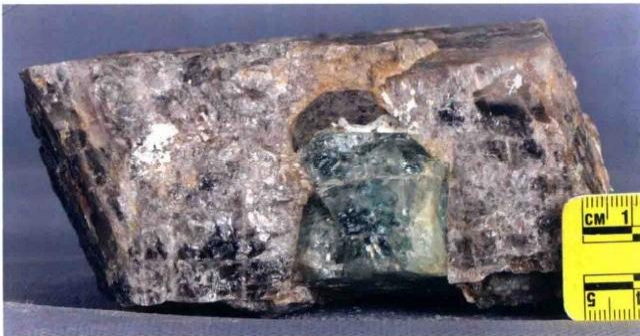
Aquamarine.
Aquamarine belongs to the beryl group in mineralogy and is a silicate of beryllium and aluminium. The crystals belong to the hexagonal system and occur as hexagonal prisms. Due to the presence of Fe²⁺, the specimen exhibits a pale blue colour. It has one set of imperfect cleavage parallel to {0001}. It shows a vitreous lustre and is translucent. Its hardness is 7.5–8, and its density ranges from 2.6 to 2.9 g/cm³. The main ore mineral is beryl, with a content of 3%–5%. The gangue minerals are mainly quartz, with minor garnet, totalling about 95%.

RE1‑B13
Aquamarine.
Aquamarine belongs to the beryl group in mineralogy and is a silicate of beryllium and aluminium. The crystals belong to the hexagonal system and occur as hexagonal prisms. Due to the presence of Fe²⁺, the specimen exhibits a pale blue colour. It has one set of imperfect cleavage parallel to {0001}. It shows a vitreous lustre and is translucent. Its hardness is 7.5–8, and its density ranges from 2.6 to 2.9 g/cm³. The main ore mineral is beryl, with a content of about 10%. The gangue minerals are mainly feldspar, quartz, and muscovite, totalling about 90%.
RE1‑B14
Biotite.
The crystals belong to the monoclinic system, and the aggregates occur as flakes. Due to the high content of ferric iron, the specimen exhibits a dark greenish‑black colour. It has a vitreous lustre and a pearly lustre on cleavage surfaces. Cleavage {001} is perfect. Thin flakes are elastic. Its hardness is 2–3, and its density ranges from 3.02 to 3.12 g/cm³. Its insulating properties are relatively poor. It is insoluble in acids.

RE1‑B15
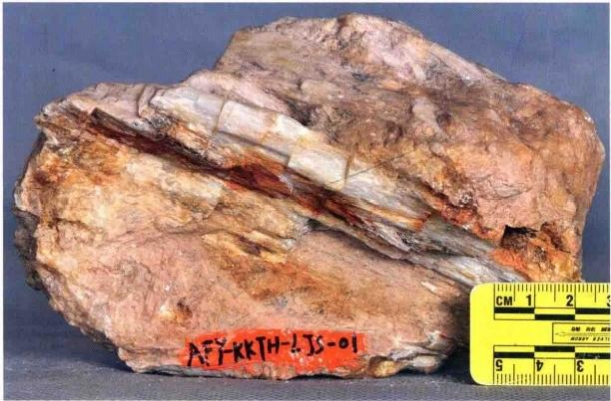
Kyanite.
The crystals belong to the triclinic system, and the individuals occur as parallel‑faced prismatic crystals. They are pale yellow in colour, with a vitreous lustre and a pearly lustre on cleavage surfaces. Cleavage {100} is perfect, {010} is moderate, and {001} is a parting. Hardness varies with direction: on (100), it is 4.5 parallel to the c‑axis and 6 perpendicular to the c‑axis; on (010) and (110) faces, it is 7 in the transverse direction. It is brittle. Density ranges from 3.53 to 3.65 g/cm³.
RE1‑B16
Kyanite.
The crystals belong to the triclinic system, and the individuals occur as parallel‑faced prismatic crystals, with aggregates showing a radial habit. They are pale blue in colour, with a vitreous lustre and a pearly lustre on cleavage surfaces. Cleavage {100} is perfect, {010} is moderate, and {001} is a parting. Hardness varies with direction: on (100), it is 4.5 parallel to the c‑axis and 6 perpendicular to the c‑axis; on (010) and (110) faces, it is 7 in the transverse direction. It is brittle. Density ranges from 3.53 to 3.65 g/cm³.

RE1‑B17
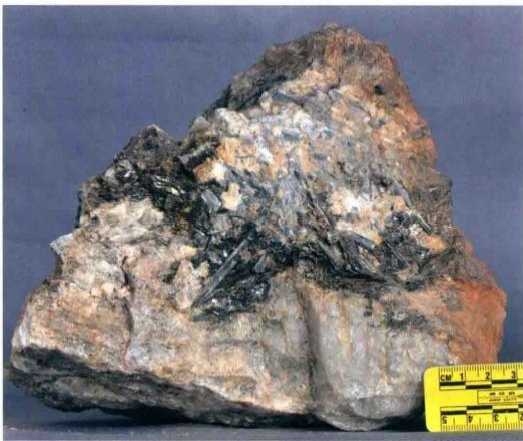
Kyanite.
The main ore mineral is kyanite, with a content of about 40%. The gangue minerals are mainly feldspar, quartz, and biotite, totalling about 60%.
The crystals belong to the triclinic system, and the individuals occur as parallel‑faced prismatic crystals, with aggregates showing a radial habit. They are pale blue in colour, with a vitreous lustre and a pearly lustre on cleavage surfaces. Cleavage {100} is perfect, {010} is moderate, and {001} is a parting. Hardness varies with direction: on (100), it is 4.5 parallel to the c‑axis and 6 perpendicular to the c‑axis; on (010) and (110) faces, it is 7 in the transverse direction. It is brittle. Density ranges from 3.53 to 3.65 g/cm³.
 English English
 Spanish
 Russian
 Arabic
 Swahili
 French
 Turkish
 Portuguese
 Korean
 Japanese
 German
 Italian