
Sarsma Masası
Sallama Masası – Yüksek Hassasiyetli Yerçekimi Konsantratörü Ürün Genel Bakışı Sallama masası (aynı zamanda…

1 PART
The reagent regime determines whether minerals can be effectively separated.
Key terms of the flotation reagent regime
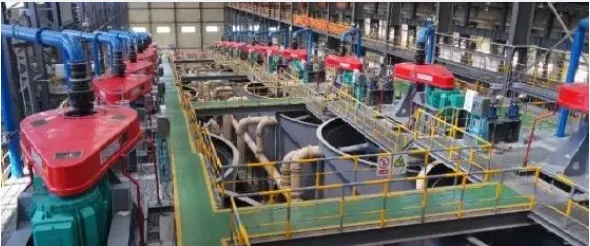
Flotation is not simply about floating minerals in the pulp to the surface; rather, it utilizes the differences in surface properties of different minerals to make the target minerals selectively attach to bubbles, and then achieves separation through the froth product. Different types of reagents serve different functions:
These reagents work together to jointly affect the flotation behavior of valuable minerals and gangue minerals.
If the reagent regime is unreasonable, even if the flotation machine is operating normally, problems such as insufficient flotation of valuable minerals or increased entrainment of gangue minerals may occur.
Therefore, the fundamental reason why the reagent regime affects concentrate grade lies in the fact that it changes the flotation selectivity of minerals, rather than merely changing the amount of froth.
02 PART
Does a higher collector dosage mean a higher concentrate grade?
When the collector dosage is insufficient, some target minerals may not obtain suitable hydrophobicity, making it difficult for them to effectively attach to bubbles, resulting in insufficient recovery of valuable minerals.
Appropriately increasing the collector dosage can sometimes improve the flotation performance of target minerals and increase recovery.
However, when the collector dosage exceeds the appropriate range, situations such as decreased selectivity and enhanced flotation of other minerals may occur. The specific impact depends on the mineral composition, reagent type, pulp chemical environment, and flotation flowsheet.
For example, in the flotation process of certain sulfide ores, if the collector regime is unreasonable, some minerals that should have remained in the tailings may also enter the froth product, causing a decrease in concentrate grade.
Here, two indicators need to be distinguished:
Increasing the collector dosage may increase recovery, but it does not necessarily increase concentrate grade. Actual production needs to find a suitable reagent regime based on product quality requirements and metal recovery targets.
03 PART
Why do frothers also affect concentrate grade?
Frothers mainly affect the formation and size of bubbles and the stability of the froth layer.
If the frother dosage is insufficient, the froth may not be stable enough, and some valuable minerals already attached to bubbles may find it difficult to enter the concentrate smoothly.
If the frother dosage is too high, the froth may be too stable, and drainage and gangue removal may be affected. Under certain conditions, fine gangue particles may also be entrained into the concentrate with the water flow, leading to a decrease in grade.
However, lower froth stability is not always better. Different ores, different flotation cells, and different operation stages may have different requirements for the froth layer.
Therefore, one cannot judge whether the reagent is appropriate simply by looking at whether the froth is high or whether the color looks good; a comprehensive analysis must also be made in combination with froth loading, pulp state, concentrate grade, and tailings loss.
04 PART
Why can regulators and depressants not be ignored?
In the flotation of polymetallic ores and complex ores, the floatability of different minerals may be relatively similar, making it difficult to achieve effective separation relying solely on collectors.
At this time, regulators and depressants become very important.
For example, changes in pulp pH may affect the surface properties of minerals and the effectiveness of reagents. Certain depressants can reduce the floatability of specific gangue minerals or associated minerals, reducing their chance of entering the concentrate.
If the pH deviates from the appropriate range, or if the depressant dosage is inappropriate, the separation effect between target minerals and non-target minerals may deteriorate.
In actual production, if the concentrate grade continues to decline, one should not blindly increase the collector or frother; one should also check the pulp pH, regulator regime, ore properties, and the state of the preceding grinding and classification stage.
The core of the reagent regime is selectivity, not simply increasing the reagent dosage.
05 PART
Why does the concentrate grade still fluctuate even when the reagent regime remains unchanged?
This is a problem frequently encountered in on-site production.
Keeping the reagent dosage constant does not mean that the conditions for reagent action remain the same. The following factors may all affect the final result.
1. Changes in raw ore properties
After changes in ore grade, mineral composition, degree of oxidation, and dissemination characteristics, the original reagent regime may no longer be suitable for the current ore.
2. Changes in the grinding and classification state
Changes in grinding fineness affect the degree of mineral liberation. When the target minerals are not yet fully liberated, it may be difficult to achieve effective separation even if the reagent regime remains unchanged.
3. Changes in pulp density and water quality
Changes in pulp density, solution ion composition, and water quality may alter the conditions for reagent action, thereby affecting the flotation results.
4. Deviation in the actual reagent dosage
Unstable reagent preparation concentration, degraded metering pump performance, pipeline blockage, or flow meter measurement deviation may all cause the actual dosage to be inconsistent with the set value.
5. Lack of coordination among flotation operations
The tasks of roughing, cleaning, and scavenging are different, and the reagent regimes should not be simply copied. If the pulp state of the preceding operation changes, the separation effect of the subsequent operation may also be affected.
Therefore, fluctuation in concentrate grade does not necessarily mean that too little reagent has been added. The correct approach is to first analyze the cause, and then decide whether to adjust the reagent regime.
06 PART
How can automation systems help stabilize the reagent regime?
For the reagent regime to be truly stable, the first priority is to ensure that reagents can be added accurately according to the set requirements; the second is to optimize it according to production conditions.
In automation upgrades, the following aspects can be prioritized.
First, monitor the actual reagent flow rate.
Install flow meters on suitable reagent pipelines, or adopt a calibrated metering pump control method, to monitor the actual dosage and reduce the problem of only displaying the pump’s start/stop status while being unable to confirm the actual reagent supply situation.
Second, establish stable metering control.
According to the reagent type and on-site conditions, control the dosage through metering pumps, control valves, or other applicable equipment. For production lines with large fluctuations in processing capacity, feed-forward regulation based on the feed rate can be considered, so that the reagent dosage changes reasonably with the ore processing capacity.
 English English
 Spanish
 Russian
 Arabic
 Swahili
 French
 Turkish
 Portuguese
 Korean
 Japanese
 German
 Italian