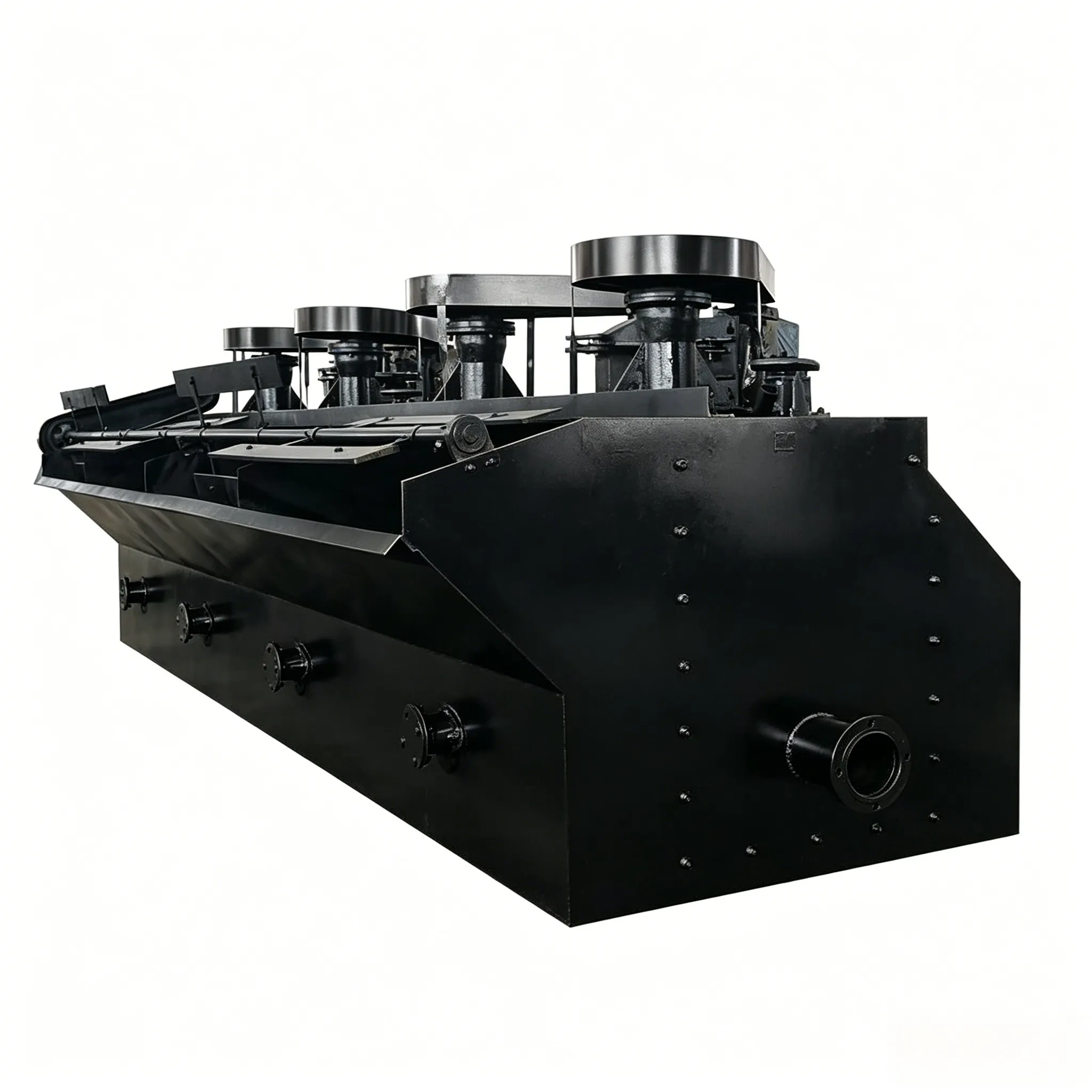
آلة التعويم XJZ
آلة التعويم XJZ: يوجد الآلاف من آلات التعويم من طراز XJ القديم في…

1. A beneficiation process for molybdenum‑tungsten oxide ore, تتميز بما يلي: the process comprises the following steps:
A. The raw material is molybdenum‑tungsten oxide ore, crushed to a fineness of 43–75% passing 200 mesh, with a mineral liberation degree of ≥70%;
B. Water glass, kerosene, 2# oil or sodium hexametaphosphate, copper sulfate, and butyl xanthate are used to float molybdenum sulfide from the molybdenum‑tungsten oxide ore, and the rough concentrate is cleaned to obtain a molybdenum sulfide concentrate;
C. The flotation tailings of the sulfide ore are classified at a classification size of 30–250 μm, with the coarse fraction entering a coarse sand roughing circuit and the fine fraction entering a slime roughing circuit;
D. In the sand‑slime system, sodium carbonate or sodium hydroxide or lime is used as a pulp modifier at a dosage of 300–2700 g/t of ore; water glass is used as a gangue depressant at a dosage of 500–2200 g/t of ore; a fatty acid is used as the collector, to which 1–10% of an anionic or non‑ionic surfactant is added, and emulsification is carried out at a temperature of 40–95°C for 2–18 hours, with a collector dosage of 120–470 g/t of ore; the rough concentrates obtained from coarse sand roughing and slime roughing are combined and fed into a cleaning circuit to obtain a molybdenum‑tungsten oxide mixed concentrate;
E. The obtained molybdenum‑tungsten oxide mixed concentrate is reground to a fineness of 65–95% passing 200 mesh, so that the molybdenum‑tungsten oxide minerals are liberated; a gangue depressant is added at a dosage of 50–350 g/t of ore; through cleaning, a secondary cleaned molybdenum‑tungsten mixed concentrate is obtained;
F. The obtained secondary cleaned molybdenum‑tungsten mixed concentrate is subjected to scheelite cleaning by the Petrov method, with the reagents and conditions of the Petrov method being: pulp density 35–65%; water glass dosage 6–30 kg/t; temperature 60–95°C; conditioning time 2–8 hours; dilution and de‑reagentization, then cleaning; the froth concentrate is scheelite, and the cleaning tailings are an oxidized molybdenum‑tungsten mixed concentrate, thereby achieving preliminary separation of the molybdenum‑tungsten oxide ore.
2. The beneficiation process for molybdenum‑tungsten oxide ore according to claim 1, تتميز بما يلي: in step A, the raw material is a quartz‑vein type ore formed by mesothermal fluids in a molybdenum‑tungsten oxide deposit, with a head grade of Mo 0.25–0.47% and WO₃ 0.11–0.25%.
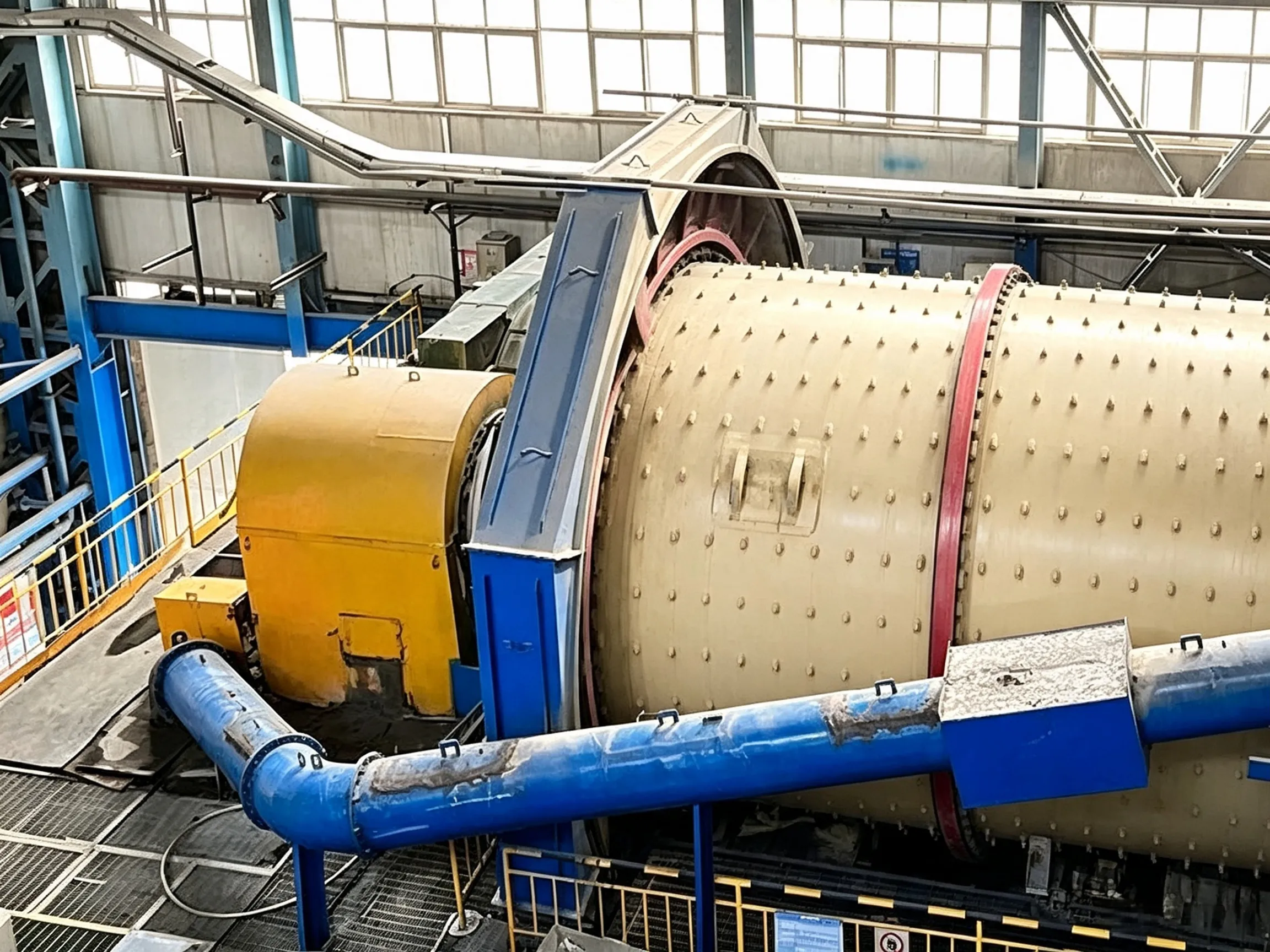
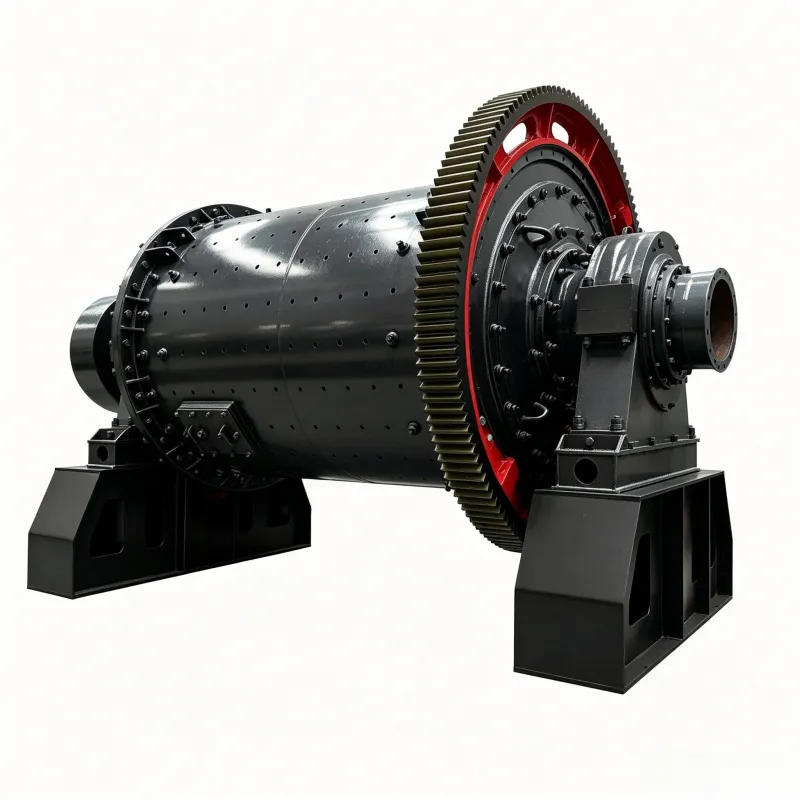
3. The beneficiation process for molybdenum‑tungsten oxide ore according to claim 1, تتميز بما يلي: in step A, conventional crushing and grinding equipment and processes with selective comminution characteristics are used to comminute the raw material, including jaw crushers, roll crushers or impact crushers, grate‑type or overflow‑type ball mills, and pre‑classification.
4. The beneficiation process for molybdenum‑tungsten oxide ore according to any one of claims 1, 2 or 3, تتميز بما يلي: in step C, classification is carried out using hydrocyclones, high‑frequency fine screens or spiral chutes.
5. The beneficiation process for molybdenum‑tungsten oxide ore according to any one of claims 1, 2 or 3, تتميز بما يلي: in step D, the water glass used as the gangue depressant is salified water glass or acidified water glass.
6. The beneficiation process for molybdenum‑tungsten oxide ore according to any one of claims 1, 2 or 3, تتميز بما يلي: in step D, the fatty acid collector is one or more of oleic acid, linoleic acid, and oxidized paraffin soap.
7. The beneficiation process for molybdenum‑tungsten oxide ore according to any one of claims 1, 2 or 3, تتميز بما يلي: in step E, the gangue depressant is one or more beneficiation reagents selected from water glass, sodium hexametaphosphate, sodium pyrophosphate, carboxymethyl cellulose, starch, and tannic acid.
عملية التخصيب لخام أكسيد الموليبدينوم-التنغستن
المجال التقني
The present invention relates to a beneficiation process, and in particular to a beneficiation process for molybdenum‑tungsten oxide ore.
الخلفية الفنية
Molybdenum and tungsten resources are advantageous mineral resources in China. China’s reserves, mining and processing volumes, and trade volumes of molybdenum and tungsten resources occupy an important position in the world for molybdenum, while for tungsten they rank first. In nature, molybdenum mainly exists in the form of sulfides such as molybdenite. Molybdenum sulfide minerals have good natural floatability and can be effectively utilized by conventional flotation processes. Generally, a molybdenum concentrate grade of ≥45% and a molybdenum recovery of ≥85% can be obtained; this product is directly sold as a primary molybdenum product. A small amount of molybdenum, however, exists in the form of oxide minerals such as molybdite, powellite, molybdenum‑tungsten calcium ore (scheelite‑powellite), wulfenite, etc. Molybdenum‑tungsten oxide ores have poor selectivity, low molybdenum concentrate grade and low molybdenum recovery, and cannot be recovered by conventional beneficiation processes. At present, China treats oxidized molybdenum ore resources as off‑balance ore that cannot be economically utilized.
Tungsten mainly occurs as wolframite and scheelite. As wolframite resources in China are now gradually being depleted, the development and utilization of scheelite resources are becoming increasingly important. Scheelite beneficiation technology has gradually matured in recent years. At present, the tungsten concentrate grade obtained is ≥65% and tungsten recovery is ≥70%. This concentrate is directly sold as a primary tungsten product. Scheelite often contains a certain amount of molybdenum, generally in the form of molybdenum sulfide, which can be separated by conventional flotation methods. However, tungsten resources containing molybdenum oxide are rarely utilized because of their small resource volume and processing difficulties. In the present invention, because molybdenum and tungsten are present in similar amounts in the ore and both occur as oxides, they act as mutual impurities during processing, and their chemical properties are very similar, making separation difficult by conventional molybdenum‑tungsten beneficiation methods.
Worldwide, oxidized molybdenum resources are scarce, and almost no independent oxidized molybdenum deposits exist. However, in China’s major molybdenum mining areas, a certain amount of oxidized molybdenum ore is present but has not been recovered due to difficulties in development and utilization. Abroad, only the former Soviet Union Mining Institute conducted mixed flotation test studies and industrial tests on sulfide and oxide ores, obtaining the following beneficiation technical indicators: molybdenum concentrate grade 7.8%; molybdenum recovery 45.7%. For iron molybdite, the concentrate grade and recovery were even lower, with a molybdenum concentrate grade of only 0.52% and a molybdenum recovery of 67.5%. Molybdenum‑tungsten oxide ores have not been industrially implemented due to high recovery costs and low technical and economic indicators. The US Climax Molybdenum Company and China’s Luanchuan Molybdenum Mine have only conducted preliminary beneficiation test studies on locally enriched oxidized molybdenum ores, but have not yet developed and utilized them.
ملخص الاختراع
The object of the present invention is to target a molybdenum‑tungsten oxide deposit in China, through research on new key beneficiation technologies, to determine a beneficiation process flow for treating this molybdenum‑tungsten oxide ore, and to achieve the following objectives:
The object of the present invention can be achieved through the following measures:
The process of the present invention is as follows:
1. A beneficiation process for molybdenum‑tungsten oxide ore, characterized in that the process comprises:
A. The raw material is molybdenum‑tungsten oxide ore, crushed to –200 mesh constituting 43–75%, with a mineral liberation degree of ≥70%;
B. Water glass, kerosene, 2# oil or sodium hexametaphosphate, copper sulfate, and butyl xanthate are used to float molybdenum sulfide from the molybdenum‑tungsten oxide ore, and the rough concentrate is cleaned to obtain a molybdenum sulfide concentrate;
C. The flotation tailings of the sulfide ore are classified, with a classification size of 30–250 μm, the coarse fraction entering a coarse sand roughing circuit, and the fine fraction entering a slime roughing circuit;
D. In the sand‑slime system, sodium carbonate or sodium hydroxide or lime is used as a pulp modifier at a dosage range of 300–2700 g/t of ore; water glass is used as a gangue depressant at a dosage range of 500–2200 g/t of ore; a fatty acid is used as the collector, to which 1–10% of an anionic or non‑ionic surfactant is added, and emulsification is carried out at a temperature of 40–95°C for 2–18 hours, with a collector dosage of 120–470 g/t of ore; the rough concentrates obtained from coarse sand roughing and slime roughing are combined and fed into a cleaning circuit to obtain a molybdenum‑tungsten oxide mixed concentrate;
E. The obtained molybdenum‑tungsten oxide mixed concentrate is reground to a fineness of –200 mesh constituting 65–95%, so that the molybdenum‑tungsten oxide minerals are liberated; a gangue depressant is added at a dosage of 50–350 g/t of ore; through cleaning, a secondary cleaned molybdenum‑tungsten mixed concentrate is obtained;
F. The obtained secondary cleaned molybdenum‑tungsten mixed concentrate is subjected to scheelite cleaning by the Petrov method, with the reagents and conditions of the Petrov method being: pulp density 35–65%; water glass dosage 6–30 kg/t; temperature 60–95°C; conditioning time 2–8 hours; dilution and de‑reagentization, then cleaning; the froth concentrate is scheelite, and the cleaning tailings are an oxidized molybdenum‑tungsten mixed concentrate, achieving preliminary separation of the molybdenum‑tungsten oxide ore.
In the present invention, in step A, the raw material is a quartz‑vein type ore formed by mesothermal fluids in a molybdenum‑tungsten oxide deposit, with a head grade of Mo 0.25‑0.47% and WO₃ 0.11‑0.25%. In step A, conventional crushing and grinding equipment and processes with selective comminution characteristics are used, such as jaw crushers, roll crushers or impact crushers, and grate‑type or overflow‑type ball mills with pre‑classification. In step C, classification is carried out using hydrocyclones, high‑frequency fine screens or spiral chutes. In step D, the water glass used as a gangue depressant is salified water glass or acidified water glass. In step D, the fatty acid collector is one or more of oleic acid, linoleic acid, and oxidized paraffin soap. In step E, the gangue depressant is one or more of water glass, sodium hexametaphosphate, sodium pyrophosphate, carboxymethyl cellulose, starch, and tannic acid.
By adopting the above process steps, the present invention has the following advantages:
The following are specific test results of the present invention at a certain mine:
Table 1 – Beneficiation test results for quartz‑vein type molybdenum‑tungsten oxide ore
| اسم المنتج | العائد (%) | Mo Grade (%) | W Grade (%) | Mo Recovery (%) | W Recovery (%) |
|---|---|---|---|---|---|
| Molybdenum sulfide concentrate | 0.15 | 45.61 | 1.71 | 16.29 | 1.60 |
| Oxidized Mo‑W concentrate | 2.26 | 12.88 | 5.67 | 69.31 | 80.08 |
| المخلفات | 97.59 | 0.062 | 0.030 | 14.40 | 18.32 |
| Feed ore | 100.00 | 0.42 | 0.16 | 100.00 | 100.00 |
The test results of the present invention show that the technical and economic indicators for molybdenum‑tungsten beneficiation from the ore have reached a relatively high level. Apart from the molybdenum sulfide concentrate, which can be directly sold as a commercial product in compliance with national standard GB‑3200‑82, the low‑grade oxidized molybdenum‑tungsten mixed concentrate with high mutual contents of tungsten and molybdenum cannot be directly sold as a product.
Table 2 – Cleaning test results for oxidized molybdenum‑tungsten concentrate
| اسم المنتج | العائد (%) | Mo Grade (%) | W Grade (%) | Mo Recovery (%) | W Recovery (%) |
|---|---|---|---|---|---|
| Scheelite concentrate | 3.41 | 0.46 | 66.71 | 0.13 | 37.54 |
| Oxidized Mo‑W concentrate | 45.63 | 22.84 | 5.13 | 83.91 | 38.63 |
| Cleaning middlings | 52.96 | 3.74 | 2.73 | 15.96 | 23.83 |
| الخلاصة | 100.00 | 12.42 | 6.06 | 100.00 | 100.00 |
The test results of the present invention show that the technical and economic indicators for cleaning the molybdenum‑tungsten rough concentrate are high. The scheelite concentrate can be directly sold as a commercial product in compliance with national standard GB‑2825‑81. The molybdenum‑tungsten mixed concentrate is further enriched, and although it cannot be directly sold as a product, the magnesium oxide and iron oxide contents in the concentrate are greatly reduced. The test results show that magnesium oxide decreased from originally ≥11% to <6%, and iron oxide from originally ≥2.5% to <0.75%, creating favorable conditions for subsequent metallurgical separation of molybdenum and tungsten.
وصف موجز للرسومات
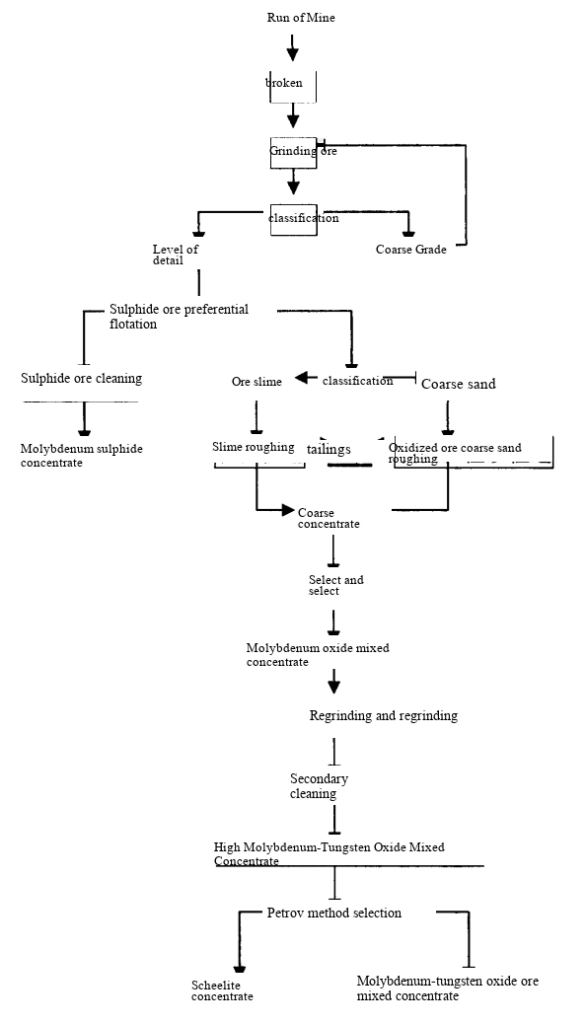
The accompanying drawing is a process flow diagram of the present invention.
وصف تفصيلي للنماذج التطبيقية
The present invention is described in detail below with reference to the accompanying drawings and examples.
المثال 1
The object of the present invention can be achieved through the following measures:
The process of the present invention is as follows:
A. The raw material is molybdenum‑tungsten oxide ore, crushed to –200 mesh constituting 43%, with a mineral liberation degree of ≥70%;
B. Water glass, kerosene, 2# oil or sodium hexametaphosphate, copper sulfate, and butyl xanthate are used to float molybdenum sulfide from the molybdenum‑tungsten oxide ore, and the rough concentrate is cleaned to obtain a molybdenum sulfide concentrate;
C. The flotation tailings of the sulfide ore are classified, with a classification size of 30 μm, the coarse fraction entering a coarse sand roughing circuit, and the fine fraction entering a slime roughing circuit;
D. In the sand‑slime system, sodium carbonate is used as the pulp modifier at a dosage of 300 g/t of ore; water glass is used as a gangue depressant at a dosage of 500 g/t of ore; a fatty acid is used as the collector, to which 1% of an anionic or non‑ionic surfactant is added, and emulsification is carried out at 40°C for 2 hours, with a collector dosage of 120 g/t of ore; the rough concentrates from coarse sand roughing and slime roughing are combined and fed into a cleaning circuit to obtain a molybdenum‑tungsten oxide mixed concentrate;
E. The obtained molybdenum‑tungsten oxide mixed concentrate is reground to a fineness of –200 mesh constituting 65%, so that the molybdenum‑tungsten oxide minerals are liberated; a gangue depressant is added at a dosage of 50 g/t of ore; through cleaning, a secondary cleaned molybdenum‑tungsten mixed concentrate is obtained;
F. The obtained secondary cleaned molybdenum‑tungsten mixed concentrate is subjected to scheelite cleaning by the Petrov method, with the reagents and conditions being: pulp density 35%; water glass dosage 6 kg/t; temperature 60°C; conditioning time 2 hours; dilution and de‑reagentization, then cleaning; the froth concentrate is scheelite, and the cleaning tailings are an oxidized molybdenum‑tungsten mixed concentrate, achieving preliminary separation of the molybdenum‑tungsten oxide ore.
In this example, in step A, the raw material is a quartz‑vein type ore from a mesothermal molybdenum‑tungsten oxide deposit, with a head grade of Mo 0.25% and WO₃ 0.11%. In step A, conventional crushing and grinding equipment and processes with selective comminution characteristics are used, such as jaw crushers, roll crushers or impact crushers, and grate‑type or overflow‑type ball mills with pre‑classification. In step C, classification is carried out using hydrocyclones, high‑frequency fine screens or spiral chutes. In step D, the water glass used as a gangue depressant is salified water glass or acidified water glass. In step D, the fatty acid collector is one or more of oleic acid, linoleic acid, and oxidized paraffin soap. In step E, the gangue depressant is one or more of water glass, sodium hexametaphosphate, sodium pyrophosphate, carboxymethyl cellulose, starch, and tannic acid.
المثال 2
The object of the present invention can be achieved through the following measures:
The process of the present invention is as follows:
A. The raw material is molybdenum‑tungsten oxide ore, crushed to –200 mesh constituting 49%, with a mineral liberation degree of ≥70%;
B. Water glass, kerosene, 2# oil or sodium hexametaphosphate, copper sulfate, and butyl xanthate are used to float molybdenum sulfide from the molybdenum‑tungsten oxide ore, and the rough concentrate is cleaned to obtain a molybdenum sulfide concentrate;
C. The flotation tailings of the sulfide ore are classified, with a classification size of 80 μm, the coarse fraction entering a coarse sand roughing circuit, and the fine fraction entering a slime roughing circuit;
D. In the sand‑slime system, sodium carbonate is used as the pulp modifier at a dosage of 400 g/t of ore; water glass is used as a gangue depressant at a dosage of 700 g/t of ore; a fatty acid is used as the collector, to which 2% of an anionic or non‑ionic surfactant is added, and emulsification is carried out at 50°C for 3 hours, with a collector dosage of 150 g/t of ore; the rough concentrates from coarse sand roughing and slime roughing are combined and fed into a cleaning circuit to obtain a molybdenum‑tungsten oxide mixed concentrate;
E. The obtained molybdenum‑tungsten oxide mixed concentrate is reground to a fineness of –200 mesh constituting 70%, so that the molybdenum‑tungsten oxide minerals are liberated; a gangue depressant is added at a dosage of 80 g/t of ore; through cleaning, a secondary cleaned molybdenum‑tungsten mixed concentrate is obtained;
F. The obtained secondary cleaned molybdenum‑tungsten mixed concentrate is subjected to scheelite cleaning by the Petrov method, with the reagents and conditions being: pulp density 40%; water glass dosage 10 kg/t; temperature 70°C; conditioning time 3 hours; dilution and de‑reagentization, then cleaning; the froth concentrate is scheelite, and the cleaning tailings are an oxidized molybdenum‑tungsten mixed concentrate, achieving preliminary separation of the molybdenum‑tungsten oxide ore.
In this example, in step A, the raw material is a quartz‑vein type ore with a head grade of Mo 0.29% and WO₃ 0.15%. The other equipment and conditions are the same as in Example 1.
المثال 3
The object of the present invention can be achieved through the following measures:
The process of the present invention is as follows:
A. The raw material is molybdenum‑tungsten oxide ore, crushed to –200 mesh constituting 53%, with a mineral liberation degree of ≥70%;
B. Water glass, kerosene, 2# oil or sodium hexametaphosphate, copper sulfate, and butyl xanthate are used to float molybdenum sulfide from the molybdenum‑tungsten oxide ore, and the rough concentrate is cleaned to obtain a molybdenum sulfide concentrate;
C. The flotation tailings of the sulfide ore are classified, with a classification size of 150 μm, the coarse fraction entering a coarse sand roughing circuit, and the fine fraction entering a slime roughing circuit;
D. In the sand‑slime system, sodium carbonate is used as the pulp modifier at a dosage of 1000 g/t of ore; water glass is used as a gangue depressant at a dosage of 1000 g/t of ore; a fatty acid is used as the collector, to which 5% of an anionic or non‑ionic surfactant is added, and emulsification is carried out at 65°C for 10 hours, with a collector dosage of 220 g/t of ore; the rough concentrates from coarse sand roughing and slime roughing are combined and fed into a cleaning circuit to obtain a molybdenum‑tungsten oxide mixed concentrate;
E. The obtained molybdenum‑tungsten oxide mixed concentrate is reground to a fineness of –200 mesh constituting 77%, so that the molybdenum‑tungsten oxide minerals are liberated; a gangue depressant is added at a dosage of 200 g/t of ore; through cleaning, a secondary cleaned molybdenum‑tungsten mixed concentrate is obtained;
F. The obtained secondary cleaned molybdenum‑tungsten mixed concentrate is subjected to scheelite cleaning by the Petrov method, with the reagents and conditions being: pulp density 53%; water glass dosage 20 kg/t; temperature 75°C; conditioning time 6 hours; dilution and de‑reagentization, then cleaning; the froth concentrate is scheelite, and the cleaning tailings are an oxidized molybdenum‑tungsten mixed concentrate, achieving preliminary separation of the molybdenum‑tungsten oxide ore.
In this example, in step A, the raw material is a quartz‑vein type ore with a head grade of Mo 0.337% and WO₃ 0.20%. The other equipment and conditions are the same as in Example 1.
المثال 4
The object of the present invention can be achieved through the following measures:
The process of the present invention is as follows:
A. The raw material is molybdenum‑tungsten oxide ore, crushed to –200 mesh constituting 70%, with a mineral liberation degree of ≥70%;
B. Water glass, kerosene, 2# oil or sodium hexametaphosphate, copper sulfate, and butyl xanthate are used to float molybdenum sulfide from the molybdenum‑tungsten oxide ore, and the rough concentrate is cleaned to obtain a molybdenum sulfide concentrate;
C. The flotation tailings of the sulfide ore are classified, with a classification size of 220 μm, the coarse fraction entering a coarse sand roughing circuit, and the fine fraction entering a slime roughing circuit;
D. In the sand‑slime system, sodium carbonate is used as the pulp modifier at a dosage of 2000 g/t of ore; water glass is used as a gangue depressant at a dosage of 1800 g/t of ore; a fatty acid is used as the collector, to which 8% of an anionic or non‑ionic surfactant is added, and emulsification is carried out at 90°C for 16 hours, with a collector dosage of 400 g/t of ore; the rough concentrates from coarse sand roughing and slime roughing are combined and fed into a cleaning circuit to obtain a molybdenum‑tungsten oxide mixed concentrate;
E. The obtained molybdenum‑tungsten oxide mixed concentrate is reground to a fineness of –200 mesh constituting 90%, so that the molybdenum‑tungsten oxide minerals are liberated; a gangue depressant is added at a dosage of 300 g/t of ore; through cleaning, a secondary cleaned molybdenum‑tungsten mixed concentrate is obtained;
F. The obtained secondary cleaned molybdenum‑tungsten mixed concentrate is subjected to scheelite cleaning by the Petrov method, with the reagents and conditions being: pulp density 60%; water glass dosage 28 kg/t; temperature 90°C; conditioning time 7 hours; dilution and de‑reagentization, then cleaning; the froth concentrate is scheelite, and the cleaning tailings are an oxidized molybdenum‑tungsten mixed concentrate, achieving preliminary separation of the molybdenum‑tungsten oxide ore.
In this example, in step A, the raw material is a quartz‑vein type ore with a head grade of Mo 0.40% and WO₃ 0.23%. The other equipment and conditions are the same as in Example 1.
Example 5
The object of the present invention can be achieved through the following measures:
The process of the present invention is as follows:
A. The raw material is molybdenum‑tungsten oxide ore, crushed to –200 mesh constituting 75%, with a mineral liberation degree of ≥70%;
B. Water glass, kerosene, 2# oil or sodium hexametaphosphate, copper sulfate, and butyl xanthate are used to float molybdenum sulfide from the molybdenum‑tungsten oxide ore, and the rough concentrate is cleaned to obtain a molybdenum sulfide concentrate;
C. The flotation tailings of the sulfide ore are classified, with a classification size of 250 μm, the coarse fraction entering a coarse sand roughing circuit, and the fine fraction entering a slime roughing circuit;
D. In the sand‑slime system, sodium carbonate is used as the pulp modifier at a dosage of 2700 g/t of ore; water glass is used as a gangue depressant at a dosage of 2200 g/t of ore; a fatty acid is used as the collector, to which 10% of an anionic or non‑ionic surfactant is added, and emulsification is carried out at 95°C for 18 hours, with a collector dosage of 470 g/t of ore; the rough concentrates from coarse sand roughing and slime roughing are combined and fed into a cleaning circuit to obtain a molybdenum‑tungsten oxide mixed concentrate;
E. The obtained molybdenum‑tungsten oxide mixed concentrate is reground to a fineness of –200 mesh constituting 95%, so that the molybdenum‑tungsten oxide minerals are liberated; a gangue depressant is added at a dosage of 350 g/t of ore; through cleaning, a secondary cleaned molybdenum‑tungsten mixed concentrate is obtained;
F. The obtained secondary cleaned molybdenum‑tungsten mixed concentrate is subjected to scheelite cleaning by the Petrov method, with the reagents and conditions being: pulp density 65%; water glass dosage 30 kg/t; temperature 95°C; conditioning time 8 hours; dilution and de‑reagentization, then cleaning; the froth concentrate is scheelite, and the cleaning tailings are an oxidized molybdenum‑tungsten mixed concentrate, achieving preliminary separation of the molybdenum‑tungsten oxide ore.
In this example, in step A, the raw material is a quartz‑vein type ore with a head grade of Mo 0.47% and WO₃ 0.25%. The other equipment and conditions are the same as in Example 1.
Example 6 – Beneficiation of quartz‑vein type molybdenum‑tungsten oxide ore
The ore had a head grade of Mo 0.42% and WO₃ 0.16%. The main oxidized molybdenum minerals in the ore were powellite, molybdenum‑tungsten calcium ore, and molybdite; tungsten mainly occurred as scheelite. Gangue minerals were mainly quartz, feldspar, calcite, fluorite, etc. The molybdenum and tungsten minerals were unevenly disseminated in the ore with coarse and fine particle sizes.
1 kg of the raw ore was crushed to 2 mm, mixed with water to a pulp density of 55%, and ground in a rod mill to a fineness of –200 mesh constituting 57%, with the mineral liberation degree of the target minerals reaching 90%. The pulp was added to a 3 L flotation cell, and reagents such as kerosene and 2# oil were added. After one roughing, three scavenging, and eight cleaning stages, a molybdenum sulfide concentrate was obtained. Then, to the molybdenum sulfide flotation tailings, reagents such as sodium carbonate, water glass, and emulsified fatty acid were added, and after one roughing, two scavenging, and three cleaning stages, an oxidized molybdenum‑tungsten mixed concentrate was obtained.
Example 7 – Cleaning of oxidized molybdenum‑tungsten concentrate and separation into scheelite concentrate and oxidized molybdenum‑tungsten mixed concentrate
500 g of oxidized molybdenum‑tungsten mixed concentrate (head grade Mo 12.42%, WO₃ 6.06%) was mixed with water to a pulp density of 55% and ground in a rod mill to a fineness of –200 mesh constituting 83%, at which point the target minerals were essentially liberated. The pulp was added to a 3 L flotation cell. Because the feed contained large amounts of acid‑consuming minerals such as calcite and iron‑bearing minerals, which would not only increase acid consumption but also greatly affect molybdenum precipitation, they had to be removed beforehand. Multiple cleaning stages with beneficiation reagents were used to remove these impurity minerals as much as possible. After cleaning, the magnesium oxide content in the feed decreased from 11.75% to 4.88%, and the iron oxide content decreased from 0.71% to 0.32%. The above concentrate was further cleaned by the Petrov method to obtain scheelite concentrate and oxidized molybdenum‑tungsten mixed concentrate.

 English English
 Spanish
 Russian
 Arabic
 Swahili
 French
 Turkish
 Portuguese
 Korean
 Japanese
 German
 Italian