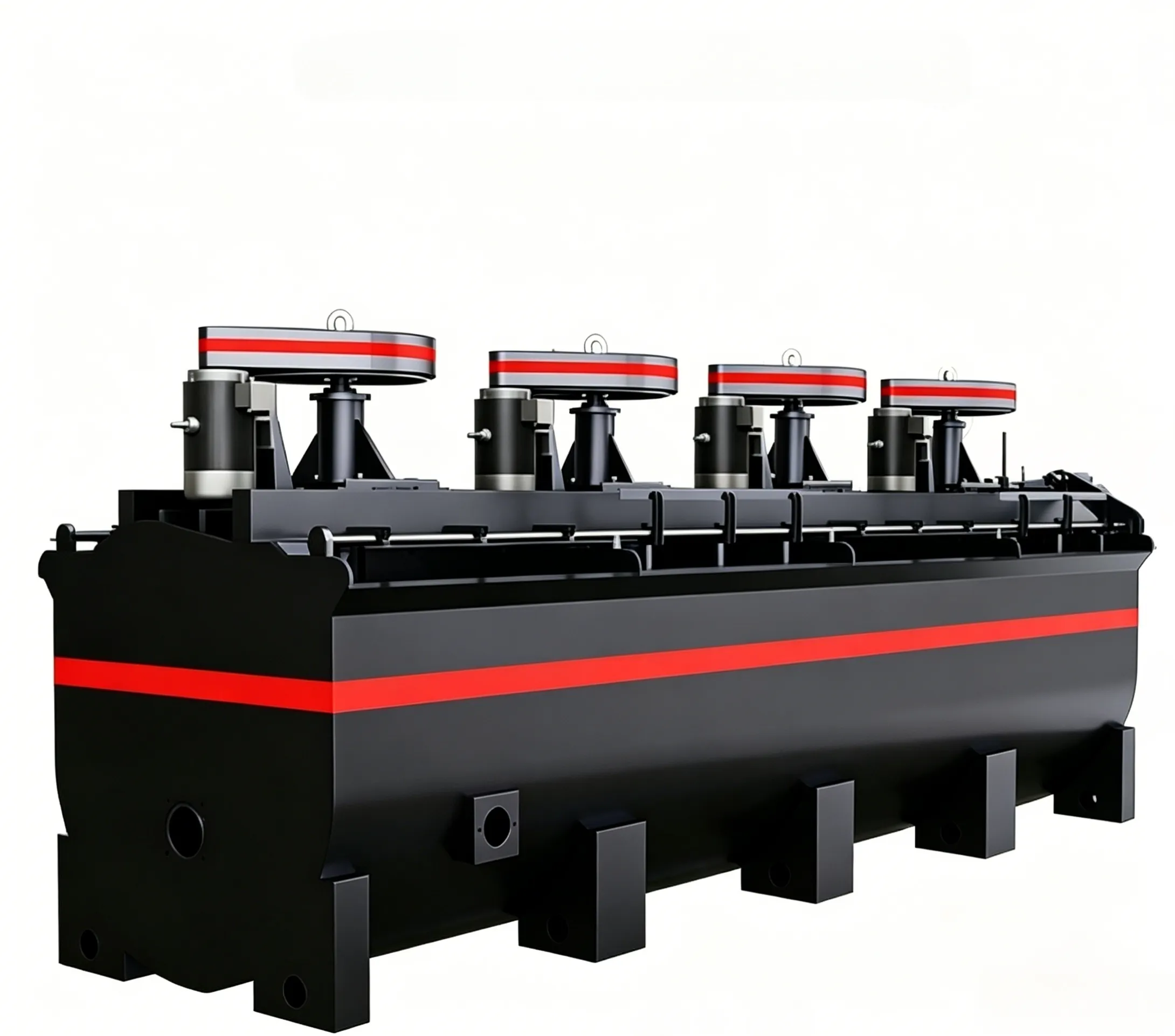
GF-Flotationsmaschine
GF-Flotationsmaschine Diese Flotationsmaschine ist für grobe Partikel ausgelegt und…


The vertical Trennmembran has poor classification capability, and the area near the diaphragm becomes a retention zone (or dead zone) for the grinding media, which restricts the impact and grinding action of the media. The inclined partition diaphragm, invented abroad, utilises the inclination of the diaphragm relative to the mill centreline to change the trajectory of the grinding media inside the mill, thereby overcoming the restraining effect of the vertical diaphragm on the media and improving the impact and grinding efficiency. However, this type of diaphragm has a weak classifying effect on the material, and during mill operation, material tends to migrate between the front and rear compartments, which is detrimental to the stability of the grinding condition inside the mill. Moreover, this inclined diaphragm exerts a pushing effect on the material, especially on the material in the rear compartment, which is unfavourable for fine grinding in mills of shorter length.
The semi‑inclined classifying diaphragm was designed to overcome the shortcomings of both the vertical and the fully inclined diaphragms. It eliminates the deficiencies of both the vertical and the inclined types, and achieves the effects of increasing production and saving energy.

The semi‑inclined diaphragm consists of a semi‑inclined grate plate and a semi‑inclined blind plate, with a discharge cone and a lifting plate fitted with a sieve screen installed between them. This type of diaphragm has the following characteristics:
(1) The movement of the grinding media inside the mill combines both longitudinal and transverse motions. The semi‑inclined diaphragm causes the working state of a portion of the grinding media to transition from cascading to cataracting, which can effectively eliminate the dead zone (retention zone) of the grinding media within the mill, increase the fluidity of the media, and thereby strengthen the impact and grinding action of the media, improving the mill’s grinding capacity.
(2) The diaphragm in this mill is a double‑layer classifying liner. After being screened by the semi‑inclined grate plate, the material enters the double‑layer diaphragm, where it is re‑classified by the lifting plate fitted with a sieve screen. The coarse particles are returned to the front compartment, while the fine particles enter the rear compartment, thus enhancing the mill’s grinding capacity.
An industrial trial was conducted in a certain plant using a Φ1.83 m × 8.046 m open‑circuit cement mill. After nearly one year of trial operation, positive results in terms of increased production and energy saving were achieved. The test data are presented in Table 2.7.
Table 2.7 Industrial trial data for the semi‑inclined classifying diaphragm
| Projekt | Before renovation | after renovation | |
| Mill condition | Mill specification (m) | 1.83 m×8.046m | φ1.83 m×8.046m |
| system process | open circuit | open circuit | |
| Motorleistung (kW) | 240 | 240 | |
| Grinding media loading capacity (t) | 23.0 | 22.7 | |
| Testbedingungen | Varieties of cement products | Ordinary Portland cement No. 425 | Ordinary Portland cement No. 425 |
| Ratio (%) of materials >25mm in the grinding feed | 18.1 | 49.4 | |
| Host voltage (V) | 6000 | 6000 | |
| Host current (A) | 26 | 22 | |
| Average output per machine hour (t/h) | 8.4 | 10.2 | |
| Finished product 0.08mm sieve residue (%) | 12.3 | 10.92 | |
| Power consumption per unit product (kW ·h/t) | 31.5 | 21.97 | |
| Comparison | Average output per machine hour ratio (%) | 100 | 121.43 |
| Power consumption ratio per unit product (%) | 100 | 69.75 | |
After adopting a semi-inclined partition plate, the output of a φ2.2 m×6.5m closed-circuit cement mill in a certain factory increased by 40%, while the power consumption decreased by 29%.

 English English
 Spanish
 Russian
 Arabic
 Swahili
 French
 Turkish
 Portuguese
 Korean
 Japanese
 German
 Italian