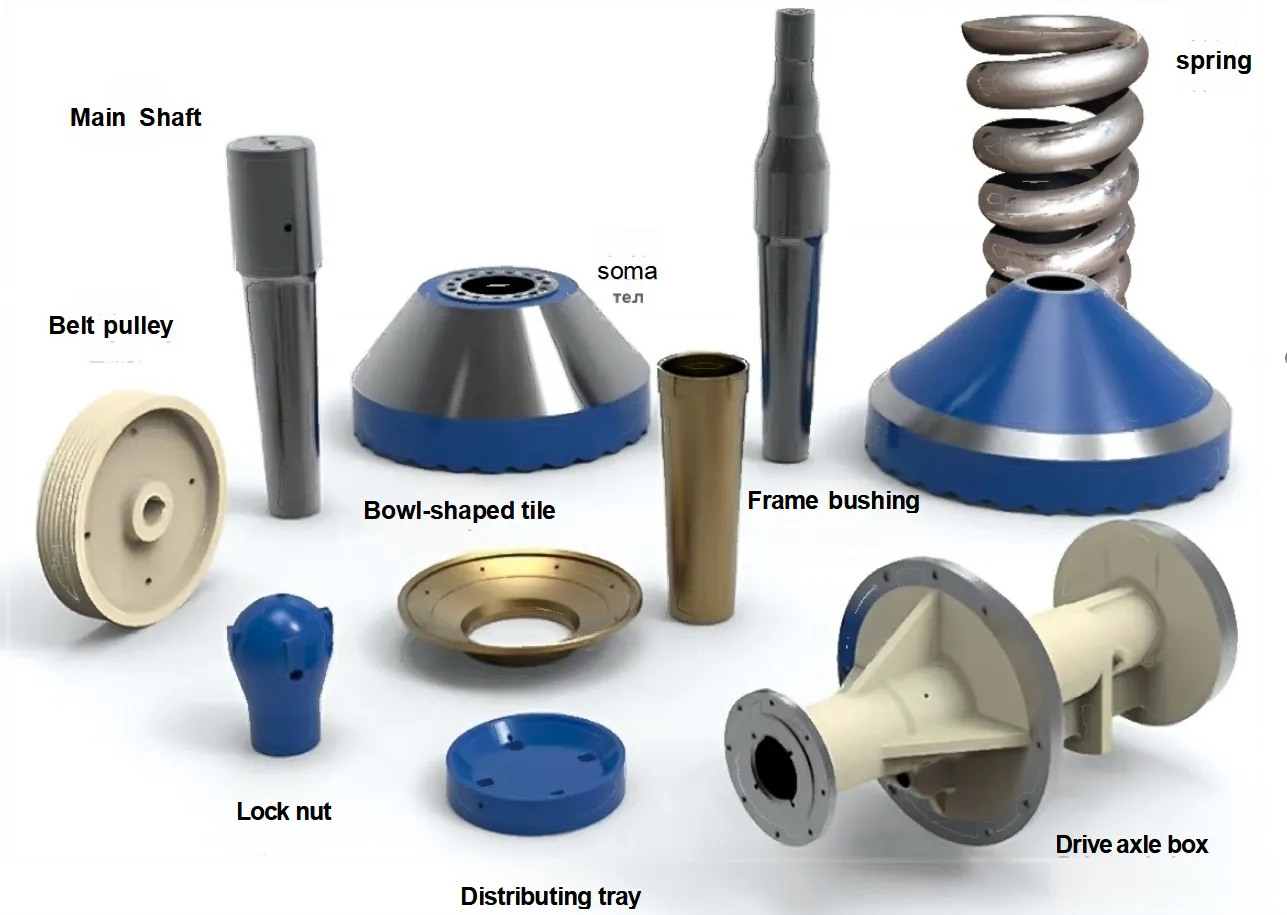
stone crusher spare part for famous brand
Oil Tank Gear wheel Adjusting ring Moving cone assembly Moving cone Socket Liner…

What to do if gold ore recovery rate is low?
Different types of gold ore beneficiation plants (oxidized ore, sulfide ore, placer gold deposits) face different problems and require different solutions.
First, determine: What type of oxidized gold ore does your beneficiation plant belong to?
→ Whole-sludge cyanidation carbon-in-pulp process → Biggest concern: Gold dissolves but isn’t captured. Sulfide gold ore → Flotation + flotation concentrate cyanidation → Biggest concern: Gold that should float doesn’t float. Placer gold ore → Primarily gravity separation → Biggest concern: Coarse gold particles are discharged with tailings. Once the problem is clearly identified, skip directly to the corresponding section. I. Oxidized Gold Ore Beneficiation Plant: Whole-sludge cyanidation carbon-in-pulp process Problem 1: Excessive gold content in lean liquor – Gold dissolves but isn’t captured. Phenomenon: Leaching rate is lower than the design value, but the cause cannot be found. Testing of the lean liquor reveals a gold concentration exceeding 0.03 g/m³. Cause: Activated carbon adsorption failure. Activated carbon has been used for more than three months; the active surface is covered by ore slime and organic matter, significantly reducing its adsorption capacity. Consequences: Gold has dissolved into the cyanide solution but hasn’t been captured by the activated carbon, and is discharged with the lean solution. This is the most hidden point of loss; the slurry is still flowing normally, but the gold has already quietly escaped. Self-inspection: Check the gold concentration in the lean solution every shift. If it exceeds 0.03 g/m³, immediately replace or regenerate the activated carbon. The normal gold concentration in the lean solution should be below 0.01 g/m³. Problem Two: Insufficient Sodium Cyanide Concentration – Insufficient Gold Dissolution Rate Phenomenon: The leaching rate is low, the concentrate grade is normal, but the gold content in the lean solution is not high, indicating that the problem lies in the dissolution stage rather than the adsorption stage. Cause: The amount of sodium cyanide added is based on experience, “adding when it feels enough,” without calculating the required amount according to the actual slurry concentration and gold surface area. The oxidation level of deep ore is reduced, requiring a higher sodium cyanide concentration to maintain the same dissolution rate. Consequences: The gold dissolution reaction is incomplete, and the gold grade in the tailings increases. Self-inspection: Compare the historical sodium cyanide consumption per unit volume with the same ore source and processing volume; a significant increase indicates insufficient concentration. Conduct small-scale tests promptly after mining deep ore to adjust the sodium cyanide concentration. Problem 3: Insufficient Leaching Time – Slurry Running Too Fast Symptoms: Increased slurry flow rate, or insufficient leaching tank level, resulting in shortened residence time. Causes: Under pressure, operators increase slurry flow rate; or equipment malfunction causes one leaching tank to be shut down, overloading the others. Consequences: Gold does not have enough time to complete the dissolution reaction, prematurely entering the next process, resulting in direct loss. Self-Check: Record the actual residence time of each leaching tank and compare it with the design value. Normal residence time should not be less than 24 hours. II. Sulfide Gold Ore Beneficiation Plant: Flotation Process Problem 1: Recovery Rate Difference of Over 5% Between Shifts – A Direct Signal of Unstable Operation Symptoms: In the same system, the recovery rate difference between the morning and afternoon shifts exceeds 5%, even 10%, and the equipment cause cannot be found. Causes: Manual addition of flotation reagents; different shift leaders’ habits lead to inconsistent reagent concentrations per shift, resulting in large fluctuations in collection efficiency. Consequences: Fluctuating daily recovery rate lowers the monthly average, reducing overall metal recovery efficiency. Self-inspection: Record the recovery rate and reagent usage for each shift for a week, identify the shift with the largest fluctuations, and focus on standardizing operating procedures. Problem 2: Continuously declining concentrate grade – increased gangue entrainment: The concentrate grade is decreasing, while the gold grade in the tailings is increasing. Cause: Unstable flotation liquid level control; too low a level leads to gangue entrainment, while too high a level prevents gold minerals from floating. Consequence: Unqualified concentrate grade, increased downstream processing costs, gold circulating in the beneficiation loop, and reduced recovery rate. Self-inspection: Install level gauges; if the concentrate grade fluctuation exceeds ±15% of the design value, check the liquid level first. Problem 3: Continuously rising tailings gold grade – declining flotation effect: The tailings gold grade climbs from 0.3 g/t to 0.6 g/t or even higher, mistakenly considered “normal fluctuation.” Cause: The ore properties have changed; mining has progressed to deeper areas, but the reagent regime and grinding parameters have not been adjusted. Consequence: Gold, encased in gangue, cannot be effectively liberated and floated, resulting in a systematic decrease in recovery rate. Self-inspection: Compare the trends of the grade of gold entering the mill and the gold grade of tailings monthly. If there is a continuous increase for three consecutive months, conduct a process review promptly. III. Placer Gold Concentration Plant: Gravity Separation Process Issue 1: Low Concentrate Grade, High Gangue Content – Unstable Feed Rate Phenomenon: The gravity separation concentrate grade is low, containing a large number of gangue particles, requiring secondary separation for processing. Cause: Fluctuating feed rate disrupts the water flow stratification in the jig and shaking table, causing coarse gangue and fine gold to enter the concentrate together. Consequence: Increased secondary separation process, higher concentrate processing costs, and some fine gold loss with gangue. Self-inspection: Check if feed rate fluctuations are within ±15% of the design value, and install feed rate instruments. Issue 2: Tailings Gold Loss – Poor Particle Size Control Phenomenon: Tailings gold grade is too high, and gravity separation recovery rate is lower than expected. Cause: If the grinding particle size is too coarse, individual gold particles are still encapsulated; if the particle size is too fine, slime is generated, affecting gravity separation. Consequence: Both coarse and fine gold are lost simultaneously, resulting in a decreased recovery rate. Self-inspection: Check for visible single gold particles in the gravity separation tailings to determine if the grinding particle size meets the liberation requirements. Summary: Quickly locate problems by ore type: Oxidized ore (carbon-in-pulp process) → Most common problems: activated carbon deactivation, insufficient cyanide concentration, insufficient leaching time → Core self-inspection: lean liquor gold concentration, sodium cyanide consumption, residence time; Sulfide ore (flotation) → Most common problems: operational fluctuations, unstable liquid level, parameter mismatch → Core self-inspection: recovery rate differences between shifts, concentrate grade trend, tailings gold grade trend; Placer gold ore (gravity separation) → Most common problems: unstable feed, particle size out of control → Core self-inspection: feed rate fluctuations, tailings gold grade, concentrate gangue content