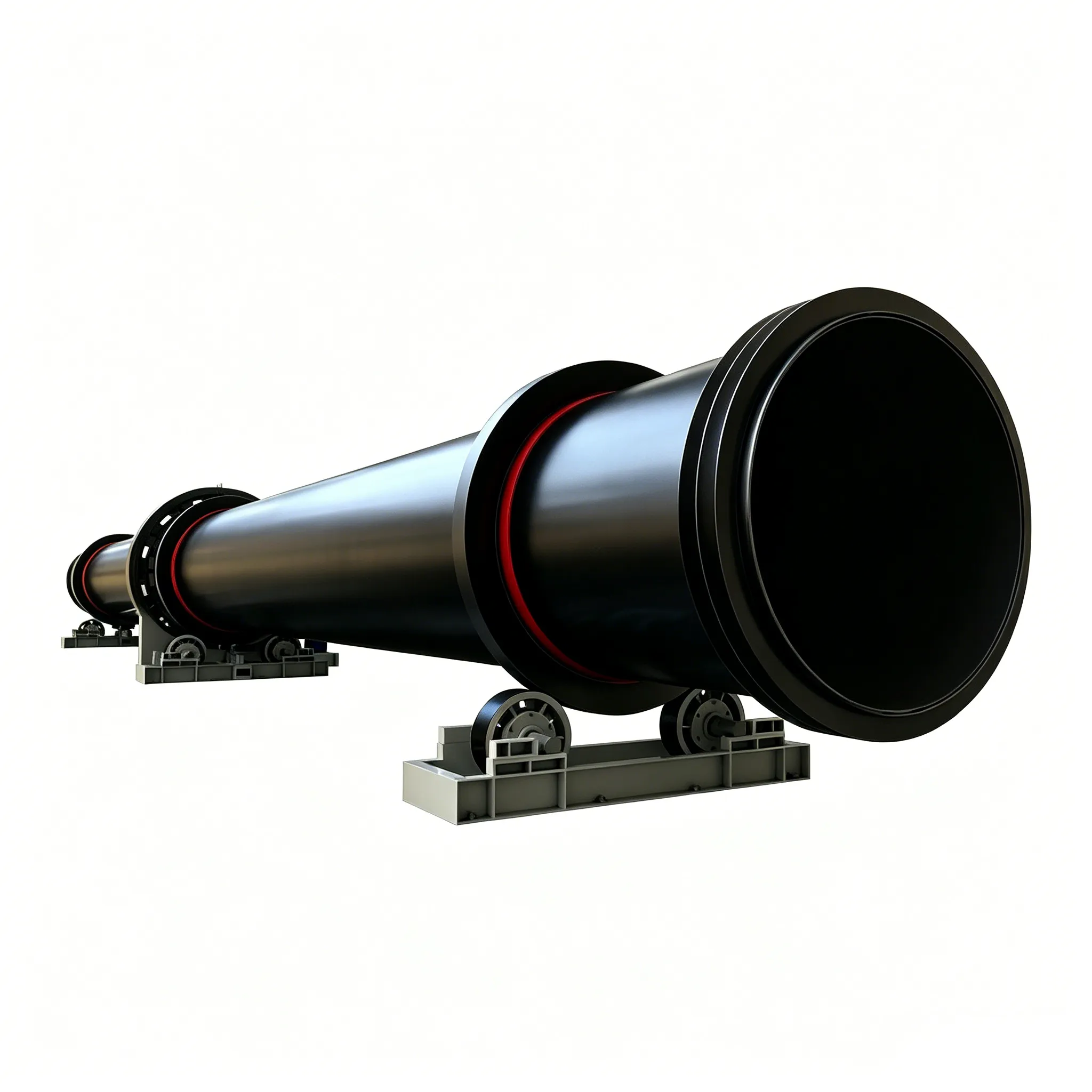
Forno rotativo
Panoramica del prodotto: Attrezzature fondamentali per la calcinazione industriale. Il forno rotativo è un…

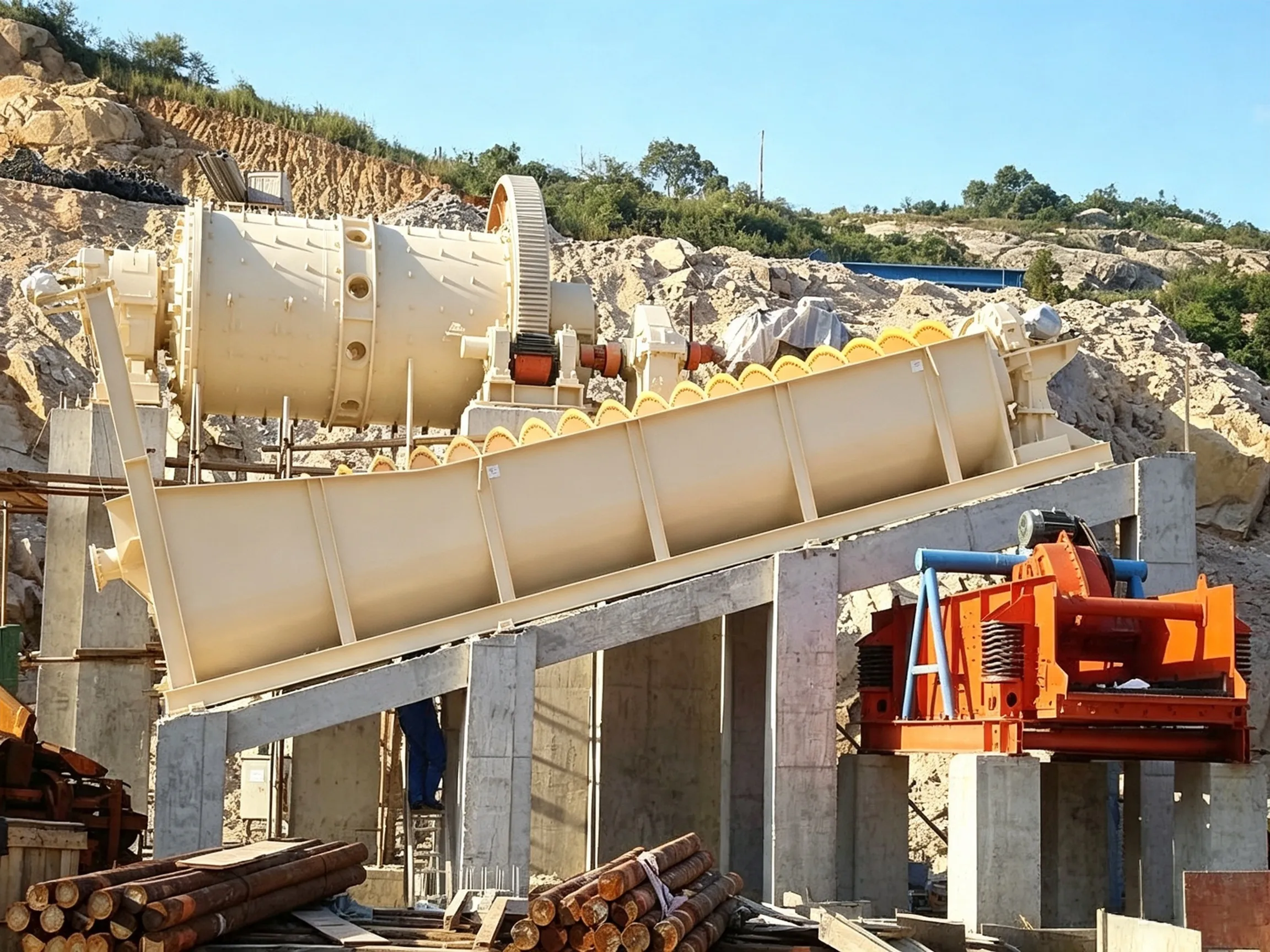
This invention relates to a beneficiation process for removing iron from feldspar, applicable to highly iron‑bearing and weathered feldspar ores, capable of producing a low‑iron feldspar concentrate with a Fe₂O₃ content of ≤0.15%.
Currently, the main beneficiation method for iron removal from feldspar both domestically and internationally is magnetic separation. An article published in Chemical Mining Technology (1996, No. 2, pp. 23–25) describes a dry magnetic separation process for feldspar iron removal at a site in Zhejiang Province. In that process, the ore is dry‑ground and classified, and the 0.833–0.053 mm size fraction is subjected to magnetic separation using a high‑intensity roller magnetic separator at a field strength of 1.5 T, which can reduce the Fe₂O₃ content from 0.8% to below 0.2%. However, in actual production, due to low drying and classification efficiencies, the Fe₂O₃ content in the obtained feldspar product typically ranges between 0.2% and 0.3%, thus compromising the quality of the feldspar. Especially when the raw ore has a high Fe₂O₃ content, e.g., above 1.5%, it is difficult to reduce the Fe₂O₃ content to below 0.2% using magnetic separation alone.
In some feldspar processing plants that employ reverse flotation for iron removal, a single collector—sodium oxidized paraffin soap—is generally used. This collector has weak collecting ability for coarse iron‑bearing minerals and their locked particles, and poor selective collecting ability for fine‑grained iron minerals. Therefore, it is not suitable for producing low‑iron feldspar products with a Fe₂O₃ content of ≤0.15% from high‑iron feldspar ores. When the raw feldspar ore contains more than 0.6% Fe₂O₃, the Fe₂O₃ content in the concentrate is always above 0.2%. The iron‑removal effect is particularly poor for severely weathered feldspar ores.
The objective of the present invention is to address the above‑mentioned problems in existing feldspar iron‑removal technologies by providing a novel beneficiation process suitable for iron removal from high‑iron, weathered feldspar ores, which can reduce the Fe₂O₃ content in the feldspar product to below 0.15%.
To achieve the above objective, the present invention adopts the following technical solution:
The raw feldspar ore is ground to liberate the iron minerals. A mixed emulsion of sodium petroleum sulfonate and fuel oil in a ratio of 1:0.1 to 1:3 is used as the collector for reverse flotation – rougher flotation. Then, a single sodium petroleum sulfonate is used as the collector for scavenging the rougher concentrate to obtain the final feldspar concentrate. The dosage of the collector mixture (sodium petroleum sulfonate + fuel oil) in the rougher stage is 2–5 kg/t, and the dosage of the single sodium petroleum sulfonate in the scavenger stage is 1/5 to 2/3 of that used in the rougher stage.
The fuel oil can be kerosene, diesel, or other fuel oils of similar properties, all of which are well known to those skilled in the art. The scavenging operation can be performed once or multiple times, depending on the desired product quality requirements. Furthermore, to further reduce the Fe₂O₃ content and upgrade the product quality, the feldspar concentrate obtained from the above process may be subjected to high‑intensity magnetic scavenging, with the magnetic field intensity adjustable between 0.8 and 1.8 T.
During the feldspar iron‑removal flotation process, the ratio of sodium petroleum sulfonate to fuel oil varies with the grinding fineness. When the grind is coarser, a higher ratio (i.e., less fuel oil) is used; when the grind is finer, increasing the proportion of fuel oil can significantly improve the separation efficiency for fine slimes without unduly sacrificing the feldspar concentrate recovery. The collector dosage can be adjusted according to the iron content of the raw ore and the product quality requirements. Higher iron content in the feed and lower iron content required in the product call for a larger collector dosage, and vice versa. In the scavenging stage, only sodium petroleum sulfonate is added to ensure smooth operation.
In the feldspar iron‑removal beneficiation process provided by the present invention, fuel oil is used in combination with the ionic collector—sodium petroleum sulfonate—as the iron mineral collector. This mixture forms a hydrophobic oil film on the surface of coarse iron mineral particles, thereby improving the floatability of coarse particles and locked aggregates. For fine slime particles, the oil droplets coated with collector ions with their polar groups oriented outward act as hydrophobic carriers, increasing the flotation rate and floatability of fine slime minerals. Hence, this process is suitable for iron removal from feldspar ores with high slime content and severe weathering.
The invention is further described below with reference to an example:
The raw feldspar ore was taken from a feldspar mine in Henan Province, which is a partially weathered pegmatite‑type feldspar deposit. The main minerals are: potassium feldspar 83%, quartz 15%, and iron‑bearing minerals (limonite, martite, biotite, and a small amount of pyrite) totaling about 2%. The raw ore contains K₂O 13.5%, Na₂O 0.2%, and Fe₂O₃ 1.5%. 500 g of the raw ore was ground at 65% solids to the particle size shown in Table 1, then diluted to 30–35% solids and subjected to one stage of roughing and one stage of scavenging by reverse flotation. The collector for the rougher stage was a 5% emulsion of sodium petroleum sulfonate and kerosene; the collector for the scavenger stage was a single sodium petroleum sulfonate emulsion at 5% concentration. Conditioning time was 5 minutes for the rougher and 2 minutes for the scavenger. Other flotation conditions and reagent regimes are listed in Table 1, and the test results are given in Table 2.
As can be seen from the results in Table 2, the process provided by the present invention, when applied to potassium feldspar iron removal, can reduce the Fe₂O₃ content in the concentrate product to below 0.15%.
Additional tests were carried out on the flotation concentrate (with 0.1% Fe₂O₃) by wet high‑intensity magnetic scavenging at a field strength of 1.0 T. A magnetic concentrate with a yield of 98.98% and a Fe₂O₃ content of 0.08% was obtained, further upgrading the product quality.
Comparative tests were also conducted on the same raw ore using single sodium petroleum sulfonate and single sodium oxidized paraffin soap as collectors in one‑rougher, one‑scavenger flowsheets. Under the premise that the feldspar concentrate yield was ≥75.00%, the Fe₂O₃ content in the feldspar concentrate obtained under all test conditions was greater than 0.2%.
Tabella 1 Potassium feldspar iron removal beneficiation process conditions
| Working conditions Example | Grinding particle size 0.074mm content(%) | Rough selection | sweep select | |||
| A/B | A+B dosage(kg/t) | t ₁(point) | A use quantity(kg/t) | t ₂(point) | ||
| 1 | 30 | 1:0.15 | 2.25 | 8 | 1.0 | 5 |
| 2 | 40 | 1:0.5 | 3.0 | 8 | 1.0 | 5 |
| 3 | 40 | 1:1 | 4.0 | 8 | 1.0 | 5 |
| 4 | 40 | 1:1.2 | 4.5 | 8 | 1.0 | 5 |
| 5 | 50 | 1:1.2 | 4.5 | 8 | 1.0 | 5 |
Tabella 1 middle A – Sodium petroleum sulfonate, B – Kerosene, t₁— Coarse selection time, t2: First scan selection time.
Tabella 2 Technical indicators obtained from potassium feldspar iron removal beneficiation process
| refer to Standard Example | concentrated ore yield (%) | Fe₂O content (%) in concentrate |
| 1 | 84.05 | 0.15 |
| 2 | 83.56 | 0.12 |
| 3 | 83.42 | 0.1 |
| 4 | 83.02 | 0.1 |
| 5 | 78.56 | 0.089 |
This invention only illustrates an example of iron removal from potassium feldspar; for iron removal from sodium feldspar, it can be… Using the same process, the same iron removal effect can be achieved.

 English English
 Spanish
 Russian
 Arabic
 Swahili
 French
 Turkish
 Portuguese
 Korean
 Japanese
 German
 Italian