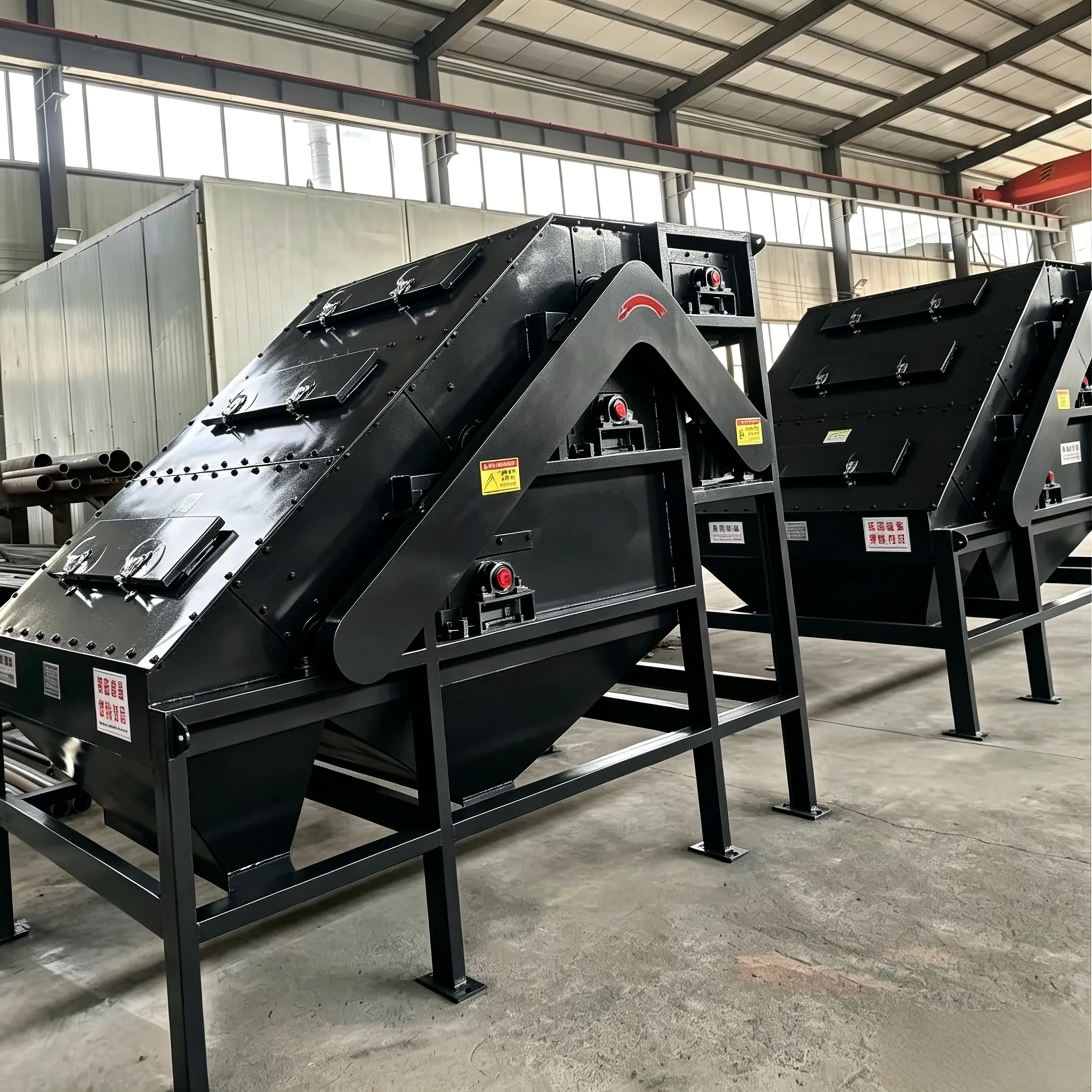
Separatore magnetico ad alto gradiente
Costruzione di un separatore magnetico ad alto gradiente. Il principio di separazione del separatore ad alto…


A mining dry separator is a mineral processing equipment that operates entirely without water during the separation process. It leverages differences in magnetic properties, density, atomic density, and other physical characteristics among various ore components to separate valuable minerals from waste rock (gangue) in air.
Compared with traditional wet beneficiation (water washing), the core advantages of dry separators are rooted in eliminating the need for water:
Mining dry separators are not a single device but a family of technologies. Based on separation principles, they fall into three main categories, each with distinct working mechanisms.
This is the most advanced and fastest‑growing type. Its working principle can be summarized as Eyes – Brain – Hands:
Typical equipment: TDS intelligent dry separator, ART intelligent dry separator, CXR series, JDS AI intelligent dry separator, etc.
This type combines multiple separation principles, mainly relying on the combined effect of vibration and airflow to stratify materials by density.
Equipment structure: Comprises a separating bed, vibrator, air chambers, frame and suspension devices, and collecting chutes. The separating bed is a right‑trapezoidal deck with air holes, back plates, grids, and discharge baffles. Multiple air chambers connected to centrifugal fans are arranged beneath the deck, each with air valves for airflow control.
Working process: Raw coal is fed onto the inclined deck. The bottom layer contacts the deck and, under vibratory inertial force, moves toward the back plate and overturns upward. The lighter top layer slides downhill under gravity and is peeled off by the discharge baffle as clean coal. Under vibration and material pressure, the material forms a spiral‑like motion. Simultaneously, upward airflow loosens the bed for density stratification and, together with fine coal particles, creates a gas‑solid suspension medium that further improves separation accuracy.
Typical equipment: FGX series compound dry separator, CZM series ultra‑fine coal dry separator, etc.
This is the most traditional type, using differences in the magnetic properties of minerals.
Working principle: A strong magnetic field (semicircular magnetic system) is built inside the drum. As material passes through the field, magnetic minerals (e.g., magnetite) are immediately attracted to the drum surface. The drum rotates, carrying the magnetic particles to the lower non‑magnetic zone, where they fall by gravity into the concentrate outlet. Non‑magnetic materials are unaffected by magnetic force and are thrown off by centrifugal and gravitational forces.
Magnetic material: The magnetic system uses high‑performance permanent magnets such as neodymium‑iron‑boron (NdFeB) and high‑quality ferrite, with surface magnetic induction intensity reaching 100–600 mT.
Typical equipment: Permanent magnet iron ore dry separator, GCX series dry magnetic separator, LCGX high‑frequency eddy‑current dry separator, etc.
| Tipo | Representative Equipment | Applicazione |
|---|---|---|
| Intelligent recognition | TDS, ART, CXR series | Large‑block coal pre‑deshaling, multi‑ore sorting |
| Compound dry | FGX, CZM series | Fine coal, steam coal, easily slaked coal |
| Magnetic dry | Permanent magnet drum, GCX series | Iron ore, magnetic minerals, iron removal |
– Dry low‑intensity magnetic separators
– Dry medium‑intensity magnetic separators
– Dry high‑intensity magnetic separators
– Dry high‑gradient magnetic separators
– Roughing (pre‑concentration for waste rejection)
– Cleaning (grade improvement)
– Scavenging (tailings recovery)
– Iron removal
– Vertical vs. horizontal
– Drum vs. roll types
Parameters vary widely among models. Here are the most critical indicators:
Typical cases:
Intelligent dry separators have moved from surface to underground integrated separation‑backfill systems, where separation is done in situ and gangue is directly used for backfilling, greatly reducing hoisting and surface disposal.
According to industry estimates, the global intelligent dry separator market for coal was ~CNY 93.5 billion in 2024, and is projected to reach ~CNY 212.1 billion by 2031, with a CAGR of 12.5%. By 2026, the penetration rate in China’s coal sector is expected to rise from currently <15% to over 30%, adding ~CNY 5 billion annually.
With increasing national emphasis on green mining, water conservation, and the “15th Five‑Year Plan” push for intelligent equipment, dry beneficiation is entering an unprecedented growth phase. The industry adage “Global dry separation looks to China, and China looks to Tangshan” is becoming a reality.
Mining dry separators – as a green, efficient, and intelligent beneficiation technology – are fundamentally transforming traditional mining. From conventional magnetic separation, through vibration‑airflow compound systems, to AI‑driven X‑ray recognition, dry separation now covers the entire particle size range from large boulders to micron‑scale fines. Against the backdrop of increasing water scarcity, tightening environmental regulations, and accelerating intelligent transformation, the future of mining dry separators is exceptionally bright.
 English English
 Spanish
 Russian
 Arabic
 Swahili
 French
 Turkish
 Portuguese
 Korean
 Japanese
 German
 Italian