Tipi e introduzione al minerale di niobio-tantalio
Tipi e introduzione al minerale di niobio-tantalio
27 giugno 2026
TaNb1‑B01 Metamorphosed quartz greywacke.
Yellowish‑brown metamorphosed quartz siltstone, with blastopsammitic texture and banded structure. The main mineral is quartz, which has high hardness. Most quartz has recrystallised, though some rounded granular quartz sand grains (grainsize <0.2 mm) are still visible, accounting for about 95% of the rock. The rock is metamorphosed from fine‑grained quartz sandstone.
Quartzite alternates with pale greyish‑green to yellowish‑brown argillaceous quartz fine sandstone, forming a banded structure.
The yellowish‑brown metamorphosed quartz siltstone – argillaceous siltstone exhibits a yellowish‑brown, very fine‑grained silty to crystalloblastic texture, with massive to faintly streaky structure. The rock is composed mainly of very fine‑grained quartz, with minor argillaceous material.
Felsic vein‑derived clots are present in the rock; minerals within these clots are relatively coarsely crystalline and consist of quartz, feldspar, and calcite. The rock at the margins of the clots shows obvious bleaching, and chloritisation alteration is observable. Weak pyritisation is generally developed throughout the specimen, occurring as very fine‑grained disseminated grains with a content of less than 1%.
TaNb1‑B02 Pegmatite.
The rock consists entirely of pegmatitic albite. It is white to milky‑white, with a vitreous lustre, translucent, and has a hardness greater than that of a knife. Within the feldspar, fine banded or lenticular perthite can be seen. It exhibits one set of very perfect cleavage, and along this cleavage, flaky feldspar is developed. Minor muscovite can be observed at the margins of the pegmatite.
Along the cleavage planes or fractures of the albite, fine veinlets and irregular small clots of dark minerals are visible. The dark minerals are black, occurring as fine to very fine‑grained aggregates, with a brown streak and a hardness greater than that of a knife. They are extremely unevenly distributed in the pegmatite, with an average content of 1%–2% in the specimen. Because the dark mineral grains are very fine, macroscopic identification is difficult. Based on preliminary observations of mineral colour, streak, hardness, and crystal form/grain size, they are tentatively identified as columbite‑tantalite.
TaNb1‑B03 Highly albitized lepidolite‑bearing granite (strongly albitized and lepidolitized granite).
This is an albitized and lepidolitized altered granite type Nb‑Ta ore. The rock is white to light greyish‑white, with a fine‑grained texture and disseminated structure. The main ore minerals are columbite‑tantalite, tantalum‑bearing cassiterite, and lepidolite.
Columbite‑tantalite: Black with brownish streak, fine granular to small aggregated grains, sparsely disseminated; content is trace.
Tantalum‑bearing cassiterite (mineral name as designated by the mining area): Waxy yellow, with greasy lustre, occurring as fine grains or small aggregates sparsely disseminated in the granite; content is trace.
Lepidolite (designated as lithian muscovite by the mining area): White, colourless and transparent, flaky, with flakes mostly 1‑2 mm in diameter; content about 5%.
The ore‑bearing rock is altered granite to alaskite. Gangue minerals include albite, quartz, topaz, and fluorite. The rock has a medium‑grained granoblastic texture and massive structure.
Albite: White to milky white, vitreous lustre, hardness greater than that of a knife blade; mostly irregular subhedral to anhedral tabular‑granular to granular, grain size generally 2‑5 mm; content about 50%.
Quartz: Colourless to light greyish‑white, greasy lustre, hardness greater than that of a knife blade; mostly anhedral granular, grain size mostly 1‑3 mm; content about 40%.
Topaz: Colourless and transparent, greasy lustre, hardness greater than that of a knife blade; shows bright green fluorescence under ultraviolet light; mostly anhedral granular, grain size 1‑2 mm; content about 2%.
Fluorite: Light purple to rose‑red, white streak, hardness less than that of a knife blade; content about 2%.
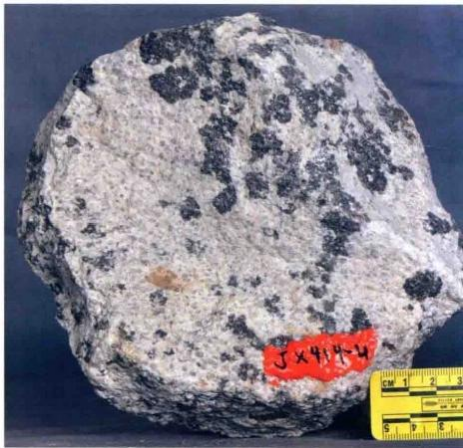
The ore is mottled, pale greyish‑white to pale yellowish‑white, with a very fine‑grained to glomerogranular texture and disseminated structure. The main ore minerals are columbite‑tantalite and tantalum‑bearing cassiterite.
Columbite‑tantalite: Black, with a brown streak. It occurs mostly as very fine‑grained aggregates, associated with fine flaky biotite and quartz, forming greyish‑black clustered spots. The columbite‑tantalite is concentrated within these spots. The spots range from about 5 mm to 3 cm in size and are unevenly distributed in the rock, with a total spot content of about 10%. Within the spots, the columbite‑tantalite content is approximately 10%, giving an overall columbite‑tantalite content of about 1% in the ore.
Tantalum‑bearing cassiterite: Waxy‑yellow to pale yellow, with a greasy lustre. It occurs as very fine‑grained to small clustered grains, unevenly disseminated in the granite, in trace amounts.
The host rock is altered granite. The gangue minerals are mainly quartz, followed by feldspar, with minor muscovite and biotite. The rock has a blastogranitic texture and a massive structure.
Quartz: Colourless, transparent, with a greasy lustre and a hardness greater than that of a knife. It occurs as anhedral rounded grains, uniformly distributed in the rock, with grain sizes of 1–2 mm, accounting for about 40%.
Feldspato: Two types are distinguished. One is yellowish to slightly reddish medium‑grained tabular‑prismatic K‑feldspar; the other is white to milky‑white anhedral granular albite. Their total content is about 50%, uniformly distributed.
Muscovite: White, fine flaky, with a content of less than 5%.
Biotite: Black, fine flaky, associated with the columbite‑tantalite spots, with a content of 1%–2%.
Topaz: Colourless, transparent, with a greasy lustre and high hardness. It shows bright green fluorescence under ultraviolet light. It occurs as anhedral granular grains about 1 mm in size, with a content of about 2%.
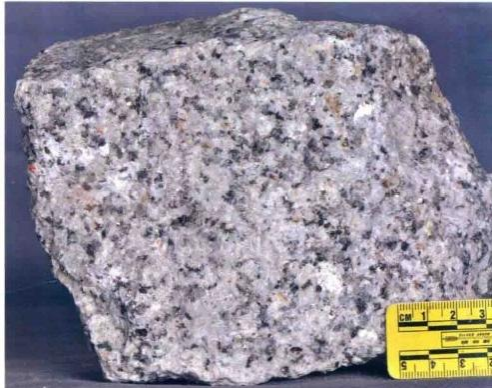
The rock is pale greyish‑white, with a medium‑grained granitic texture and a massive structure. The main minerals are quartz and albite, with minor muscovite and trace columbite‑tantalite.
Quartz: Colourless, transparent, with a greasy lustre and a hardness greater than that of a knife. It occurs mostly as anhedral rounded grains, uniformly distributed, with grain sizes of 1–3 mm, accounting for about 40%.
Albite: Milky‑white, with a vitreous lustre and a hardness greater than that of a knife. It occurs mostly as irregular anhedral grains, with a few subhedral tabular‑prismatic crystals up to 1 mm × 10 mm in size. It accounts for about 50%.
Muscovite: White, fine flaky, with a vitreous to pearly lustre. Most flakes are less than 1 mm across, constituting about 5%.
Columbite‑tantalite: Dark brown to blackish‑brown, with a brownish‑red streak. It occurs as very fine‑grained disseminated grains scattered throughout the rock. The largest grains can reach 1 mm, but most are around 0.2 mm in size.
The rock is greyish‑white, with a porphyritic medium‑ to coarse‑grained granitic texture and a massive structure. The phenocrysts consist of plagioclase and quartz.
Plagioclasio: Milky‑white to pale greyish‑white, with a vitreous lustre and a hardness greater than that of a knife. It occurs as euhedral tabular‑prismatic crystals, with grain sizes up to 1 cm × (2–3) cm, and accounts for about 4%.
Quartz: Colourless, transparent, with a greasy lustre and a hardness greater than that of a knife. It occurs as anhedral rounded grains, with grain sizes up to about 1 cm, and accounts for about 1%.
The groundmass minerals are mainly feldspar and quartz, with minor muscovite and biotite.
Feldspar in the groundmass has essentially the same characteristics as the phenocrysts, but with slightly smaller crystal sizes, generally about 5 mm, accounting for about 60%.
Quartz in the groundmass also has the same characteristics as the phenocrysts, with grain sizes generally about 5 mm, accounting for about 30%.
Biotite: Black to brownish‑black, flaky, with maximum flake diameters up to 5 mm, generally 1–3 mm, accounting for about 5%.
TaNb1‑b01 Metamorphosed quartz greywacke.
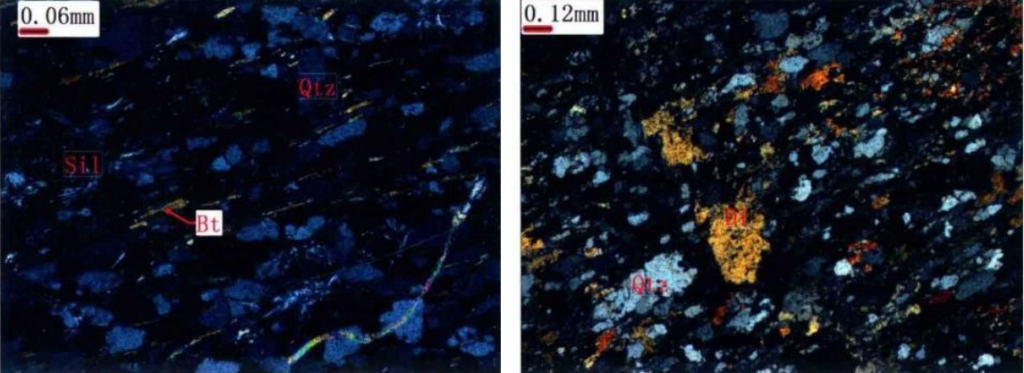
Lepido‑granoblastic texture and blastopsammitic texture, with a weak gneissic structure. The rock is mainly composed of quartz (Qtz), diopside (Di), biotite (Bt), sillimanite (Sil), epidote, and metallic minerals.
Quartz: Anhedral, granular, with a mosaic texture; grain sizes range from 0.05 to 0.5 mm, accounting for 60%–65%.
Diopside: Anhedral, prismatic, with pyroxene cleavage; grain sizes range from 0.04 to 0.4 mm, constituting 20%–25%.
Biotite: Euhedral, flaky, brown; flake diameters range from 0.1 to 0.2 mm, showing oriented arrangement with a weak foliated structure; content is 4%–5%.
Sillimanite: Euhedral, colourless, hair‑like fibrous forms, filling interstices between quartz and other grains; content is 8%–10%.
Epidoto: Anhedral, granular, with anomalous interference colours; grain sizes range from 0.04 to 0.2 mm; present in minor amounts.
Metallic minerals: Magnetite and others, in trace amounts.
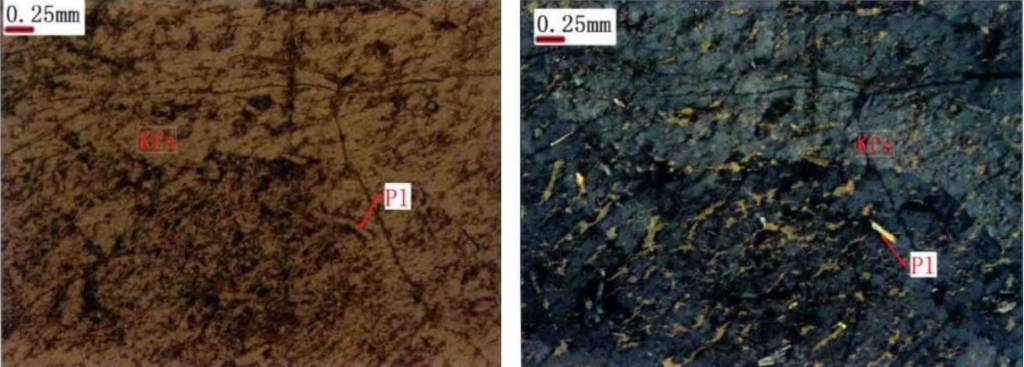
TaNb1‑b02 Pegmatite.
Subhedral granular texture, massive structure. The rock is mainly composed of K‑feldspar (Kfs) and plagioclase (Pl), with argillaceous material as alteration minerals.
K‑feldspar: Subhedral, prismatic, with a composition of perthite. Only one grain is observed in the field of view, with a grain size >30 mm, accounting for 90%–92% of the rock.
Plagioclasio: Euhedral, prismatic, occurring as inclusions within the K‑feldspar, with grain sizes of 0.2–0.3 mm, constituting 8%–10%.
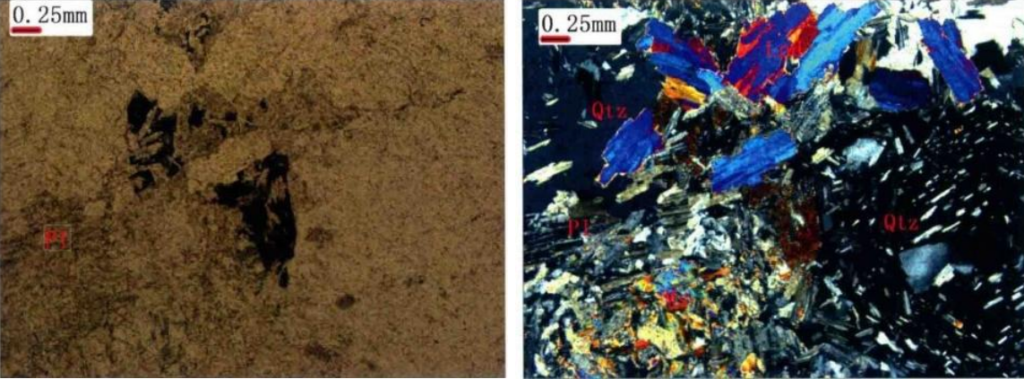
Subhedral granular texture, with porphyritic and poikilitic textures, massive structure. The rock is mainly composed of plagioclase (Pl), K‑feldspar, quartz (Qtz), lepidolite (Lpd), muscovite (Ms), and metallic minerals.
Plagioclasio: Subhedral, prismatic, with polysynthetic twinning, mainly acidic albite‑oligoclase. Grain sizes range from 0.2 to 0.5 mm, with some grains occurring as inclusions within porphyritic quartz. It accounts for 55%–60% of the rock.
Quartz: Anhedral, granular, with dominant grain sizes of 2–5 mm. It commonly contains inclusions of subhedral prismatic plagioclase and muscovite, and appears porphyritic in the rock. It constitutes 25%–30%.
K‑feldspar: Anhedral, granular, argillised (clay‑altered), mainly orthoclase. Grain sizes range from 0.2 to 0.5 mm, accounting for 4%–5%.
Lepidolite: Euhedral, flaky, colourless, with second‑order blue interference colours (lower than those of muscovite). Flake diameters range from 0.2 to 1 mm, accounting for 8%–10%.
Muscovite: Euhedral, flaky, colourless, with third‑order bright yellow‑green interference colours. Flake diameters range from 0.1 to 0.5 mm, accounting for 1%–2%.
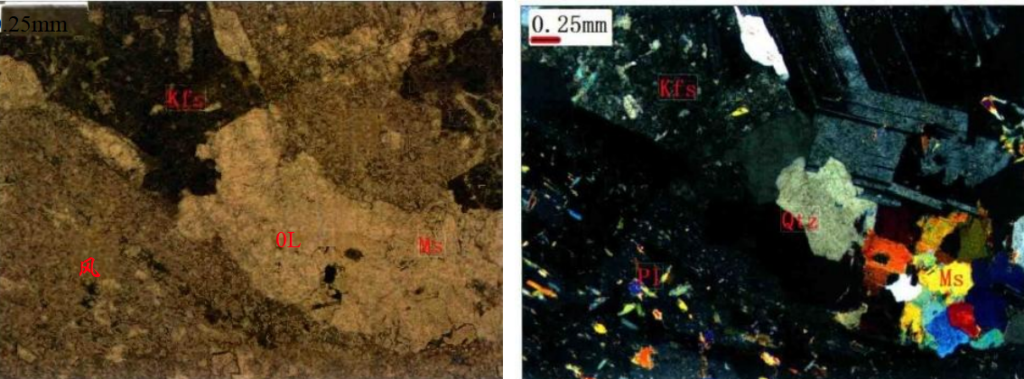
Subhedral granular texture, with poikilitic (inclusion) texture, massive structure. The rock is mainly composed of plagioclase (Pl), K‑feldspar (Kfs), quartz (Qtz), lepidolite (Lpd), muscovite, and metallic minerals.
Plagioclasio: Subhedral, prismatic, with polysynthetic twinning, mainly acidic albite‑oligoclase. Grain sizes range from 0.2 to 0.5 mm, with some grains occurring as inclusions within quartz. It accounts for 40%–45% of the rock.
Quartz: Anhedral, granular, with dominant grain sizes of 2–5 mm. It commonly contains inclusions of subhedral prismatic plagioclase and muscovite, and constitutes 25%–30%.
K‑feldspar: Anhedral, granular, argillised (clay‑altered), mainly orthoclase. Grain sizes range from 0.5 to 2 mm, accounting for 15%–20%.
Lepidolite: Euhedral, flaky, colourless, with second‑order blue interference colours (lower than those of muscovite). Flake diameters range from 0.2 to 1 mm, accounting for 8%–10%.
Muscovite: Euhedral, flaky, colourless, with third‑order bright yellow‑green interference colours. Flake diameters range from 0.1 to 0.5 mm, present in minor amounts.
Metallic minerals: Columbite, pyrite, magnetite, ilmenite, etc., in minor amounts.
Subhedral granular texture, with poikilitic (inclusion) texture and monzonitic texture, massive structure. The rock is mainly composed of plagioclase (Pl), K‑feldspar (Kfs), quartz (Qtz), lepidolite (Lpd), muscovite (Ms), and metallic minerals.
Plagioclasio: Subhedral, prismatic, with polysynthetic twinning, mainly acidic albite‑oligoclase. Dominant grain sizes range from 0.2 to 0.5 mm, with some grains occurring as inclusions within quartz. It exhibits a monzonitic texture with K‑feldspar. It accounts for 40%–45% of the rock.
Quartz: Anhedral, granular, with dominant grain sizes of 2–5 mm. It commonly contains inclusions of subhedral prismatic plagioclase and muscovite, and constitutes 25%–30%.
K‑feldspar: Anhedral, granular, argillised and showing brownish colour, mainly orthoclase. Dominant grain sizes range from 0.5 to 2 mm, exhibiting a monzonitic texture with plagioclase, and accounting for 15%–20%.
Muscovite: Euhedral, flaky, colourless, with third‑order bright yellow‑green interference colours. Flake diameters range from 0.1 to 0.5 mm, accounting for 7%–8%.
Lepidolite: Euhedral, flaky, colourless, with second‑order blue interference colours (lower than those of muscovite). Flake diameters range from 0.2 to 1 mm, constituting 2%–3%.
Subhedral granular texture, with monzonitic texture, massive structure. The rock is mainly composed of plagioclase (Pl), K‑feldspar (Kfs), quartz (Qtz), biotite, muscovite (Ms), and metallic minerals. Alteration minerals include chlorite and argillaceous material.
Plagioclasio: Subhedral, prismatic, with polysynthetic twinning, mainly oligoclase‑andesine. Dominant grain sizes range from 2 to 10 mm, with some grains showing slight sericitisation. It exhibits a monzonitic texture with K‑feldspar, and accounts for 40%–45% of the rock.
Quartz: Anhedral, granular, with dominant grain sizes of 2–5 mm, constituting 25%–30%.
K‑feldspar: Anhedral, granular, argillised and showing brownish colour, mainly orthoclase. Dominant grain sizes range from 2 to 5 mm, exhibiting a monzonitic texture with plagioclase, and accounting for 15%–20%.
Muscovite: Euhedral, flaky, colourless, with third‑order bright yellow‑green interference colours. Flake diameters range from 0.1 to 0.5 mm, accounting for 7%–8%.
Biotite: Euhedral, flaky, colourless to brown, with varying degrees of chloritisation and iron oxide exsolution. Flake diameters range from 0.2 to 1 mm, constituting 1%–2%.
Metallic minerals: In minor amounts.
TaNb1‑g01 Niobium‑tantalum ore.
The ore has a subhedral granular texture and a massive structure. Metallic minerals mainly comprise columbite‑tantalite (Col), magnetite (Mag), pyrite (Py), ilmenite, etc., which occur as sparse disseminations in minor amounts.
Magnetite: Grey with a slight brownish tint; occurs as an accessory mineral in the rock. Grain size mainly ranges from 0.01 to 0.1 mm; present in minor amounts.
Ilmenite: Grey, gradually altering to translucent leucoxene. Grain size ranges from 0.01 to 0.2 mm; sparsely disseminated in very minor amounts.
Pyrite: Anhedral, granular, yellowish‑white in colour. Grain size mainly ranges from 0.01 to 0.02 mm; sparsely disseminated in very minor amounts.
Columbite‑tantalite: Euhedral, tabular to prismatic, greyish‑white in colour. Internal reflections are cherry‑red, and it shows strong anisotropy. Grain size mainly ranges from 0.01 to 0.15 mm; sparsely disseminated in trace amounts.











 English
 Spanish
 Russian
 Arabic
 Swahili
 French
 Turkish
 Portuguese
 Korean
 Japanese
 German
 Italian