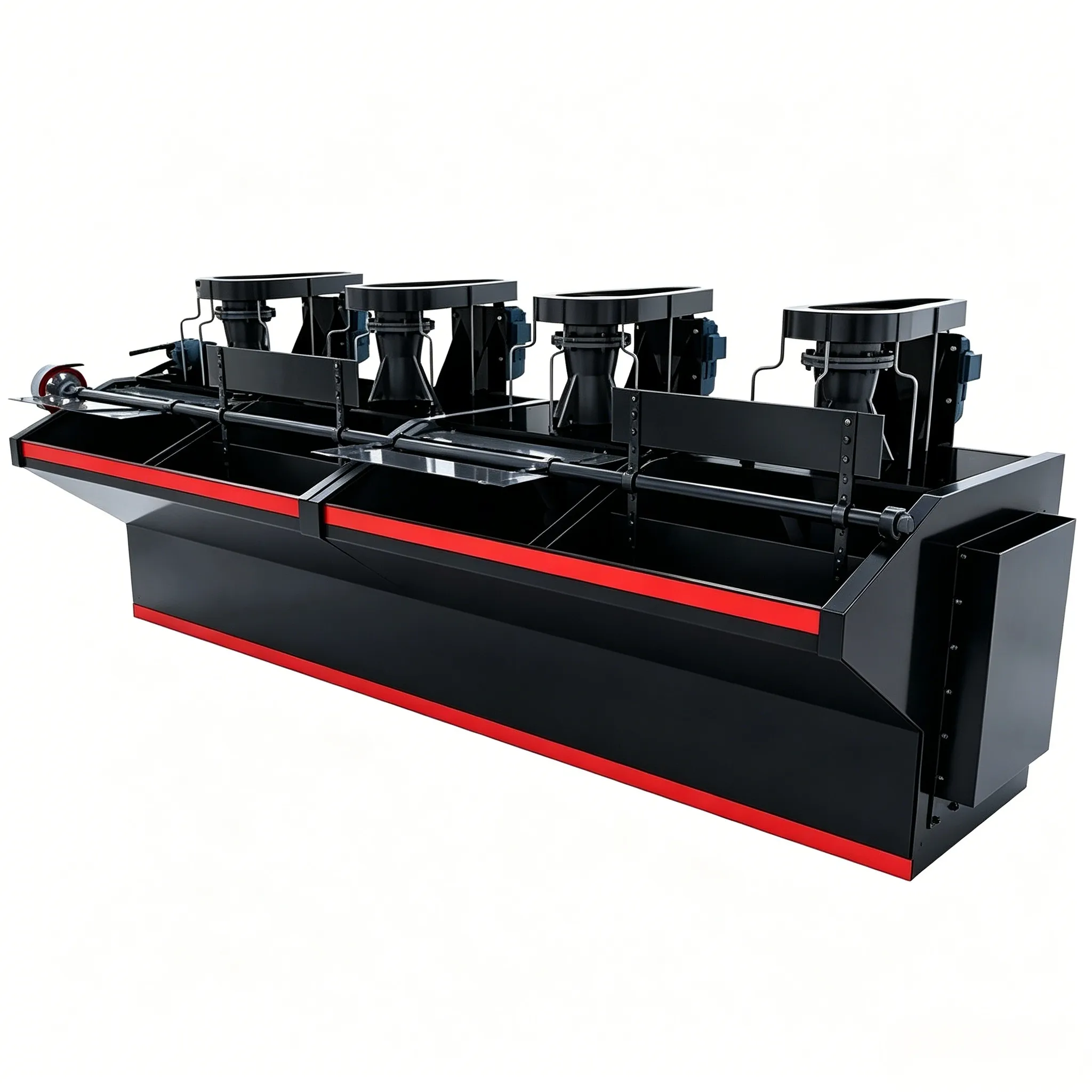
Macchina di flottazione a barre XJB
Macchina di flottazione a barre XJB La macchina di flottazione a barre XJB è simile a…


Wet ball mills and dry ball mills are the two most core grinding equipment in mineral processing. The fundamental difference between the two lies in whether water (or other liquid medium) is added during the grinding process. This article provides a detailed comparison from multiple dimensions, including working principle, structural composition, technical parameters, performance characteristics, and application scenarios, to serve as a reference for equipment selection.
A dry ball mill is a key piece of equipment for fine grinding after material has been crushed. The production process does not require water and belongs to dry grinding operation. The mill diameter ranges from 0.9 m to 4.0 m, motor power from 18.5 kW to 1800 kW, and single‑unit capacity from 1.5 to 149 t/h. It is widely used in cement, silicate products, new building materials, refractories, chemical fertilizers, black and non‑ferrous metal beneficiation, as well as glass and ceramics industries.
A wet ball mill requires the addition of water or other liquid medium (e.g., anhydrous ethanol) during grinding to form a slurry. The capacity ranges from 0.14 to 65 t/h, diameter from 0.75 to 2.75 m, and motor power from 4 to 400 kW. It is mainly used for grinding finished products and raw materials in wet‑process plants, and is also suitable for metallurgy, chemical, power and other industrial enterprises to grind various ores and other grindable materials.
The dry ball mill is a horizontal cylindrical rotating device with an outer‑edge gear drive, usually of a two‑compartment grid type. Material is uniformly fed into the first compartment through the feeding device via the hollow shaft screw. This compartment is lined with stepped or corrugated liners and contains steel balls of various sizes. As the cylinder rotates, centrifugal force lifts the balls to a certain height, from which they drop, impacting and grinding the material. After coarse grinding in the first compartment, the material passes through a single‑layer partition diaphragm into the second compartment for finer grinding. The powdered material is discharged through the discharge grate plate.
Dry grinding requires that the material inside the mill is dry – no water or other liquid may be added. After being crushed by the grinding media, the material that meets the required fineness is carried out by air or airflow.
The working principle of a wet ball mill is similar to that of a dry one. The motor drives the cylinder to rotate via a reduction device. The ore and steel balls inside the cylinder are carried by the liners to a certain height due to friction and centrifugal force, then fall and impact, gradually crushing the ore through impact and attrition.
In the wet process, water is added. As large pieces of material develop cracks under the impact and attrition of the grinding media, the fluidity of water forces water into the cracks, creating a separation effect. Under further impact and compression by the grinding media, the cracks gradually enlarge, eventually breaking the large pieces. The crushed ore is discharged through the discharge section. In a spiral classifier, the discharged mineral is classified: the qualified product is sent out, while the coarse sand is returned to the ball mill for further grinding.
| Elemento di confronto | Mulino a sfere a secco | Mulino a sfere a umido |
|---|---|---|
| Discharge port shape | Straight cylindrical | Flared (bell‑shaped) |
| Discharge device | Discharge grate plate; discharge by air or gravity | Built‑in spiral device; slurry discharged by liquid flow |
| Auxiliary equipment | Must be equipped with induced‑draft fan, dust exhaust duct and dust collector | Simple structure, fewer auxiliary accessories required |
| Sealing requirements | Enhanced sealing to prevent dust leakage | Better sealing to prevent liquid leakage |
| Structural complexity | Relatively complex | Relatively simple |
The dry ball mill has a straight cylindrical discharge port, equipped with induced‑draft fan, dust exhaust duct and dust collector – this is required for dust control in dry operation. The wet ball mill has a flared discharge port with a built‑in spiral device, facilitating smooth slurry discharge.
| Modello | Velocità di rotazione (giri/min) | Carica della palla (t) | Dimensioni del mangime (mm) | Dimensioni dello scarico (mm) | Capacità (t/h) | Potenza del motore (kW) | Peso (t) |
|---|---|---|---|---|---|---|---|
| Φ900×1800 | 36-38 | 1.5 | ≤20 | 0,075-0,89 | 0,65–2 | 18.5 | 3,6–5,85 |
| Φ900×3000 | 36-38 | 2.7 | ≤20 | 0,075-0,89 | 1,1–3,5 | 22 | 4.5 |
| Φ1200×2400 | 32-36 | 3‑3,8 | ≤25 | 0,075-0,6 | 1,5–4,8 | 30-45 | 11,5–13,6 |
| Φ1200×3000 | 32-36 | 3,5–5 | ≤25 | 0,074‑0,4 | 1,6–5 | 37-45 | 12,8–14,3 |
| Φ1200×4500 | 32-32,4 | 5-7 | ≤25 | 0,074‑0,4 | 1,6–5,8 | 45-55 | 13.8 |
| Φ1500×3000 | 27-29,7 | 7,5-8 | ≤25 | 0,074‑0,4 | 2–5 | 75-90 | 17‑19.5 |
| Φ1500×4500 | 27 | 11-14 | ≤25 | 0,074‑0,4 | 3-6 | 90-110 | 21-22 |
| Φ1500×5700 | 27-28 | 12-15 | ≤25 | 0,074‑0,4 | 3,5–8 | 130-132 | 24.7 |
| Φ1830×3000 | 24-25,4 | 11 | ≤25 | 0,074‑0,4 | 4-10 | 130-180 | 28-34,5 |
| Φ1830×6400 | 21.1-24 | 21-23 | ≤25 | 0,074‑0,4 | 6,5-15 | 210 | 34 |
| Φ1830×7000 | 24-24.1 | 23-25 | ≤25 | 0,074‑0,4 | 7,5-17 | 245 | 36–43,8 |
| Φ2100×3000 | 23.7 | 15 | ≤25 | 0,074‑0,4 | — | 155 | 45 |
| Φ2100×7000 | 23.7 | 26 | ≤25 | 0,074‑0,4 | 8-48 | 280 | 50-59,5 |
| Φ2200×4500 | 21.5 | 27 | ≤25 | 0,074‑0,4 | 9-45 | 280 | 48,5–54,5 |
| Φ2200×5500 | 21 | 30 | ≤25 | 0,074‑0,4 | 10-22 | 370 | 48.5 |
| Φ2200×6500 | 21.7 | 31-35 | ≤25 | 0,074‑0,4 | 14-26 | 370 | 52.8 |
| Φ2200×7500 | 21.7 | 35 | ≤25 | 0,074‑0,4 | 15-30 | 380 | 56-64,8 |
| Φ2400×3000 | 21 | 23 | ≤25 | 0,074‑0,4 | — | 245 | 58 |
| Φ2700×4000 | 20.7 | 40 | ≤25 | 0,074‑0,4 | 12-80 | 380-400 | 94-95 |
| Φ3200×4500 | 18 | 65 | ≤25 | 0,074‑0,4 | da elaborare | 630-800 | 137-149 |
| Φ3600×4500 | 17 | 90 | ≤25 | 0,074‑0,4 | da elaborare | — | — |
Table 1: Wet Ball Mill
| Modello | Velocità di rotazione (giri/min) | Potenza del motore (kW) | Ball charge (kg) | Dimensioni del mangime (mm) | Capacità (t/h) |
|---|---|---|---|---|---|
| MQ750×1060 | 49.6 | 4 | 600 | 0‑12 | 0.14‑0.34 |
| MQ750×1800 | 49.6 | 7.5 | 1000 | 0‑12 | 0.55‑1.11 |
| MQ900×1800 | 41 | 13 | 1500 | 0‑15 | 0.66‑1.26 |
| MQ900×2100 | 41 | 15 | 1700 | 0‑15 | 0.69‑1.30 |
| MQ1200×1600 | 35 | 18.5 | 2500 | 0‑20 | 0.80‑2.0 |
| MQ1200×2000 | 35 | 22 | 3000 | 0‑20 | 1.1‑2.6 |
| MQ1200×2400 | 35 | 30 | 3500 | 0‑20 | 1.3‑3.2 |
| MQ1200×2800 | 35 | 30 | 4000 | 0‑20 | 1.42‑3.8 |
| MQ1500×2000 | 31 | 37 | 4400 | 0-25 | 1,8–4,5 |
| MQ1500×3500 | 31 | 75 | 8200 | 0-25 | 3.3‑8.2 |
| MQ1830×3600 | 24.23 | 135 | 11000 | 0-25 | 6.6‑18.5 |
| MQ2100×3600 | 23.8 | 180 | 15000 | 0‑30 | 12‑30 |
| MQ2400×4500 | 21.3 | 380 | 38000 | 0‑35 | 29‑62 |
| MQ2700×3600 | 20.6 | 400 | 39000 | 0‑35 | 31‑65 |
Table 2: Wet Ball Mill (Kenex Group)
| Modello | Capacità (t/h) | Velocità di rotazione (giri/min) | Carico di corpi di macinazione (t) | Potenza del motore principale (kW) | Peso (t) |
|---|---|---|---|---|---|
| 1.5×5.7 | 3.0‑8.0 | 29.2 | 11.0 | 130 | 23.6 |
| 1.8×6.4 | 6.0‑13 | 24.5 | 19.6 | 245 | 36.0 |
| 2.2×6.5 | 8.0‑16 | 21.4 | 32 | 380 | 47.5 |
| 2.4×6.0 | 10-20 | 20.9 | 29 | 400 | 66.0 |
| 2.4×7.0 | 10‑25 | 20.9 | 32.5 | 475 | 73.0 |
| 2.4×8.0 | 10‑28 | 20.9 | 38 | 570 | 76.0 |
| 2.6×5.0 | 8.0‑22 | 20.9 | 31 | 475 | 68.0 |
| 2.6×6.5 | 8.0‑30 | 20.9 | 34 | 570 | 84.0 |
| 2.7×6.0 | 15‑35 | 19.4 | 52 | 630 | 94.0 |
| 2.7×7.0 | 16‑38 | 19.4 | 60 | 710 | 116 |
| 3.0×6.0 | 18‑36 | 19.4 | 68 | 710 | 126 |
| 3.2×6.0 | 26‑50 | 19.4 | 75 | 800 | 135 |
| 3.2×8.0 | 30-60 | 18.3 | 90 | 1000 | 160 |
| 3.6×6.0 | 38‑80 | 16.5 | 105 | 1600 | 188.5 |
| 3.6×7.0 | 45‑90 | — | — | — | — |
Wet Ball Mill:
Dry Ball Mill:
| Elemento di confronto | Mulino a sfere a secco | Mulino a sfere a umido |
|---|---|---|
| Unit power consumption | Relativamente più basso | Relativamente più alto |
| Total system power consumption | Requires air duct system, so total energy consumption is higher | No air duct system needed, total energy consumption is lower |
| Energy per ton of ore | 25‑30% more than wet grinding | Inferiore |
| Estimated drive power | About 30% more than wet grinding | Baseline |
| Wet grinding efficiency improvement | — | Provides 39% more capacity and 26% more efficiency than dry |
Although the wet ball mill itself requires more power than the dry ball mill, when the dry mill is combined with its air duct system, the total power consumption exceeds that of the wet mill. For continuously operating dry ball mills, due to the influence of ore moisture, a thin layer of material forms on the ore and liner surfaces, so the energy consumption per ton of ore is 25‑30% higher than that of a wet ball mill.
| Aspetto | Mulino a sfere a umido | Mulino a sfere a secco |
|---|---|---|
| Advantages | Finer grinding (down to micron level) Less dust, better environmental performance Fast heat dissipation, less overheating risk Suitable for separating mineral impurities Lower noise Uniform and fine grinding particle size | No liquid handling required Suitable for continuous production Simple maintenance Fast and smooth discharge Cylinder does not need cooling, longer service life |
| Disadvantages | Higher energy consumption Requires wastewater treatment Higher equipment corrosion risk Dewatering and drying required after grinding, adding cost | Serious dust pollution Prone to high temperature Coarser product fineness Possible dead zones inside the mill Strict requirements on material moisture |
| Industry | Typical Materials |
|---|---|
| Materiali da costruzione | Cement clinker, gypsum powder, lime, marble, etc. |
| Materiali refrattari | Quartz sand, bauxite, etc. |
| Ceramics | Ceramic bodies and other water‑sensitive materials |
| Coal powder preparation | Where moisture must be avoided to maintain combustion efficiency |
| Altro | Materials that react with water; products that must be stored and sold in powder form; arid/water‑scarce regions |
| Industry | Typical Materials |
|---|---|
| Metal beneficiation | Copper ore, iron ore, molybdenum ore, gold ore, etc. |
| Minerali non metallici | Phosphate rock, feldspar, fluorite, etc. |
| Ceramics/Glass | Ceramic raw materials, glass raw materials, glaze slurry preparation |
| Industria chimica | Pigments, coatings, fertilizers, etc. |
| Altro | Processes requiring subsequent wet processing (e.g., leaching, hydrometallurgy) |
The typical ratio of steel balls, material and water in wet grinding is 4:2:1, but the exact ratio should be determined through grinding tests.
The following factors should be comprehensively considered:
 English English
 Spanish
 Russian
 Arabic
 Swahili
 French
 Turkish
 Portuguese
 Korean
 Japanese
 German
 Italian