
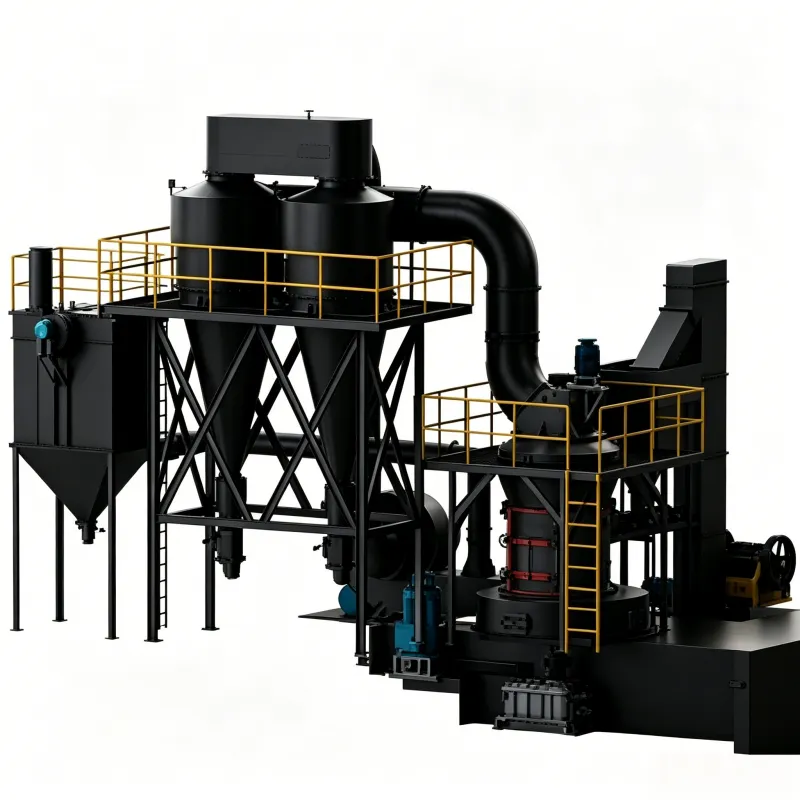
車輪付き移動式砕石機
FOUR COMBINATION MOBILE STATION シリーズ 標準モデル 搭載機器 搭載機器 処理能力(t/h) 輸送寸法(mm)…


銅、鉛、亜鉛およびその他の金属を含む複合多金属硫化鉱石からの銅精鉱の浮選法
The present invention relates to a beneficiation method for complex polymetallic sulphide ores, and in particular to a method for preferentially flotating a copper concentrate from a Cu‑Pb‑Zn bulk concentrate obtained by flotation of complex sulphide ores containing copper, lead, zinc and other metals.
In complex Cu‑Pb‑Zn sulphide ores, due to the intimate intergrowth of several metals and their fine disseminated grain sizes, separation is extremely difficult. In both domestic and international practice, such ores are generally ground to the required fineness and then subjected to flotation to obtain a Cu‑Pb‑Zn bulk concentrate. There are mainly three methods for separating copper, lead and zinc from such a bulk concentrate: first, the heating method, which achieves separation by heating to desorb various reagents from the mineral surfaces, thereby creating differences in floatability; second, the use of chloride reagents to depress the floatability of copper minerals while floating galena, thereby achieving separation; and third, the addition of organic salts, using starch, tannin extract, dextrin, etc., as depressants to depress galena and float copper minerals. However, the common problems with the above methods are poor separation efficiency among the various metal minerals, low metal recoveries, high copper and zinc contamination in the lead concentrate resulting in inferior product quality, high energy consumption in some methods, and toxic reagents and environmental pollution in others. Therefore, there has been a continuing search for a simple and effective separation method.
The object of the present invention is to overcome the shortcomings of the prior art and to provide a method for preferentially flotating and separating a copper concentrate from a Cu‑Pb‑Zn bulk concentrate obtained from complex sulphide ores containing copper, lead, zinc and other metals, with high separation indices and good separation efficiency.
The method first subjects the complex sulphide ore containing copper, lead, zinc and other metals to a conventional flotation procedure, i.e., crushing and grinding to a fineness of –0.074 mm accounting for 80%, then adding appropriate amounts of xanthate, frother, No. 2 oil and lime as a regulator to carry out bulk flotation of the copper, lead and zinc sulphide minerals, obtaining a Cu‑Pb‑Zn bulk concentrate. Subsequently, the copper concentrate is preferentially floated and separated from the Cu‑Pb‑Zn bulk concentrate through the following steps:
a. Regrinding the bulk concentrate containing copper, lead, zinc and other metal sulphides to –0.033 mm accounting for 90%, and adding activated carbon at 300–600 g/t (preferably 500 g/t) during the regrinding process for reagent removal and thickening‑dewatering;
b. Adding fresh water for pulp conditioning to a pulp density of 40%;
c. Adding sodium sulphide at 1500–5000 g/t (preferably 2000 g/t) and mixing uniformly;
d. Adding sodium sulphite at 3000–6000 g/t and ferrous sulphate at 2000–5000 g/t, and mixing uniformly; the preferred dosages are 5000 g/t for the former and 3000 g/t for the latter;
e. Adding zinc sulphate at 500–900 g/t (preferably 800 g/t) and mixing uniformly;
f. Adding sulphuric acid to adjust the pulp pH to 5–6 and mixing uniformly;
g. Adding ethyl xanthate at 40–60 g/t and Z‑200 reagent at 30–50 g/t (preferably 50 g/t for the former and 40 g/t for the latter); conducting preferential flotation to separate copper from lead and zinc, whereby the froth product is a copper rough concentrate and the cell product is a lead concentrate or a Pb‑Zn bulk concentrate.
Finally, the floated copper rough concentrate is subjected to one cleaning stage to obtain a finished copper concentrate.
Using the flotation method for copper concentrate according to the present invention, bench‑scale tests were conducted on a polymetallic sulphide ore from a certain mine, achieving favourable separation results. This ore contains some secondary copper sulphides and a large amount of iron sulphides, with fine disseminated grain sizes, making it a refractory ore. The run‑of‑mine ore contained Cu 0.25%, Pb 1.14%, Zn 1.91% and Ag 35.5 g/t. After obtaining a Cu‑Pb‑Zn bulk concentrate by conventional flotation, it was reground to –0.033 mm accounting for 90%. During regrinding, activated carbon was added at 500 g/t for reagent removal, followed by thickening‑dewatering, and fresh water was added to adjust the pulp density to 40%. Sodium sulphide was added at 2000 g/t with 5 minutes of conditioning; sodium sulphite at 5000 g/t and ferrous sulphate at 3000 g/t were then added with 15 minutes of conditioning; zinc sulphate at 800 g/t was subsequently added with 3 minutes of conditioning; sulphuric acid at 8000 g/t was added to maintain the pulp pH at 5–6 with 3 minutes of conditioning; finally, ethyl xanthate at 40 g/t and Z‑200 reagent at 30 g/t were added for preferential flotation. Bench‑scale closed‑circuit flotation tests showed that a copper concentrate with a grade of 21.29% Cu was obtained, containing only 3.91% Pb and 5.18% Zn, with a copper recovery of 75.32%. The Pb‑Zn bulk concentrate obtained had grades of 19.30% Pb and 33.40% Zn, with lead and zinc recoveries of 89.57% and 92.68%, respectively. In addition, when the flotation method of the present invention was applied to an ore from a northern Chinese mine, favourable results were also achieved. This ore contained Cu 0.23%, Pb 0.62%, Zn 2.42% and Fe 3.09%. Under the conditions of activated carbon 500 g/t, sodium sulphide 2000 g/t, sodium sulphite 5000 g/t, ferrous sulphate 3000 g/t, zinc sulphate 800 g/t, sulphuric acid 8000 g/t, ethyl xanthate 30 g/t and Z‑200 reagent 40 g/t, bench‑scale tests obtained a copper concentrate with a copper grade of 15% and a copper recovery of 60%, achieving the objective of separating copper from lead and zinc.
The method of the present invention has the advantages of high separation indices, good separation of copper from lead and zinc, energy savings, and no environmental pollution. It is suitable for the separation of refractory polymetallic sulphide ores, particularly complex Cu‑Pb‑Zn ores containing secondary copper minerals, high pyrite content, and very fine disseminated grain sizes of the valuable minerals.
 English English
 Spanish
 Russian
 Arabic
 Swahili
 French
 Turkish
 Portuguese
 Korean
 Japanese
 German
 Italian