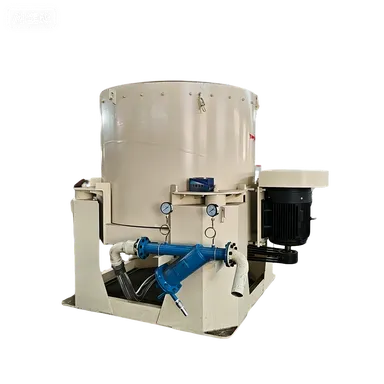
Concentrador centrífugo
Concentrador centrífugo – Concentrador por gravidade de alta eficiência para partículas finas Visão geral do produto O concentrador centrífugo…

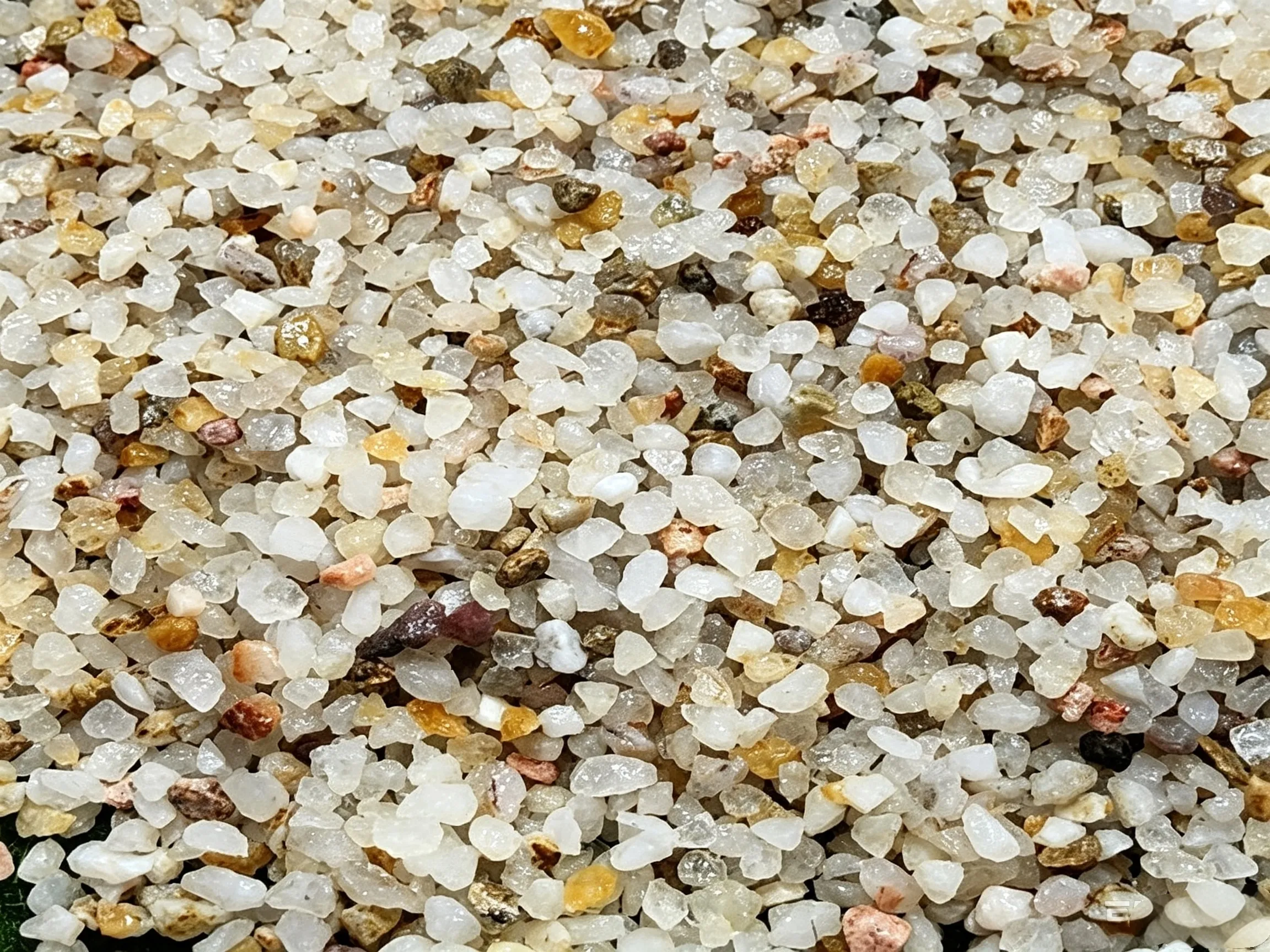
Processo de beneficiamento de areia de quartzo
Área Técnica
The present invention relates to a quartz sand beneficiation process, in particular to a quartz sand beneficiation process using multi‑layer screening meshes for screening.
Arte de fundo
High‑grade high‑quality quartz sand is the main raw material for producing glass. In particular, quartz sand for manufacturing white glass requires high silicon content and extremely low iron content. High iron content will cause the white glass to turn blue and form bubbles, affecting glass quality. In the raw ore, most of the sand with high iron content is concentrated in the fine sand with a particle size below 100–130 mesh. In the traditional process, after preliminary beneficiation, the raw ore is subjected to screening, desliming, scrubbing, and classification to produce finished sand. The screening process usually uses a single‑layer screen mesh for one‑time screening, which cannot remove the fine sand below 100–130 mesh, resulting in persistently high iron content in the finished sand and affecting the quality of white glass. For this reason, improvements have been made on the basis of the traditional process: after preliminary beneficiation of the raw ore, through screening, desliming, and multiple scrubbing operations, electronic iron removal is added to remove iron impurities, thereby improving the grade of the finished sand to meet the production requirements of white glass. However, the above process has disadvantages such as large investment, high cost, and inconvenient maintenance.
Resumo da invenção
The object of the present invention is to overcome the above deficiencies of the prior art and to provide a quartz sand beneficiation process with low investment, low cost, convenient maintenance, and good finished sand quality.
The object of the present invention is achieved as follows: A quartz sand beneficiation process, wherein after preliminary beneficiation of the raw ore, through screening, desliming, scrubbing, and classification, a quartz sand product is produced with a silicon content higher than 96%, an iron content lower than 0.15%, and a particle size ranging from 20–24 mesh to 100–130 mesh. The preliminarily beneficiated raw ore flows into two or more layers of screen meshes for two or more screening operations. The screen meshes are arranged from coarse to fine in the order from top to bottom. The uppermost screen mesh is a 20–24 mesh screen, which removes coarse sand with a particle size larger than 20–24 mesh. The lowermost screen mesh is a 100–130 mesh screen, which removes fine sand with a particle size smaller than 100–130 mesh. The sand with particle sizes between 20–24 mesh and 100–130 mesh is collected and passes through a channel to the desliming process. The screening meshes used in the screening process may be vibrating screens, trommel screens, or other types of screens with different modes of motion.
In the quartz sand beneficiation process of the present invention, since two or more layers of screen meshes are used for screening, the screen meshes are arranged in layers from top to bottom. Under the action of water flow, the preliminarily beneficiated raw ore first flows through the uppermost screen mesh, then continuously falls under gravity, sequentially passing through the lower screen meshes down to the lowermost screen mesh, undergoing multiple screening operations. The uppermost 20–24 mesh screen removes coarse sand larger than 20–24 mesh, and the lowermost 100–130 mesh screen removes fine sand smaller than 100–130 mesh. Since a large amount of iron impurities are concentrated in the fine sand with a particle size smaller than 100–130 mesh, removing the fine sand smaller than 100–130 mesh reduces the iron content of the sand. Other impurities are concentrated in the coarse sand larger than 20–24 mesh, so removing the coarse sand larger than 20–24 mesh increases the silicon content of the sand. The finished quartz sand thus has a particle size between 20–24 mesh and 100–130 mesh, with a silicon content higher than 96% and an iron content lower than 0.15%, meeting the production requirements of white glass and preventing the white glass from turning blue or forming bubbles. When a certain screen mesh is damaged, it can be repaired by simply removing and replacing it with a new one, making installation and maintenance extremely convenient. Since complex electronic iron removal equipment is not required, production costs are reduced. The production cost per tonne of quartz sand is reduced from 50 RMB to 22 RMB, saving 56% of production cost per tonne.
Descrição detalhada das formas de realização
A presente invenção é descrita em mais detalhes a seguir, com referência a formas de realização específicas.
Exemplo 1:
The mined raw quartz sand ore has a silicon content lower than 92%, an iron content between 0.2% and 0.25%, contains a large amount of impurities, and has a wide particle size distribution.
After preliminary beneficiation, the raw quartz sand ore undergoes the following process steps:
Exemplo 2:
The mined raw quartz sand ore has a silicon content lower than 92%, an iron content between 0.2% and 0.25%, contains a large amount of impurities, and has a wide particle size distribution.
After preliminary beneficiation, the raw quartz sand ore undergoes the following process steps:
Exemplo 3:
The mined raw quartz sand ore has a silicon content lower than 92%, an iron content between 0.2% and 0.25%, contains a large amount of impurities, and has a wide particle size distribution.
After preliminary beneficiation, the raw quartz sand ore undergoes the following process steps:
Exemplo 4:
The mined raw quartz sand ore has a silicon content lower than 92%, an iron content between 0.2% and 0.25%, contains a large amount of impurities, and has a wide particle size distribution.
After preliminary beneficiation, the raw quartz sand ore undergoes the following process steps:
Exemplo 5:
Under the action of water flow, the preliminarily beneficiated raw quartz sand ore flows through a channel into screen meshes for screening. The screen meshes are arranged in three layers, with the upper screen being 20 mesh, the middle screen being 80 mesh, and the lower screen being 100 mesh. Coarse sand larger than 20 mesh and fine sand smaller than 100 mesh are removed. The sand with particle sizes between 20 mesh and 100 mesh is collected and enters the channel. A channel is provided between the upper and middle screen meshes for the sand with particle sizes between 20 mesh and 80 mesh to flow into the desliming and subsequent processes. A second channel is provided between the middle and lower screen meshes for the sand with particle sizes between 80 mesh and 100 mesh to flow into the desliming and subsequent processes. Other process steps are the same as in Example 1.
 English English
 Spanish
 Russian
 Arabic
 Swahili
 French
 Turkish
 Portuguese
 Korean
 Japanese
 German
 Italian