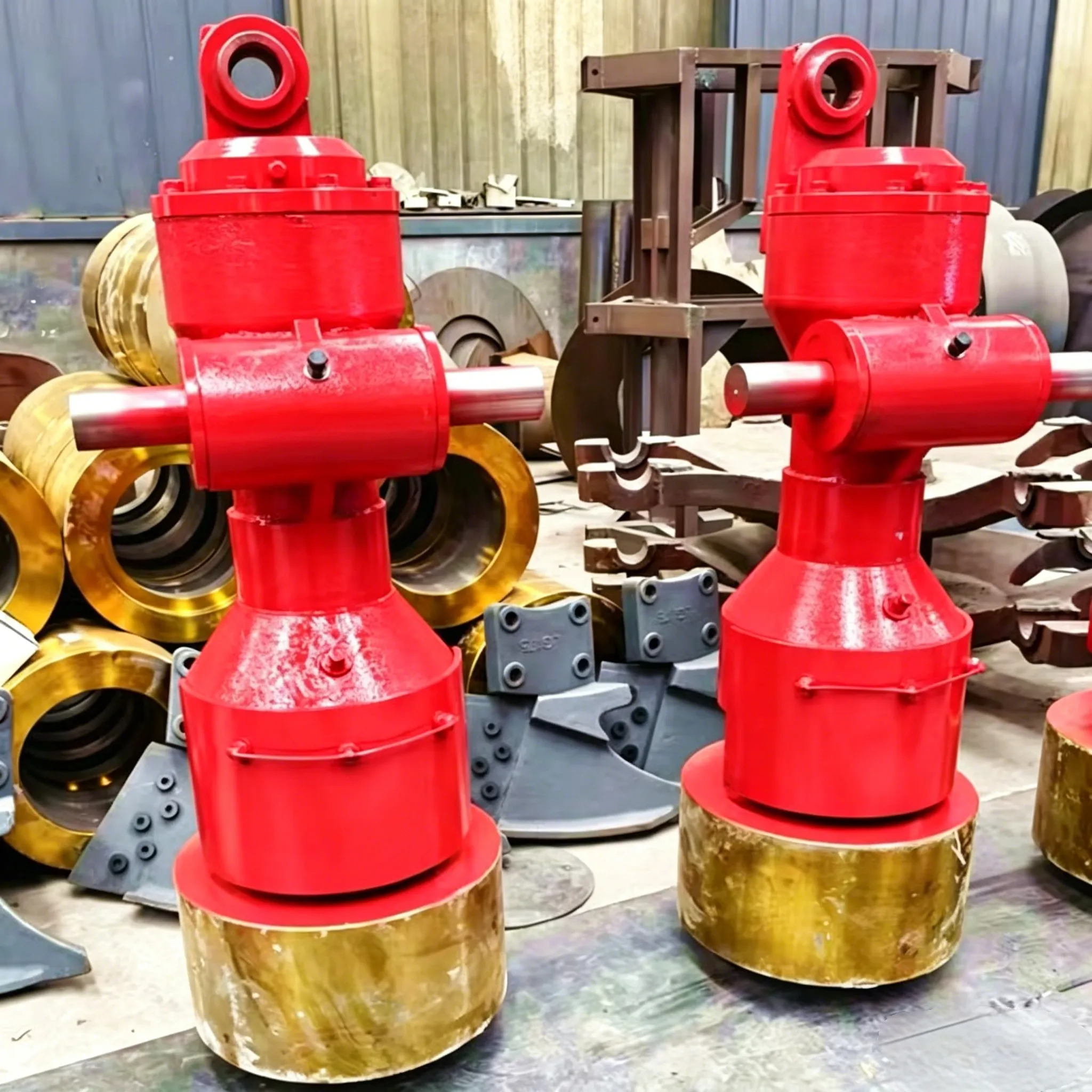
Rolo de moagem do moinho Raymond
1. Visão geral do produto O rolo de moagem é o principal componente operacional e a peça-chave sujeita a desgaste do…

Vanadium‑titanium slag is an industrial solid waste generated during the smelting of vanadium‑titanium magnetite. With the increasing demand for stainless steel products and special steels in China, the discharge of vanadium‑titanium slag continues to rise. China’s vanadium‑titanium slag is mainly concentrated in the Panzhihua‑Xichang region, where each ton of iron produced generates 0.3 to 1 ton of waste slag—the lower the ore grade, the greater the slag output. Pangang Group alone discharges 3.6 million tons of high‑titanium blast furnace slag annually, with cumulative stockpiles exceeding 60 million tons. Large accumulations of vanadium‑titanium slag not only occupy valuable land but also pose potential environmental risks.
However, vanadium‑titanium slag is not “waste.” It features high vanadium, high titanium, low sulfur, low phosphorus, and low aluminium content, and is often referred to as a “golden alloy.” Through scientific grinding, vanadium‑titanium slag can be converted into highly reactive ultra‑fine powders, widely used in building materials, metallurgy, chemicals, environmental protection, and many other fields, achieving a remarkable transformation from “industrial solid waste” to “high‑value resources.”
This article provides a comprehensive analysis of the vanadium‑titanium slag grinding system, covering raw material characteristics, processing challenges, core equipment, process flow, application scenarios, e muito mais.
Vanadium‑titanium slag is an industrial solid waste generated during blast furnace smelting of vanadium‑titanium magnetite. It is a granulated furnace slag formed by water quenching of molten material primarily composed of FeO and SiO₂. Due to the characteristics of resource occurrence, about 50% of the titanium in vanadium‑titanium magnetite enters the blast furnace with the iron concentrate. During ironmaking, titanium almost entirely enters the slag phase, forming titanium‑iron slag (blast furnace slag) with a titanium content of approximately 18%–26%.
Vanadium‑titanium slag is called a “golden alloy” because of its distinctive chemical composition:
| Característica | Specific Performance |
|---|---|
| High vanadium content | Vanadium is an excellent alloying element that significantly improves steel strength, wear resistance, and corrosion resistance |
| High titanium content | Titanium is an important strategic metal used for producing titanium dioxide, titanium metal, and titanium alloys |
| Low sulfur and phosphorus | Low impurity content facilitates subsequent processing and utilisation |
| Latent hydraulic activity | After ultra‑fine grinding, it exhibits cementitious properties and can serve as an active admixture for cement and concrete |
The reuse pathways for vanadium‑titanium slag are extensive, mainly falling into two categories:
In recent years, the state has continuously strengthened policy support for industrial solid waste resource utilisation. The comprehensive utilisation of vanadium‑titanium slag has been incorporated into the national circular economy and “dual carbon” strategic directions. The “Guidelines for Comprehensive Utilisation Evaluation of Solid Waste in Iron and Steel Enterprises” , effective from July 1, 2025, provides institutional safeguards for the standardised utilisation of metallurgical solid wastes such as vanadium‑titanium slag. Several large‑scale vanadium‑titanium slag powder production lines have been built across the country—for example, a company in Chengde has constructed a 1,000,000 t/y vanadium‑titanium slag powder line, and a 500,000 t/y tailings processing line has broken ground in Panzhihua, Sichuan. These projects fully demonstrate the enormous market potential of vanadium‑titanium slag grinding.
Grinding vanadium‑titanium slag is not a simple task, facing the following four major challenges:
Vanadium‑titanium slag has high hardness and is classified as a hard‑to‑grind material. It contains difficult‑to‑grind phases (such as perovskite and other stable mineral particles that are hard and resistant to comminution), resulting in high overall power consumption during grinding. Given the poor grindability of materials like vanadium‑titanium slag, traditional grinding equipment often struggles to meet production demands.
Due to its high titanium content, the hydration activity of vanadium‑titanium slag is lower than that of ordinary blast furnace slag. When used alone as an admixture, its activity index can only reach Grade S75, and the replacement ratio is generally low, limiting its large‑scale application in building materials.
Titanium‑bearing minerals are dispersedly distributed within the slag, making them difficult to separate and increasing the complexity of comprehensive utilisation.
The moisture content of vanadium‑titanium slag varies considerably depending on the water‑quenching process, imposing higher demands on the drying capacity and operational stability of grinding equipment.
These characteristics mean that vanadium‑titanium slag grinding cannot simply adopt conventional equipment; isso exige soluções de processo específicas e maquinário especializado.
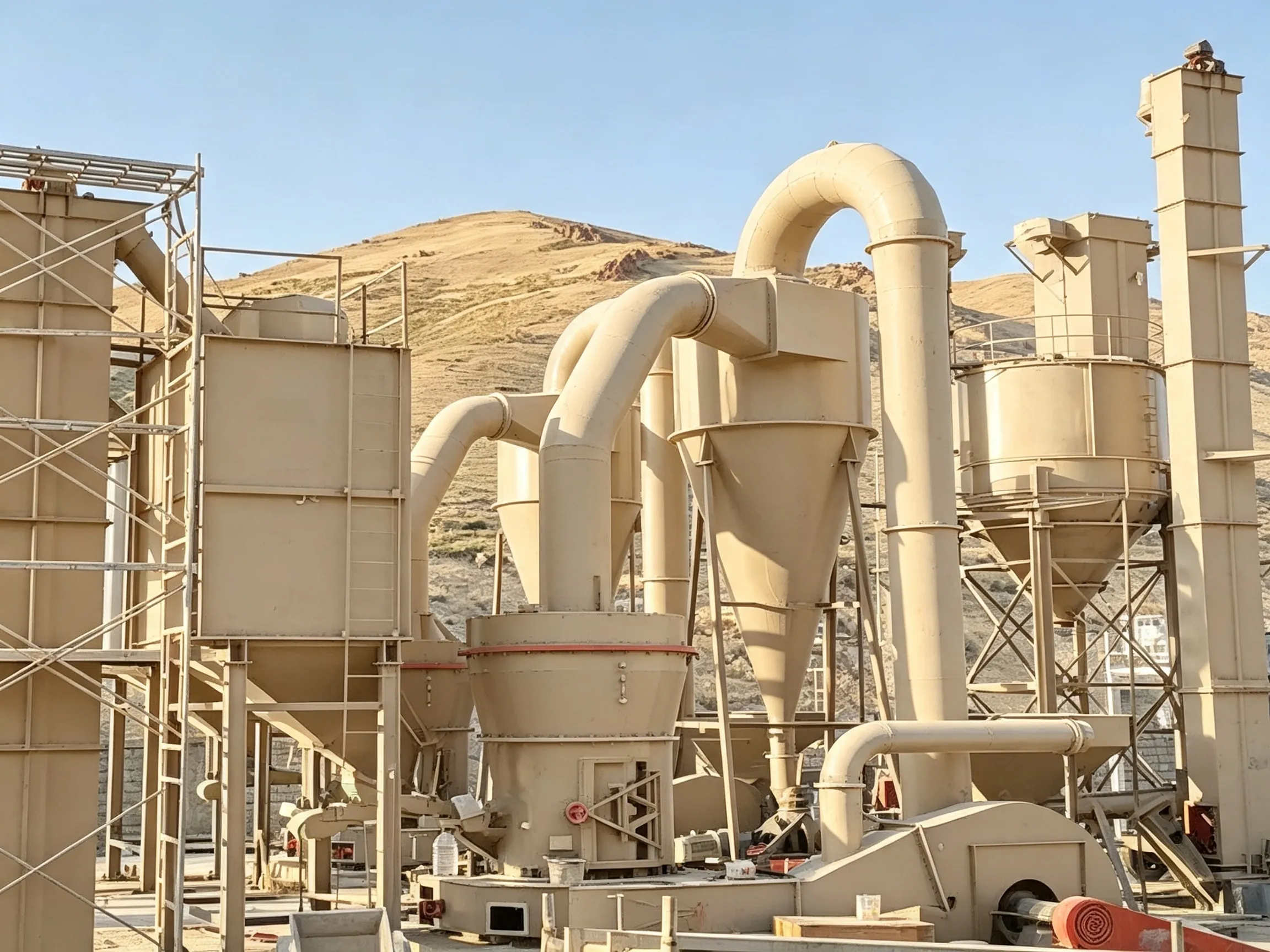
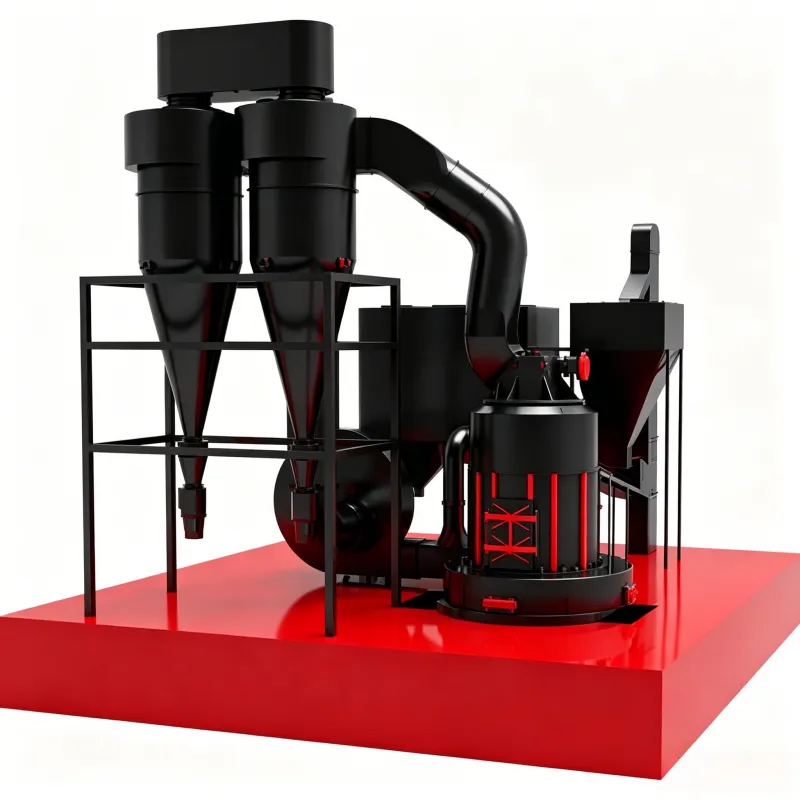
O moinho de rolos vertical (VRM) is currently the most widely used and most effective core equipment in vanadium‑titanium slag grinding. The VRM integrates drying, grinding, classification, and conveying in one unit, with a simple process flow, few system components, and a compact layout.
The VRM has become the preferred choice for vanadium‑titanium slag processing due to the following key advantages:
✅ Baixo consumo de energia: The VRM adopts the princípio de moagem em leito de material—rollers directly compact and grind material on the table without metal‑to‑metal contact. Compared with traditional ball mills, VRM energy consumption can be reduced by 30%–40%.
✅ High throughput: Single‑unit capacity ranges from 1 to 200 t/h, suitable for medium‑to‑large‑scale powder processing projects, capable of meeting annual capacities of hundreds of thousands of tons. Some large VRMs can even meet production demands exceeding 1 million tons per year.
✅ Compact footprint: Occupies only about 50% of the floor area of a ball mill system, significantly reducing construction costs.
✅ Strong drying capability: Can handle materials with moisture content <15%, concluindo a secagem simultaneamente à moagem.
✅ Superior product quality: Can stably produce GGBFS with a specific surface area ≥420 m²/kg, with precise and controllable fineness.
✅ Excellent environmental performance: Negative‑pressure operation, low dust emissions, and low noise meet the green production requirements of modern industry.
✅ Low maintenance cost: Low wear material consumption, using high‑quality wear‑resistant materials and hardfacing technology for long service life.
| Aspecto comparativo | Moinho de rolos vertical | Moinho de bolas | Moinho Raymond |
|---|---|---|---|
| Consumo de energia do sistema | Low (30%–40% reduction) | Alto | Moderado |
| Capacidade por unidade | 1–200 t/h | Menor | A few to dozens t/h |
| Funções integradas | Grinding+drying+classification+conveying | Apenas retificação | Grinding+classification |
| Pegada ecológica | ~50% of ball mill system | Grande | Moderado |
| Investimento de capital | Moderado | Mais baixo | Mais baixo |
| Escala adequada | Large, medium, small | Pequeno | Pequeno a médio |
| Adaptability to Slag | Strong (designed for hard‑to‑grind materials) | Geral | Geral |
For ultra‑fine powder requirements above 400 mesh, o LUM ultra‑fine vertical mill e Moinho vertical ultrafino HLMX are ideal choices. These units focus on ultra‑fine grinding in the 400–3.250 mesh range, with adjustable and controllable fineness, breaking through the capacity bottleneck of ultra‑fine powder production.
A standard vanadium‑titanium slag grinding production line typically includes the following core stages:
Esmagamento: Large vanadium‑titanium slag is crushed by a triturador de mandíbulas ou triturador de impacto to ensure feed size ≤30 mm.
Remoção de ferro: Separadores magnéticos e vibrating screens remover impurezas ferrosas, protegendo os equipamentos e melhorando a pureza do produto.
Triagem: Vibrating screens control feed particle size to ensure uniformity and stability.
After pre‑treatment, the vanadium‑titanium slag is accurately weighed by a weighing device and conveyed by a elevador de caçambas to the VRM feed device. An air‑lock feeder ensures uniform material entry while preventing system air leakage.
Material enters the VRM and is evenly distributed on the grinding table centre under centrifugal force. The hydraulic system drives the rollers to compact the material bed, and the vanadium‑titanium slag is pulverised under high pressure. Simultaneously, a hot‑gas system introduces high‑temperature airflow from the bottom of the table, achieving on‑line drying during grinding.
O material moído é transportado para cima pela corrente de ar até o dynamic classifier. By adjusting the classifier rotor speed, the finished fineness can be precisely controlled. Coarse particles fall back onto the table for re‑grinding, while qualified fine particles are carried by airflow to the dust collection system.
Dust‑laden gas is purified by a filtro de mangas com jato pulsante. The collected vanadium‑titanium slag powder is conveyed by conveying equipment to the finished product silo for storage. After treatment, the dust concentration in the exhaust gas meets environmental standards.
Vanadium‑Titanium Slag Ore → Crushing → Iron Removal → Screening → Weighing → Bucket Elevator → Vertical Roller Mill (Grinding + Drying + Classification) → Pulse‑Jet Bag Filter → Finished Product Silo
After ultra‑fine grinding, vanadium‑titanium slag powder is no longer “industrial waste” but a genuine “mina urbana.” Its application areas are increasingly diverse:
Cement additive: When vanadium‑titanium slag is mixed and ground with steel slag, ordinary blast furnace slag, and cement clinker in certain proportions, composite cement with a strength grade of 52.5 can be produced. Tests show that with 45% clinker and 46% vanadium‑titanium slag, the 28‑day flexural strength reaches 8.8 MPa and compressive strength 48.5 MPa.
Aditivo para concreto: Vanadium‑titanium slag powder can serve as an active admixture for concrete, improving workability and mechanical properties. The finished powder can achieve a specific surface area ≥400 m²/kg.
Building blocks and bricks: Using high‑titanium blast furnace slag as the main raw material with steam curing, MU10‑grade slag bricks can be produced with slag content exceeding 80%.
Slag glass‑ceramics: Can be used for sanitary tiles, interior/exterior wall tiles, floor tiles, and corrosion‑resistant/wear‑resistant pipes.
Extraction of vanadium‑titanium alloys: Vanadium‑titanium slag can be processed to extract vanadium and titanium for producing ferrovanadium and ferrotitanium alloys.
Production of titanium dioxide: After activation grinding, vanadium‑titanium blast furnace slag can be used in the hydrochloric acid process to produce crude titanium dioxide. Over 75% of the titanium in vanadium‑titanium magnetite smelting slag can be extracted to prepare crude rutile titanium dioxide.
Matérias-primas químicas: Vanadium compounds can be used to produce catalysts, dyes, and battery materials.
Vanadium‑titanium slag has a certain capacidade de adsorção and can be used for treating industrial wastewater (adsorbing heavy metal ions and organic pollutants) and flue gas desulfurisation/denitrification. Its porous structure also allows it to be used in green building materials such as eco‑bricks.
Vanadium‑titanium slag can also be used to produce ceramics, glass, and refractories. For example, it can be used in ceramic glazes to improve hardness and gloss.
With technological advances, the application fields of ultra‑fine vanadium‑titanium slag powder continue to expand. Current new directions include vanadium‑titanium slag‑based low‑carbon cementitious materials e ultra‑fine composite mineral admixtures. Through mechanical grinding combined with chemical activation, the hydration activity of vanadium‑titanium slag can be significantly improved.
Xinxiang Great Wall Machinery used a GRMS slag vertical roller mill to build a 400,000 t/y vanadium‑titanium slag powder production line. The VRM integrates grinding, drying, classification, conveying, and collection, producing powder with a specific surface area of 420–450 m²/kg.
An environmental company in Chengde built a 1,000,000 t/y vanadium‑titanium slag powder production line equipped with a JLMK‑56.3.3x VRM system. The main products are ultra‑fine vanadium‑titanium slag powder and steel‑slag composite cementitious materials, widely used as raw materials for cement, concrete, insulation mortar, etc., with market coverage across Chengde, Beijing, Tangshan, Baoding, and Zhangjiakou.
Chengde Vanadium‑Titanium New Materials Co., Ltd. uses vanadium‑titanium blast furnace water‑quenched slag as raw material. Leveraging patented technology, they have overcome challenges such as significantly reduced glassy phase content and lowered activity, producing deep‑processed products containing vanadium‑titanium slag powder.
In the Yanbian County Vanadium‑Titanium Industrial Development Zone, a 500,000 t/y tailings processing line project has broken ground with a planned investment of RMB 120 million. The project utilises vanadium‑titanium magnetite tailings to produce tailings powder, which serves as a high‑quality building material raw material for cement plants, concrete batching plants, dry‑mix mortar plants, and various brick plants.
In recent years, the state has continuously strengthened policy support for industrial solid waste resource utilisation. The comprehensive utilisation of vanadium‑titanium slag aligns with national circular economy e “dual carbon” strategic directions. Many regions have listed vanadium‑titanium slag powder production line projects as key engineering initiatives, with investments ranging from tens of millions to hundreds of millions of RMB.
From the market side, demand for vanadium‑titanium slag powder continues to grow. In the Panzhihua region alone, the civil market demand for tailings powder is about 4 million cubic metres per year. With the promotion of low‑carbon cement and green concrete, the market space for ultra‑fine vanadium‑titanium slag powder as a high‑quality mineral admixture will continue to expand.
Inteligência: VRM systems generally employ PLC/DCS automation control, enabling remote monitoring, automatic operation, and fault early warning.
Em grande escala: Million‑ton‑per‑year vanadium‑titanium slag powder production lines are gradually becoming mainstream.
Ultrafino: Ultra‑fine grinding capabilities in the 400–3.250 mesh range continue to improve, opening up more high‑value application opportunities.
Verde: Environmentally friendly technologies such as energy savings, low dust emissions, and waste heat utilisation are becoming increasingly mature.
Vanadium‑titanium slag grinding processing is a caminho verde that transforms metallurgical solid waste into high‑value resources. Through scientific process design and appropriate equipment selection centred on the moinho de rolos vertical, enterprises can turn problematic “waste slag” into value‑creating “treasure.”
From cement additives to concrete admixtures, from extracting vanadium‑titanium alloys to producing titanium dioxide, from environmental adsorption materials to low‑carbon cementitious materials—the application scenarios for ultra‑fine vanadium‑titanium slag powder are increasingly diverse, and the market space continues to expand. Driven by apoio de políticas, progresso tecnológico e demanda do mercado, the vanadium‑titanium slag grinding industry is entering an unprecedented golden period of development.
For both steel and building‑material enterprises, building a scientifically designed vanadium‑titanium slag grinding production line is not only an inevitable choice for fulfilling environmental responsibilities but also a strategic move to reduce costs, improve efficiency, and open new growth avenues.

 English English
 Spanish
 Russian
 Arabic
 Swahili
 French
 Turkish
 Portuguese
 Korean
 Japanese
 German
 Italian