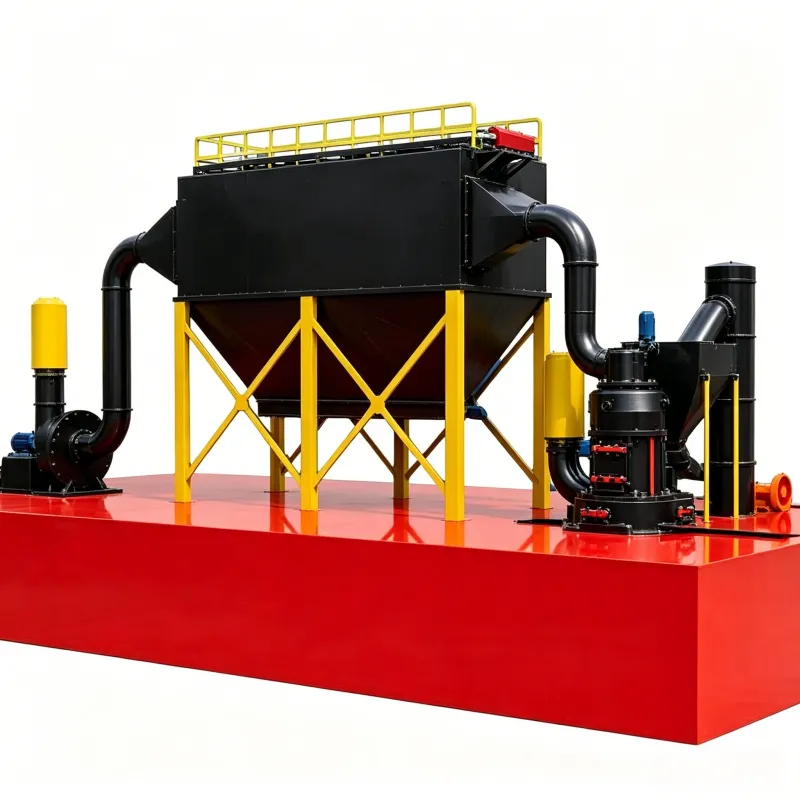
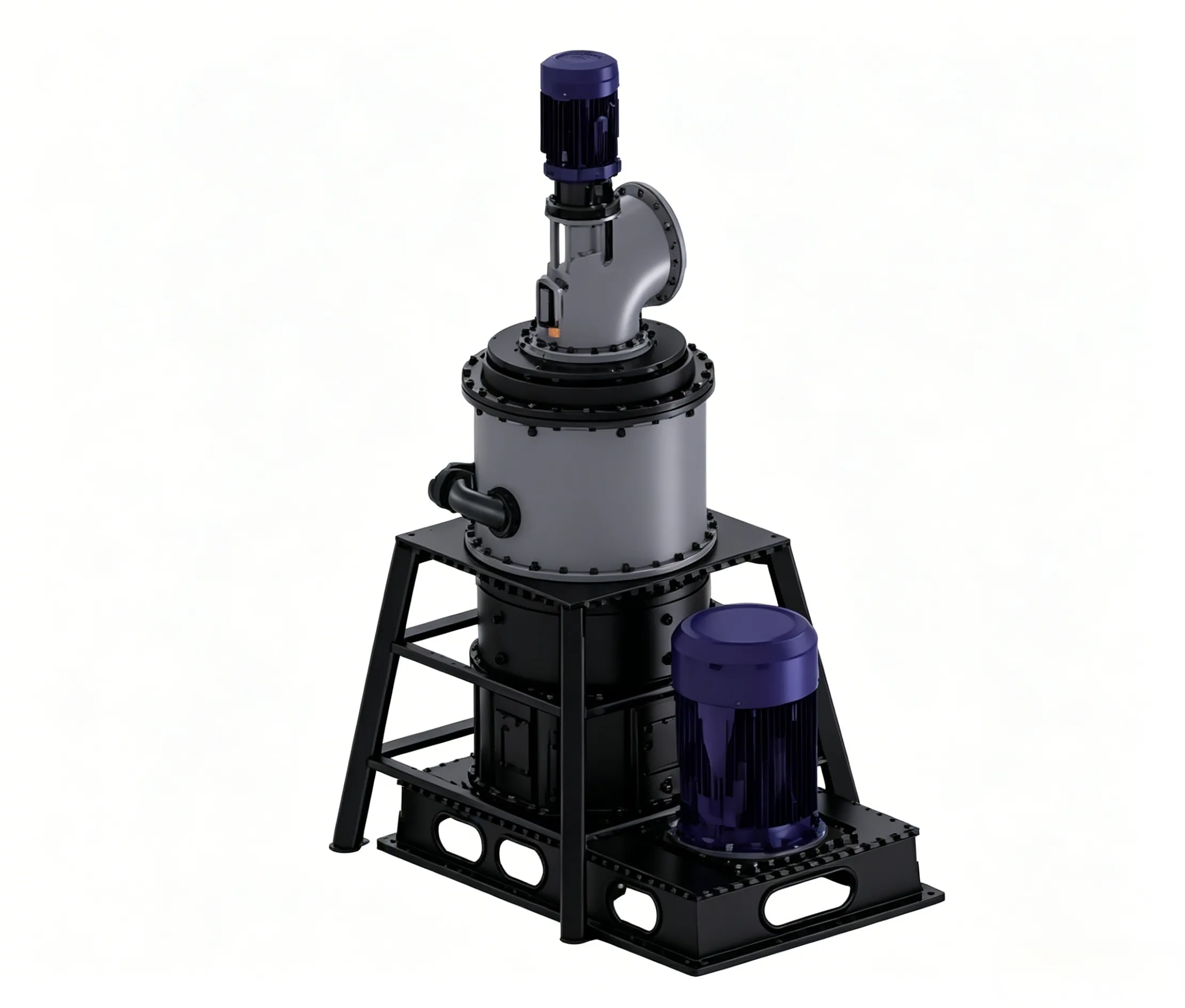
Raymond-Mühle im offenen Kreislauf
Einführung in die Raymond-Mühle im offenen Kreislauf Die Raymond-Mühle KX im offenen Kreislauf ist eine…


The present invention relates to a beneficiation desilication method for bauxite. The concentrate product obtained by this method can be used for producing alumina.
In industrial applications of bauxite, it is often required that the alumina-silica ratio (A/S) of bauxite reaches a certain value. Especially in alumina production, the Bayer process, which is efficient, low-cost, and simple in technology, generally requires an A/S greater than 10. For diaspore-type bauxite, the vast majority have an A/S of less than 10, which restricts the economical and reasonable industrial application of such bauxite. Desilication to increase the A/S of bauxite is the key to solving this problem. There are many methods for desilication of diaspore-type bauxite, and flotation desilication technology is one of the economically effective methods.
At present, in the flotation process of diaspore-type bauxite, there are two approaches for removing silicon-bearing minerals. One is closed-circuit flotation, where the flotation tailings are discarded as final tailings; the other is that the silicon-bearing minerals must be ground finely and then deslimed before discarding. For example, two typical bauxite froth flotation methods: one involves grinding bauxite finely and then floating it, obtaining a concentrate after roughing and cleaning, with the cleaning tailings returned to the circuit and the roughing tailings being the flotation tailings, or after scavenging the roughing tailings, the scavenging tailings become the flotation tailings, which are discarded as final tailings; the other involves grinding bauxite finely and then floating it, obtaining a concentrate after roughing and cleaning, with the cleaning tailings returned to the circuit, and after scavenging the roughing tailings, the scavenging tailings become flotation tailings, which (also called middlings) are classified, with the fine fraction discarded as final tailings and the coarse fraction returned to the mill for regrinding.
Most of the silicon-bearing gangue minerals in bauxite have low hardness and are easily slimed during crushing and grinding. The distribution of silicon minerals in the feed material shows a polarization into coarse and fine fractions. While silicon minerals are relatively enriched in the fine fraction, a portion also exists as coarse liberated particles and their rich intergrowths. In bauxite flotation, the froth yield is large and the concentration gradient in the flotation cells is high. Therefore, slime is easily entrained into the froth. The fine fraction in the cleaning tailings is mainly gangue, while the coarse silicon-bearing minerals and their rich intergrowths generally remain in the roughing and scavenging cells and eventually enter the flotation tailings. In the above process, returning the cleaning tailings to the circuit not only brings fine silicon-bearing gangue back into the circuit but also introduces a large amount of water, causing a significant decrease in roughing and scavenging concentrations. The fine silicon-bearing gangue interferes with flotation, the selectivity of aluminum-silicon separation deteriorates, and the recovery of coarse valuable minerals is poor. As a result, the production capacity of the flotation operation is reduced, flotation reagent consumption increases, the concentrate becomes too fine or the tailings become too fine, and/or the flotation indices deteriorate. If the flotation tailings (or middlings) are classified, with the fine fraction discarded as final tailings and the coarse fraction returned for regrinding, it also causes overgrinding of the coarse silicon-bearing minerals, making the tailings even finer.
The object of the present invention is to address the characteristics of the crushed and ground products of bauxite and the characteristics of bauxite flotation, and to overcome the deficiencies of the prior art in the bauxite flotation process, which cannot remove in a timely and effective manner the slime dominated by silicon-bearing minerals, coarse silicon-bearing minerals and their rich intergrowths, nor recover coarse diaspore and its intergrowths. The flotation concentration cannot be guaranteed, resulting in low flotation production capacity, high grinding energy consumption, deterioration of the flotation process, poor desilication effect, fine concentrate or excessively fine tailings, and difficulty in stabilizing the production process. The present invention provides a new bauxite beneficiation desilication method that can remove coarse and fine silicon-bearing gangue in a timely and effective manner, recover coarse valuable minerals, ensure flotation operation concentration, improve flotation production capacity, and offer flexible product schemes.
The present invention is achieved through the following technical solutions.
The present invention includes grinding the ore finely and adding flotation reagents for flotation. Under the condition that the grinding fineness is -0.074 mm accounting for 38%–95%, flotation reagents are added for flotation. The flotation process includes one or more stages of roughing, one or more stages of cleaning, zero or one or more stages of scavenging, producing a bauxite flotation concentrate, cleaning tailings, and flotation tailings (roughing tailings or scavenging tailings). Tailings 2 are further separated from the cleaning tailings and combined with the flotation tailings as the final tailings.
The treatment of the cleaning tailings generated from flotation is to classify and/or screen the cleaning tailings, with the fine fraction being Tailings 2, and the coarse fraction being combined with the flotation concentrate as the final concentrate.
The treatment of the cleaning tailings generated from flotation is to classify and/or screen the cleaning tailings, with the fine fraction being Tailings 2, and the coarse fraction being returned to the flotation or grinding operation.
The treatment of the cleaning tailings generated from flotation is to subject the cleaning tailings to gravity separation, with the gravity tailings being Tailings 2, and the gravity concentrate being combined with the flotation concentrate as the final concentrate.
The treatment of the cleaning tailings generated from flotation is to subject the cleaning tailings to gravity separation, with the gravity tailings being Tailings 2, and the gravity concentrate being returned to the flotation or grinding operation.
The main aluminum-rich minerals in bauxite, such as diaspore, and the main silicon-bearing minerals, such as kaolinite, illite, and pyrophyllite, have significantly different hardness. Their Mohs hardness are: diaspore 6–7, kaolinite 1–3, illite 1–2, and pyrophyllite 1–2. Therefore, aluminum-rich minerals such as diaspore are relatively difficult to crush and grind, so that Al₂O₃ is relatively enriched in the coarse fractions of the grinding product. Silicon-bearing minerals such as kaolinite, illite, and pyrophyllite are easily ground, so that SiO₂ is relatively enriched in the fine fractions of the grinding product. In the bauxite flotation process, due to the high content of valuable minerals and the large froth yield, fine silicon-bearing minerals are inevitably entrained into the froth. During cleaning of the froth, the fine silicon-bearing minerals are removed and remain in the cell, while the coarse diaspore and its intergrowths are more likely to drop back into the cell. As a result, the cleaning tailings have a low concentration and a particle size distribution polarized into coarse and fine fractions, with the fine fraction having high silicon content and the coarse fraction having relatively higher aluminum content. By further classifying, screening, or gravity separating the cleaning tailings, the separated fine fraction can be used as final tailings, and the coarse fraction can be combined with the flotation concentrate as the final concentrate or re-treated, depending on the actual production requirements for the concentrate product. This timely removal of desilication slime and dewatering not only avoids slime deteriorating the flotation process but also ensures the flotation operation concentration, guarantees the recovery of coarse valuable minerals, improves the production capacity of the flotation equipment, and provides flexible product schemes. The coarse silicon-bearing minerals in the feed material remain in the flotation tailings and are directly discharged as final tailings, which avoids their overgrinding and ensures a coarser tailings size. Therefore, the grinding fineness can be further coarsened.
The present invention reduces the pulp volume of the flotation operation (excluding the last cleaning stage) by 30%–50%, increases the processing capacity of the flotation operation by 30%–50%, coarsens the concentrate and tailings particle sizes, reduces the percentage of -0.074 mm in the concentrate by 3%–30%, and reduces the percentage of -0.074 mm in the tailings by 5%–27%. The product scheme can be flexibly changed according to different requirements for the concentrate product. Compared with the existing froth flotation technology, the selectivity of aluminum-silicon separation is higher, the production process is easier to stabilize, and the economic benefits are significant.
Die vorliegende Erfindung wird im Folgenden anhand von Ausführungsformen näher beschrieben.
Beispiel 1: Raw material: a composite ore sample from a bauxite mining area in Shanxi, with main chemical composition (%):
| Al₂O₃ | SiO₂ | Fe₂O₃ | A/S ratio |
|---|---|---|---|
| 60.40 | 13.43 | 4.67 | 4.50 |
Table 1: Beneficiation desilication results
| Product scheme | Concentrate yield (%) | Concentrate A/S ratio | Al₂O₃ recovery in concentrate (%) | Concentrate -0.074 mm (%) | Tailings -0.074 mm (%) | Pulp volume of Tailings 2 as % of cleaning tailings pulp (%) | Tailings 2 A/S ratio |
|---|---|---|---|---|---|---|---|
| Flotation concentrate | 72.36 | 12.64 | 81.56 | 75.7 | 73.2 | 100 | 1.24 |
| Flotation concentrate + oversize from cleaning II & cleaning III tailings | 75.40 | 11.74 | 84.17 | 73.0 | 81.1 | 97 | 1.05 |
| Flotation concentrate + oversize from cleaning tailings | 76.44 | 11.02 | 85.35 | 71.7 | 85.7 | 96 | 1.01 |
| Cleaning II concentrate + oversize from cleaning tailings | 79.03 | 9.5 | 87.03 | 72.62 | 84.0 | 97 | 0.97 |
One or more of oxidized paraffin soap, tall oil, fatty acids and their soaps and derivatives, etc., are used as collectors. One or more of sodium carbonate, sodium hydroxide, polyphosphates, sodium silicate, small organic molecules, etc., are used as regulators for froth flotation.
The process flowsheet is: grinding fineness of -0.074 mm accounting for 75%, one stage of roughing, three stages of cleaning to produce flotation concentrate, flotation tailings, and cleaning tailings. The cleaning tailings are classified by screening at 0.074 mm. The fine fraction is combined with the flotation tailings directly as tailings, and the coarse fraction is combined with the flotation concentrate. Various concentrate products can be obtained according to the requirements for the concentrate product. The beneficiation desilication results are listed in Table 1.
Example 2: Other conditions are the same as in Example 1. The process flowsheet is: grinding fineness of -0.074 mm accounting for 75%, two stages of roughing, three stages of cleaning to produce flotation concentrate, flotation tailings, and cleaning tailings. The cleaning tailings are classified by sedimentation. The fine fraction is combined with the flotation tailings directly as tailings, and the coarse fraction is combined with the flotation concentrate as the final concentrate.
Beneficiation desilication results: concentrate yield 78.02%, A/S ratio 10.05, Al₂O₃ recovery 86.35%. Concentrate -0.074 mm 73.4%, tailings -0.074 mm 80.7%. Pulp volume of Tailings 2 as % of cleaning tailings pulp: 93%, Tailings 2 A/S ratio 0.99.
Example 3: Other conditions are the same as in Example 1. The process flowsheet is: grinding fineness of -0.074 mm accounting for 85%, two stages of roughing, three stages of cleaning to produce flotation concentrate, flotation tailings, and cleaning tailings. The cleaning tailings are classified by sedimentation. The fine fraction is combined with the flotation tailings directly as tailings, and the coarse fraction is combined with the flotation concentrate as the final concentrate.
Beneficiation desilication results: concentrate yield 76.13%, concentrate A/S ratio 11.32, Al₂O₃ recovery 85.68%. Concentrate -0.074 mm 83%, tailings -0.074 mm 91%. Pulp volume of Tailings 2 as % of cleaning tailings pulp: 90%, Tailings 2 A/S ratio 0.99.
Example 4: Other conditions are the same as in Example 1. The process flowsheet is: grinding fineness of -0.074 mm accounting for 65%, two stages of roughing, three stages of cleaning, one stage of scavenging to produce flotation concentrate, flotation tailings, and cleaning tailings. The cleaning tailings are classified to produce a fine fraction and a coarse fraction. The fine fraction is combined with the flotation tailings directly as tailings, and the coarse fraction is returned to the grinding circuit.
Beneficiation desilication results: concentrate A/S ratio 11.21, Al₂O₃ recovery 85.38%. Concentrate -0.074 mm 75%, tailings -0.074 mm 82%. Pulp volume of Tailings 2 as % of cleaning tailings pulp: 93%, Tailings 2 A/S ratio 1.01.
Example 5: Other conditions are the same as in Example 1. The process flowsheet is: grinding fineness of -0.074 mm accounting for 75%, one stage of roughing, two stages of cleaning, one stage of scavenging to produce flotation concentrate, flotation tailings, and cleaning tailings. The cleaning tailings are classified. The fine fraction is combined with the flotation tailings directly as tailings, and the coarse fraction is returned to the flotation circuit.
Beneficiation desilication results: concentrate A/S ratio 11.08, Al₂O₃ recovery 85.31%, concentrate -0.074 mm 73%, tailings -0.074 mm 80%. Pulp volume of Tailings 2 as % of cleaning tailings pulp: 92%, Tailings 2 A/S ratio 1.01.
Example 6: Raw material: a composite ore sample from a bauxite mining area in Henan, with main chemical composition (%):
| Al₂O₃ | SiO₂ | Fe₂O₃ | A/S ratio |
|---|---|---|---|
| 64.69 | 11.39 | 4.93 | 5.68 |
Other conditions are the same as in Example 1. The process flowsheet is: grinding fineness of -0.074 mm accounting for 68%, two stages of roughing, three stages of cleaning, one stage of scavenging to produce flotation concentrate, flotation tailings, and cleaning tailings. The cleaning tailings are classified. The separated fine fraction is combined with the flotation tailings directly as tailings, and the separated coarse fraction is combined with the flotation concentrate as the final concentrate.
Beneficiation desilication results: concentrate yield 81.39%, A/S ratio 11.85, Al₂O₃ recovery 90.63%, concentrate -0.074 mm 63.8%, tailings -0.074 mm 86.4%. Pulp volume of Tailings 2 as % of cleaning tailings pulp: 93%, Tailings 2 A/S ratio 1.2.
Example 7: Other conditions are the same as in Example 6. The process flowsheet is: grinding fineness of -0.074 mm accounting for 58%, two stages of roughing, three stages of cleaning, one stage of scavenging to produce flotation concentrate, flotation tailings, and cleaning tailings. The cleaning tailings are classified. The fine fraction is combined with the flotation tailings directly as tailings, and the coarse fraction is returned to the grinding circuit.
Beneficiation desilication results: concentrate yield 80.28%, A/S ratio 12.17, Al₂O₃ recovery 90.14%, concentrate -0.074 mm 65.5%, tailings -0.074 mm 82.3%. Pulp volume of Tailings 2 as % of cleaning tailings pulp: 95%, Tailings 2 A/S ratio 1.06.
Example 8: Other conditions are the same as in Example 6. The process flowsheet is: grinding fineness of -0.074 mm accounting for 38%, two stages of roughing, two stages of cleaning to produce flotation concentrate, cleaning tailings, and roughing tailings. The cleaning tailings are classified. The produced fine fraction is directly used as tailings, and the coarse fraction is combined with the roughing tailings for regrinding and re-flotation.
Beneficiation desilication results: concentrate yield 80.36%, A/S ratio 12.43, Al₂O₃ recovery 90.57%, concentrate -0.074 mm 60.1%, tailings -0.074 mm 89.8%. Pulp volume of Tailings 2 as % of cleaning tailings pulp: 93%, Tailings 2 A/S ratio 1.03.
Example 9: Other conditions are the same as in Example 6. The process flowsheet is: grinding fineness of -0.074 mm accounting for 95%, two stages of roughing, two stages of cleaning, one stage of scavenging to produce flotation concentrate, flotation tailings, and cleaning tailings. The cleaning tailings are separated using a desliming cone. The fine fraction is combined with the flotation tailings directly as tailings, and the coarse fraction is returned to roughing.
Beneficiation desilication results: concentrate yield 81.61%, A/S ratio 11.02; Al₂O₃ recovery 88.47%, concentrate -0.074 mm 92.5%, tailings -0.074 mm 95.3%. Pulp volume of Tailings 2 as % of cleaning tailings pulp: 50%, Tailings 2 A/S ratio 1.37.
Example 10: Other conditions are the same as in Example 6. The process flowsheet is: grinding fineness of -0.074 mm accounting for 58%, two stages of roughing, two stages of cleaning, one stage of scavenging to produce flotation concentrate, flotation tailings, and cleaning tailings. The cleaning tailings are separated using a shaking table. The shaking table tailings are combined with the flotation tailings directly as tailings, and the shaking table concentrate is returned to grinding.
Beneficiation desilication results: concentrate A/S ratio 11.78, Al₂O₃ recovery 90.39%, concentrate -0.074 mm 59.4%, tailings -0.074 mm 89.7%. Pulp volume of Tailings 2 as % of cleaning tailings pulp: 90%, Tailings 2 A/S ratio 1.1.
Example 11: Other conditions are the same as in Example 6. The process flowsheet is: grinding fineness of -0.074 mm accounting for 68%, two stages of roughing, three stages of cleaning, one stage of scavenging to produce flotation concentrate, flotation tailings, and cleaning tailings. The cleaning tailings are separated using a shaking table. The shaking table tailings are combined with the flotation tailings directly as tailings, and the shaking table concentrate is combined with the flotation concentrate as the final concentrate.
Beneficiation desilication results: concentrate yield 81.33%, A/S ratio 11.56, Al₂O₃ recovery 90.25%, concentrate -0.074 mm 63.2%, tailings -0.074 mm 88.91%. Pulp volume of Tailings 2 as % of cleaning tailings pulp: 88%, Tailings 2 A/S ratio 1.1.
Example 12: Other conditions are the same as in Example 6. The process flowsheet is: grinding fineness of -0.074 mm accounting for 68%, one stage of roughing, three stages of cleaning, one stage of scavenging to produce flotation concentrate, flotation tailings, and cleaning tailings. The cleaning tailings are separated using a centrifuge. The centrifuge tailings are combined with the flotation tailings directly as tailings, and the centrifuge concentrate is combined with the flotation concentrate as the final concentrate.
Beneficiation desilication results: concentrate yield 81.07%, A/S ratio 11.73, Al₂O₃ recovery 90.88%, concentrate -0.074 mm 64.1%, tailings -0.074 mm 84.7%. Pulp volume of Tailings 2 as % of cleaning tailings pulp: 88%, Tailings 2 A/S ratio 1.2.
Example 13: Other conditions are the same as in Example 6. The process flowsheet is: grinding fineness of -0.074 mm accounting for 68%, one stage of roughing, three stages of cleaning, one stage of scavenging to produce flotation concentrate, flotation tailings, and cleaning tailings. The cleaning tailings are separated using a spiral chute. The spiral chute tailings are combined with the flotation tailings directly as tailings, and the spiral chute concentrate is combined with the flotation concentrate as the final concentrate.
Beneficiation desilication results: concentrate yield 82.3%, A/S ratio 11.25, Al₂O₃ recovery 91.11%, concentrate -0.074 mm 64.6%, tailings -0.074 mm 83.8%. Pulp volume of Tailings 2 as % of cleaning tailings pulp: 88%, Tailings 2 A/S ratio 1.06.

 English English
 Spanish
 Russian
 Arabic
 Swahili
 French
 Turkish
 Portuguese
 Korean
 Japanese
 German
 Italian