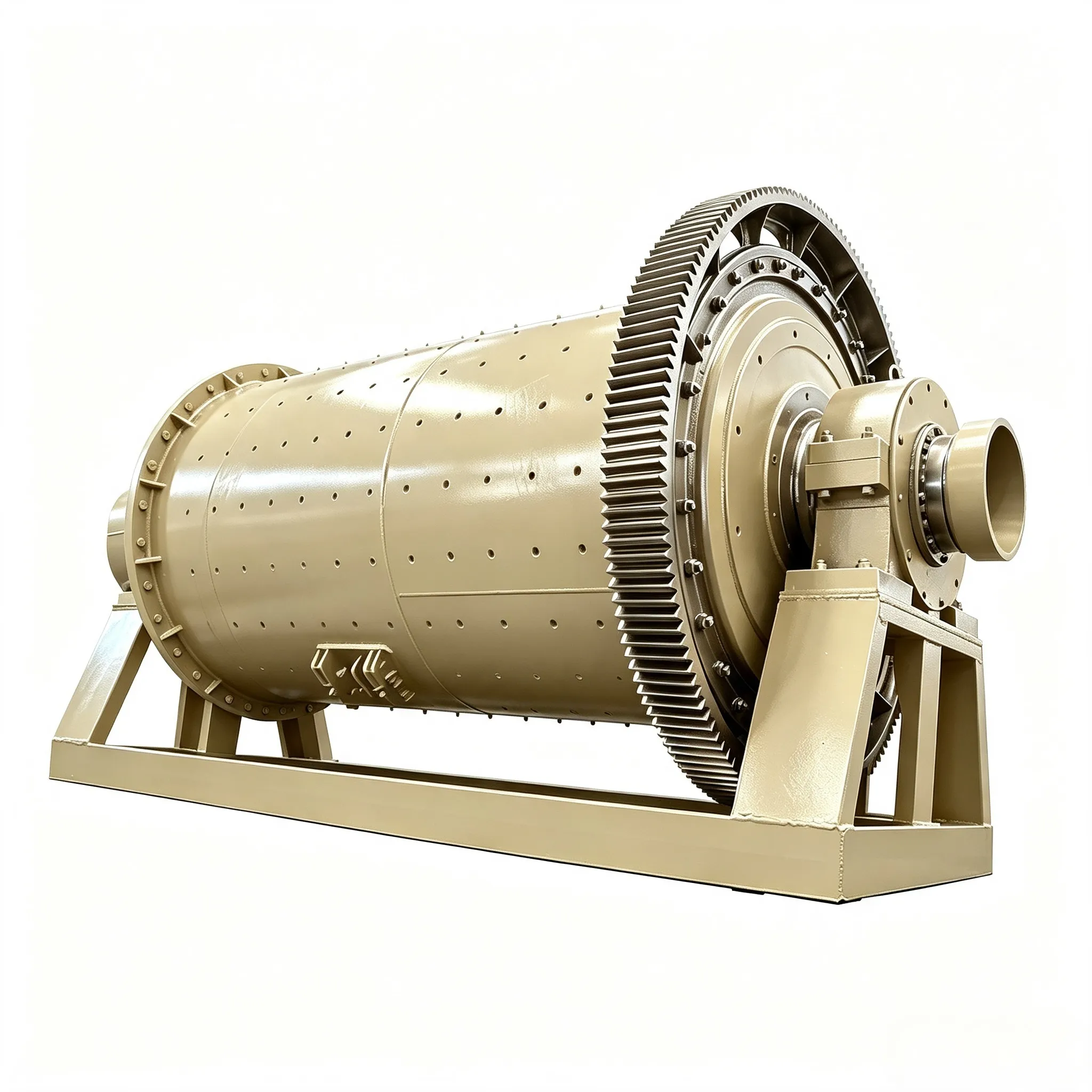
Kiesmühle
Bau einer Kieselmühle In einigen Industriezweigen, wie beispielsweise der chemischen Industrie,…

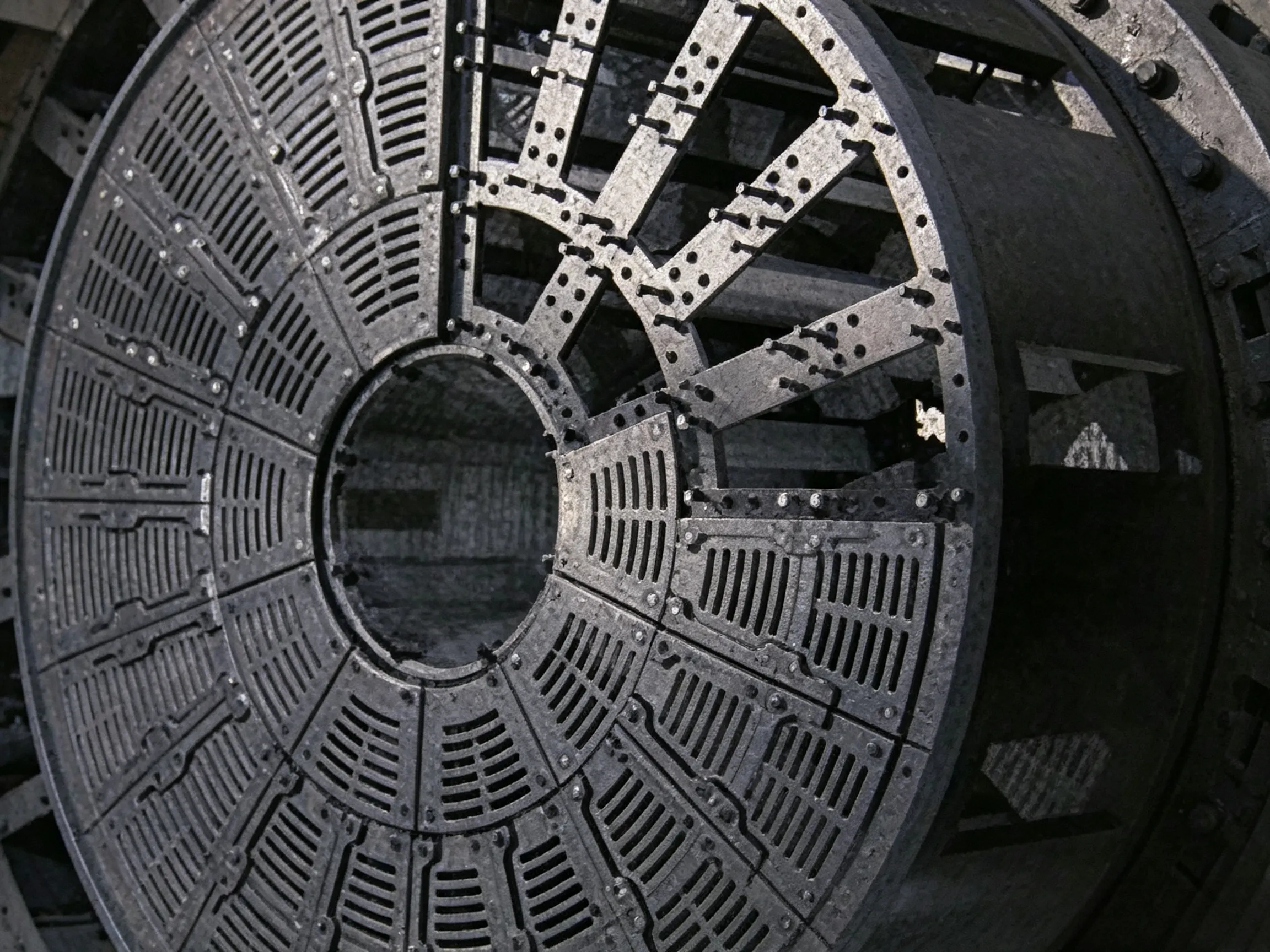
Soviet grinding experts discovered that in mills equipped with vertical partition diaphragms, over‑grinding causes fine particles to agglomerate and adhere to the liners and grinding media, thereby reducing grinding efficiency. When the layer of adhered material on the steel balls and liners reaches 200 μm, the impact energy is reduced by 80%.
The experts also found that only about half of the grinding media actually participate in the grinding process; the rest form a dense layer in the central region of the mill, rotating together with the shell during operation and contributing little to the grinding action. On this basis, they proposed and designed the inclined partition diaphragm.
This diaphragm consists of a row of A3 mild steel round bars, each 90 mm in diameter. These bars are arranged to form a plane inclined at a certain angle to the mill rotation centreline, with specified gaps between the bars. The assembled plane is secured to the mill shell by bolts through lug plates welded at both ends.
The working principle of the inclined Trennmembran is shown in Figure 2.24.
As can be seen from Figure 2.24, when the mill equipped with an inclined partition diaphragm is in operation, the positions of the top and bottom of the diaphragm, as well as the positions of the grinding media and material, are constantly changing: when the diaphragm is at position I in the figure, the length of the coarse-grinding compartment L₁ is at its shortest, while the stacking height h₁ of the grinding media in this compartment is at its maximum; at the same time, the length of the fine-grinding compartment L₃ is at its longest (L₃ = L₂ + △L), and the stacking height h₂ of the grinding media in this compartment is at its minimum. When the mill shell rotates 180° and the inclined diaphragm reaches position II (shown by the dashed lines in the figure), the length of the coarse-grinding compartment increases by △L and becomes its maximum (△L = D / tan α, where D is the effective inner diameter of the tube mill and α is the angle between the diaphragm and the longitudinal axis of the mill). At this point, the grinding media and material in the coarse-grinding compartment move longitudinally by a distance of △L, and the stacking height of the grinding media in the coarse-grinding compartment becomes its minimum. The situation in the fine-grinding compartment is the opposite: the compartment length decreases by △L and becomes its minimum, while the stacking height of the grinding media increases to its maximum. In this way, during mill operation, the positions of the top and bottom of the inclined diaphragm periodically and continuously change, and the grinding media in the compartments also undergo periodic longitudinal movement, thereby intensifying the grinding action. The reason for the longitudinal movement of the grinding media is that the installation inclination angle of the diaphragm is greater than the natural angle of repose of the grinding media, requiring no additional energy input. It should be noted that the natural angle of repose of steel cylinders (cylpebs) is larger than that of steel balls; therefore, a tube mill equipped with an inclined partition diaphragm should not use steel cylinders, but should instead use small steel balls of φ25–30 mm.
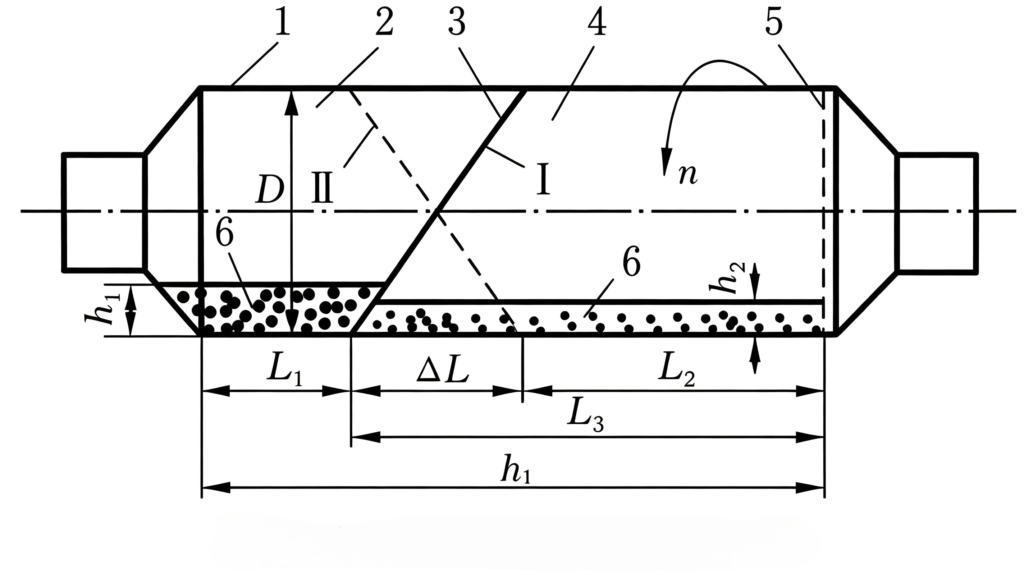
1—Shell; 2—Coarse-grinding compartment; 3—Inclined partition diaphragm device; 4—Fine-grinding compartment; 5—Discharge grate plate; 6—Grinding media
The grate openings of the inclined partition diaphragm are arranged only in the area that comes into contact with the material in the coarse‑grinding compartment; no grate openings should be provided in the area that contacts the material in the fine‑grinding compartment. In this way, during the rotation of the inclined diaphragm from position I to position II, both the grinding media and the material in the △L section of the coarse‑grinding compartment are lifted up and then move downward along its surface. At this time, the fine particles pass through the grate openings into the fine‑grinding compartment, while the coarse particles are returned to the L₁ section of the coarse‑grinding compartment for re‑grinding.
In summary, in a mill equipped with an inclined partition diaphragm, not only is the “static layer” (dead layer) of the grinding media eliminated, thereby intensifying the impact and grinding action of the media, but the classification of material within the mill is also enhanced, and over‑grinding is reduced. Consequently, the grinding efficiency is high.
The former Soviet Union conducted trials on a Φ4 × 13.5 m cement mill equipped with an inclined partition diaphragm. The diaphragm inclination angle was 42.5°, the filling rate of the first compartment was 0.30, that of the second compartment was 0.25, the mill speed ratio was 76%, and the operating speed was 16.3 r/min. With a total reduction in grinding media load of 60 tonnes, the mill output increased by 15.29%, the output per kilogram of grinding media was 40% higher than that with a vertical diaphragm, the unit power consumption decreased by 25.8%, the required power decreased by 14.5%, the current required for the main drive dropped from 310 A to 240 A, the discharge material temperature decreased by about 10 °C, the lubricating oil and main bearing temperatures dropped by 10–15 °C, the motor bearing temperature of the main drive decreased by 3–8 °C, and the temperature of the rotor and stator coil windings decreased by 10–12 °C.
The Changshu Building Materials Plant in China conducted production comparison tests on MB1577 raw mills and MB1870 mills, both with vertical and inclined partition diaphragms. The results are shown in Table 2.8.
Table 2.8: Results of Productivity Comparison Tests between Installing Vertical Partition Plates and Installing Inclined Partition Plates
| Mill specification | MB1577 | MB1870 | ||
| Form of compartment divider | Vertical compartment divider | Inclined compartment divider | Vertical compartment divider | Inclined compartment divider |
| One-bin ball loading capacity (t) | 4.84 | 4.3 | 8.22 | 7.5 |
| Ball loading capacity of bin 2 (t) | 8.8 | 9 | 16 | 14.7 |
| Total ball volume (t) | 13.64 | 13.3 | 24.22 | 22.2 |
| Average ball diameter (mm) | 64.9 | 64 | ||
| Average output (t/h) | 3.32 | 3.7 | 5.5 | 7.5 |
| Average yield increase rate (%) | 11.4 | 36.4 | ||
| Ammeter reading (A) | 320 | 260~280 | ||
| Decrease in ammeter reading (A) | 20 | 40~60 | ||
| Ammeter reading decrease rate (%) | 12.5~18.8 | |||
Factory tests also showed that:
(1) Because the area of the inclined partition diaphragm is 30%–45% larger than that of the vertical type, and the gaps between the inclined bars are wider than the slots of the vertical diaphragm, the internal ventilation of the mill is improved: the negative pressure inside the mill, originally less than 10 MPa, increased to 30–50 MPa after installing the inclined diaphragm.
(2) The consumption of grinding media decreased: originally 6–9 t had to be added every 10 days, now only 6 t is added every 2 months.
(3) The mill operation rate reached 89%, indicating that the inclined partition diaphragm is reliable.
(4) Changing from a vertical to an inclined partition diaphragm does not involve altering the geometric dimensions or rotational speed of the mill shell, nor does it require increasing the motor power; it is easy to implement.
(5) The filling rate of steel balls in the first compartment should be appropriately reduced (to about 20%) to provide sufficient space for the balls to move freely and fully utilise their kinetic energy. The average diameter of the balls in the first compartment should be reduced by 10–20 mm.
(6) The second compartment should be charged with steel balls. If steel cylinders (cylpebs) are used instead, their load should be increased appropriately (by about 10%) to balance the grinding capacity of the second compartment with that of the first. This is because, in a mill with an inclined diaphragm, the flowability of cylinders is poorer, and the improvement in grinding capacity of the cylinder compartment is not as great as that of the ball compartment.
(7) The inclination angle of the inclined partition diaphragm to the horizontal should preferably be between 42° and 60°.
(8) The classifying (screening) effect of the inclined partition diaphragm is not ideal: when the diaphragm is at position I in Figure 2.24, the height of the grinding media and material in the front compartment is higher than that in the rear compartment, causing a large amount of material to flow backward into the rear compartment; when the diaphragm is at position II, the height in the rear compartment is higher than that in the front, and a large amount of material flows forward into the front compartment. This phenomenon results in an unstable grinding condition inside the mill. In addition, the angle formed between the inclined diaphragm and the mill shell creates a retention zone (dead zone), where the longitudinal movement of the grinding media is restrained and their grinding action cannot be fully developed.
 English English
 Spanish
 Russian
 Arabic
 Swahili
 French
 Turkish
 Portuguese
 Korean
 Japanese
 German
 Italian