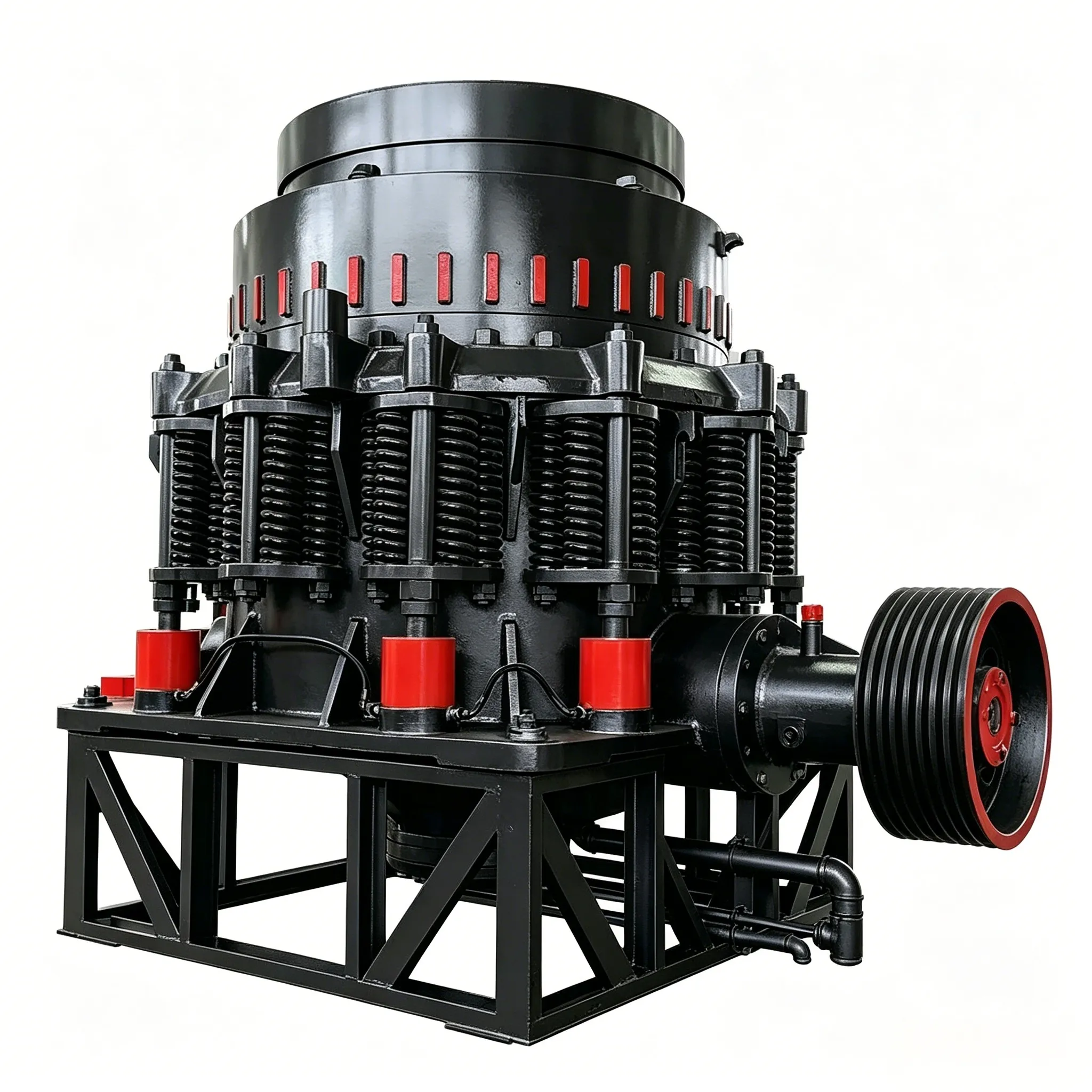

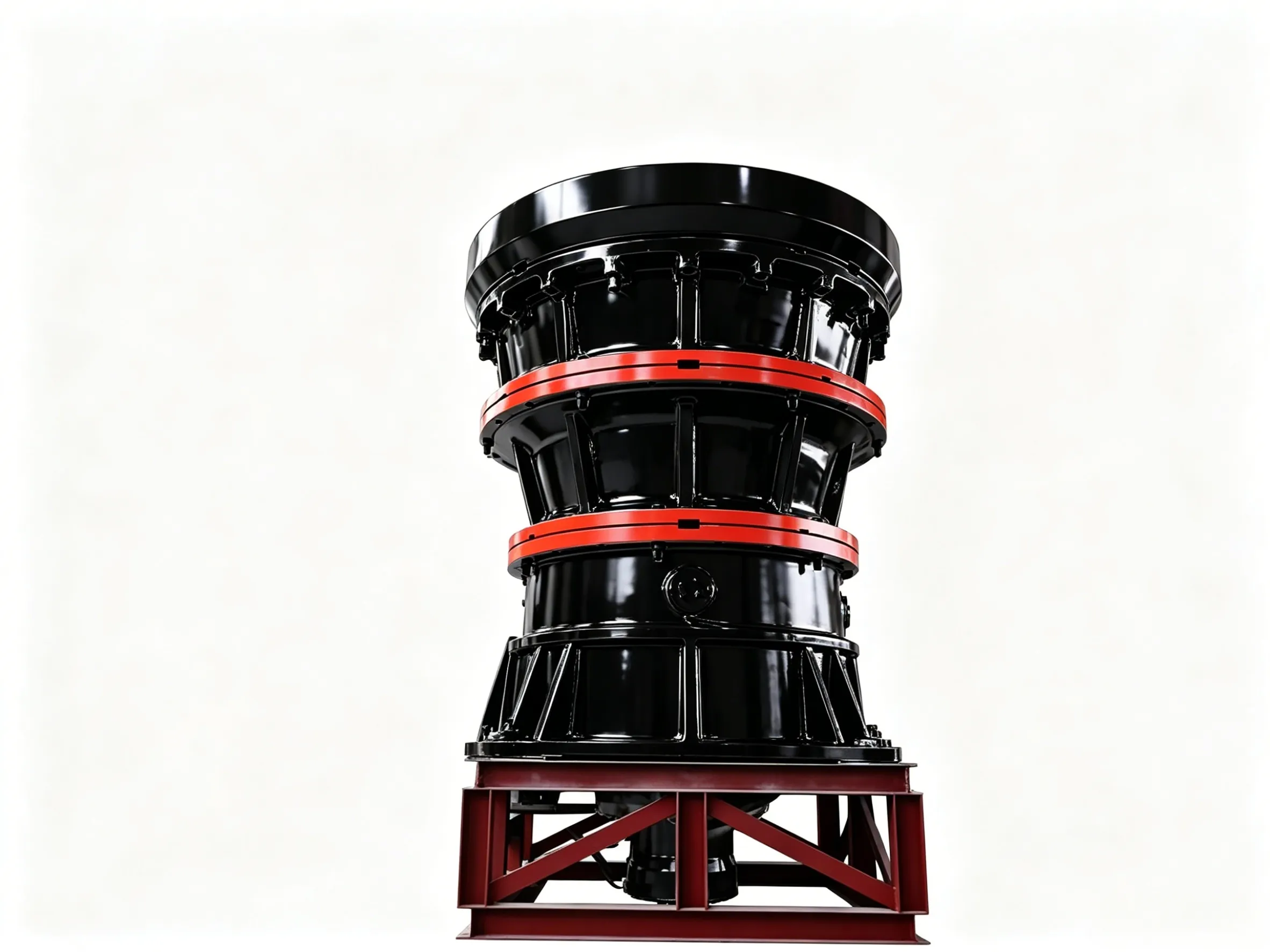
Gyratory crushers have been used in industry since 1880 and are still widely applied in large and medium-sized mineral processing plants and large quarries for coarse crushing of ores and rocks of various hardness levels.
Gyratory crushers have been used in industry since 1880 and are still widely applied in large and medium-sized mineral processing plants and large quarries for coarse crushing of ores and rocks of various hardness levels.
The working principle of this type of crusher is shown in Figure 3-1. The crushing chamber is the space between the movable cone (1) and the fixed cone (2). The motor drives the eccentric bushing (5) to rotate via a V-belt pulley (3) and a bevel gear pair (4). The eccentric bushing (5) then causes the movable cone (1) to perform a gyratory motion around the centerline of the crusher. The movable cone (1) alternately approaches and moves away from the fixed cone (2), so that the ore fed into the crushing chamber is continuously crushed by squeezing and bending forces. The crushed ore is discharged from the bottom of the crushing chamber by gravity.
Compared with jaw crushers, gyratory crushers crush ore continuously, so their production efficiency is higher than that of jaw crushers.
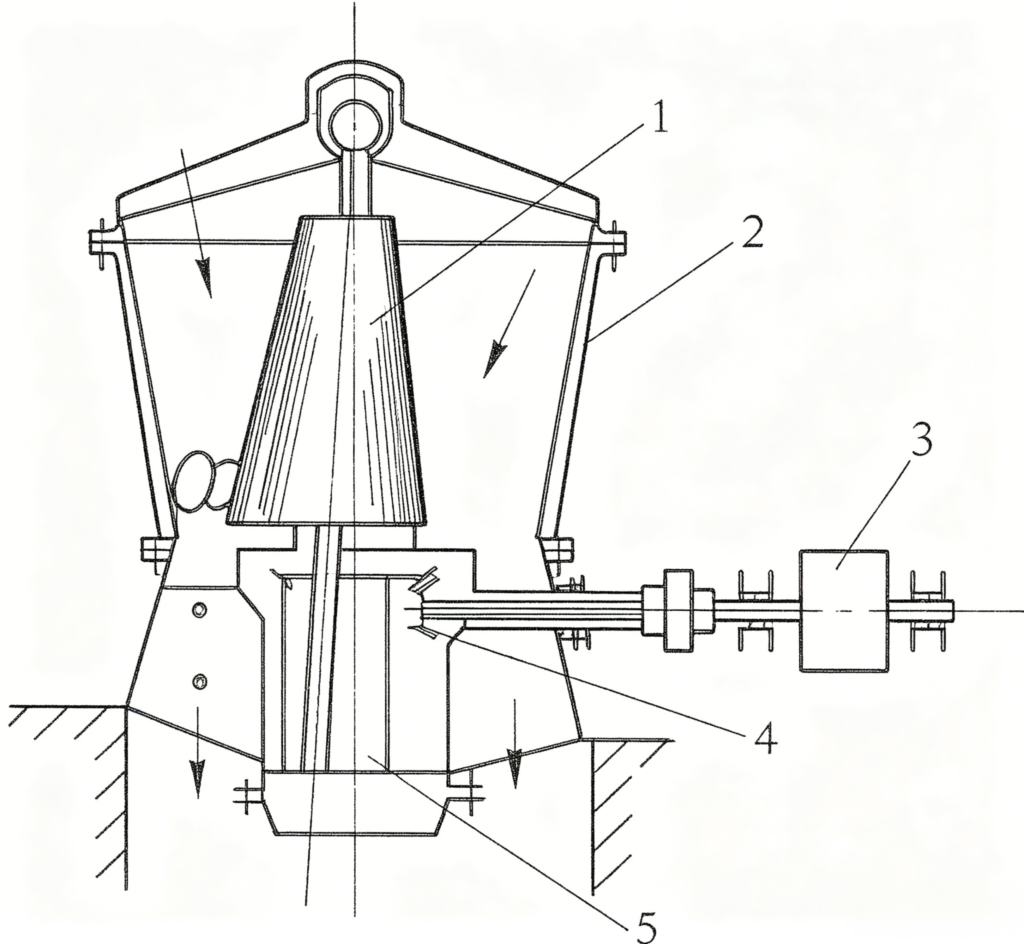
Figure 3-1 Schematic diagram of a gyratory crusher
1 – Movable cone 2 – Fixed cone 3 – V-belt pulley 4 – Bevel gear pair 5 – Eccentric bushing
Compared with jaw crushers, gyratory crushers crush ore continuously, so their production efficiency is higher than that of jaw crushers.
Gyratory crushers are basically of three types: fixed-shaft type, inclined discharge type, and center discharge type. Because the first two types have many disadvantages, China only produces the center discharge type of gyratory crusher. The disadvantage of this type of gyratory crusher is that it lacks a reliable safety device, and the discharge opening adjustment device is not only inconvenient to operate but also has a very small adjustment range. Therefore, hydraulic gyratory crushers are also produced. The use of hydraulic adjustment and hydraulic safety makes it easy to adjust the discharge opening width and makes the machine’s safety device reliable and secure.
At present, the technical performance and parameters of domestically produced gyratory crushers are listed in Tables 3-1 and 3-2. An example of the model specification interpretation is as follows:
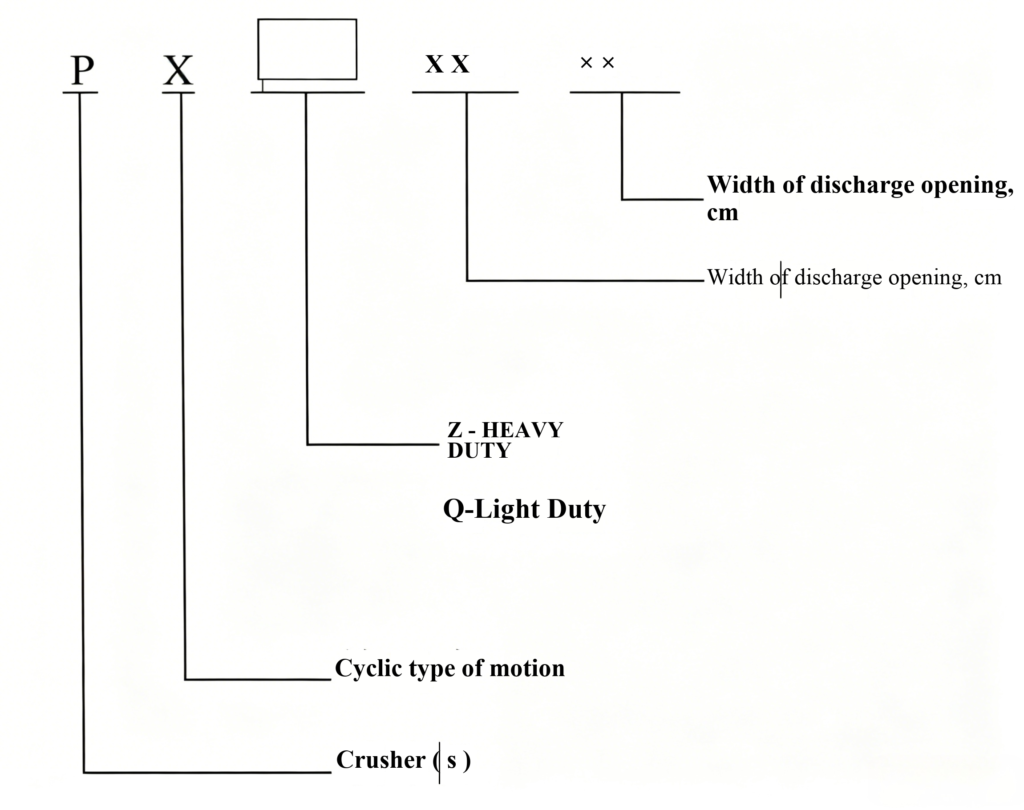
Table 3-1 Technical performance and parameters of hydraulic gyratory crushers
| Modelo | inlet size/mm | outlet size /mm | max size/mm | capacity/t ·h-¹ | Movable cone diameter /mm | movable cone speed/rmin⁻¹ | Drive motor | Lubrication and hydraulic specifications /L ·min¹ | weigh/t | |||
| modelo | power/kW | rotation/r+nin-¹ | V | |||||||||
| PXZ700/100 | 700 | 100 | 580 | 310~400 | 1400 | 140 | JRI36-8 | 145 | 730 | 380 | 40 | 92 |
| PXZ900/90 | 900 | 90 | 750 | 380~510 | 1400 | 140 | JR137-8 | 210 | 730 | 380 | 63 | 142 |
| PXZ900/130 | 900 | 130 | 750 | 625-800 | 1650 | 125 | JR137-8 | 210 | 730 | 380 | 63 | 142 |
| PXZ1200/160 | 1200 | 160 | 1000 | 1250-1480 | 2000 | 110 | JR158-10 | 310 | 590 | 6000 | 125 | 230 |
| PXZ1200/210 | 1200 | 210 | 1000 | 1560-1720 | 2000 | 110 | JR158-10 | 310 | 590 | 6000 | 125 | 230 |
| PXZ1400/170 | 1400 | 170 | 1200 | 1750~2060 | 2200 | 105 | JR1510-10 | 400 | 590 | 6000 | 125 | 315 |
| PXZ1400/220 | 1400 | 220 | 1200 | 2160-2370 | 2200 | 105 | JR1510-10 | 400 | 590 | 6000 | 125 | 306 |
| PXZ1600/180 | 1600 | 180 | 350 | 2400-2800 | 2500 | 100 | JR1512-8 | 570 | 730 | 6000(3000) | 125 | 480 |
| PXZ1600/230 | 1600 | 230 | 1350 | 2950-3200 | 2500 | 100 | JRI512-8 | 570(700) | 730 | 6000(3000) | 125 | 480 |
| PXZ1524/178 | 1524 | 178 | 1300 | 2340 | 105 | JR1510-10 | 430 | 590 | 3000 | 125 | 450 | |
| PXZ1850/220 | 1850 | 220 | 1450 | 4000-4550 | 2800 | 90 | JR1512-6 | 780 | 970 | 6000 | 125 | 700 |
| PXZ1850/270 | 1850 | 270 | 450 | 4700~5000 | 2800 | 90 | JR1512-6 | 780 | 970 | 6000 | 125 | 700 |
Table 3-2 Technical performance and parameters of PXZ and PXQ type gyratory crushers
| mmodel | inlet size/mm | outlet size/mm | max feed size/mm | Discharge opening adjustment range/mim | capacity/1t ·h-¹ | Bottom diameter of the crushing cone/mn | motor | Lubrication and hydraulic specifications /L ·min¹ | Cooling water consumption/m³ ·h- | weigh/t | |||
| modelo | power/kW | rotation/r+nin-¹ | V | ||||||||||
| PXZ0506 | 500 | 60 | 420 | 60-75 | 140~170 | 1200 | JR128-10 | 130 | 585 | 380 | 40 | ||
| 3 | 44.1 | ||||||||||||
| PXZ0710 | 700 | 100 | 580 | 100-130 | 310-400 | 1400 | JR128-8JR136-8 | 155145 | 730 | 3803000 | 40 | 3 | 91.2 |
| PXZ0909 | 900 | 90 | 750 | 90~120 | 380-510 | 1650 | JR137-8 | 210 | 735 | 380 | 63 | 3 | 141 |
| PXZ0913 | 900 | 130 | 750 | 130-160 | 625-770 | 1650 | JR137-8 | 210 | 735 | 380 | 63 | 3 | 141 |
| PXZ0917 | 900 | 170 | 750 | 170-190 | 815-910 | 1650 | JR137-8 | 210 | 735 | 380 | 63 | 3 | 141 |
| PXZ1216 | 1200 | 160 | 1000 | 160-190 | 1250~ 1480 | 2000 | JRQ158-10 | 310 | 590 | 6000 | 125 | 6 | 228.2 |
| mmodel | inlet size/mm | outlet size/mm | max feed size/mm | 排料口调整范围/mm | capacity/1t ·h-¹ | Bottom diameter of the crushing cone/mn | motor | Lubrication and hydraulic specifications /L ·min¹ | Cooling water consumption/m³ ·h-1 | weigh/t | |||
| modelo | power/kW | rotation/r+nin-¹ | V | ||||||||||
| PXZ122 | 1200 | 210 | 1000 | 210-230 | 1560~ 1720 | 2000 | JRQ158-10 | 310 | 590 | 6000 | 125 | 6 | 228.2 |
| PXZ1417 | 1400 | 170 | 1200 | 170-200 | 1750-2060 | 2200 | JRQ1510-10 | 430400 | 590 | 30006000 | 125 | 6 | 309 |
| PXZ1422 | 1400 | 220 | 1200 | 210~ 230 | 2160-2370 | 2200 | JRQ1510-10 | 430400 | 590 | 30006000 | 125 | 6 | 309 |
| PXZ1618 | 1600 | 180 | 1350 | 180-210 | 2400~ 2800 | 2500 | JRQ158-10② | 310 | 590 | 6000 | 125 | 6 | 481 |
| PXZ1623 | 1600 | 230 | 1350 | 210~ 240 | 2800-3200 | 2500 | JRQ158-102 | 310 | 590 | 6000 | 125 | 6 | 481 |
| PXQ0710 | 700 | 100 | 580 | 100-120 | 200-240 | 1200 | JR128-10 JR136-8 | 130145 | 585 | 3803000 | 40 | 3 | 45 |
| PXQ0913 | 900 | 130 | 750 | 130-150 | 350-400 | 1400 | JR128-8 | 155 | 730 | 380 | 40 | 3 | 86.7 |
| PXQ1215 | 1200 | 150 | 1000 | 150~ 170 | 720~ 815 | 1650 | JR137-8 | 210 | 735 | 380 | 63 | 6 | 144 |
① Production capacity is calculated based on the bulk density of the ore as 1.6 t/m³;
② Dual motor drive.
Construction of a Center Discharge Gyratory Crusher
The construction of a center discharge gyratory crusher is shown in Figure 3-2.
As can be seen from Figure 3-2, the lower frame (4) of the crusher is installed on a reinforced concrete foundation. A steel plate (39) is laid over the central discharge hole in the foundation to prevent the ore falling from the crusher from damaging the foundation. The lower frame (4), the middle frames (6, 10), and the crossbeam (11) are connected by pins tightened with wedges.
A manhole is provided on the side wall of the lower frame for inspecting the operation of the machine. During normal operation, the manhole is covered with a cover (29). Protective plates (28 and 35) are laid over the four ribs (30) connecting the side wall of the frame to the central sleeve (31) and over the transmission shaft sleeve (34) to prevent falling ore from damaging the ribs and the sleeve.
A steel bushing (32) is press-fitted into the bored hole of the central sleeve (31). The eccentric bushing (5), which is lined with Babbitt metal on its inner surface and three-quarters of its outer surface, rotates inside the steel bushing (32). To ensure a strong bond with the Babbitt metal, the inner and outer surfaces of the eccentric bushing (5) are provided with dense dovetail grooves and many small holes, so that the Babbitt metal on both surfaces is cast more firmly. Between the central sleeve (31) and the large bevel gear (26), three thrust disks are placed to support the weight of the large bevel gear and the eccentric bushing. The lower disk is made of steel and fixed to the upper end of the central sleeve with pins to prevent rotation; the upper disk is also made of steel and fixed to the large bevel gear with screws, rotating together with it; the middle bronze disk (27) rotates freely between the upper and lower disks at approximately half the rotational speed of the eccentric bushing.
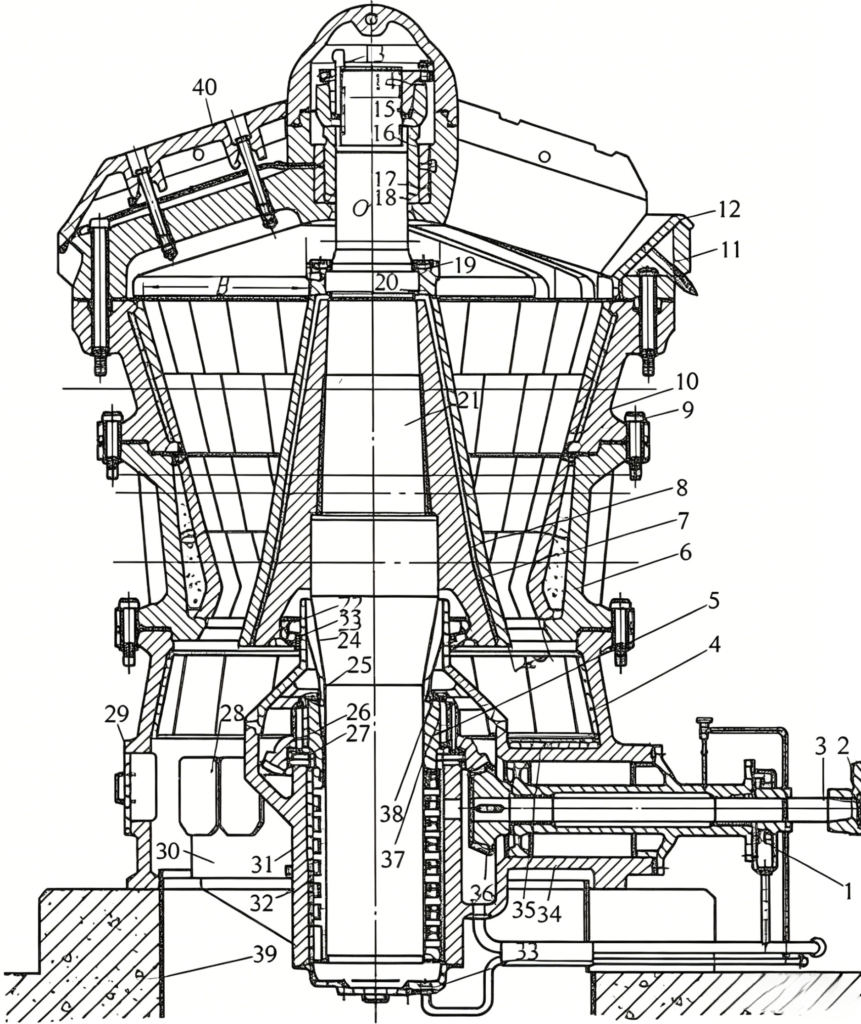
Figure 3-2 Structure of a gyratory crusher
1 – Drive bearing housing 2 – Coupling 3 – Drive shaft 4, 6, 10 – Frame sections 5 – Eccentric bushing 7 – Movable cone body 8, 9 – Liner plates 11 – Crossbeam
12, 28, 35, 40 – Protective plates 13 – Key 14, 20 – Nuts 15 – Pressing sleeve 16 – Tapered sleeve 17, 32 – Bushings 18 – Support ring 19 – Locking plate 21 – Main shaft 22, 23, 24 – Collars
25 – Oil baffle ring 26, 36 – Gears 27 – Disk 29 – Manhole cover 30 – Rib 31, 34 – Sleeves 33 – Bottom cover 37 – Dust cover 38 – Dust seal ring 39 – Steel plate
The motor drives the crushing cone through the V-belt pulley, elastic coupling (2), drive shaft (3), bevel gear pair (36 and 26), and eccentric bushing (5). The lower end of the main shaft (21), which is suspended from the crossbeam, is inserted into the eccentric bore of the eccentric bushing. When the eccentric bushing (5) rotates, the main shaft and the movable cone body (7), which is shrink-fitted onto the middle part of the main shaft, perform a gyratory motion. Any point on the surface of the movable cone moves along a conical surface with the suspension point O as the apex, thereby crushing the ore. The crushed ore is discharged from the bottom of the movable cone by gravity.
The outer surface of the movable cone body is fitted with a liner plate (8) made of manganese steel. To ensure tight contact between the liner plate and the movable cone body, zinc is poured between them, and the upper end of the liner plate is secured with a nut (20). A locking plate (19) is mounted on top of the nut to prevent it from loosening.
Two rings of liner plates (9) are fitted inside the middle frame sections (6 and 10). The lower ring rests on the protruding part at the lower end of the frame, while the upper ring is inserted into the upper flange of the frame. This arrangement can withstand both the thrust force caused by friction during crushing and the vertical component of the crushing force. After the liner plates are installed, concrete is poured to secure them.
The main shaft (21) is suspended from the crossbeam (11) by means of a tapered nut (14), tapered pressing sleeve (15), tapered sleeve (16), and support ring (18), with a wedge key (13) preventing the tapered nut (14) from loosening. The tapered end of the tapered sleeve (16) rests on the support ring (18), while its side rests on the bushing (17). During operation, because both the lower end and the side of the tapered sleeve (16) are conical surfaces, the tapered sleeve (16) can roll on the support ring (18) and the bushing (17), thereby meeting the requirements of the movable cone’s gyratory motion.
The upper part of the crossbeam is covered with protective plates (12 and 40) to prevent damage and wear from falling ore.
To prevent dust and fine ore particles from entering the rotating parts of the machine, three spherically contacting collars (22, 23, and 24) are mounted at the lower end of the movable cone to form a dust seal. Collar (24) is fixed to the lower end of the movable cone with screws. Collar (23) fits over the dust cover (37), with a dust seal ring (38) made of flexible rubber hose between them. The upper collar (22) rests freely on collar (23). Thus, dust cannot enter the interior of the crusher through the gaps between the collars.
The lubricating oil required by the crusher is supplied by a dedicated oil pump. The oil enters the lower space of the eccentric bushing through an oil hole in the bottom cover (33) of the frame, then rises along the gap between the main shaft and the eccentric bushing, as well as along the gap between the eccentric bushing and the bushing (32), simultaneously lubricating these two friction surfaces. Oil rising from the inner surface of the eccentric bushing meets the oil baffle ring (25) and overflows onto the bevel gear pair (26, 36), lubricating them, and then flows out through the oil discharge pipe. Oil rising from the outer surface of the eccentric bushing reaches the thrust disk (27) of the eccentric bushing, lubricates the disk, and also discharges through the oil discharge pipe.
The bearings of the crusher’s drive shaft have separate oil inlet and outlet pipes. The four bearings of the movable cone suspension device and the large and small belt pulleys are periodically lubricated with grease using a hand-operated grease pump.
The construction of other sizes of gyratory crushers is essentially similar to the above.
The original safety device for this type of gyratory crusher was a safety pin mounted on the drive belt pulley. Because it was difficult to accurately select the material and critical cross-sectional dimension of the safety pin, the safety effect was poor, and it has since been removed. As a result, these crushers now operate without a safety device.
The adjustment of the discharge opening of the gyratory crusher is achieved by the tapered nut (14) at the upper end of the main shaft. This adjustment structure is very inconvenient. Therefore, hydraulic gyratory crushers are generally adopted domestically at present.
Construction of a Hydraulic Gyratory Crusher
The previously introduced gyratory crusher has the following disadvantages: no safety device; difficulty in adjusting the discharge opening; and when the crusher is blocked by tramp material, it is very difficult to remove the ore or uncrushable objects jammed in the crushing chamber. In order to develop an ideal and perfected hydraulic gyratory crusher, several types of support structures for hydraulic gyratory crushers have been manufactured. Based on more than thirty years of practical experience and comprehensive analysis, the bottom hydraulic support structure was determined as the basic structure for hydraulic gyratory crushers, and a series design based on this structure began in 1975. The series of hydraulic gyratory crushers is shown in Table 3-1.
The basic structure of a hydraulic gyratory crusher is completely identical to that of a non-hydraulic gyratory crusher, with only the addition of a hydraulic device and minor local modifications. Therefore, this section only describes the differences.
Figure 3-3 shows the structure of a 1400/170 hydraulic gyratory crusher. A hydraulic cylinder (1) is provided at the lower part of the crusher. The hydraulic cylinder (1) consists of a cylinder body (2), a piston (3), a bushing (4), a lower friction disk (5), a middle friction disk (6), and an upper friction disk (7). The upper friction disk is fixed to the lower end of the main shaft, and the lower friction disk is fixed to the piston (3). Because the spherical center of the upper friction disk is at point O’ in the middle of the main shaft, when the crushing cone swings and rotates, the upper spherical surface and the lower flat surface of the middle friction disk each slide relative to the other surfaces at approximately half the swing stroke and half the rotational speed of the crushing cone.
The upper suspension device has been greatly simplified, thereby significantly improving the stress condition of the crossbeam (it is no longer subjected to the vertical component of the crushing force or the influence of the crushing cone’s autorotation on the crossbeam). To prevent wear of the main shaft, a copper bushing (9) is installed inside the tapered sleeve (8). A cover (10) is provided on the tapered sleeve (8) to prevent it from moving upward when the crusher returns rapidly to its normal position after ejecting tramp material.
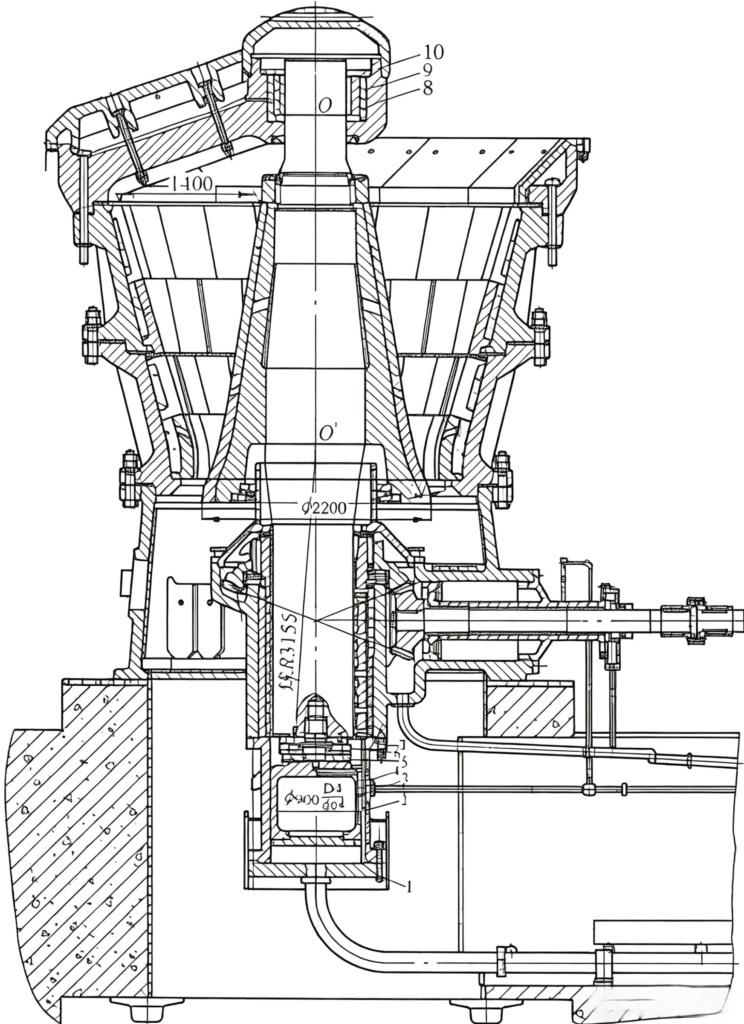
Figure 3-3 Structure of the 1400/170 hydraulic gyratory crusher
1 – Hydraulic cylinder 2 – Cylinder body 3 – Piston (plunger) 4 – Bushing 5 – Lower friction disk 6 – Middle friction disk 7 – Upper friction disk 8 – Tapered sleeve 9 – Bushing (copper bushing)
10 – Cover (gland)
The hydraulic cylinder (1) is connected via pipelines (3) to the accumulator (6) and the hydraulic power unit (7), as shown in Figure 3-4. To prevent individual ore pieces in the discharge from striking the hydraulic cylinder, a protective cover (2) is installed around the cylinder. To facilitate the disassembly and assembly of the hydraulic cylinder, slide rails (4) and a trolley (5) are provided in the foundation corridor.
The hydraulic system consists of a single-stage vane pump (1), a check valve (2), a relief valve (3), a shut-off valve (4), a one-way throttle valve (7), and an accumulator (8), as shown in Figure 3-5. The accumulator serves as a safety device, with its internal gas charging pressure generally at 1.1 MPa. The one-way throttle valve allows rapid action when tramp iron passes through and slow action during resetting, thereby reducing the intense impact on the crusher during resetting.
Before starting the crusher, the hydraulic cylinder (11) must first be filled with oil. The filling sequence is as follows: first open shut-off valve (4a) and close shut-off valve (4b), then start the pump (1). When the oil pressure reaches 0.8 MPa, the crushing cone begins to rise. After the crushing cone rises to its working position, shut-off valve (4a) can be closed and the pump (1) stopped simultaneously. The hydraulic system pressure is maintained at 0.8 MPa, and the crusher can then begin operation. After the crusher starts working, due to the crushing action on the ore, the hydraulic system naturally maintains an oil pressure that balances the crushing force, generally in the range of 0.8 to 1.1 MPa.
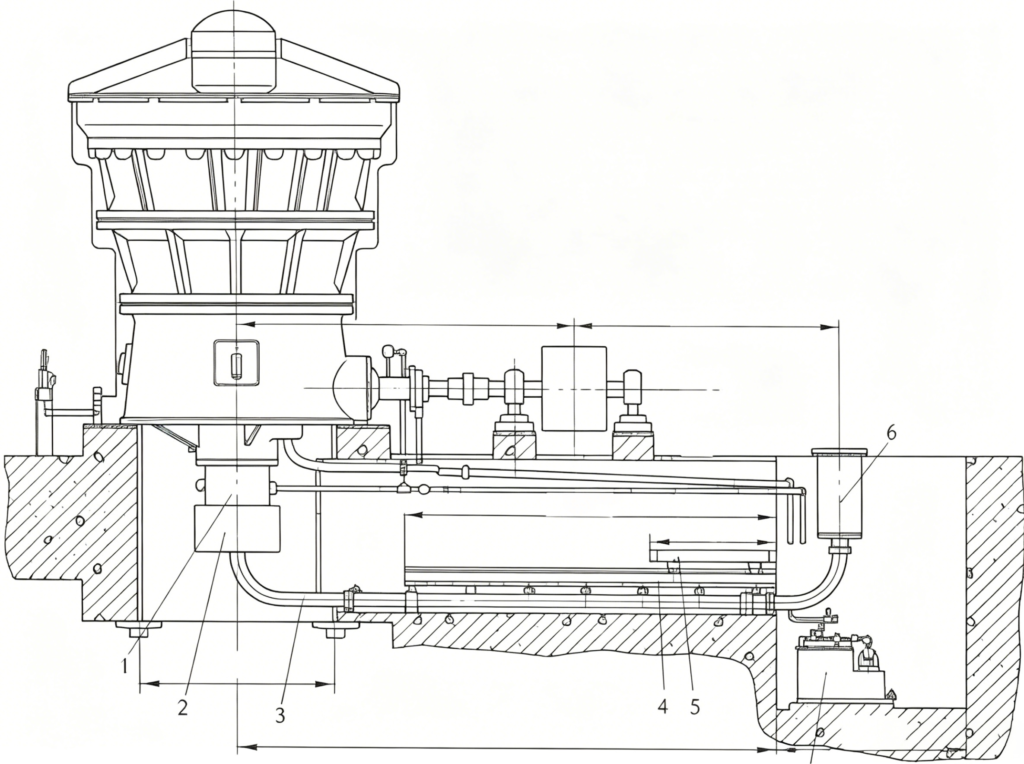
Figure 3-4 Outline side view of the 1400/170
1 – Hydraulic cylinder 2 – Protective cover 3 – Pipeline 4 – Slide rail
5 – Trolley 6 – Accumulator 7 – Hydraulic power unit (hydraulic station)
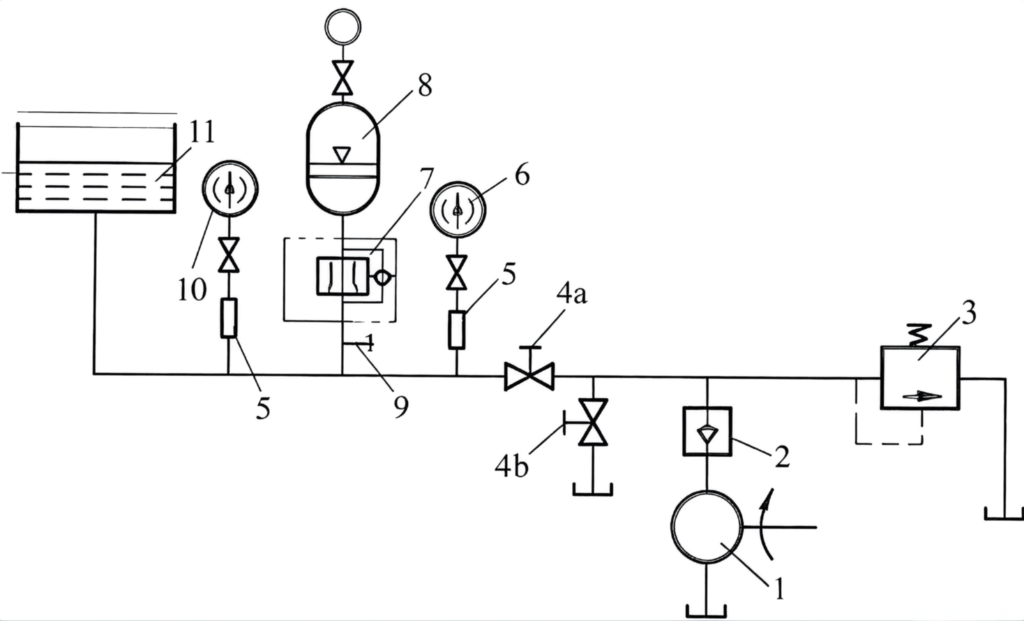
When an uncrushable object falls into the crushing chamber, the crushing force increases sharply, and the system oil pressure also rises rapidly. This breaks the relationship where the accumulator pressure is greater than the system oil pressure, forcing oil from the hydraulic cylinder into the accumulator (at this point, both the oil pressure in the cylinder and the gas pressure in the accumulator fluctuate between 1.1 and 1.5 MPa, forming a temporary balance). While oil is being forced from the hydraulic cylinder into the accumulator, the crushing cone does not drop; instead, the discharge opening increases, allowing the uncrushable object to be discharged. After the uncrushable object is discharged, the crushing force drops sharply, breaking the temporary balance again. Due to the action of the one-way throttle valve, the system gradually and relatively slowly returns to its original balance, and the crushing cone also slowly and automatically resets.
When the uncrushable object is too large to pass through the discharge opening (although hydraulic crushers can discharge uncrushable objects, there is still a limit), the oil pressure can be increased to 1.6 MPa. At this point, the electric contact pressure gauge triggers an automatic shutdown of the main motor.
After the crusher stops, the crushing chamber is jammed not only with the uncrushable object but also with a large amount of ore. To handle this situation, oil can be released to unload (i.e., open shut-off valves 4a and 4b to lower the crushing cone), followed by re-pressurizing to raise the cone. By repeatedly raising and lowering the crushing cone (like pounding garlic), the ore and uncrushable object jammed in the crushing chamber can be expelled.
When it is necessary to increase or decrease the discharge opening during operation, the following procedures are used:
(1) Increasing the discharge opening: Open shut-off valves 4a and 4b to drain the oil from the hydraulic cylinder back to the tank, allowing the crushing cone to descend. After reaching the desired setting, close shut-off valves 4a and 4b.
(2) Decreasing the discharge opening: Open shut-off valve 4a, start pump 1, and fill the hydraulic cylinder with oil, causing the crushing cone to rise. After reaching the desired setting, close shut-off valve 4a and simultaneously stop the pump.
The oil pressure variation values for various operating conditions depend on the properties of the material being crushed. The values mentioned above are calculated for a specific crusher size based on the rated power of the motor. End users may modify them according to their specific conditions.
The trolley is a device for disassembling and assembling the hydraulic cylinder during maintenance (Figure 3-6). Below the slide rails (4), there are seven pairs of support rollers (1) and one pair of pinch rollers (2). The pinch rollers (2) both support the slide rails and the trolley and also press down on the slide rails, keeping them balanced when moving to the left. The procedure for removing the hydraulic cylinder is as follows:
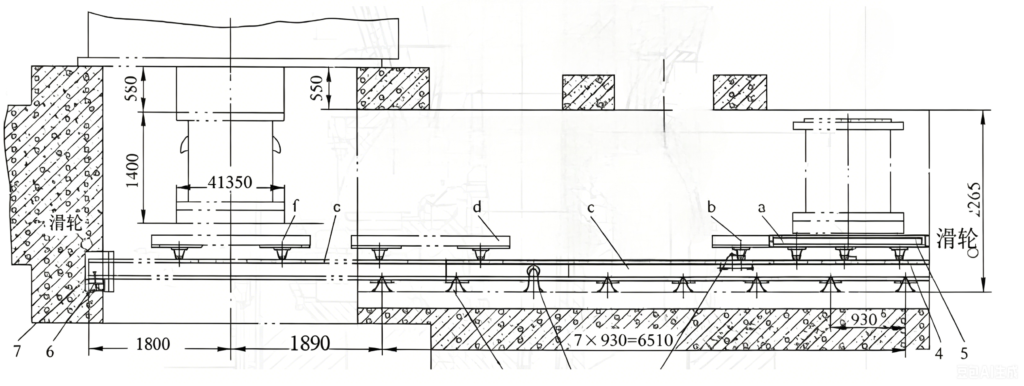
Figure 3-6 Trolley device
1 – Support roller 2 – Pinch roller (or pressure roller) 3 – Baffle plate 4 – Slide rail
5 – Trolley (or small cart) 6 – Bracket 7 – Pin (or dowel pin)
(1) As shown in Figure 3-6, first move the trolley (5) from position a to position b, then secure the trolley with the baffle plate (3). The purpose of this step is to ensure that when the slide rail moves to the left, the right-side roller of the trolley enters the left side of the second support roller on the right side of the slide rail before the slide rail disengages from the first support roller on the right, thereby ensuring smooth movement.
(2) Move the slide rail from position c to position e, and secure the slide rail to the bracket (6) using the pin (7). At this point, the trolley enters position d.
(3) Remove the baffle plate (3), move the trolley to position f, then secure it again with the baffle plate.
(4) Use a crane to lift the cylinder lug, and place the hydraulic cylinder onto the trolley.
(5) Move the trolley back to position d and secure it, move the slide rail back to position c, then move the trolley back to position a. The hydraulic cylinder can now be lifted out for repair.
The procedure for returning the hydraulic cylinder is the same as above. When moving the slide rail or the trolley, it can be done manually, or a winch can be installed on both sides and operated by a crane.
The hardness of ores varies greatly. In the past, the same type of gyratory crusher was used for both hard ores (with a hardness above 18) and soft ores (with a hardness below 8). This resulted in significant waste for the latter. For this reason, the hydraulic gyratory crusher series now includes light-duty models: 700/100, 900/130, and 1200/150. As can be seen from Table 3-2, for the same 1200 size, the light-duty model is 80 t lighter than the standard model. The basic structure and working principle of the light-duty and standard hydraulic gyratory crushers are completely identical (see Figure 3-7).
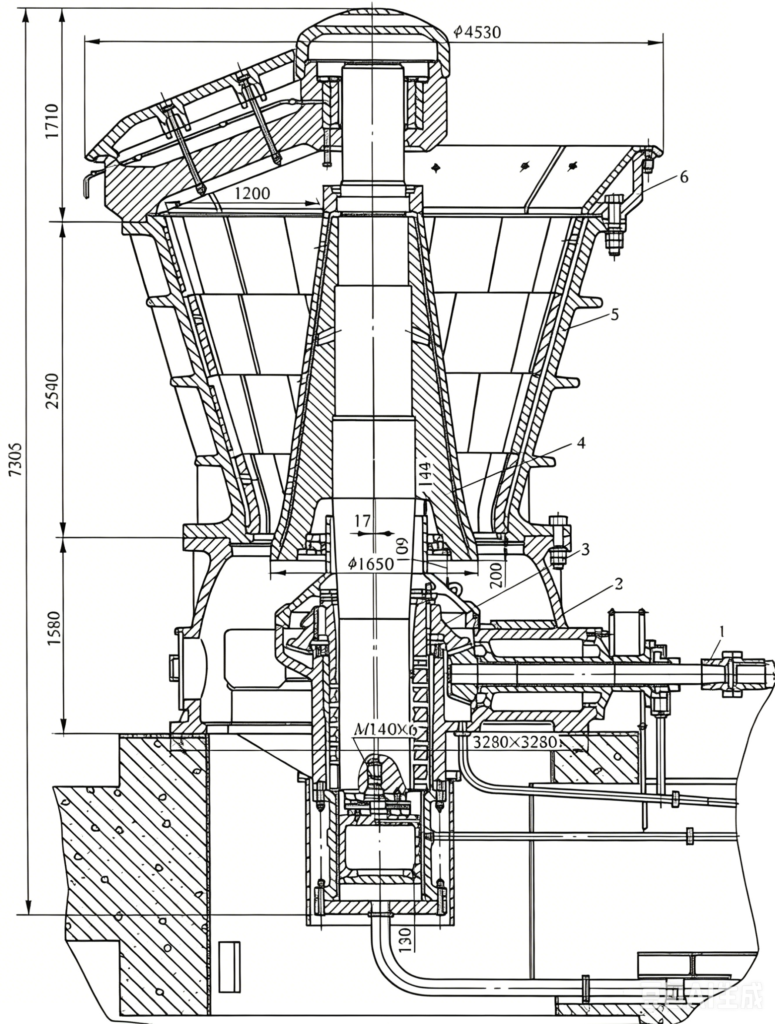
Figure 3-7 Structure of the 1200 light-duty hydraulic gyratory crusher
1 – Drive unit 2 – Frame 3 – Eccentric sleeve 4 – Movable cone 5 – Middle frame body 6 – Crossbeam