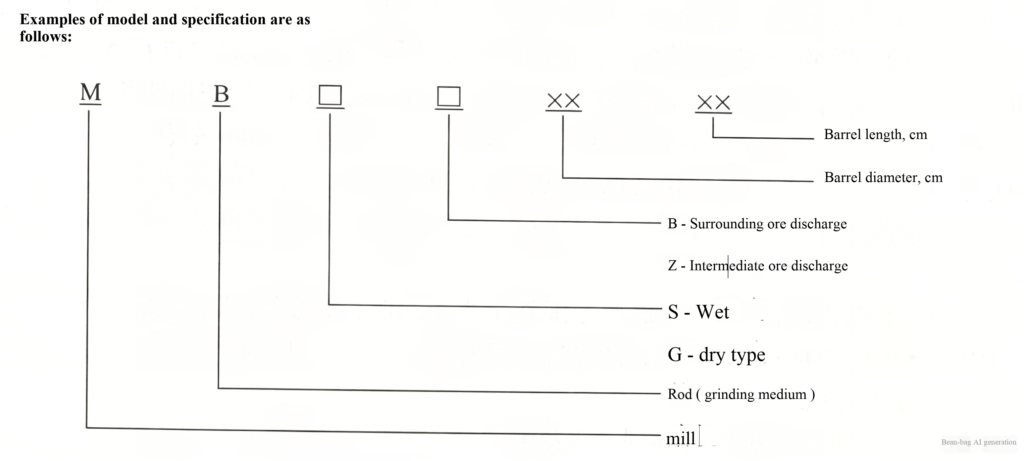

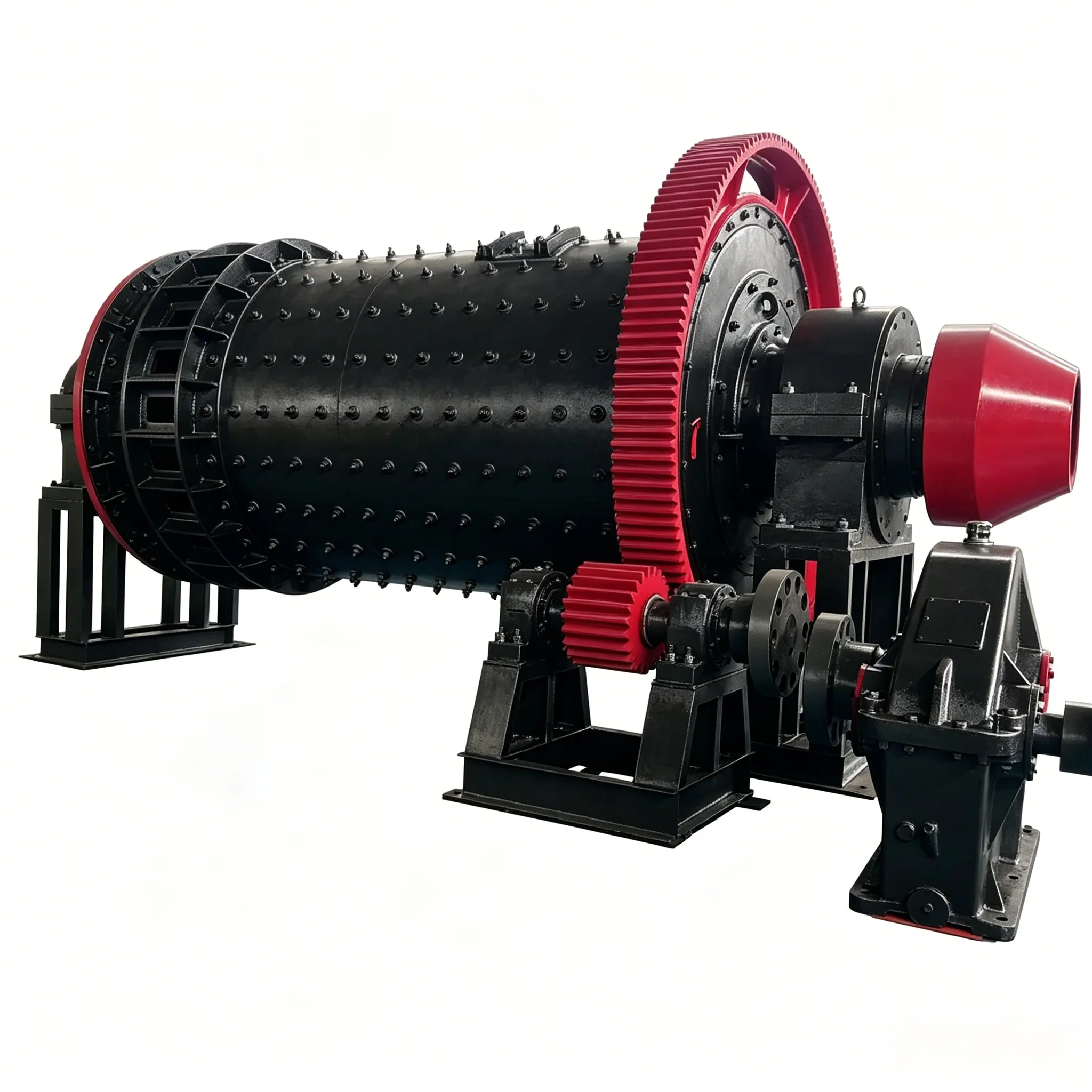
Wet rod mills can be classified into overflow type, open‑end type, and peripheral discharge type according to the discharge method, with the overflow type being the most common. Dry rod mills use air sweeping for discharge, but this type is generally not manufactured in China.
Wet rod mills can be classified into overflow type, open‑end type, and peripheral discharge type according to the discharge method, with the overflow type being the most common. Dry rod mills use air sweeping for discharge, but this type is generally not manufactured in China.
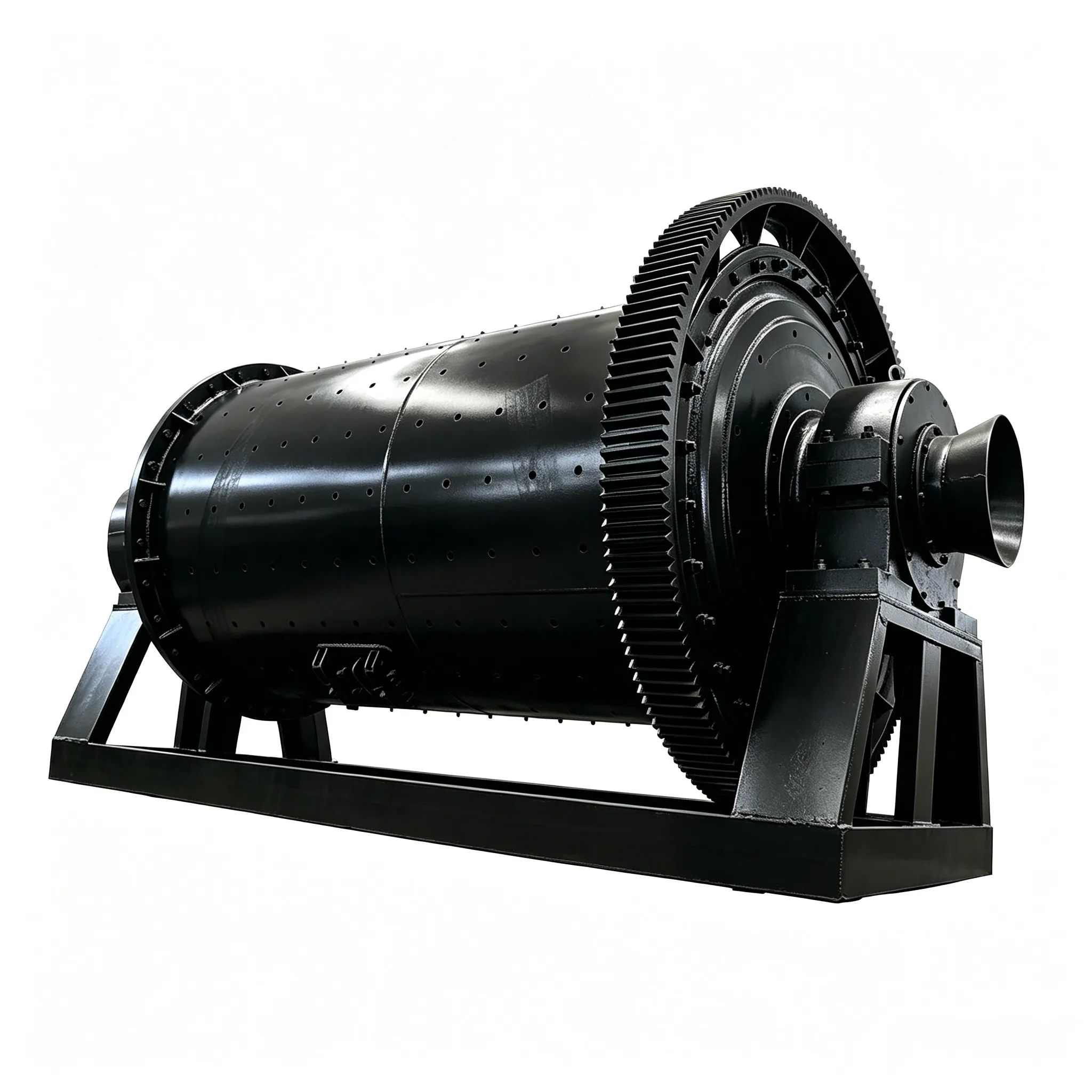
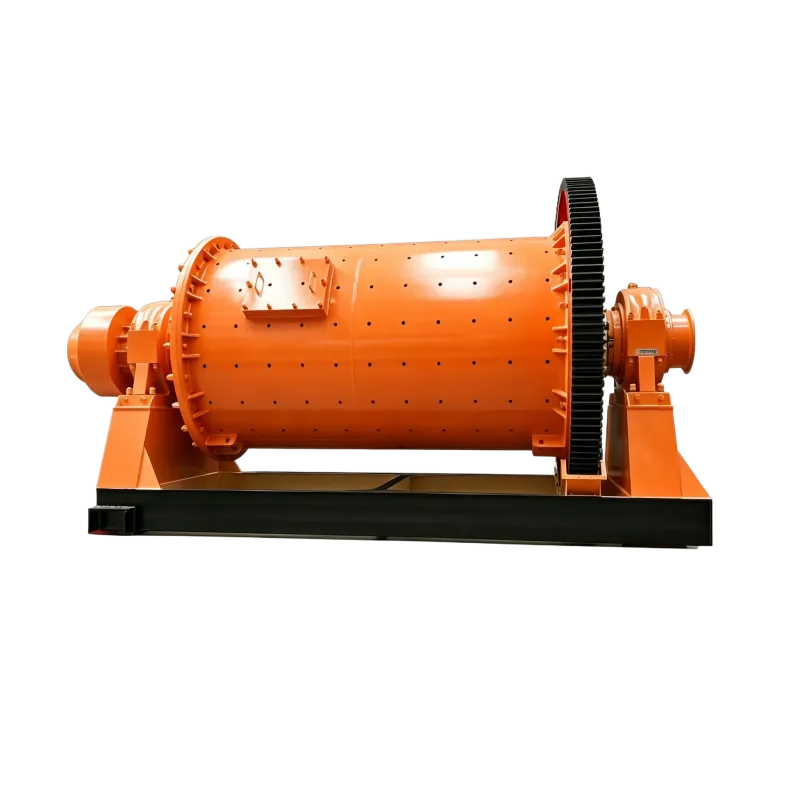
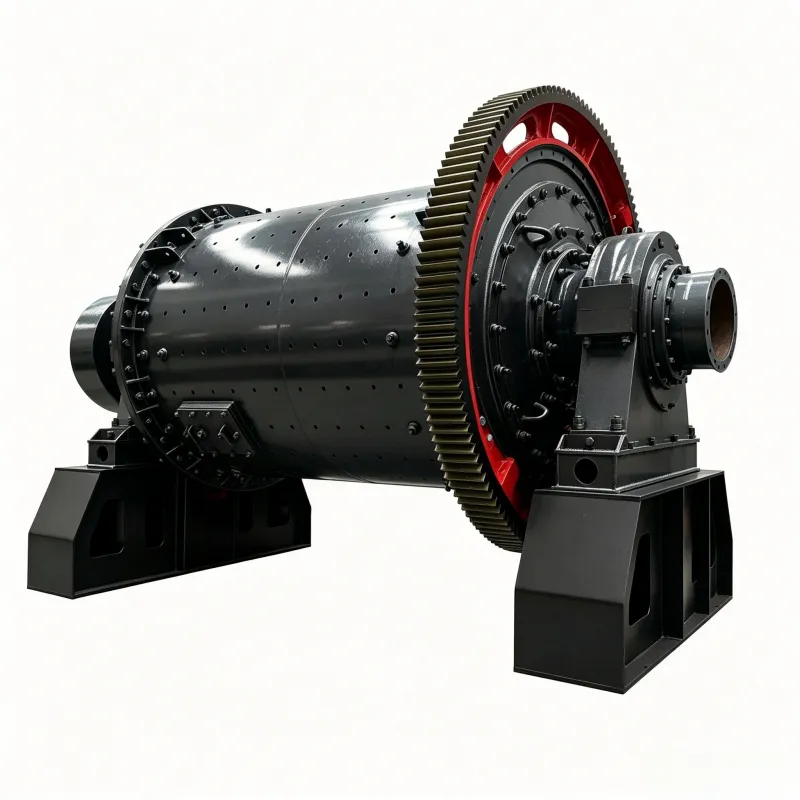
The construction of an overflow rod mill is basically the same as that of an overflow ball mill (Figure 9‑14). The differences are that the conical end cover of the rod mill has a smaller curvature, its inner surface is lined with smooth liners, while the shell is generally lined with non‑smooth (profiled) liners; the discharge trunnion has a larger diameter. The purpose is to ensure that the steel rods move regularly inside the mill without becoming skewed, so that they do not strike and bend each other when falling. The larger discharge opening also facilitates rod charging, access for inspection and maintenance, and lowers the slurry level, allowing the slurry to be discharged quickly.
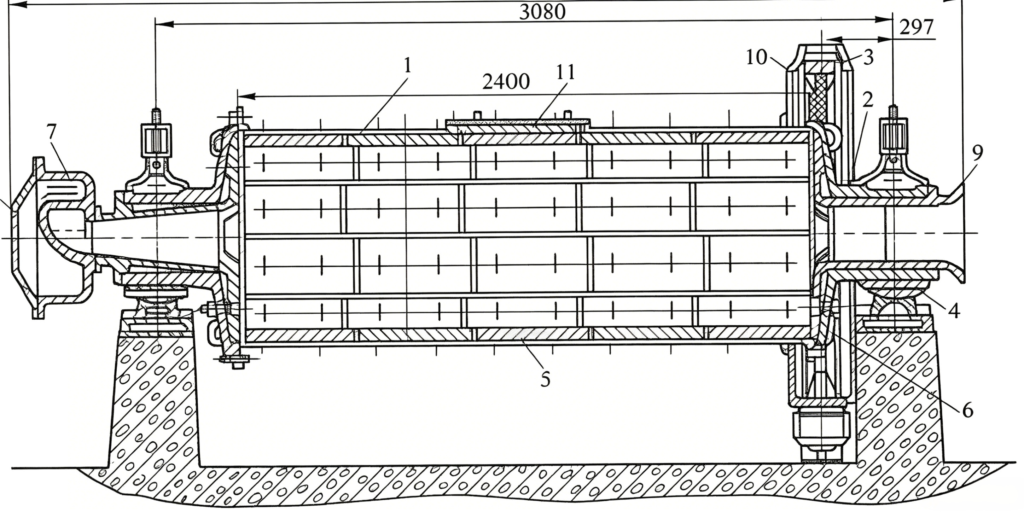
Figure 9‑14 Overflow rod mill
1 – shell; 2 – end cover; 3 – drive gear; 4 – main bearing; 5 – shell liner; 6 – end cover liner; 7 – feeder; 8 – feed opening; 9 – discharge opening; 10 – flange; 11 – inspection port
The rotational speed of a rod mill is relatively low, generally 60%–70% of critical speed. The media charge ratio is also low, about 35%–40%. The feed size is generally 25–30 mm. If the feed is too coarse, the rods may become skewed, causing bending and breakage during operation. At the same time, coarse ore blocks create large gaps between rods, making it difficult to grind fine particles and reducing throughput. The ore is crushed and ground by the “line contact” of the falling rods. Before large blocks are broken, fine particles are seldom impacted by the rods, so over‑grinding is minimal and the product size is relatively uniform, generally 1–3 mm. Therefore, rod mills are suitable for fine crushing and coarse grinding in the first stage of open‑circuit grinding, especially for brittle materials. The rod length is generally about 25–50 mm shorter than the shell length.
At present, China basically produces only wet rod mills. These mills can be used for grinding ores and other materials of various hardness levels, and are particularly suitable for processing brittle materials. They are widely used in mineral processing plants for ferrous, non‑ferrous, and non‑metallic ores, as well as in the chemical, building materials, and other industrial sectors.
However, compared with ball mills, the application range of rod mills is much narrower. In many cases, ball mills can replace rod mills. Therefore, the production volume and number of rod mills in operation in China are much lower than those of ball mills, and there are only about 20 specifications. Consequently, only a few domestic manufacturers produce rod mills.
The technical performance of rod mills currently produced in China is shown in Table 9‑5.
Table 9‑5 Technical performance of rod mills
| Modelo | Shell size (D×L) / mm×mm | Effective shell volume / m³ | Rod charge / t | Shell speed / r·min⁻¹ | Potencia / kW | Discharge particle size / mm | Throughput / t·h⁻¹ | Weight / t |
|---|---|---|---|---|---|---|---|---|
| GMB1530 | 1500×3000 | 5.0 | 8 | 23 | 75 | 2.5~0.2 | 12~5.5 | 16.71 |
| GMB1830 | 1800×3000 | 6.5 | 17 | 22.8 | 132 | 2.5~0.2 | 20~9.5 | 29.8 |
| GMB2122 | 2100×2200 | 6.7 | 18 | 20.9 | 160 | 2.5~0.2 | 27~12 | 42.5 |
| GMB2130 | 2100×3000 | 9.2 | 25 | 20.9 | 160 | 2.5~0.2 | 30~13 | 43.9 |
| GMB2136 | 2100×3600 | 11.0 | 28 | 20.9 | 200 | 2.5~0.2 | 35~14.8 | 49.4 |
| GMBZ2136 | 2100×3600 | 11.0 | 32.5 | 20.9 | 210 | ~5.0 | 61.5~43 | 49.9 |
| GMB2140 | 2100×4000 | 12.2 | 31 | 20.9 | 220 | 2.5~0.2 | 38~17 | 50.3 |
| GMB2145 | 2100×4500 | 13.8 | 35 | 20.9 | 250 | 2.5~0.2 | 43~19 | 51.8 |
| GMB2430 | 2400×3000 | 12.2 | 31 | 19 | 250 | 2.5~0.2 | 47~22 | 56.0 |
| GMBZ2430 | 2400×3000 | 12.2 | 31 | 19 | 250 | ~5.0 | 73~52 | 58.3 |
| GMB2436 | 2400×3600 | 14.6 | 37 | 19 | 280 | 2.5~0.2 | 55~26 | 61.0 |
| GMBZ2436 | 2400×3600 | 14.6 | 37 | 19 | 280 | ~5.0 | 84~60 | 62.4 |
| GMB2730 | 2700×3000 | 15.3 | 35 | 17.5 | 315 | 2.5~0.8 | 125~37.5 | 75.6 |
| GMB2736 | 2700×3600 | 18.4 | 42 | 17.5 | 355 | 2.5~0.8 | 150~45 | 81.8 |
| GMBZ2740 | 2700×4000 | 20.5 | 47 | 17.5 | 400 | 2.5~0.8 | 165~50 | 84.3 |
| GMB3040 | 3000×4000 | 25.9 | 50 | 16.2 | 500 | 2.5~0.8 | 206~62 | 130 |
| GMB3245 | 3200×4500 | 33 | 56 | 15.5 | 630 | 2.5~0.8 | 228~70 | 138 |
| GMB3248 | 3200×4800 | 34 | 60 | 15.5 | 710 | 2.5~0.8 | 240~74 | 142 |
| GMB3645 | 3600×4500 | 40.8 | 78 | 14.5 | 800 | 2.5~0.8 | 270~83 | 168 |
| GMB3650 | 3600×5000 | 14.5 | 1000 | 2.5~0.8 | 100~250 | |||
| GMB3654 | 3600×5400 | 50 | 94 | 14.5 | 1000 | 2.5~0.8 | 340~103 | 192 |
| GMB4361 | 4300×6100 | 195 | 12.0 | 1600 | 3 | 150~306 | 265 |