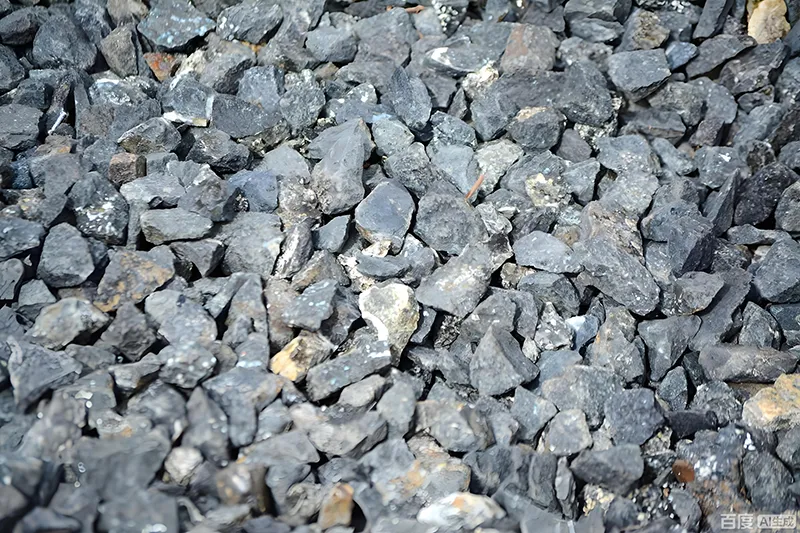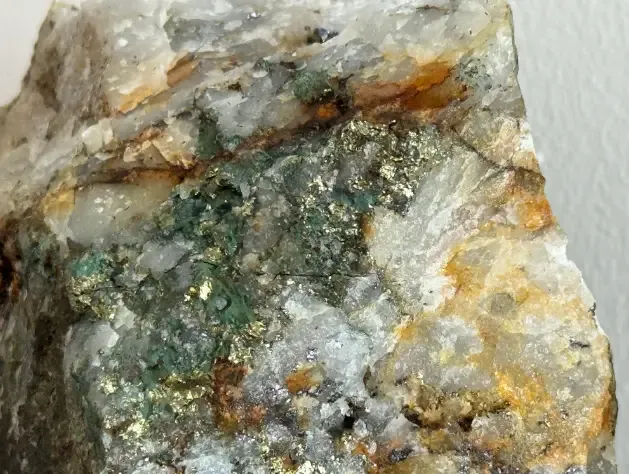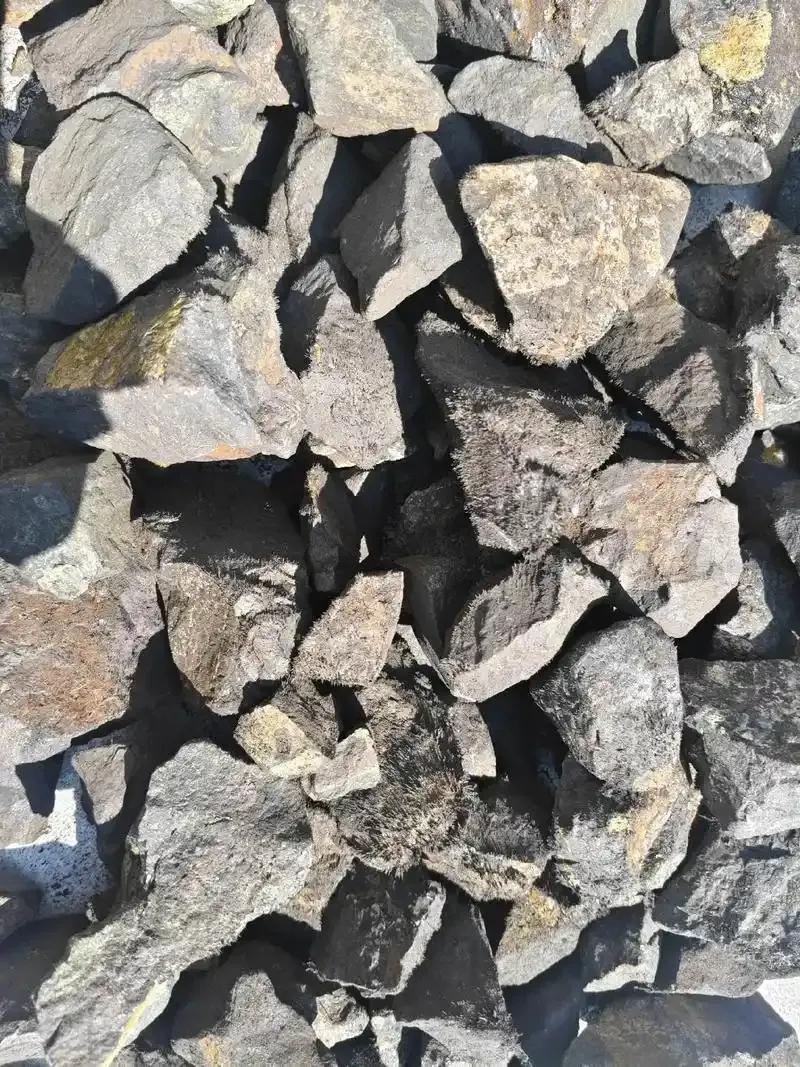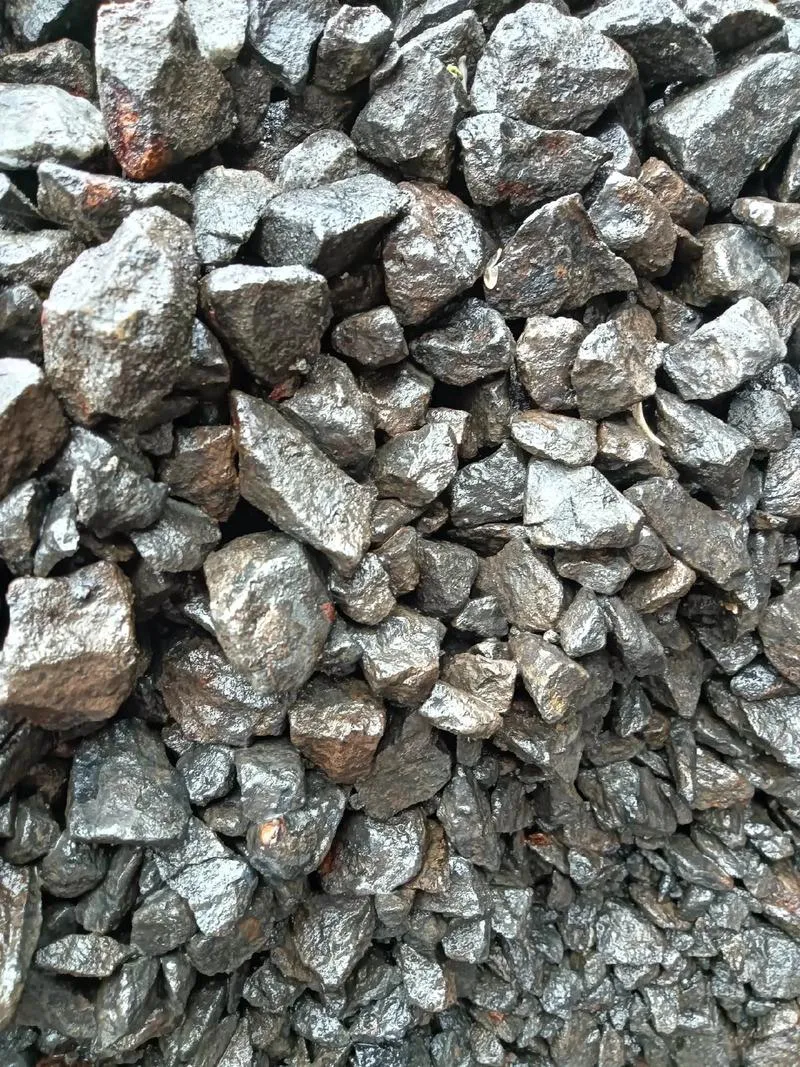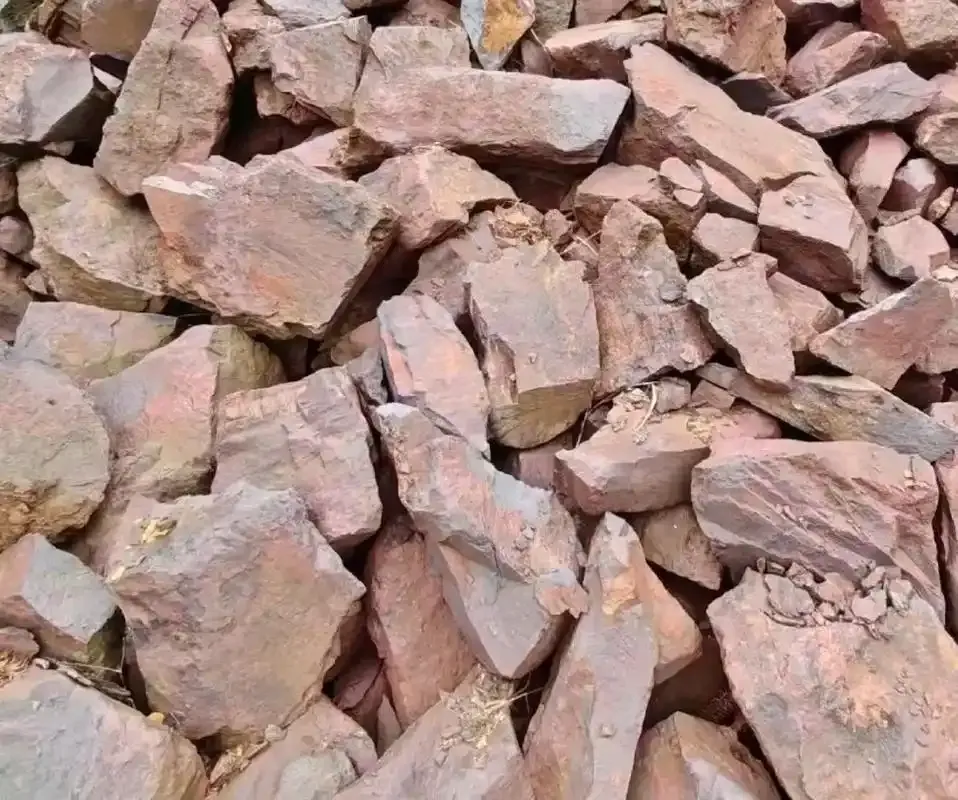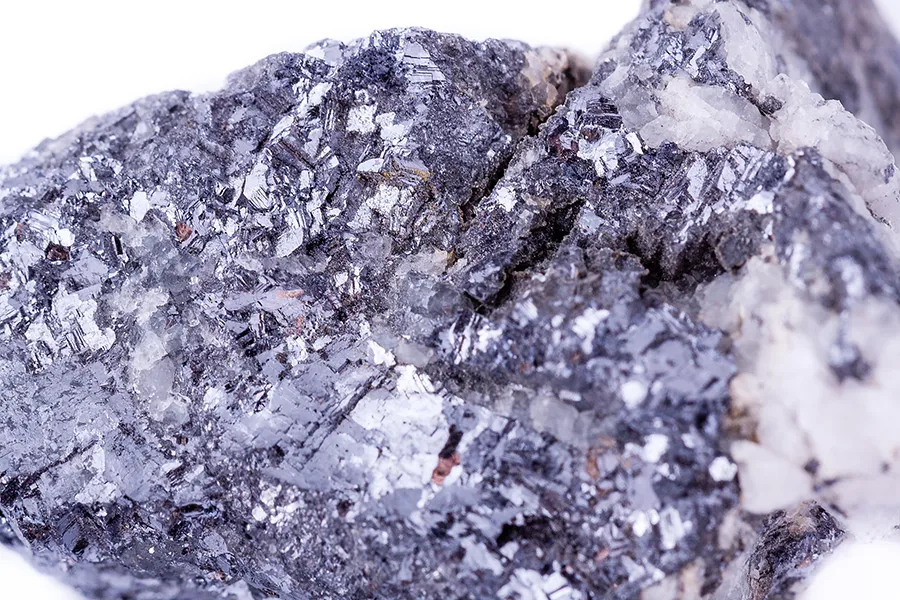


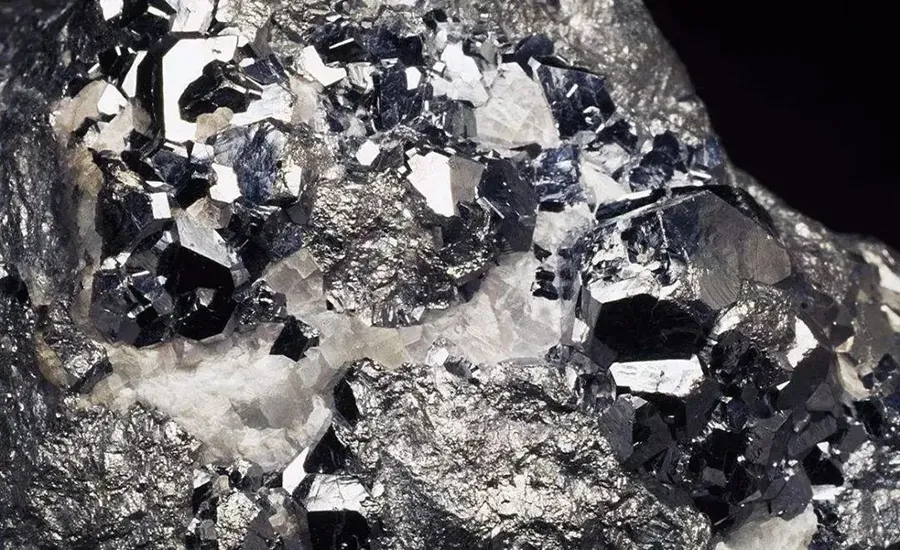
7.5.1 Minerals and Classification of PGM Ores
In chemical terms the six main platinum group elements (PGE), ruthenium, rhodium, palladium, osmium, iridium and platinum, belong to the group VIl transition metals, to which also belong iron, nickel and cobalt. These elements have long been considered, when grouped with gold and silver, as “precious metals”. This, in fact, is misleading because the mineralogy and geochemistry of silver and gold do not correlate with that of PGE.
Also, in literature, there are two terms of reference, including PGE and platinum group minerals (PGM). From a flotation point of view, PGM is the more common term. Therefore, the term PGM will be used in this text.
The chemical similarity between the six PGE and iron, nickel and cobalt accounts for the fact that they tend to concentrate together as a result of geological processes. This is quite important not only for the formation of PGM ores, but also for beneficiation.
There are over 100 different platinum group minerals. Some of the most common PGM are shown in Table 7.11. The stoichiometry of most of the PGM named is known, but because these minerals are subject to a wide range of element substitution, as indicated in Table 7.11, there is little consistency between an ideal formula for the individual minerals and compositions of the given minerals from various locations.
Table 7.11 List of platinum group minerals and their compositions (Srdjan M. Bulatovic, 2010)
| PGM | Ideal formula | Other elements present |
| Anduoite | RuAs₂ | (RuOslr)As |
| Arsenopalladinite | Pd₈As2.5Sbo.5 | (PdCu)AsSb |
| Atheneite | (PdHg)₃As | (PdHgAuCu)AsSb |
| Atokite | PdSn | (PdPt)Sn |
| Borovskite | Pd₈SbTe₄ | (PdPtNFe)SbBiTe |
| Braggite | (PtPd)S | (PINiPd)S |
| Cooperite | PtS | (PtNiPd)S |
| Daomanite | PtCuAsS₂ | (PICuAs)S |
| Erlichamanite | OsS₂ | (OsRhIrPdRu)S |
| Froodite | PdBi₂ | (PdPt)Bi |
| Genkinite | (PtPd)₄Sb₃ | (PtPdRhNiCu)SbAsBi |
| Geversite | PISb₂ | Pt(SbBi) |
| Guanglinite | Pd₃As | (Pd)As |
| Hollingworthite | RhAsS | (RhPdPtLr)AsS |
| Hongshiite | Pt(Cu) | (Pt)Cu |
| Irarsite | IrAsS | (IrRuRhPt)AsS |
| Iridium | Ir | (IrPtFeOsRhPdNi) |
| Isoferroplatinum | Pt₃Fe | (PtFeCuNi) |
| Kotulskite | PtTe | (PdPt)(TeBiSb) |
| Majakite | PtNiAs | (PdNiAs) |
| Moncheite | PtTe₃ | PtPd(TeBi) |
| Niglite | PtSn | (PtBiSb)Sn |
| Omeiite | OsAs₂ | (OsRuFeNilrCo)As |
| Osmium | Os | (OsIrRuPt) |
| Palarstanide | Pd₈ (SnAs)₃ | (PdPtAuCu)(AsSnSb) |
| Palladium | Pd | PdHg |
| Platiniridium | (IrPt) | (IrPtFeOsCuNi) |
| Rhodium | Rh | RhPt |
| Ruthenium | Ru | RulrRhOsPdFe |
| Ruthenosmiridium | (IrOsRu) | (IrRuOsPtRhFeNiPd) |
| PGM | Ideal formula | Other elements present |
| Sperylite | PtAs₂ | (Pt)(AsSb) |
| Temagamite | PdHgTe₃ | (PdHg)(TeBi) |
| Vysotskite | PdS | (PdFePt) |
| Xingzhongite | (IrCuRh)S | (IrCuRhFePbPtOs)S |
| Zvyagintsevite | Pd₃Pb | (PdPtFeNiCu)Pb |
Minerales metálicos del grupo del platino
7.5.1 Minerals and Classification of PGM Ores
In chemical terms the six main platinum group elements (PGE), ruthenium, rhodium, palladium, osmium, iridium and platinum, belong to the group VIl transition metals, to which also belong iron, nickel and cobalt. These elements have long been considered, when grouped with gold and silver, as “precious metals”. This, in fact, is misleading because the mineralogy and geochemistry of silver and gold do not correlate with that of PGE.
Also, in literature, there are two terms of reference, including PGE and platinum group minerals (PGM). From a flotation point of view, PGM is the more common term. Therefore, the term PGM will be used in this text.
The chemical similarity between the six PGE and iron, nickel and cobalt accounts for the fact that they tend to concentrate together as a result of geological processes. This is quite important not only for the formation of PGM ores, but also for beneficiation.
There are over 100 different platinum group minerals. Some of the most common PGM are shown in Table 7.11. The stoichiometry of most of the PGM named is known, but because these minerals are subject to a wide range of element substitution, as indicated in Table 7.11, there is little consistency between an ideal formula for the individual minerals and compositions of the given minerals from various locations.
Table 7.11 List of platinum group minerals and their compositions (Srdjan M. Bulatovic, 2010)
In general, PGM are concentrates in the crust found in two different ways: (1) by leaching the metal-rich lava (mantle) deposited into the crust, which is known as chemical weathering, especially in a hot climate where silica and magnesia are leached away. This leaves a residue enriched in iron and nickel, which contains the PGM elements; (2) melting a portion of the mantle may give rise to ultramafic or basalic lava, which is then squeezed upwards as a result of pressure within the earth to intrude the crust or extrude lava on the surface. This magma is not particularly rich in nickel or PGM; however, because of their siderophile nature, the group VⅢ metals are also chalcophile in nature, that is they prefer to form bonds with sulphur than oxygen.
These sulphide deposits are able to concentrate these metals by a factor of 100-1000 g/t and form PGM deposits, together with precious metals, nickel and copper. Almost always the PGM deposits contain nickel minerals.
The PGM deposits can be classified into the following two groups: (1) PGM-dominated deposits and (2) nickel-copper-dominated deposits.
According to the processing characteristics of PGM-dominated deposits, they can be divided into the following three groups: (1) Morensky type, (2) hydrothermal deposits and (3) placer deposits.
7.5.2 Recovery of Platinum Group Minerals
The recovery of PGM minerals is a subject which has received very little attention in published literature. This is mainly due to the fact that major PGM producers are surrounded by secrecy, therefore, neither commercial processes nor research work on recovery of PGM is publicly available. From a processing point of view, PGM-containing ores can be divided into three general groups as follows: ores amenable to gravity preconcentration, ores amenable to flotation and ores that can only be treated using a hydrometallurgical route.
7.5.2.1 Ores Amenable to Gravity Preconcentration
The most important features of these ores are: (1) the valuable constituents occur as minerals of high density, (2) they do not have middlings and (3) the grain-size distribution falls in a region where a gravity technique can be adopted successfully. Ore types where gravity preconcentration is used include Alaskan-type deposits, alluvial and fossil placer deposits. In the Alaskan-type deposits, the principal PGM minerals include Pt-Fe alloys, isoferroplatinum (Pt₂Fe) and platiniridium (Ir,Pt). There are several producing plants that process these ores, mainly in rural mountain areas (USSR). The alluvial deposits were treated in the early 20th century. The PGM in these deposits occur as alloys, usually as Pt rich in the form of loose grains and nuggets. The PGM ores from Alaska contain magnetite, which is removed before gravity preconcentration. The fossil placer deposits are in fact gold-bearing conglomerates that carry small amounts of PGM, together with gold, uranium and other heavy minerals. Some of the fossil placer deposits contain about 22 PGM species, including Ir-Os-Ru alloys, sperrylite and isoferroplatinum.
7.5.2.2 Ores Amenable to Flotation
Based on flotation processing characteristics, these ores can be divided into the following major groups:
(1) PGM sulphide-dominated deposits. In these deposits, PGM are in general associated with base metal sulphides, as grain boundaries between sulphides and silicates. In some cases, the PGM may be present in solid solution with sulphides. From these deposits, PGM are recovered in a bulk Cu/Ni/Co/PGM concentrate that is further processed using pyrometallurgical techniques. In many cases these ore types contain floatable non-opaque gangue minerals, including talc, chlorites, etc.
(2) PGE-dominated deposits. This in fact is a term for stratiform deposits containing sparse sulphides and PGM concentration in a range between 5 g/t and 30 g/t. These deposits are characterized by a variety of different gangue minerals and high content of PGM sulphide minerals, such as cooperate (PIS), braggite [(PtPd)S] and vysotskite (PdS). Note that these minerals are rare and non-existent in most PGM-bearing copper-nickel sulphide deposits.
7.5.2.3 Copper-Nickel and Nickel Sulphide Deposits with PGM as a By-Product
Prior to discovery of the PGM Morensky Reef deposit, copper-nickel deposits in Ontario, Canada, and the Norilsk (USSR) were the principal sources of PGM production. However, about 40% of the world’s production of PGM comes from different Cu-Ni deposits. The major deposits from this group are discussed in the following sections.
(1) The Sudbury area in Ontario, Canada. Mineralogical examination of these ores revealed a variety of PGM and their associations. The michenerite (PdBiTe) and sperrylite (PtAs₂) are the most common platinum/palladium minerals for many deposits in the Sudbury region. Other minerals of economic value found in these deposits are moncheite (PtTe₃), froodite (PdBi₂), inszwaite (PtBi₂), irarsite (IrAsS), niggliite (PISn) and mertieite (PdSb₃). Most of these minerals are liberated at a relatively coarse size (40-200 μm).
(2) The Norilsk Talnakh ore in Russia. In this area, the PGM are distributed in: 1) disseminated sulphides, mostly in pyrrhotite, chalcopyrite and pentlandite. The predominant platinum minerals are Pt-Fe alloys, cooperite (PIS) and sperrilite (PtAs₂); 2) massive sulphide ores where the predominant PGM are Pt-Fe alloys, rustenburgite (Pt₃Sn) and sperrilite (PtAs₂), occurring in fine inclusions in chalcopyrite and pyrrhotite; and finally; 3) disseminated veins and breccia ores that may consist of mainly chalcopyrite or pyrrhotite. The PGM in these ores is present as Pt-(cooperite) and Pd-(vysotskite) sulphides.
(3) Pechenga Cala Peninsula (USSR). The ores from this region are of tholeiitic intrusions hosting Cu-Ni sulphides with relatively low PGM content. In these ores, most of the palladium is associated with pentlandite, where the platinum and rhodium are mainly associated with pyrrhotite. Only sperrilite and Pt-Fe alloys have, so far, been found in these ores.
7.5.2.4 Chromium Deposits with PGM
There are a number of deposits of this type with different origins. Most economical PGM chromite deposits are described as follows:
(1) Podiform chromite deposits occur in ultramafic bodies referred to as alpine types and are located in Tibet and North-western China.
(2) Stratiform chromite deposits occur in different layered intrusions, such as Bushveld (South Africa) and the Great Dyke (Zimbabwe). The best known chromite deposit, with a number of operating plants, is the UG2 Complex located below the Morensky Reef. It ranges in thickness from 15 cm to 255 cm and dips at an angle of 5°-70° towards the centre of the Bushveld Complex. Mineralogically, it consists mainly of chromite (60%-90%) or thopyroxene (5%-25%) and plagioclase (5%-15%) with only trace amounts of base metal sulphides.
PGM are usually closely associated with sulphides, such as laurite (RuS₂), cooperate (PtS), braggite [(PtPd)S], Pt-Fe alloys, sperrilite (PtAs₂) and vysotskite (PdS).
The average chemical analyses of the PGM from various areas are shown in Table 7.12.
Table 7.12 Average chemical analyses of PGM from various areas of the UG2 deposits
| Area | Group | Assays/g ·t⁻¹ | ||||||
| Pt | Pd | Rh | Ru | Ir | Au | Total | ||
| Marikoma | A1 | 1.58 | 1.29 | 0.49 | 0.72 | <1.0 | <0.2 | 4.08 |
| A2 | 3.09 | 0.77 | 0.51 | 0.90 | <0.5 | <0.2 | 5.27 | |
| Brits | A3 | 2.91 | 0.99 | 0.28 | 1.17 | <1.0 | 0.06 | 5.41 |
| A4 | 2.85 | 1.34 | 0.49 | 1.06 | <0.5 | <0.03 | 5.77 | |
| Hoekfontein | A5 | 2.55 | 0.23 | 0.40 | 0.86 | <0.5 | <0.1 | 4.04 |
| South-western region | 一 | 2.61 | 1.87 | 0.49 | 0.99 | 0.05 | 0.17 | 6.18 |
| Bushveld complex | A | 2.67 | 1.53 | 0.51 | 0.93 | <0.5 | 0.03 | 5.68 |
| B | 3.04 | 2.50 | 0.56 | 1.00 | <0.5 | 0.07 | 7.17 | |
| Moandagchoek | C | 4.33 | 3.92 | 0.95 | 1.22 | 0.16 | 0.07 | 10.65 |
| D | 5.25 | 3.53 | 0.73 | 1.40 | <0.1 | <0.1 | 10.91 | |
| North-eastern region | E | 3.14 | 3.09 | 0.81 | 0.97 | 0.45 | 0.09 | 8.55 |
| Bushveld complex | F | 4.31 | 2.43 | 0.91 | 1.51 | 0.09 | 0.02 | 9.30 |
7.5.3 Flotation of PGM-Containing Ores
There is little published data on the flotation of PGM-containing ores. Development work on beneficiation of PGM ores has been conducted by mining companies themselves and by a few research organizations close to the mining companies, which produce PGM. Many operating plants treating PGM ores use conventional flotation techniques and the metallurgical results are below optimum in a number of these plants.
Each ore type requires different flowsheets and reagent schemes, which is dictated by the mineral composition of the ore and the geological setting, as well as the type of PGM carrier minerals. The following sections discuss the flotation properties and practices of the different ore types.
7.5.3.1 Flotation Properties of PGM from Sulphide-dominated Deposits
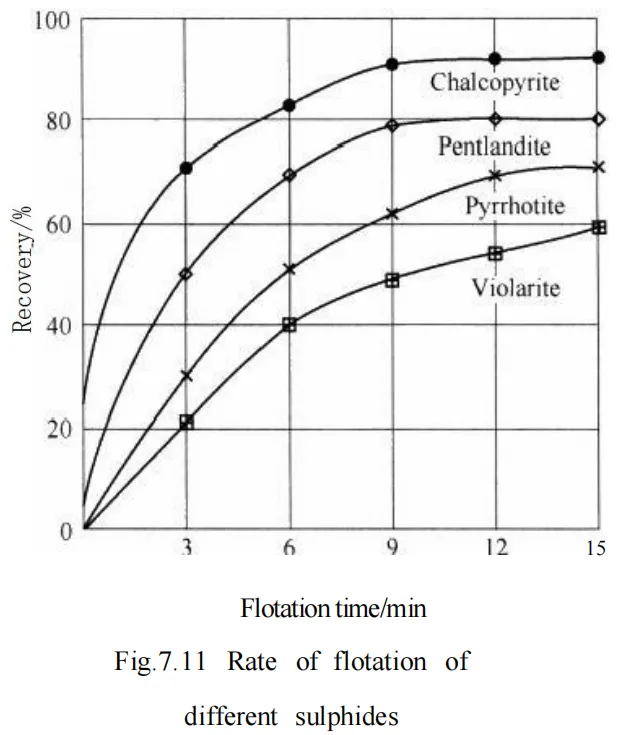
Most of the current commercial operations that treat PGM from sulphide-dominated deposits are located in South Africa (Morensky Reef), Stillwater mines (Montana, USA) and Lac des Illes (Ontario, Canada). From a processing point of view, most of these ore types contain hydrophobic gangue minerals, including talc, which has a negative effect on PGM recoveries. Other major factor that affects flotation recovery of PGM is the presence of a variety of sulphide minerals, including pyrrhotite, pentlandite, chalcopyrite, violarite and pyrite, where the PGM are associated with all sulphides. In addition, in some operating plants, a portion of the PGM is represented by braggite, vysotskite, moncheite and Pt-Fe alloys.
In general, the flotation properties of PGM from sulphide-dominated deposits are very dependent on the ratio of the individual sulphide minerals present in the ore and the nature and occurrence of hydrophobic gangue minerals present in the ore.
Each of the sulphide minerals, which are PGM carriers (i.e. pyrrhotite, pyrite, pentlandite, etc.) have different flotation properties under some flotation conditions. The selectivity between sulphide minerals and gangue minerals is relatively poor in principle, and in the majority of cases, a hydrophobic gangue depressant has to be used.
The flotation behaviour of the individual sulphide minerals contained in PGM sulphide-dominated ores can be described as follows:
Fig.7.11 shows the rate of flotation of different sulphides. In these experiments, xanthate was used as the primary collector with dithiophosphate as the secondary collector.
One of the major problems associated with beneficiation of PGM from sulphide-dominated deposits is the presence of hydrophobic gangues, such as talc, chlorites, carbonates and aluminosilicates. The concentrates produced in most of the Morensky Reef operations (South Africa) varies from 80 g/t to 150 g/t of combined PGM, where most of the contaminants are silicates, aluminosilicates and talc (i.e. up to 60%). The major hydrophobic gangue depressants used are carboxymethyl cellulose (CMC) and different modifications of guar gums.
In recent years, a new line of hydrophobic gangue depressants were developed, based on a mixture of guar gums and low-molecular-weight polyacrylates modified with organic acid, which are extremely effective. With the use of these depressants, the grade of the PGM concentrate could increase from 100 g/t up to 400 g/t without any loss in recovery.
7.5.3.2 Reagent Practice in Flotation of PGM Sulphide-dominated Ores
There is very little published information available on flotation of PGM ores in general. Most operations treating PGM sulphide-dominated ores have similar reagent schemes, with maybe a different choice of hydrophobic gangue depressants. Most of these plants use CuSO₄ as the principal sulphide activator. In the past 10 years, extensive research was carried out and directed towards finding better gangue depressants.
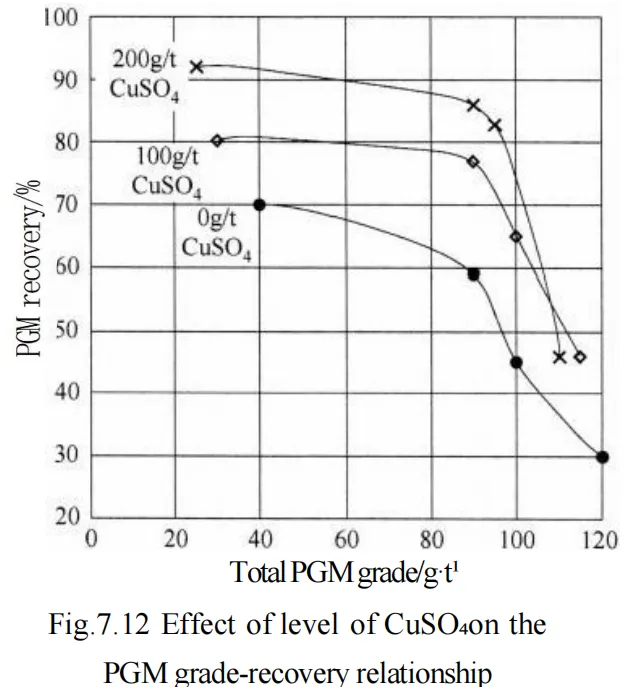
The principal sulphide activator used in most operating plants is small additions of CuSO₄, normally added to the secondary grind and scavenger flotation stages. Although CuSO₄ improves PGM recovery, it may also reduce the concentrate grade because an excess of CuSO₄ will activate the gangue minerals. Fig.7.12 shows the effect of level of CuSO₄ on the PGM grade-recovery relationship from the Morensky Reef Plant A ore. In these experiments, carboxymethyl cellulose (CMC) was used as the main gangue depressant.
Total PGM grade/g·t¹
Fig.7.12 Effect of level of CuSO₄ on the PGM grade-recovery relationship
In recent years, a number of alternative activators were examined. It was found that organic acids along with a mixture of organic acid and thiourea can replace CuSO₄ with significant improvement in PGM recovery and selectivity. The results obtained using different activators on the Morensky ore are compared in Table 7.13. The highest concentrate grade and PGM recoveries were achieved using a mixture of oxalic acid and thiourea. The use of CuSO₄ as an activator was examined in relation to the point of addition and type of depressant used. It was concluded that the point of reagent addition played an important role in PGM recovery.
Table 7.13 Effect of different activators on PGM flotation and upgrading
| Activator | Product | Weight/% | Assays/g ·t¹ | Distribution/% | ||||
| Pt | Pd | Au | Pt | Pd | Au | |||
| CuSO₄=220g/t | PGM cleaner concentrate | 1.67 | 120 | 61.8 | 8.26 | 70.0 | 67.0 | 60.0 |
| PGM rougher concentrate | 6.90 | 35.5 | 18.2 | 2.20 | 85.3 | 81.4 | 66.3 | |
| PGM rougher tail | 93.10 | 0.45 | 0.31 | 0.08 | 14.7 | 18.6 | 33.7 | |
| Feed(cale) | 100.00 | 2.87 | 1.54 | 0.23 | 100.0 | 100.0 | 100.0 | |
| Oxalic acid/DETA(80:20 ratio)=350g/t | PGM cleaner concentrate | 1.10 | 198 | 101 | 13.2 | 74.2 | 70.5 | 60.6 |
| PGM rougher concentrate | 5.70 | 44.4 | 23.8 | 2.77 | 88.5 | 88.4 | 67.8 | |
| PGM rougher tail | 94.3 | 0.35 | 0.19 | 0.08 | 11.5 | 11.6 | 32.2 | |
| Feed(cale) | 100.00 | 2.87 | 1.54 | 0.23 | 100.0 | 100.0 | 100.0 | |
| Oxalic acid/thiourea (60:40 ratio)=350g/t | PGM cleaner concentrate | 0.87 | 250 | 132 | 19.9 | 75.0 | 74.0 | 63.0 |
| PGM rougher concentrate | 4.02 | 66.6 | 35.9 | 3.78 | 92.3 | 93.3 | 69.1 | |
| PGM rougher tail | 95.98 | 0.23 | 0.11 | 0.07 | 7.7 | 6.7 | 30.9 | |
| Feed(cale) | 100.00 | 2.90 | 1.55 | 0.22 | 100.0 | 100.0 | 100.0 | |
The primary collector used in PGM flotation is xanthate. As a choice of secondary collectors, dithiophosphates and mercaptans are used in some operating plants. The type of xanthate has a significant effect on PGM recoveries. Studies conducted on the Stillwater Complex by the US Bureau of Mines indicated that the type of xanthate had a significant effect on PGM recovery (Table 7.14). The highest PGM recovery was achieved using sodium amyl and sodium isobutyl xanthate. Using a mercaptan collector alone gave poor PGM recovery. However, when using xanthate with mercaptan, substantial improvement in PGM recoveries was achieved.
Table 7.14 Effect of type of xanthate on PGM recovery from the Stillwater ore(USA)
| Types of xanthate | Concentrate | Tailing | ||||||
| Assays/g ·t⁻¹ | Distribution/% | Assays/g ·t⁻¹ | Distribution/% | |||||
| Pt | Pd | Pt | Pd | Pt | Pd | Pt | Pd | |
| K-amyl xanthate | 34.1 | 89.9 | 64 | 54 | 1.24 | 4.96 | 36 | 46 |
| Na-amyl xanthate | 34.2 | 80.6 | 83 | 63 | 0.62 | 3.72 | 17 | 37 |
| Na-isobutyl xanthate | 31.0 | 77.5 | 81 | 65 | 0.61 | 3.70 | 19 | 35 |
| Mercaptan | 55.8 | 114.7 | 53 | 35 | 1.55 | 6.51 | 47 | 65 |
| Na-isobutyl xanthate+ mercaptan | 31.0 | 83.7 | 90 | 80 | 一 | 一 | 10 | 20 |
In recent studies, a new line of PGM collectors had been developed known as the PM series. These collectors are an ester-modified mixture of xanthate + mercaptan. The reaction product forms an oily greenish-colored liquid. The results obtained using the PM series of collectors are shown in Table 7.15. High PGM recovery was obtained using a combination of sodium amyl xanthate plus collector PM301. Collector PM306 was the most selective collector from the PM300 series.
Table 7.15 Effect of collectors from the PM series on PGM recovery from the Morensky operation A ore
| Collector | PGM cleaner concentrate | PGM rougher concentrate | |||||||
| Assays/g ·t⁻¹ | Distribution/% | Assays/g ·t⁻¹ | Distribution/% | ||||||
| Pt | Pd | Pt | Pd | Pt | Pd | Pt | Pd | ||
| Na-isobutyl | xanthate+R3477 | 110 | 60.5 | 71 | 65 | 36.2 | 17.8 | 84.3 | 82.2 |
| Na-isobutyl | xanthate+PM301 | 160 | 98.5 | 82.3 | 80.6 | 65.2 | 36.1 | 94.4 | 94 |
| Na-isobutyl | xanthate+PM305 | 180 | 100.3 | 76.6 | 74 | 45.3 | 24.1 | 87.4 | 86.8 |
| Na-isobutyl | xanthate+PM306 | 244 | 128 | 73.3 | 71.8 | 67.2 | 37.7 | 86.6 | 84.3 |
| Na-isobutyl | xanthate+PM308 | 120.5 | 62.3 | 73.1 | 70.0 | 37.2 | 19.6 | 85.5 | 84.0 |
Choosing a depressant for hydrophobic gangue depression is dependent on the type of gangue present in the ore. During treatment of ores that contain talc, carboxymethyl cellulose (CMC) is normally used as the gangue depressant, or in some operations, guar gum + CMC. Typical examples of talc-containing ores are the Stillwater Complex (USA) and Lac des Illes (Canada). Both operations use CMC for talc depression. In the Stillwater operation, the additions of CMC are relatively high (i.e. up to 600 g/t) and are added to the ball mill, the PGM roughers and cleaners.
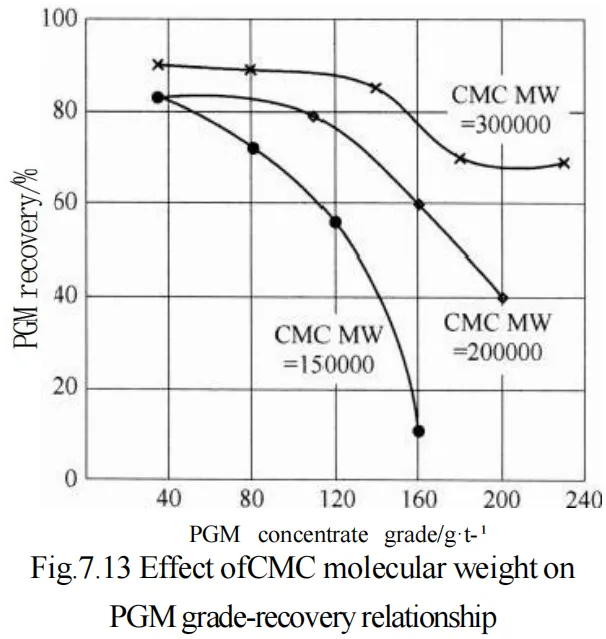
Laboratory and pilot plant studies on the Stillwater ore showed that the molecular weight of the CMC affected both PGM grade and recovery. Fig.7.13 shows the effect of molecular weight of CMC on PGM grade-recovery relationship. The best results were obtained using CMC with an average 300000 molecular weight, corresponding to a viscosity of over 3000 cps.
Studies conducted by the University of Cape Town (South Africa) researchers indicated that the point of CMC addition had a significant effect on sulphides (PGM carriers) grade and recovery. It should be noted that in several operating plants from the Morensky Reef and Stillwater Complex, from which plant metallurgical results are available, the total PGM recoveries ranges from 82% to 85% PGM. The grade of concentrate from the Morensky operations ranges from 80 g/t to about 120 g/t (Plants A and B). Most of the contaminants are silicates and talc.
7.5.3.3 Reagent Practice in Flotation of Cu-Ni and Ni Ores with PGM as the by-product
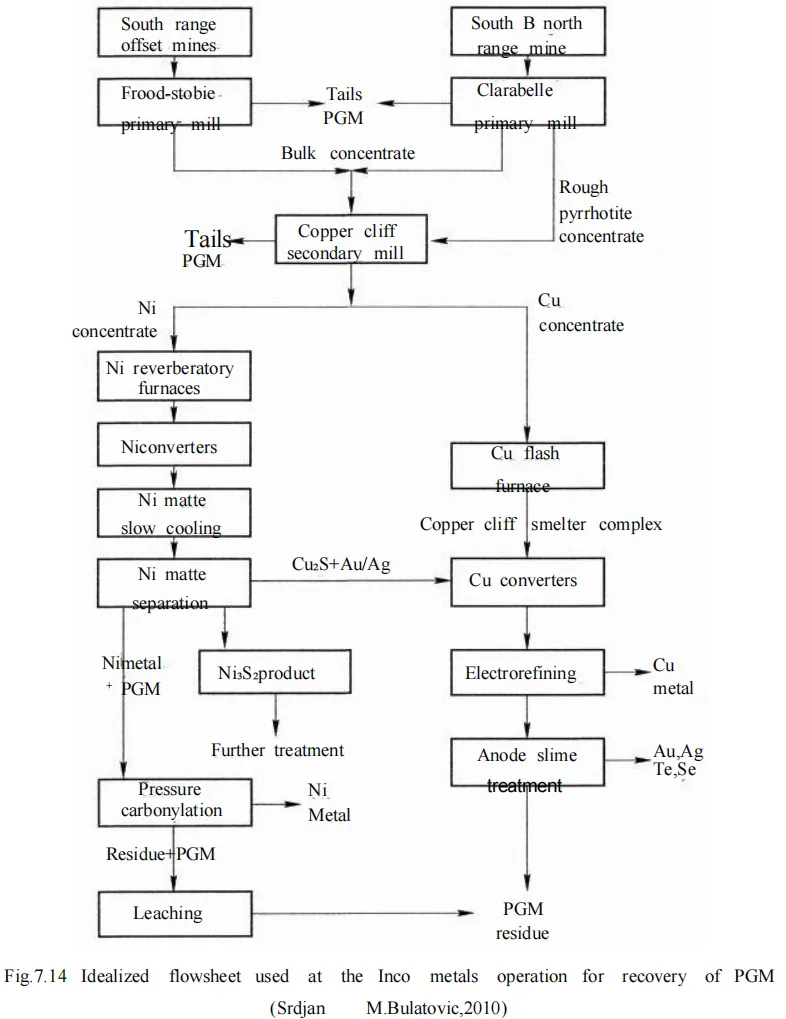
In the flotation of Cu-Ni and Ni ores, the emphasis is usually placed on Cu-Ni and Ni recovery and concentrate grade, and most of the research on these ores was directed towards improvement in Cu-Ni recovery and pentlandite-pyrrhotite separation, whereas little or no attention was paid to improvement in recovery of PGM. In operations from the Sudbury Region (Canada), PGM are recovered as by-products of Cu-Ni concentrates. The idealized flowsheet of the Inco Metal (Sudbury, Canada) PGM recovery flowsheet is shown in Fig.7.14.
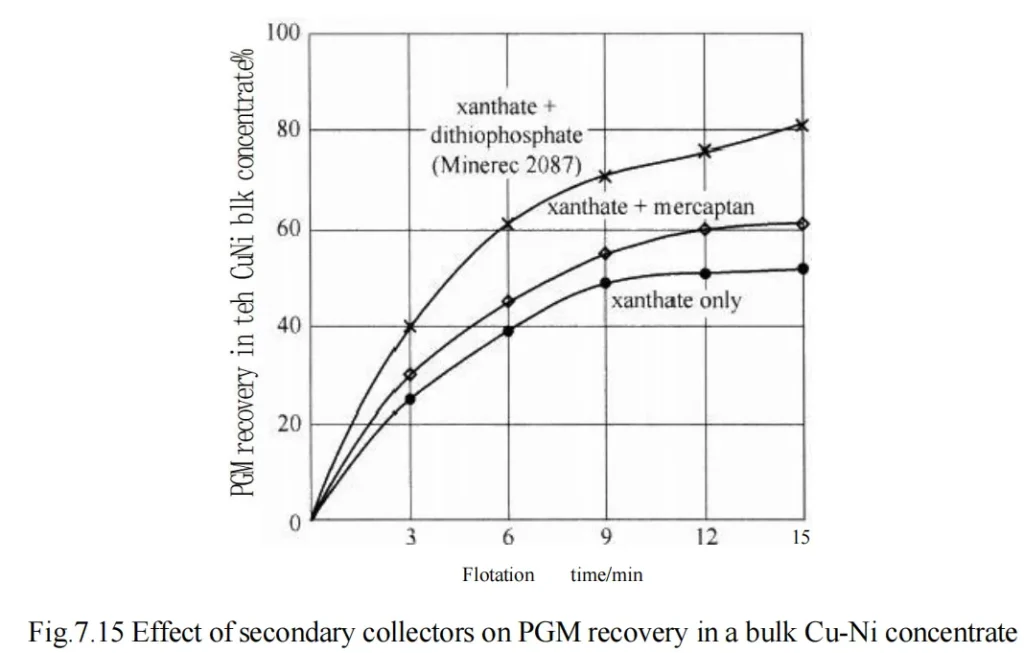
Laboratory studies conducted on Falconbridge ores, also from the Sudbury Region, showed that PGM recovery can be improved with the use of a secondary collector. Fig.7.15 shows the effect of level of secondary collector on PGM recovery in a Cu-Ni bulk concentrate. The highest PGM recoveries were achieved using isobutyl dithiophosphate as the secondary collector.
Plant data from the Copper Cliff Mine showed that about 85% of the platinum was recovered in a Cu-Ni concentrate, most of which was from the nickel concentrate. The plant metallurgical results are shown in Table 7.16. Similar plant results were obtained at other Inco operations.
Table 7.16 Platinum recovery in the Copper Cliff plant
| Product | Weight/% | Assays/%(g ·t⁻¹) | Distribution/% | ||||
| Cu | Ni | Pt | Cu | Ni | Pt | ||
| Copper concentrate | 13.0 | 29.2 | 0.91 | 1.80 | 83.0 | 3.0 | 17.0 |
| Nickel concentrate | 29.0 | 2.28 | 12.8 | 3.04 | 14.0 | 85.0 | 65.0 |
| Tails | 58.0 | 0.93 | 0.22 | 0.41 | 3.0 | 12.0 | 18.0 |
| Feed | 100.00 | 4.58 | 4.42 | 1.39 | 100.0 | 100.0 | 100.0 |
In the Norilsk Region, research work was carried out on Oktyabrski disseminated Cu/Ni-PGM ore. This ore contains high-grade PGM, most of which is represented by palladium. The results using different collectors are shown in Table 7.17. Improvement in overall PGM recoveries was obtained using xanthate as the primary collector and dithiophosphate as the secondary collector. A slight improvement in metallurgical results was achieved when using mercaptan as the secondary collector.
Table 7.17 Effect of secondary collectors on PGM from theNorilsk(Russia)disseminated Cu/Ni-PGM ore
| Product | Weight/% | Assays/%(g ·t⁻¹) | Distribution/% | ||||||
| Cu | Ni | Pt | Pd | Cu | Ni | Pt | Pd | ||
| CuCl concentrate | 10.25 | 29.6 | 0.8 | 6.5 | 55.0 | 92.0 | 9.1 | 13.9 | 32.2 |
| Ni/PGM concentrate | 5.58 | 2.0 | 12.8 | 55.0 | 188 | 3.4 | 79.4 | 75.0 | 60.0 |
| Bulk concentrate | 15.83 | 19.88 | 5.03 | 26.95 | 101.9 | 95.4 | 88.5 | 88.9 | 92.2 |
| Bulk flot tail | 84.17 | 0.18 | 0.12 | 0.63 | 1.62 | 4.6 | 11.5 | 11.1 | 7.8 |
| Head(cale) | 100.00 | 3.3 | 0.9 | 4.8 | 17.5 | 100.0 | 100.0 | 100.0 | 100.0 |
| CuCl concentrate | 10.60 | 30.3 | 0.7 | 5.8 | 49.5 | 94.5 | 9.2 | 12.9 | 30.7 |
| Ni/PGM concentrate | 6.45 | 1.32 | 11.41 | 58.98 | 180.9 | 2.5 | 80.0 | 80.1 | 68.0 |
| Bulk concentrate | 17.05 | 19.34 | 4.81 | 25.92 | 98.97 | 97.0 | 89.2 | 93.0 | 98.7 |
| Bulk flot tail | 82.95 | 0.13 | 0.12 | 0.40 | 0.27 | 3.0 | 10.8 | 7.0 | 1.3 |
| Head(cale) | 100.00 | 3.4 | 0.92 | 4.75 | 17.1 | 100.0 | 100.0 | 100.0 | 100.0 |
| CuCl concentrate | 11.49 | 27.5 | 1.2 | 6.1 | 52.0 | 90.3 | 15.1 | 14.9 | 35.4 |
| Ni/PGM concentrate | 6.29 | 1.16 | 9.83 | 52.4 | 165.5 | 2.1 | 68.0 | 70.1 | 60.2 |
| Bulk concentrate | 17.78 | 18.19 | 4.26 | 22.47 | 93.05 | 92.4 | 83.1 | 85.0 | 95.6 |
| Bulk flot tail | 82.22 | 0.31 | 0.18 | 0.86 | 0.92 | 7.6 | 16.9 | 15.0 | 4.4 |
| Head(cale) | 100.00 | 3.5 | 0.91 | 4.7 | 17.3 | 100.0 | 100.0 | 100.0 | 100.0 |
7.5.3.4 Reagent Practice in Flotation of PGM from Chromium-containing Ores
The major problem associated with processing of high-chromium ores includes the following:
(1) High chromium content in PGM concentrates has a negative effect on pyro- and hydrometallurgical processing.
(2) The major carriers of PGM are a variety of minerals and alloys, where the flotation properties of the PGM minerals and alloys are not well defined. These ores have very little to no sulphides present that are PGM carriers.
In recent years, extensive research has been conducted on these ore types with the objective of finding a more effective PGM collector and chromium depressant. Research work was conducted on UG2 high-chromium ore. Detailed chemical analyses of the high-chromium ore used in this research are presented in Table 7.18.
| Element | Platimum | Palladium | Nickel | Sulphur | Copper | Chromium | Iron | Gold |
| Pt | Pd | w(Ni) | w(S) | w(Cu) | w(Cr) | w(Fe) | Au | |
| Assays | 2.06g/t | 1.29g/t | 0.10 | 0.04 | 0.011 | 20.0 | 18.5 | <0.02g/t |
The PGM carriers in this ore include a variety of PGM minerals (sperrilite) and its alloys. The main problems identified associated with processing this ore type were:
(1) poor concentrate grade;
(2) low rate of PGM flotation;
(3) excessive chromium reporting to the PGM concentrate;
(4) high collector consumption.
The reason for high collector consumptions was the presence of small, but significant quantities of clay-like slimes. The high collector consumption was the principal reason for the excessive amount of chromium reporting to the PGM concentrate (mainly as fines).
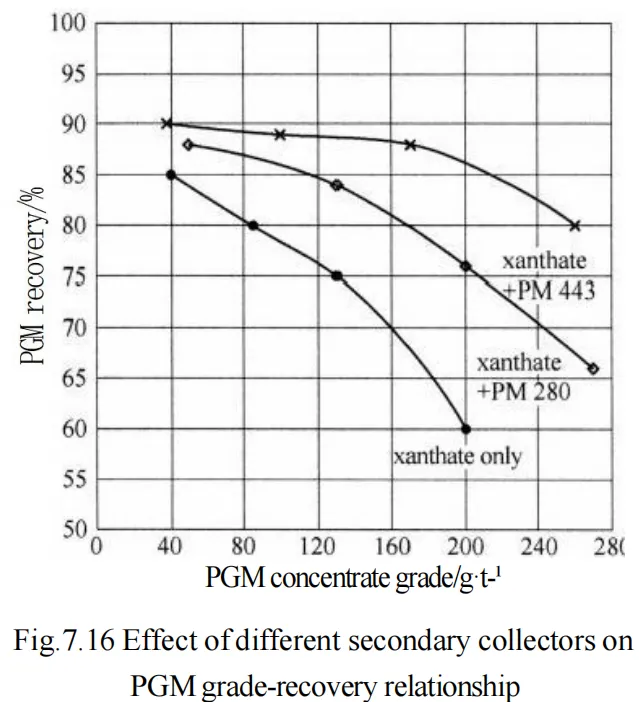
Types of secondary collectors were extensively examined in research work. Fig.7.16 shows the effect of secondary collectors on the PGM grade-recovery relationship. The highest PGM recovery was achieved using collector PM443, which is an amine + ester-modified xanthate. Among the chromium slime depressants evaluated, modified mixtures of organic acids, RQ depressants and a low-molecular-weight polyacrylic acid + pyrophosphate mixture were there. The effect of different chromium depressants on chromium assays of the PGM concentrate are illustrated in Fig.7.17.
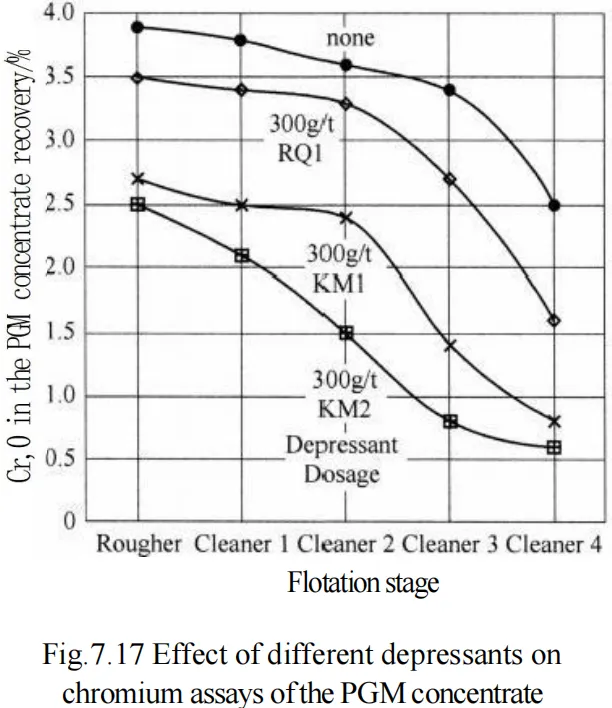
Significant improvement in chromium depression has been achieved using depressants from the KM series, representing mixtures of organic acid and low-molecular-weight acrylic acid mixtures. It is, therefore, possible to depress chromium during PGM flotation and at the same time reduce collector consumption. The relationship between the level of collector and level of KM3 depressant is shown in Table 7.19. The data shown in this table demonstrate that overall collector consumption can be reduced by 50% with the use of slime/chromium depressant, KM3. At the same time, the chromium assays in the PGM concentrate reduced from 3.8% to 0.9% Cr. It is obvious that high collector consumption is responsible for high chromium content in the cleaner concentrate.
Table 7.19 Effect of depressant KM3 on collector consumption duringPGM flotation from UG2 high-chromium ore
| Reagent/g ·r¹ | PGM cleaner concentrate | PGM rougher concentrate | |||||||||||
| Assays/%(g ·t⁻¹) | Distribution/% | Assays/%(g ·t⁻¹) | Distribution/% | ||||||||||
| Collector | Depressant | Pt | Pd | Cr | Pt | Pd | Cr | Pt | Pd | Cr | Pt | Pd | Cr |
| 330 | 0 | 80.1 | 54.3 | 3.8 | 57 | 61 | 0.4 | 21.0 | 13.0 | 7.3 | 82 | 80 | 4.1 |
| 330 | 200 | 90 | 60.9 | 2.5 | 60 | 64 | 0.2 | 28.2 | 17.4 | 6.0 | 84 | 82 | 2.6 |
| 200 | 200 | 110 | 71 | 2.2 | 70 | 71 | 0.2 | 33.2 | 20.5 | 4.2 | 86 | 84 | 1.5 |
| 200 | 200 | 120 | 77.6 | 2.0 | 75 | 76 | 0.15 | 38.3 | 23.9 | 3.8 | 88 | 87 | 1.3 |
| 160 | 400 | 135.1 | 86.2 | 0.9 | 77 | 77 | 0.02 | 40.2 | 25.2 | 2.5 | 90 | 89 | 0.14 |
Comparative continuous locked cycle tests were conducted using the reagent scheme currently used in an operating plant and the new reagent scheme was developed during the research on ore from the Waterval plant (South Africa). These results are compared in Table 7.20.
Table 7.20 Comparison of results using the new and standard plant reagent scheme from Waterval Plant
| Reagent scheme | Product | Weight/% | Assays/%(g ·t⁻¹) | Distribution/% | |||
| Pt | Pd | Cr | Pt | Pd | |||
| Newly developed scheme | PGM Cl concentrate | 2.08 | 89.54 | 55.54 | 1.02 | 89.0 | 86.1 |
| PGM comb tail | 97.92 | 0.24 | 0.19 | 一 | 11.0 | 13.9 | |
| Feed(cale) | 100.00 | 2.10 | 1.34 | 一 | 100.0 | 100.0 | |
| Standard pant scheme | PGM Cl concentrate | 2.01 | 86.01 | 49.08 | 2.72 | 79.8 | 76.7 |
| PGM comb tail | 97.99 | 0.45 | 0.31 | 一 | 20.2 | 23.3 | |
| Feed(cale) | 100.00 | 2.16 | 1.29 | 一 | 100.0 | 100.0 | |
A substantial improvement in metallurgical results was achieved using the new reagent scheme.
This new reagent scheme included collector PM443 and depressant KM3. The collector type plays a significant role in PGM recovery from high-chromium ores. Collectors were examined in detail on several high-chromium ores, where new collectors from the PM series were included in the evaluation. These collectors are ester-modified mixtures of xanthate and dithiophosphates. The results are presented in Table 7.21. The highest PGM recovery was achieved using a combination of isobutyl xanthate and collector PM303.
Table 7.21 Effect of type of collector on PGM rougher-scavenger flotation from high-chromium ores
| Collector type | PGE rougher concentrate | PGE rougher+scavenger concentrate | ||||||
| Assays/g ·t⁻¹ | Distribution/% | Assays/g ·t⁻¹ | Distribution/% | |||||
| Pt | Pd | Pt | Pd | Pt | Pd | Pt | Pd | |
| PAX① | 110.7 | 96.8 | 55.1 | 54.3 | 45.5 | 40.4 | 81.2 | 80.3 |
| PAX①R3477② | 120.4 | 98.5 | 66.3 | 64.2 | 44.3 | 39.8 | 84.8 | 83.5 |
| PAX①R404② | 110.1 | 97.0 | 64.3 | 62.1 | 46.3 | 41.1 | 85.2 | 83.6 |
| PAX①PM301 | 116.6 | 94.5 | 70.2 | 70.0 | 42.3 | 38.0 | 88.5 | 86.2 |
| PAX①PM305 | 113.8 | 96.3 | 80.2 | 80.0 | 43.3 | 39.6 | 92.5 | 91.1 |
| SIBX①PM303 | 122.4 | 97.9 | 82.2 | 81.0 | 44.6 | 40.1 | 92.3 | 92.1 |
7.5.3.5 Flotation of Oxide PGM Ores
There are only a few known oxidized PGM deposits in which the ore is in the development stage. These deposits can be found in Brazil and Australia. The PGM in these ores is usually represented by different PGM minerals and alloys, finely disseminated in a gangue matrix. Using a flotation method with conventional reagent schemes, results in low PGM recoveries, ranging from 65% to 70% PGM. Recent studies conducted on an ore from Brazil indicated that a mixture of organic acid and thiourea has a positive effect on PGM recovery from oxidized ores.
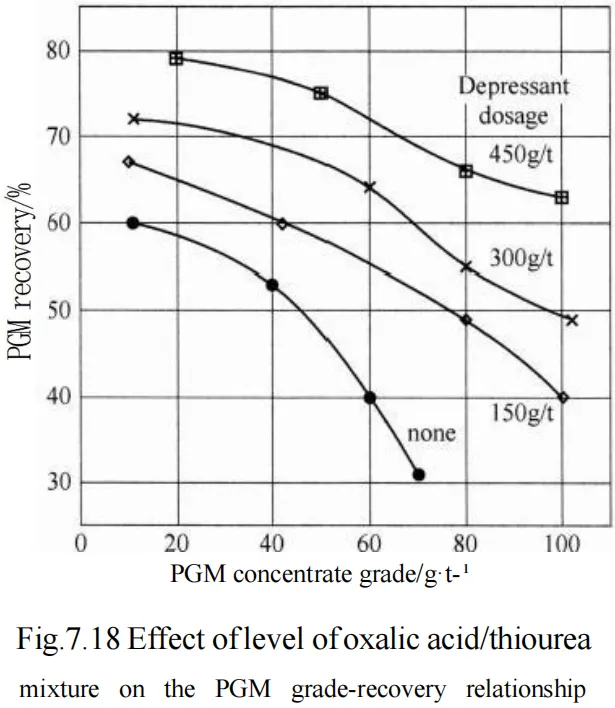
Fig.7.18 shows the effect of organic-acid-modified thiourea on PGM flotation from oxidized PGM ore. This data show that substantial improvement in PGM grade and recovery was achieved using organic-acid-modified thiourea.
7.5.4 Plant Practice in Treatment of PGM Ores
In contrast to other sulphide-treatment flowsheets and reagent schemes, which are relatively simple, the flowsheet and reagent schemes for treatment of PGM ores can be highly complex, and varies from one ore type to the next.
In general, the type of flowsheet used to treat PGM ores largely depends on the type of ore. For example, ores that are sulphide dominated have the simplest flowsheet but relatively complex reagent scheme. Chromium-containing PGM ores have a complex flowsheet but relatively simple reagent scheme.
7.5.4.1 Flowsheets for Treatment of Sulphide-dominated PGM Ores
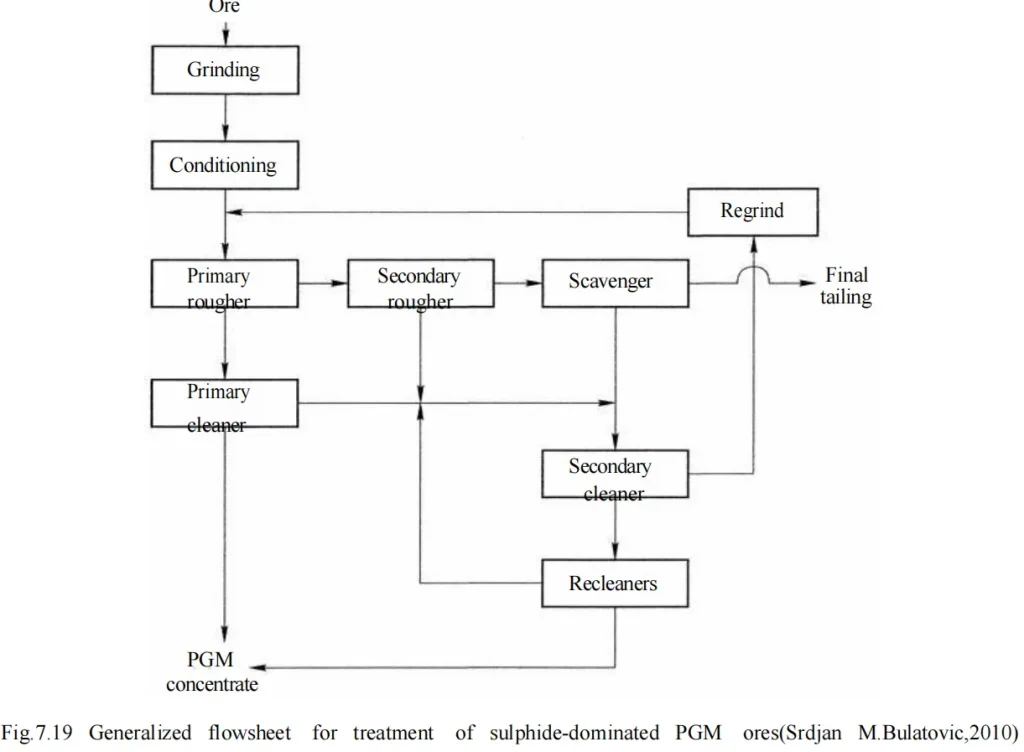
A generalized flowsheet for treatment of sulphide-dominated PMG ores is presented in Fig.7.19. There can be some variation in this flowsheet, such as (1) retreatment of the cleaner tailings; (2) regrinding the scavenger concentrate; (3) the number of cleaning stages. This flowsheet is used in several operations from the Bushveld Complex (South Africa), Stillwater Complex (USA) and Lac des Iles (Canada).
7.5.4.2 Flowsheets for Treatment of Cu-Ni-containing PGM Ores
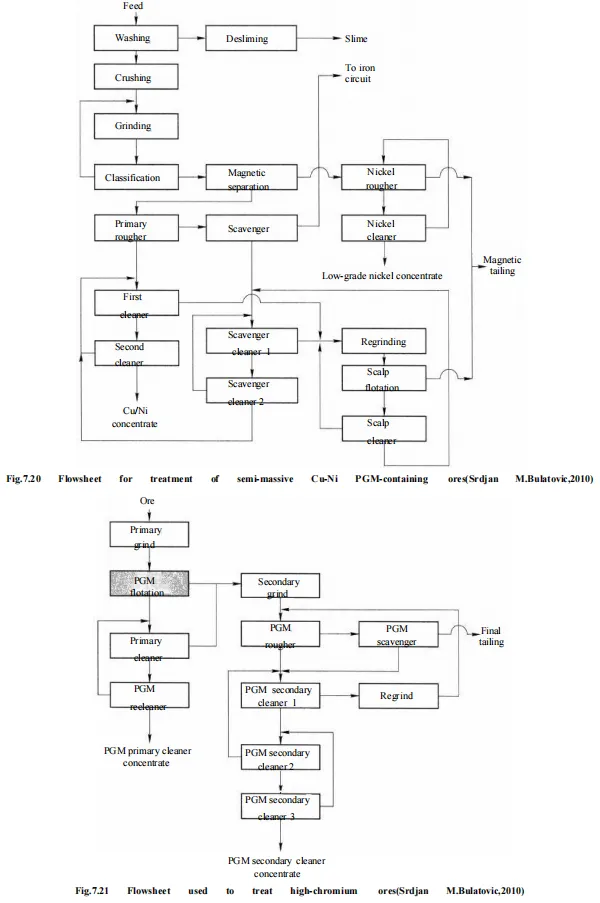
These flowsheets are usually designed for treatment of Cu-Ni ores with the PGM being recovered as a by-product. A typical flowsheet used to treat Cu-Ni-containing PGM ores is shown in Fig.7.20. The configuration of these flowsheets may vary considerably, depending on the amount and type of pyrrhotite present in the ore. In some cases, where the ore has a high PGM value contained in the pyrrhotite, an additional PGM recovery stage is required.
7.5.4.3 Flowsheet Used for Treatment of High-chromium PGM-containing Ores
These flowsheets are specifically designed to maintain the chromium content in the PGM concentrate as low as possible, since chromium is an unwanted impurity. The generalized flowsheet for treatment of high-chromium PGM-containing ores is shown in Fig.7.21. Usually, these flowsheets include a two-stage PGM flotation. In stage 1, a high-grade PGM concentrate is recovered after coarse grinding. The rougher tailing is reground followed by the stage 2 of PGM flotation and upgrading, where a low-grade concentrate is recovered.
7.5.5 Reagent Schemes Used to Treat PGM-Containing Ores
The reagent schemes used for treatment of PGM-containing ores varies considerably and depend largely on the type of ore being treated. In some operations, emphasis is placed on maximizing the PGM recovery, while a low-grade concentrate is maintained. Table 7.22 lists the ore type and reagent scheme, along with metallurgical results achieved in some PGM operations.
Table 7.22 Ore type,reagent scheme and metallurgical results fromoperatingplants(SrdjanM.Bulatovic,2010)
| Name of operation | Ore type/reagent scheme/metallurgical results |
| Amplats-Mine No.1 South Africa, Morensky Reef | Ore:Sulphide-dominated PGM ore composed of Cu,Ni,pyrrhotite and some pyrite. This ore contains a fair amount of floatable gangue minerals.Grind:To a Kgo of about 105μm.Reagents:CuSO₄=200-300g/tCMC①=200-400g/tamyl xanthate =100-250g/tdithiophosphate =40-80g/tMetallurgy:total PGM concentrate grade =70-85g/t PGM recovery =82%-85% |
| Amplats-Mine No.2 South Africa, Morensky Reef | Ore:Sulphide-dominated PGM ore containing nickel,pyrrhotite and a little copper. Floatable gangue was dominated by tale and Chlorites.Grind:To a Kgo of 87μm Reagents:CuSO₄=100-200g/tdibutyl xanthate =320g/tmodified guar gum =200-250g/tMetallurgy:90-100g/t total PGM in concentrate PGM recovery =80%-82% |
| Amplats -Mine No.3 South Africa, Morensky Reef | Ore:Sulphide-dominated PGM deposit containing Cu/Ni and mixed pyrite-pyrhotite. The main floatable gangues are calcite,chlorites with lesser tale. Grind:Kgo=95μmReagents:CuSO₄=100-150g/tisopropyl xanthate =150g/tguar =150-200g/tmercaptan =30-40g/tMetallurgy:total PGM in concentrate =110-120g/t PGM recovery =84%-86% |
| Continued Table 7.22 | |
| Name of operation | Ore type/reagent scheme/metallurgical results |
| Stillwater complex Montana,USA | Ore:Sulphide-dominated PGM-containing Cu,Ni associated with PGM. Principal gangue floatable mineral is talc.Grind:K₈o=115μmReagents:CMC=400-600g/tsodium amyl xanthate =80-150g/tdithiophosphate =20-40g/tMetallurgy:total PGM in concentrate =300-600g/t PGM recovery =86%-88% |
| Norilsk complex Siberia,Russia | Ore:Massive sulphide Cu/Ni ore with high PGM content.The bulk of the PGM is contained in pentlandite and monoclinic pyrrhotite.Main gangue minerals are serpentine and pyrrhotite. Grind:Kgo=74μmReagents:lime =200-300g/tCuSO₄=0-300g/t;xanthatemixture =40-60g/taerofloat =20-30g/t Metallurgy:grade is variable PGM recovery =70%-85% |
| UG2 Morensky Reef Plant A | Ore:PGM dominated with some chromium.Main gangue minerals are calcite,silicate and some aluminosilicate.The ore contains a moderate amount of clay-like slimes.Grind:K₈o=85-100μmRegrind:regrind the middlingsReagents:potassium amyl xanthate =300-400g/tdithiophosphate=30-50g/tguar gum =50-100g/tMetallurgy:total PGM in concentrate =300-400g/t PGM recovery =80%-84% |
| UG2 Morensky Reef Plant B | Ore:PGM-dominated ores-with very little sulphides.Main gangue minerals include silicate,mica,aluminosilicate and some chromium. Grind:Kgo=95μmRegrind:cleaner tailingsReagents:sodium isobutyl xanthate =280-350g/tdithiophosphate =50-60g/tCuSO₄=50-100g/tguar gum =50-100g/tMetallurgy:total PGM in concentrate =180-200g/t PGM recovery =80%-82% |
| Name of operation | Ore type/reagent scheme/metallurgical results |
| Barrier Reef Plant WF1 | Ore:high-chromium PGM ore.Main gangue minerals are chromite with some silicates,calcite and clay-like slimes. Grind:K₈o=150μm for stage 1K8o=90μm for stage 2Regrind:cleaner tailingsReagents:xanthate mixture =250-300g/t mercaptan =30-50g/tmodified guar =50-100g/t CuSO₄=50-100g/tMetallurgy:Total PGM in concentrate =80-110g/t at 2.75%Cr₂O₃ PGM recovery =83% |
| Amplats Barrier Reef Plant WF2 | Ore:high-chromium PGM ore.Dominant gangue minerals are chromite with some non-opaque gangue.Ore contains moderate amount of clay-like slimes.Grind:K₈o=150μm for stage 1K8o=95μm for stage 2Reagents:isobutyl xanthate =200-300g/t dithiophosphate =20-35g/tmodified guar =50-100g/tMetallurgy:total PGM in concentrate =75-90g/t at 95%Cr₂O₃ PGM recovery =83% |
① CMC, carboxymethyl cellulose.
In the majority of operations, collector consumption is relatively high, especially in plants treating high-chromium ores. It appears that PGM concentrates with high chromium contents are in fact related to a high collector consumption, which usually results from entrapment of fine chromium in the concentrate. In fact, high collector consumptions are related to the presence of clay-like slimes, which are known to consume collectors. Recent studies conducted on high-chromium ores indicated that collector consumption can be substantially reduced (i.e. up to 60%) by using a suitable slime depressant/dispersant.