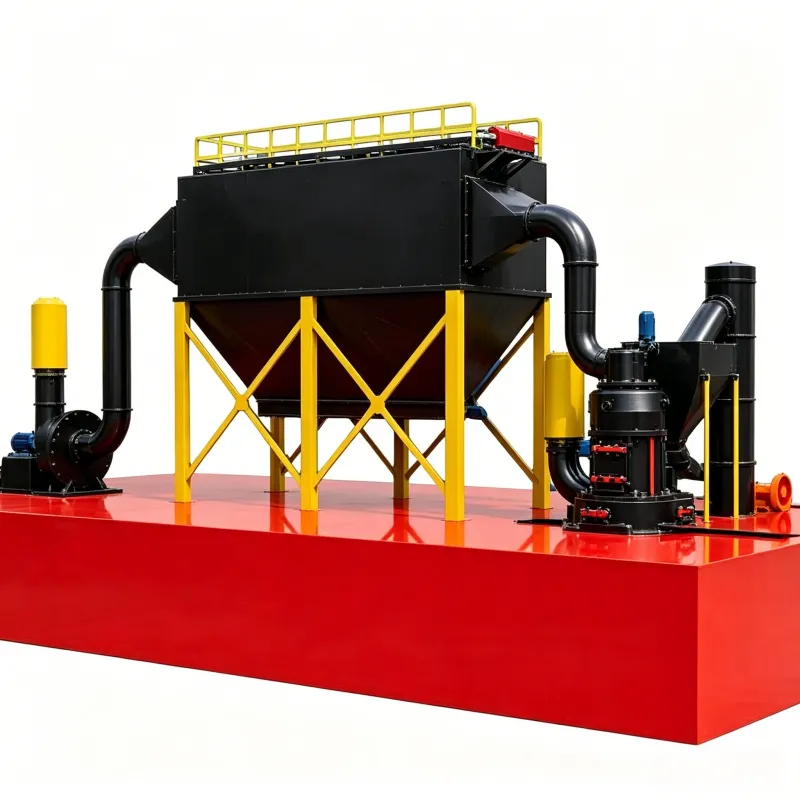
Mulino Raymond a circuito aperto
Introduzione al mulino Raymond a circuito aperto Il mulino Raymond a circuito aperto KX è un…


In the field of flue gas desulfurization (FGD) at coal‑fired power plants, the limestone‑gypsum wet FGD process is the most mature and widely used technology for controlling SO₂ emissions worldwide, with over 90% of thermal power plants in China adopting this process. As the core desulfurization agent, the quality of limestone powder preparation directly affects desulfurization efficiency. The vertical roller mill (VRM), with its unique advantages of high efficiency, energy saving, and environmental protection, is becoming the mainstream choice for processing desulfurization limestone powder. This article provides a comprehensive analysis of the process scheme, equipment selection, and core advantages of using VRMs for desulfurization limestone processing.
The particle size of limestone powder has a decisive impact on desulfurization efficiency. The finer the particle size, the larger the specific surface area, and the more favourable it is for SO₂ absorption. Currently, desulfurization limestone powder is typically required to have a fineness of 95% passing 250 mesh or over 90% passing 325 mesh. Limestone powder ground to 325 mesh achieves even better desulfurization performance.
There are three main methods for preparing desulfurization limestone powder in China: dry tube mill grinding, wet ball mill grinding, and dry VRM grinding. Traditional ball mills suffer from high energy consumption, high noise, and large space requirements. In contrast, the VRM uses the “interparticle bed grinding” principle and integrates crushing, drying, grinding, classification, and conveying into a single unit, enabling continuous and intensive operation.
In recent years, with the growing demand for finer limestone powder and the need for energy conservation and emission reduction, more and more power plants are adopting VRMs for desulfurization limestone processing. At present, China’s VRM manufacturing technology has improved significantly, and its reliability has been repeatedly verified in cement raw meal preparation, fine powder grinding in the non‑metallic minerals industry, and pulverised coal preparation in power plants and steel mills.
The VRM uses the interparticle bed grinding principle, reducing energy consumption by 30%–40% compared with traditional ball mills. Power consumption of the grinding system is 20%–30% lower than that of a ball mill, and the savings become even more pronounced as the raw material moisture content increases. Large VRM units (e.g., HLM3400) can achieve a single‑unit capacity of 100–120 t/h. The operating costs of VRMs are lower, with power savings of over 25% compared with ball mills, and the investment payback period is generally within six months.
The VRM has an integrated classifier, eliminating the need for an external classifier and simplifying the flow. From raw material to finished product, the system comprises only four core components: feeding equipment, hot‑gas supply system, vertical roller mill, and product collection equipment.
The VRM system occupies more than 30% less floor space than a ball mill system, reducing civil construction costs and fitting the compact layout requirements of modern power plants.
The limestone powder produced by a VRM has uniform particle size, which is beneficial for the subsequent desulfurisation chemical reactions. For finer powder grinding, the VRM is not affected by electrostatic effects that can cause over‑grinding.
The VRM can directly handle materials with a moisture content of up to 15%. If steam from the power plant is used as the heat source, it can further reduce coal‑related pollution and lower operating costs.
The entire process can be divided into four main stages: raw material preparation, grinding operation, classification and collection, and finished product storage and conveying.
Desulfurization limestone usually enters the plant as lump ore, with particle sizes generally below 20 mm. The raw material first undergoes primary crushing; if the lumps are too large, a jaw crusher or impact crusher is used for coarse and medium crushing.
The crushed limestone is stored in a dedicated碎石仓 (stone bin) with a valve underneath and an adjustable electronic belt scale that controls the feed rate. The belt scale discharges a set quantity of limestone as required by the system. After iron removal, the material is fed into the VRM via a bucket elevator and a rotary feeder with an air‑lock function.
This stage also includes raw material testing, requiring analysis of the limestone’s CaO content, impurity composition, and moisture to ensure stable quality.
After entering the VRM, the material is thrown by the rotating grinding table towards the gap between the grinding rollers and the table. Under hydraulic system pressure, the rollers apply compression, shearing, and grinding forces to the material, achieving efficient size reduction. The material moves from the centre to the edge of the table as it rotates, being crushed by the rollers.
Simultaneously, hot air from a hot‑gas generator enters from the bottom of the mill, creating an internal circulating air stream that both dries the material and assists in material transport. The hot air is generated by a dedicated hot‑gas generator, which can be coal‑fired or oil‑fired depending on plant conditions. Some power plants directly use steam heat exchangers, making full use of the plant’s steam resources.
For limestone, a medium‑hardness non‑metallic mineral, the VRM offers high grinding efficiency, low specific energy consumption, and precise particle size control.
The ground material is carried by the air stream into the high‑efficiency classifier for separation. The classifier controls the final fineness by adjusting its rotor speed. Typically, desulfurization limestone powder is required to achieve 95% passing 250 mesh or over 90% passing 325 mesh.
Coarse particles that do not meet the fineness requirement are returned to the grinding table for regrinding, forming a closed‑circuit loop that ensures a uniform particle size distribution and high reactivity of the final product. Qualified fine powder is carried with the air stream into a high‑efficiency bag filter, where it is collected under negative pressure for gas‑solid separation. Collection efficiency can reach 99.99%, achieving near‑zero dust emissions.
The collected limestone powder is transported by screw conveyor or pneumatic conveying system to finished product silos for storage. The silos are equipped with discharge devices at the bottom. According to the desulfurization system demand, the limestone powder is metered and conveyed to the slurry preparation system.
The limestone powder is mixed with water to form a limestone slurry, which is then sprayed into the FGD tower to react chemically with SO₂ in the flue gas, producing gypsum and achieving desulfurisation.
| Modello | Capacità | Product Fineness | Scenario applicativo |
|---|---|---|---|
| HLM Vertical Roller Mill | 5–200 t/h | 22–180 μm | Large‑scale desulfurization projects |
| HLMX Ultrafine Vertical Mill | Various options | 325–2500 mesh, adjustable | Ultrafine powder requirements |
| LM Vertical Roller Mill | 10–400 t/h | 20–400 mesh | Large‑scale continuous production |
The HLM vertical mill is specifically designed for grinding desulfurization limestone, featuring low energy consumption, low wear, and stable operation. The HLMX ultrafine vertical mill uses a dynamic‑static combination classifier, allowing product fineness to be adjusted within the range of 325–2500 mesh (5–40 μm) .
The actual selection should take the following dimensions into account:
For power plants with an annual throughput exceeding 100,000 tonnes, the VRM’s advantage in specific power consumption per tonne can offset the initial investment difference within six months.
The entire system is equipped with an automated control platform that monitors parameters such as grinding pressure, air flow, temperature, and current in real time, ensuring stable, energy‑efficient operation. The equipment also offers advantages such as easy maintenance and a small footprint.
In terms of environmental protection, the system operates under fully enclosed negative‑pressure conditions and is equipped with a high‑efficiency pulse‑jet bag filter, achieving near‑zero dust emissions.
Processing desulfurization limestone with a vertical roller mill is an advanced process solution that integrates high‑efficiency grinding, energy saving, precise classification, and environmentally friendly operation. From raw material preparation to finished product conveying, the VRM system meets the stringent requirements of large industrial facilities such as power plants and steel mills for desulfurization agent fineness, reactivity, and throughput through a scientific and continuous process flow. Whether for new desulfurization projects or upgrading existing processes, VRM processing technology deserves serious consideration.

 English English
 Spanish
 Russian
 Arabic
 Swahili
 French
 Turkish
 Portuguese
 Korean
 Japanese
 German
 Italian