
Mulino a sfere tubolare
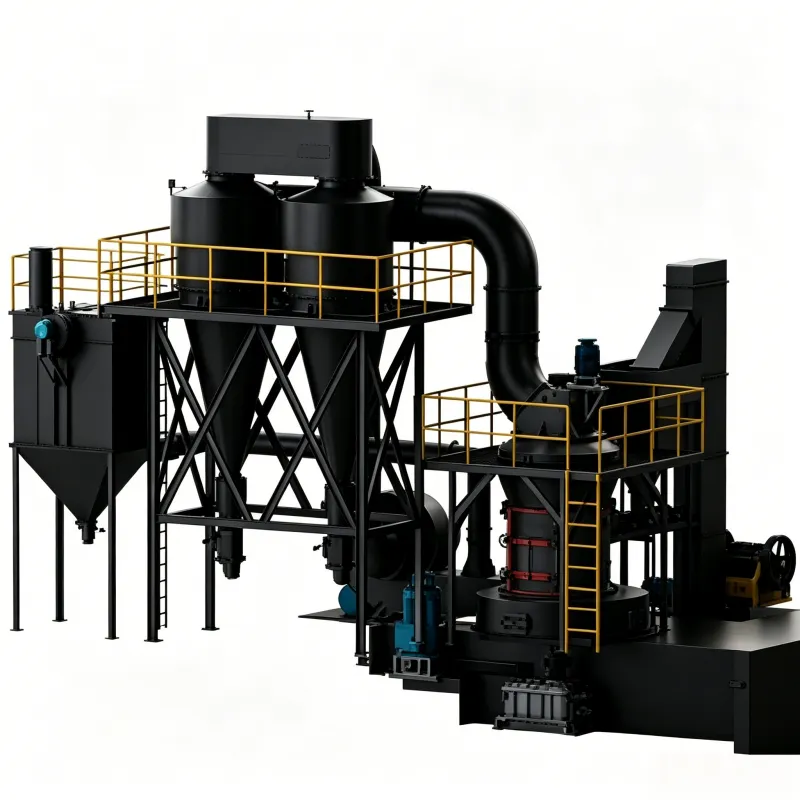
Panoramica del prodotto Il mulino a tubi è un’apparecchiatura di macinazione fine di estrema importanza…


At a certain plant, the discharge grate plate of a Φ2.4 m × 13 m tube mill had long suffered from short service life and easy clogging, which affected the normal operation of the mill.
As shown in Figure 2.25, the original design had an effective wear thickness of 15 mm and an included angle of 53°07′. Because the effective wear thickness was too small, the grate plate had to be replaced once its thickness was worn down to 25 mm. However, practical operating experience indicated that this thickness was not the actual failure limit of the plate. Moreover, due to the small included angle of the slots, coarse particles and small grinding media (cylpebs) could easily become wedged in the slots, reducing the open area and sometimes even completely blocking it. The slots had to be cleaned every half month, which increased labour intensity and significantly affected both output and product quality. To improve this situation, Ke Junquan modified the grate slot design. Based on analysis and testing, the effective wear thickness of the grate plate was increased by 5 mm, and the included angle of the slots was enlarged to 69°04′, as shown in Figure 2.26.
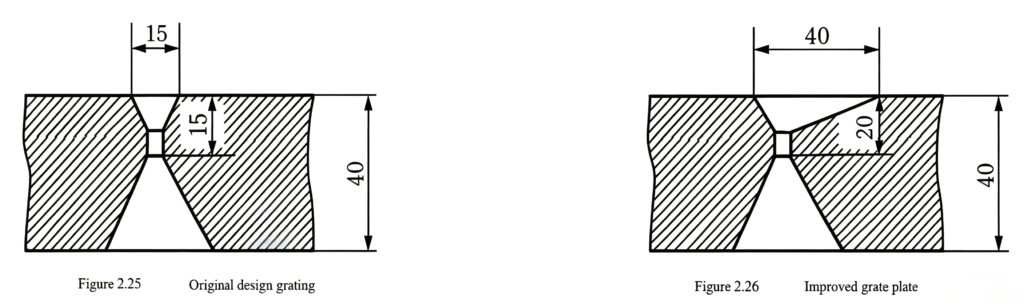
Through the above modifications, the wear condition of the grate plate was improved, and clogging (wedging) was significantly reduced, greatly decreasing the frequency of cleaning the grate slots. As a result, the service life (operating time) of the grate plate was extended from the original 5,286 hours to 9,879 hours, and the mulino output also increased.
 English English
 Spanish
 Russian
 Arabic
 Swahili
 French
 Turkish
 Portuguese
 Korean
 Japanese
 German
 Italian