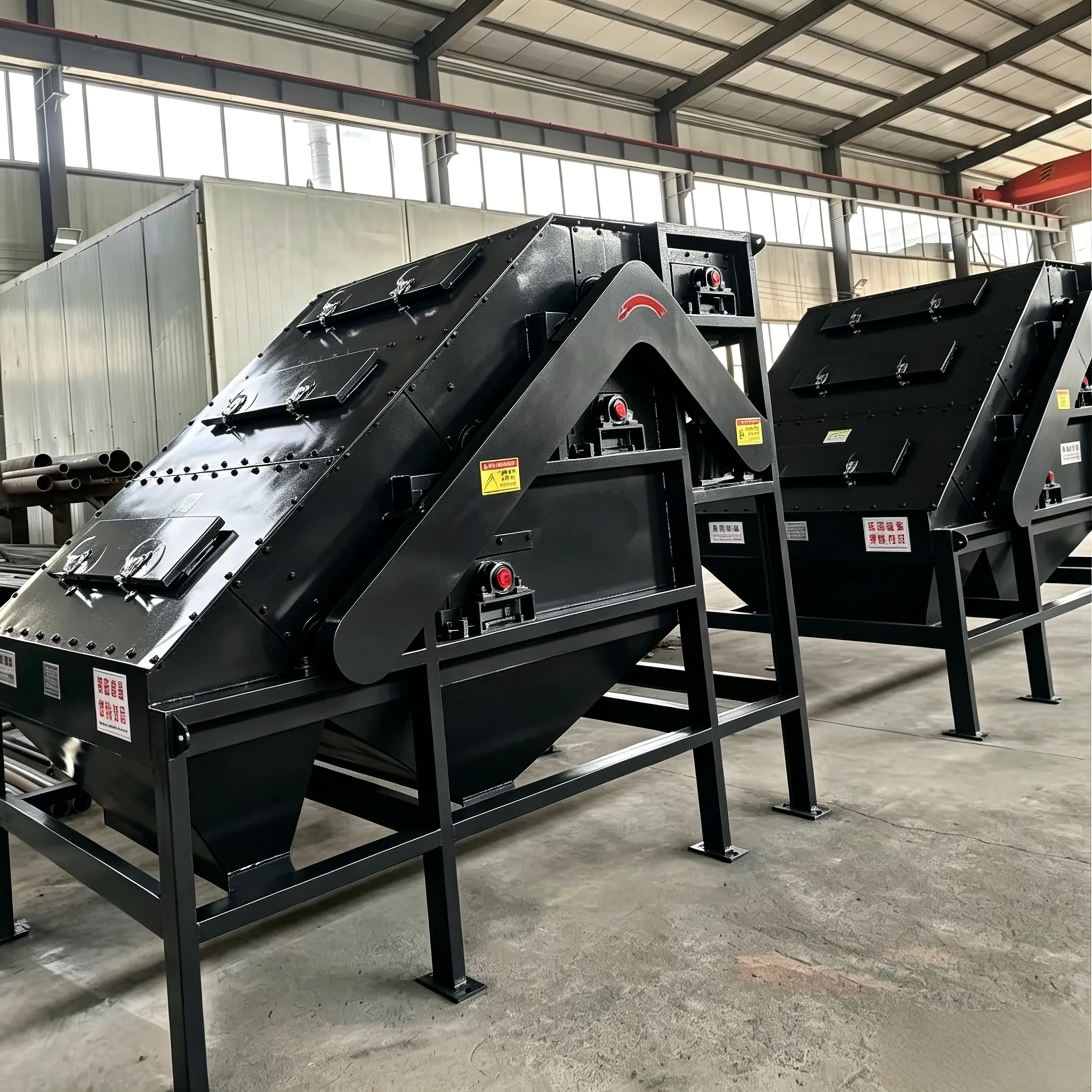
Separatore magnetico ad alto gradiente
Costruzione di un separatore magnetico ad alto gradiente. Il principio di separazione del separatore ad alto…

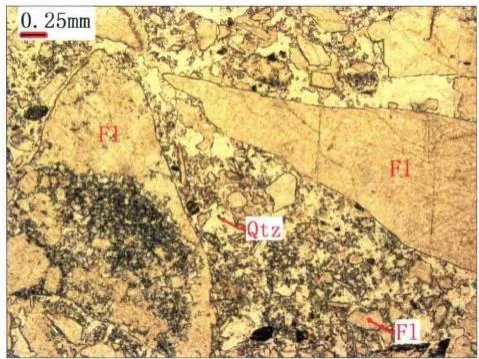
CaF1-B01
Granite porphyry. The rock is grayish-yellow in color, with a porphyritic texture and massive structure. The phenocryst assemblage consists of quartz, feldspar, and biotite. Quartz: smoky gray to pale yellowish-brown, transparent to translucent, with a greasy luster; mostly rounded granular forms with prominent corrosion embayments; grain sizes typically range from 1 to 3 mm, with larger grains up to 5 mm; content 15%–20%. Feldspar: yellowish-white to white, with vitreous luster, anhedral granular; generally 1–3 mm in size; content about 10%. Biotite: black to dark brownish-black, mostly occurring as scaly flakes or aggregates of flaky clusters; individual flakes about 1 mm across, while aggregates are generally 3–5 mm, with some up to 10 mm; content about 5%. The matrix is cryptocrystalline, light grayish-white, composed of felsic material, accounting for about 60% of the rock. Fine quartz veinlets are developed in the rock, with vein widths of 1–2 mm; the vein fillings contain not only quartz but also fine-grained biotite.

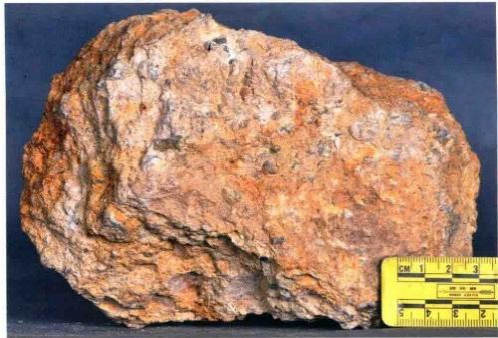
CaF1-B02
Yellowish-brown siliceous breccia. The rock is light yellowish-brown to light yellowish-white in color, with a cataclastic texture and massive structure. The clasts are composed of felsic material with minor siliceous rock, white to light grayish-white in color, and are angular to subangular in shape. They range from 1–2 cm in maximum diameter down to 1–2 mm at minimum, with an average size of about 5 mm. All clasts show no reaction to dilute hydrochloric acid. Clast content is approximately 65%. The cement is argillaceous powder, yellowish-brown to yellowish-white in color, also non-reactive to dilute hydrochloric acid, and exhibits strong water absorption; it is possibly composed of kaolin-group minerals, accounting for about 35% of the rock. Within the cement, fine-grained limonitized particles are unevenly distributed, imparting a yellowish-brown hue to the rock.
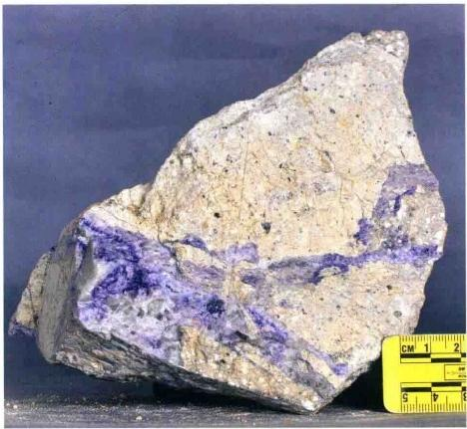
CaF1-B03
Fluorite-vein-bearing granite porphyry. The rock is light grayish-yellow in color, with porphyritic texture, massive structure, and rhyolitic structure. Quartz: smoky gray to pale yellowish-brown, transparent to translucent, with greasy luster; mostly rounded granular, with distinct corrosion features; grain sizes range from 1 to 3 mm, with larger grains up to 5 mm; content 15%–20%. Feldspar: yellowish-white to white, vitreous luster, anhedral granular; generally 1–3 mm, with larger grains up to 5 mm; content about 20%. Biotite: black to dark brownish-black, fine scaly; content about 1%. The matrix is cryptocrystalline, white to light grayish-white, composed of felsic material, in which colorless siliceous fine streaks develop, giving rise to the rhyolitic structure. Irregular fluorite veins are developed in the rock; the widest veins are 1–3 cm across, while thin veinlets are 1–2 mm wide. The vein fillings are predominantly purple fluorite, which occurs as medium- to fine-grained anhedral crystals; grains near the vein walls are finer, whereas those in the central part are slightly coarser. In addition to fluorite, quartz is also present—colorless, transparent, with greasy luster and high hardness, mostly occurring in the middle portions of the veins, accounting for about 10% of the vein material. Within the fluorite veins, elongated rhyolite porphyry breccia clasts distributed parallel to the vein orientation can be observed. Fine to very fine-grained pyrite is also visible in the rock.
CaF1-B04
Grayish-green argillaceous siltstone. The rock is light greenish-gray in color, with an argillaceous–silty texture, finely laminated structure, and massive structure. The mineral grains composing the rock are very fine, and their composition cannot be determined by the naked eye. Neither the rock nor its powdered form reacts with dilute hydrochloric acid, indicating that the rock contains very little carbonate material. Based on its color and other features, the main constituents are inferred to be argillaceous material, fine quartz silt, and possibly volcanic ash. The rock contains calcite-bearing quartz veins of varying compositions, with vein widths of 1–3 mm, and occasionally occurring as irregular patchy aggregates.
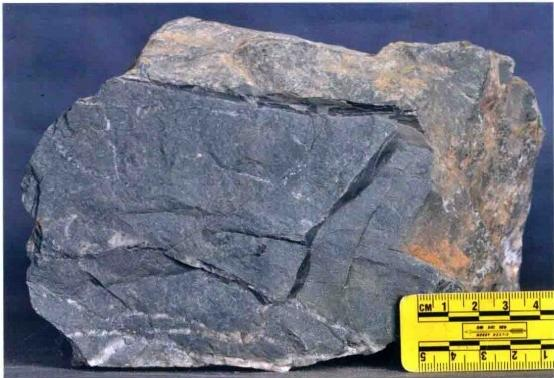
CaF1-B05
Tectonic breccia. The rock is gray to yellowish-gray in color, with a cataclastic texture and brecciated structure. The clasts are of three types: the first is dark grayish-black argillaceous siltstone or silty mudstone; the second is yellowish-white tuff clasts; and the third is white quartzite clasts. The clasts vary in size, ranging from 3–5 cm for the larger ones down to 0.5–1 cm for the smaller ones. They are all angular to sharply angular and chaotically distributed, without any orientation or sorting. All clasts show no reaction to hydrochloric acid. The clast content is approximately 70%. The cement consists of argillaceous material and calcite, distributed between the clasts. The calcite is yellowish-white, anhedral, medium- to fine-grained, and effervesces with dilute hydrochloric acid. The cement content is about 30%.

CaF1-B06
Siliceous pebbly fine sandstone. The rock is light greenish-gray in color, with a fine-grained crystalloblastic texture and blastoporphyritic (relict) texture, and massive structure. The mineral composition consists of quartz, chlorite, calcite, and a small amount of talc. Quartz: colorless, very fine-grained, evenly distributed throughout the rock, with grain sizes ranging from 0.1 to 0.2 mm; content 40%–50%. Chlorite: grayish-green to dark grayish-black, occurring as very fine grains, granular aggregates, and tiny scaly flakes, derived from the metamorphism of argillaceous material in the original rock; content 20%–30%. Calcite: white, cryptocrystalline, slippery to the touch, with hardness less than that of a fingernail; it is unevenly distributed in the rock as spotted and patchy aggregates; content about 5%. The protolith of this rock is inferred to be calcareous–argillaceous siltstone.
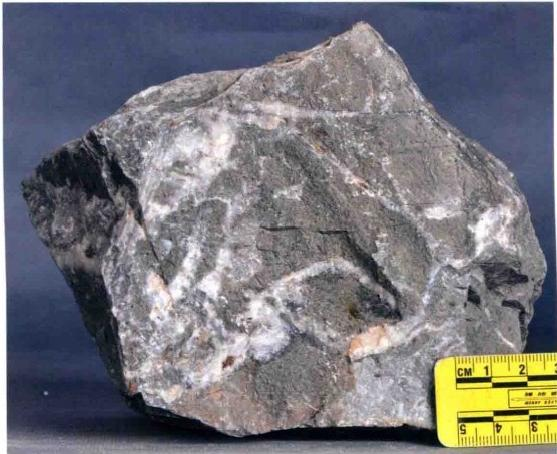
CaF1-B07
Fluorite ore. The ore is pale pink to green and colorless, with a medium- to coarse-grained allotriomorphic granular texture, massive structure, and banded structure. The specimen consists entirely of fluorite, with two color varieties—pale green and colorless—forming distinct color bands. The streak is white in all cases. It has a vitreous luster, hardness slightly less than that of a a knife blade, and exhibits a rose-red fluorescence under ultraviolet light. The ore is pure, containing no metallic sulfides; only one small vug measuring 0.5 cm × 1 cm is observed, which contains hexagonal prismatic–pyramidal quartz crystals. Fluorite content exceeds 99%.
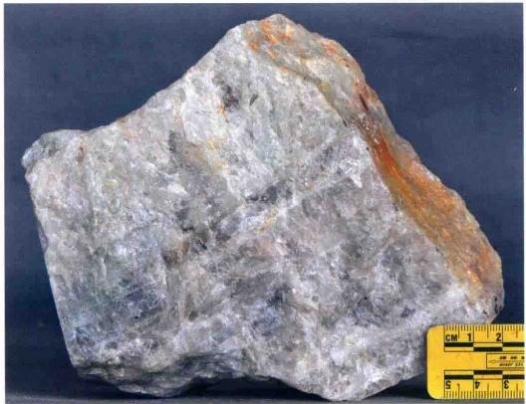
CaF1-B08
Fluorite ore. The ore is green, purple, pale yellowish flesh-red, and colorless, resulting from fluorite of different colors. It exhibits a medium- to coarse-grained allotriomorphic granular texture, banded structure, and massive structure. The fluorite varieties present include purple, dark green to light green, pale yellow to pale flesh-red, and colorless; they are distributed in alternating bands, forming a banded structure. The streak is white in all cases. It has a vitreous luster, with hardness slightly less than that of a knife blade. Under ultraviolet light, it shows rose-red and green fluorescence; however, the green interference causes it to appear purplish. The fluorite is medium- to coarse-grained allotriomorphic granular, with grain sizes ranging from 0.5 to 1 cm, and the aggregates are massive, with band widths of 1–2 cm. Quartz veinlets, about 2 mm wide, are visible in the ore, cutting across the fluorite bands. Apart from these quartz veinlets, the ore contains no other impurities, and the fluorite content exceeds 95%.
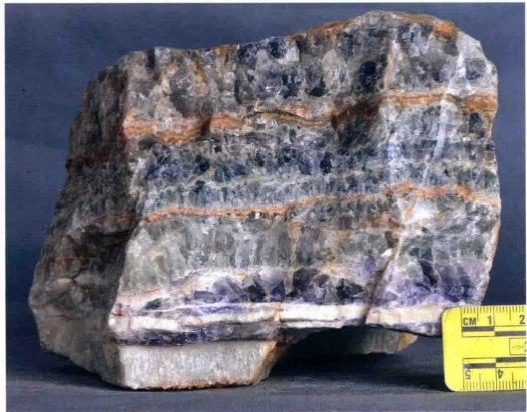
CaF1-B09
Fluorite ore. The ore is pale green to pale rose in color, with a coarse-grained allotriomorphic granular texture and massive structure. The ore is composed of fluorite of two main colors—one pale green, the other pale rose—with some colorless portions as well. The streak is white in all cases. It has a vitreous luster, is transparent to translucent, and has a hardness slightly less than that of a knife. Cleavage is well-developed, and crystal faces are curved. The fluorite occurs as coarse-grained allotriomorphic crystals, with grain sizes ranging from 2 to 5 cm, forming massive aggregates. Under ultraviolet light, it exhibits a rose-red fluorescence. Fluorite content exceeds 95%. On the margin of the ore, a yellowish-white cryptocrystalline siliceous crust is developed; it is hard and does not effervesce with acid. The crust is 1–2 mm thick, sometimes occurring as a single layer and occasionally as two layers. Rare argillaceous siltstone xenoliths are observed in the ore, measuring about 0.5 cm × 1.5 cm in size, and oxidized limonite rims are present around these xenoliths.
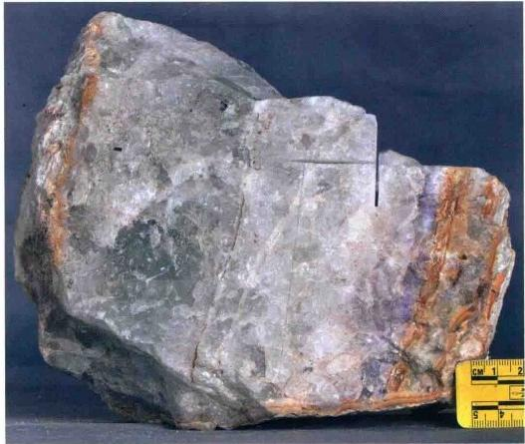
CaF1-B10
Fluorite ore. The ore is pale green to pale rose in color, with a coarse-grained allotriomorphic granular texture, massive structure, and vuggy structure. The ore is composed of fluorite of two colors—one pale green and the other pale rose. The streak is white in all cases. It has a vitreous luster, hardness slightly less than that of a knife, well-developed cleavage with curved cleavage surfaces. The fluorite occurs as coarse-grained allotriomorphic crystals, ranging from 1 to 5 cm in size, forming massive aggregates. Under ultraviolet light, it exhibits a rose-red fluorescence. A quartz vein is present in the ore, ranging from 2 mm to 1 cm in width; the vein contains vugs, along the walls of which quartz crystal druses have developed. The quartz crystals are hexagonal prismatic–pyramidal in form. The vein cuts across the fluorite minerals, indicating that it formed after the fluorite.

CaF1-B11
Argillaceous siltstone. The rock is light greenish-gray in color, with an argillaceous–silty texture, massive structure, and finely laminated structure. The mineral grains composing the rock are very fine, and their composition cannot be determined by the naked eye. Neither the rock surface nor its powder reacts with dilute hydrochloric acid, indicating that the rock contains very little carbonate material. Based on its color, texture, and structural features, the main constituents are inferred to be argillaceous material, fine quartz silt, and possibly volcanic ash. Hair-like chlorite–pyrite veinlets are developed in the rock, with veinlet widths of 0.1–0.2 mm and lengths ranging from 2 to 20 cm; they exhibit branching and rejoining phenomena and are cut by later (younger) calcite–quartz veins.
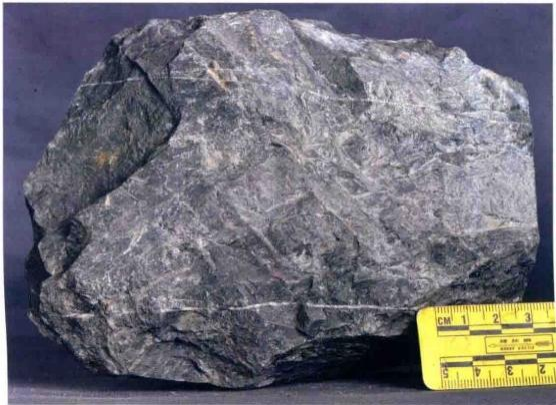
CaF1-B12
Siliceous rock (quartz vein). The main body of the specimen is a quartz vein, 6–10 cm wide, with the surrounding wall rock being gray metamorphosed argillaceous siltstone. The quartz vein is composed of white, anhedral, fine-grained quartz, with high hardness and no reaction to hydrochloric acid. Within the quartz vein, colorless quartz veinlets are developed. The boundary between the quartz vein and the wall rock is sharp, and branches of the white quartz vein can be seen penetrating into the metamorphosed argillaceous siltstone on the vein side.

CaF1-B13
Grayish-green argillaceous siltstone. The rock is light greenish-gray in color, with an argillaceous–silty texture, massive structure, and micro-laminated structure. The mineral grains are very fine and their composition cannot be distinguished by the naked eye. Neither the rock nor its powder reacts with dilute hydrochloric acid. The mineral constituents are mainly quartz, feldspar, mica, and clay minerals. Chlorite–pyrite veins are developed in the rock, and calcite–quartz veinlets are also present, cutting across the chlorite–pyrite veins. Pyritization is also observed within the calcite–quartz veins.

CaF1-B14
Fluorite ore. The ore is yellowish-white in color, with a medium-grained texture and vuggy structure. The mineral composition of the ore is mainly fluorite, which is uniformly yellowish-white with a slight pale flesh-red tint. It has a vitreous luster, is transparent to translucent, with hardness slightly less than that of a knife and a white streak. The fluorite occurs as medium- to fine-grained euhedral to subhedral crystals, forming massive aggregates. The massive fluorite forms a framework, within which vugs are developed; coarser fluorite druses are grown on the walls of the vugs, indicating a near-surface weathering environment. The vugs in the ore are filled with yellow soil and yellow kaolinitic ferruginous–argillaceous material.

CaF1-B15
Fluorite ore. The ore is pale rose-red to colorless, with a medium-coarse to coarse-grained texture, botryoidal structure, and massive structure. The ore is composed entirely of fluorite, occurring in two color varieties: one pale rose-red, medium-coarse-grained anhedral; the other colorless, coarse-crystalline. The two fluorite varieties are distributed in arcuate patterns. The rose-red fluorite is translucent, with a white streak and hardness slightly less than that of a knife. Its aggregates grow in bundle-like forms perpendicular to the vein walls, exhibiting a tendency to contract inward toward the cavity; individual crystals can reach up to 5 cm in length, forming a rose-red fluorite band about 5 cm wide. The colorless fluorite is botryoidal, coarse-crystalline, transparent, with vitreous luster; cube and octahedron crystal forms are well developed, with grain sizes up to 8–10 mm, forming a colorless fluorite band approximately 2 cm wide, indicating that it crystallized under conditions of ample time and space.
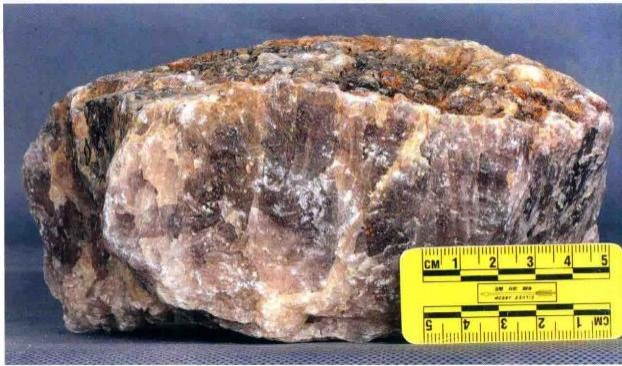
CaF1-B16
Brecciated fluorite ore. The ore is brownish-yellow in color, with a medium-fine to medium-grained texture and brecciated structure. The clasts of the ore are composed entirely of fluorite. The fluorite is yellowish with a pale flesh-red tint, with a white streak, hardness slightly less than that of a knife, and vitreous luster. It occurs as medium-fine to medium-grained anhedral crystals forming massive aggregates. The clasts are angular and vary greatly in size, ranging from as large as 4 cm × 8 cm down to as small as 3 mm × 5 mm, with a clast content of 70%–75%. The cement consists of kaolinite and limonite. The kaolinite is earthy yellow, occurring as irregular fine grains and earthy powder. The limonite is dark brownish-black, black earthy, and commonly exhibits a cellular (honeycomb) structure; its streak is brown to brownish-red. The cement content is 25%–30%. The ore was formed by tectonic brecciation of fluorite followed by subsequent cementation.

CaF1-B17
Brecciated fluorite ore. The ore is pale rose-red to brownish-yellow in color, with a medium-fine grained texture, and brecciated, crustiform, and vuggy structures. The clasts are composed of siliceous rock, occurring in dark gray and brownish-yellow varieties. The clasts are angular, varying greatly in size, ranging from 12 cm × 18 cm (largest) down to 1–2 cm (smallest), with an average size of 3–8 cm, and are chaotically distributed without sorting. All clasts consist of siliceous rock, which is fine-grained cryptocrystalline, hard, and non-effervescent with hydrochloric acid. The clast content is about 80%. The cement is medium-fine grained fluorite, pale rose-red in color, with a white streak, vitreous luster, and hardness slightly less than that of a knife. It occurs as subhedral to anhedral medium-fine crystals, forming massive, crustiform, and colloform aggregates. The fluorite content is about 20%. As cement, the fluorite grows around the siliceous clasts, exhibiting leathery and concentric ring textures, with crystals radiating in bundle-like forms from the clast cores. Some inter-clast pores are completely filled with fluorite, forming massive aggregates, while others are incompletely filled, resulting in vuggy structures, with euhedral fluorite druses growing within the vugs. This ore was formed by tectonic brecciation of pre-existing siliceous rocks, followed by condensation, precipitation, and cementation by calcium fluoride-rich hydrothermal solutions, resulting in the brecciated ore.
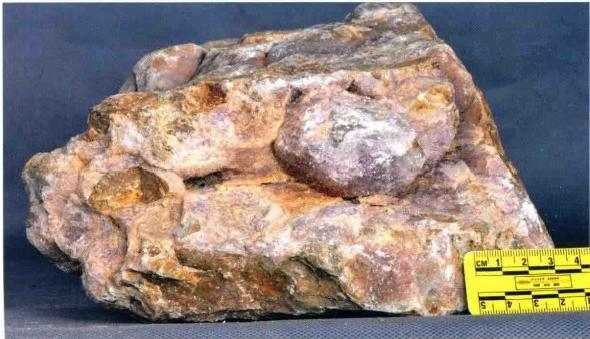
CaF1-B18
Calcite quartz schist. The rock is pale yellowish-white to brownish-tawny in color, with a lepidoblastic texture and schistose structure. The main mineral constituents are muscovite, calcite, and minor quartz. Calcite: white to milky white, with vitreous luster, hardness less than that of a knife, effervescing vigorously with dilute hydrochloric acid; occurs as euhedral to subhedral flaky and granular forms, with a content exceeding 40%, and also occurs as granular aggregates or patches. Quartz: colorless, transparent, mostly anhedral fine-grained, with a content of about 40%. Muscovite: fine scaly, with pearly luster, transparent and colorless, content about 10%, occurring as flaky minerals. The rock contains small brownish manganese spots, which effervesce uniformly with hydrogen peroxide, with a content of about 5%. The orientation of the flaky minerals is indistinct and non-parallel, mostly exhibiting crenulation features, indicating thermal–dynamic compressive metamorphism. On the margin of the specimen, fluorite veins are developed along rock fractures, and fluorite occurring as granular aggregates is also visible in the rock.

CaF1-B19
Silicified pebbly quartz wacke. The rock is gray in color, with a crystalloblastic texture and blastopsammitic (relict sandy) texture, and massive structure. The main mineral constituents are quartz and feldspar, with minor chlorite and silicified quartz veins. Quartz: colorless to black, transparent to translucent, with greasy luster; mostly occurs as fine-grained, rounded quartz sand grains about 1 mm in size; content about 40%. Fine gravels: coarser grains, all siliceous in composition, ranging from 3 to 10 mm in size, with some larger; content about 5%. Feldspar: white to yellowish-white, anhedral fine-grained, evenly distributed throughout the rock, mostly kaolinized; content about 30%. Chlorite: grayish-green, very fine-grained and granular aggregates, unevenly distributed; content about 20%. The rock contains well-developed quartz veinlets, with the wider veins reaching 2–5 mm and the finer ones being hair-like; quartz masses are also present. The vein quartz content is about 10%. In addition, the rock contains minor disseminated fine-grained pyrite.

 English English
 Spanish
 Russian
 Arabic
 Swahili
 French
 Turkish
 Portuguese
 Korean
 Japanese
 German
 Italian