Il mulino a sfere is core ultra-fine grinding equipment widely used in mining, building materials, chemical industry, thermal power and other sectors. It is applied to finely grind crushed ores into fine powder ranging from dozens to hundreds of mesh after primary and secondary crushing. It is commonly configured in production lines for gold ore, iron ore mineral processing, calcium carbonate manufacturing, cement production, power plant desulfurization, quartz sand powder making, etc.
1.1 Core Function
Small lump ores pre-crushed by jaw crushers and cone crushers are fed into the ball mill cylinder. Through impact and abrasive grinding force of steel balls, ores are ground into fine particles. In mineral processing plants, full dissociation between valuable minerals and gangue minerals can be achieved via grinding, so that metal concentrates can be extracted by subsequent flotation, gravity separation or magnetic separation. For non-metallic industries, it is used to produce industrial fine powder.
1.2 Main Classifications
Wet Ball Mill (Most Popular in Mineral Processing) Materials are ground with water to form slurry discharge. It features low dust pollution and high grinding efficiency, widely adopted in all types of metallic ore beneficiation.
Dry Mulino a sfere No water is added during grinding; finished powder is discharged by air classification. It is mainly used for processing quartz sand, cement, calcium carbonate and other non-metallic mineral powders.
Classified by discharge type:
Grate Ball Mill: for coarse grinding and high-capacity primary grinding
Overflow Ball Mill: for fine grinding in the beneficiation concentration stage
1.3 Applicable Materials
Gold ore, iron ore, copper ore, limestone, quartz, kaolin, steel slag, cement clinker, coal and other brittle materials with Mohs hardness ≤7.
2. Main Core Structure
Feeder
Seal Cover
Bearing
Feed End Head
Grate Plate
Discharge End Head
Gland Cover
Gland Cover
Grate Type Discharge Outlet
Discharge Nozzle
Bearing
Big Gear / Bull Gear
Guide Cone Liner
Grate Type Mill Cylinder
End Liner
Gland Cover
Bearing
Feed Inlet
Bearing Cap
Bearing Base / Bearing Pedestal
Pinion Bearing Base
Pinion Gear
Reducer / Gear Reducer
Motor / Electric Motor
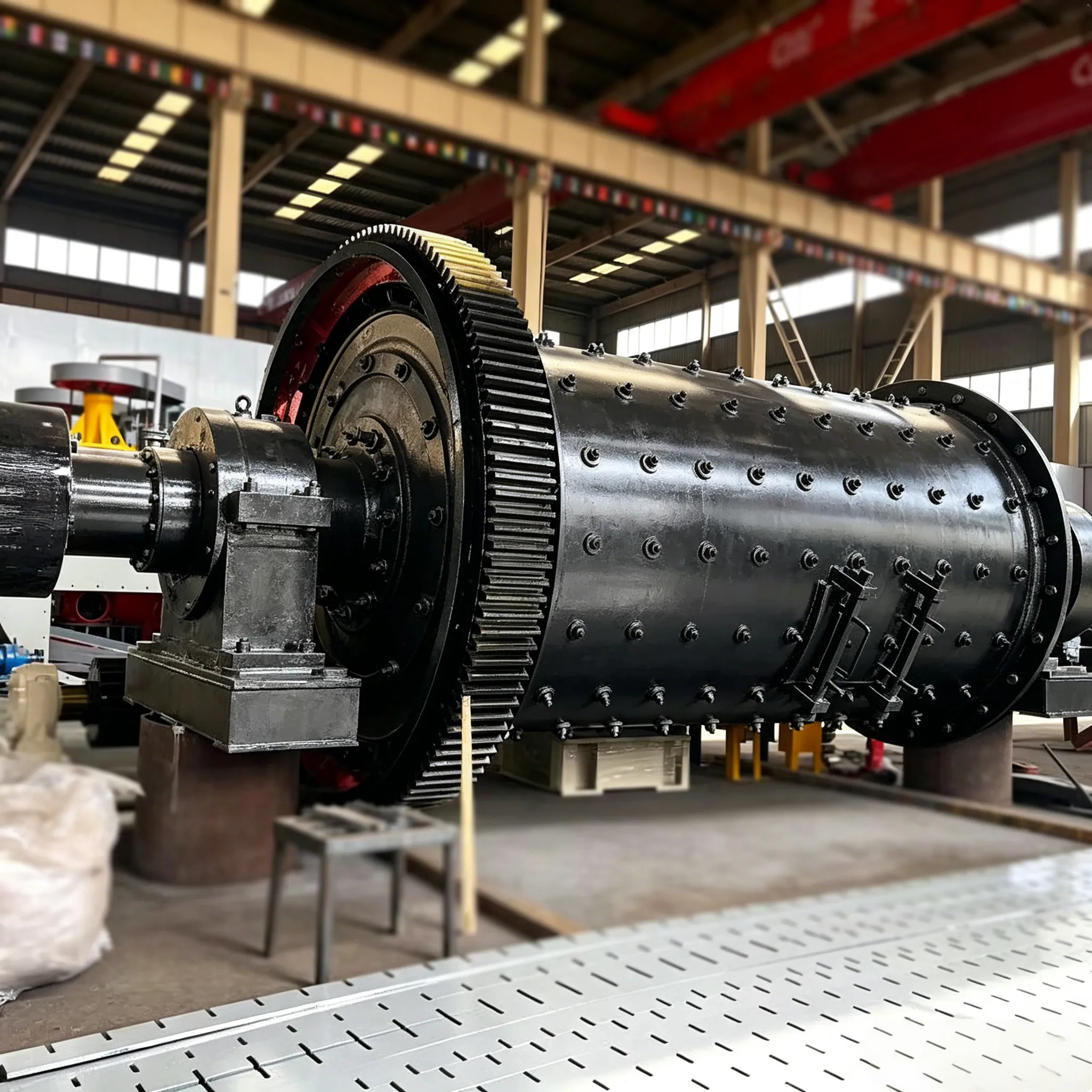
A horizontal ball mill consists of 9 key components:
Feed Hollow Shaft: Raw materials and water are fed into the cylinder from this end.
Rotating Cylinder: Heavy steel welded barrel lined with wear-resistant liners, used to hold grinding steel balls and ores.
Wear-resistant Liners: Fixed on the inner cylinder wall to lift steel balls and protect the cylinder from abrasion, mainly including wave liners and stepped liners.
Grinding Media (Steel Balls & Steel Segments): High-manganese steel balls of various diameters, the key consumable parts for ore grinding.
Discharge Hollow Shaft: Ground slurry or powder is discharged from this outlet.
Pinion & Bull Gear Transmission System: The motor and reducer drive the pinion to rotate the bull gear, so as to drive the cylinder for low-speed rotation.
Main Bearing (Slide Bearing / Rolling Bearing): Supports the entire rotating cylinder, equipped with a circulating lubrication system.
Reducer & Driving Motor: Provides rotational power and controls the cylinder speed.
High & Low Pressure Lubrication Station: Continuously supplies lubricating oil for main bearings and gears to reduce friction loss.
Structural Brief Introduction
Materials enter the rotating cylinder from the left feed end. The cylinder is filled with steel balls of different specifications. With cylinder rotation, steel balls perform cascading and cataracting movements to impact and grind ores. Fine ground materials are discharged from the right discharge end. Normally, it forms a closed-circuit grinding system matched with a spiral classifier.
3. Detailed Working Principle
The ball mill realizes dual crushing effects of impact breaking and friction grinding relying on low-speed cylinder rotation and three motion states of steel balls. The whole working process can be divided into 4 steps:
Step 1: Power Drive & Constant-speed Cylinder Rotation
The motor drives the horizontal cylinder to rotate steadily at a rated speed of 15~25 rpm via the reducer and gear pair. The cylinder is supported by two main bearings with a dedicated lubrication system to guarantee long-term continuous operation.
Step 2: Steel Balls Lifted by Inner Liners
As the cylinder rotates, inner wear-resistant liners lift various-sized steel balls and raw ores to a certain height together.
Step 3: Three Motion Forms of Steel Balls for Material Comminution
When steel balls are lifted beyond the angle of repose, three typical movements occur:
Cataracting Motion: Large steel balls fall freely from the highest position, striking ores violently to achieve impact crushing and break large ore lumps into small particles.
Cascading Motion: Medium and small steel balls slide slowly along the liner surface. Severe friction and shear force between steel balls and ores realize fine grinding, turning ore particles into fine powder.
Centrifugal Motion: If the rotating speed exceeds the critical value, steel balls will attach tightly to the cylinder wall without falling down, which belongs to abnormal fault operating conditions and must be avoided in normal production.
Step 4: Closed-circuit Cyclic Grinding & Qualified Material Discharge
Wet Grinding Process: Ores mixed with water are fed from the feed end and continuously ground into slurry by steel balls. Fine-grained slurry overflows from the discharge hollow shaft. Coarse particles are transported back to the ball mill by a spiral classifier for regrinding, while only fine qualified slurry flows into subsequent beneficiation processes such as flotation and magnetic separation.
Dry Grinding Process: No water is added inside the cylinder. Fine powder is extracted from the cylinder by airflow from the fan, and coarse particles are recycled for secondary grinding through a cyclone separator.
Steel balls of single specification are never adopted inside the cylinder. Large steel balls are responsible for crushing coarse ore particles, while medium and small steel balls undertake fine grinding. Reasonable gradation of steel balls can greatly improve grinding efficiency and ensure uniform finished particle size.
4. Closed-circuit Grinding Technological Flow
Raw Material → Belt Conveyor → Ball Mill Feed End for Grinding → Discharged Slurry into Spiral Classifier
Qualified Fine Slurry: Delivered to flotation / magnetic separation beneficiation process
Coarse Sand Particles: Returned to the ball mill for regrinding
Wide range of application, both wet and dry grinding modes are available for soft and hard ores.
Stable mechanical structure with low failure rate, supporting 24-hour full-load continuous operation for large-scale mine production.
Wide adjustable range of finished fineness from dozens to hundreds of mesh, suitable for both coarse grinding and ultra-fine grinding.
Good sealing performance; wet grinding generates nearly no dust pollution to meet environmental protection requirements.
5.2 Disadvantages
Heavy equipment weight leads to high civil construction investment, together with relatively high energy consumption per ton of materials compared with Raymond mills.
Steel balls and liners are high-frequency wearing parts, requiring regular steel ball replenishment and liner replacement, which brings continuous operation and maintenance cost.
Large equipment volume limits mobility; ball mills are mostly applied in fixed production lines and rarely deployed on mobile crushing stations.
6. Typical Application Scenarios
Metallic Ore Beneficiation: Gold, iron, copper, lead-zinc ore grinding for mineral dissociation and metal concentrate extraction.
Building Material Industry: Fine grinding of cement clinker, limestone and steel slag.
Environmental & Chemical Industry: Production of desulfurization limestone powder, kaolin powder and bentonite powder.
New Material Field: High-purity fine powder processing of quartz sand and other non-metallic minerals.
STAZIONE MOBILE A QUATTRO COMBINAZIONI Serie Modello standard Dotazione di bordo Dotazione di bordo Capacità di lavorazione (t/h) Dimensioni di trasporto (mm)…




 English
 Spanish
 Russian
 Arabic
 Swahili
 French
 Turkish
 Portuguese
 Korean
 Japanese
 German
 Italian