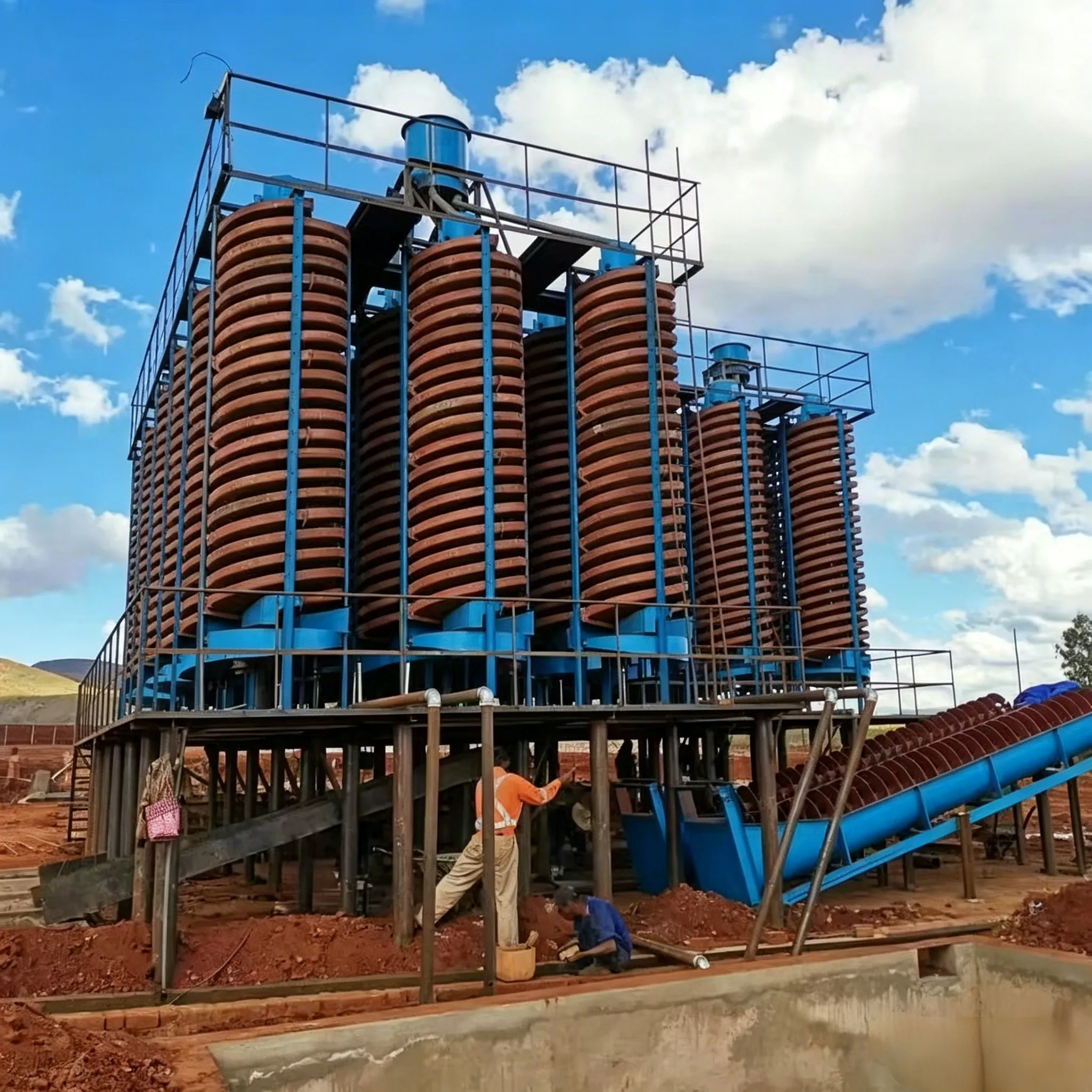
スパイラルシュート
Spiral Chute – High-Efficiency, Low-Cost Gravity Concentrator Product Overview The spiral chute…

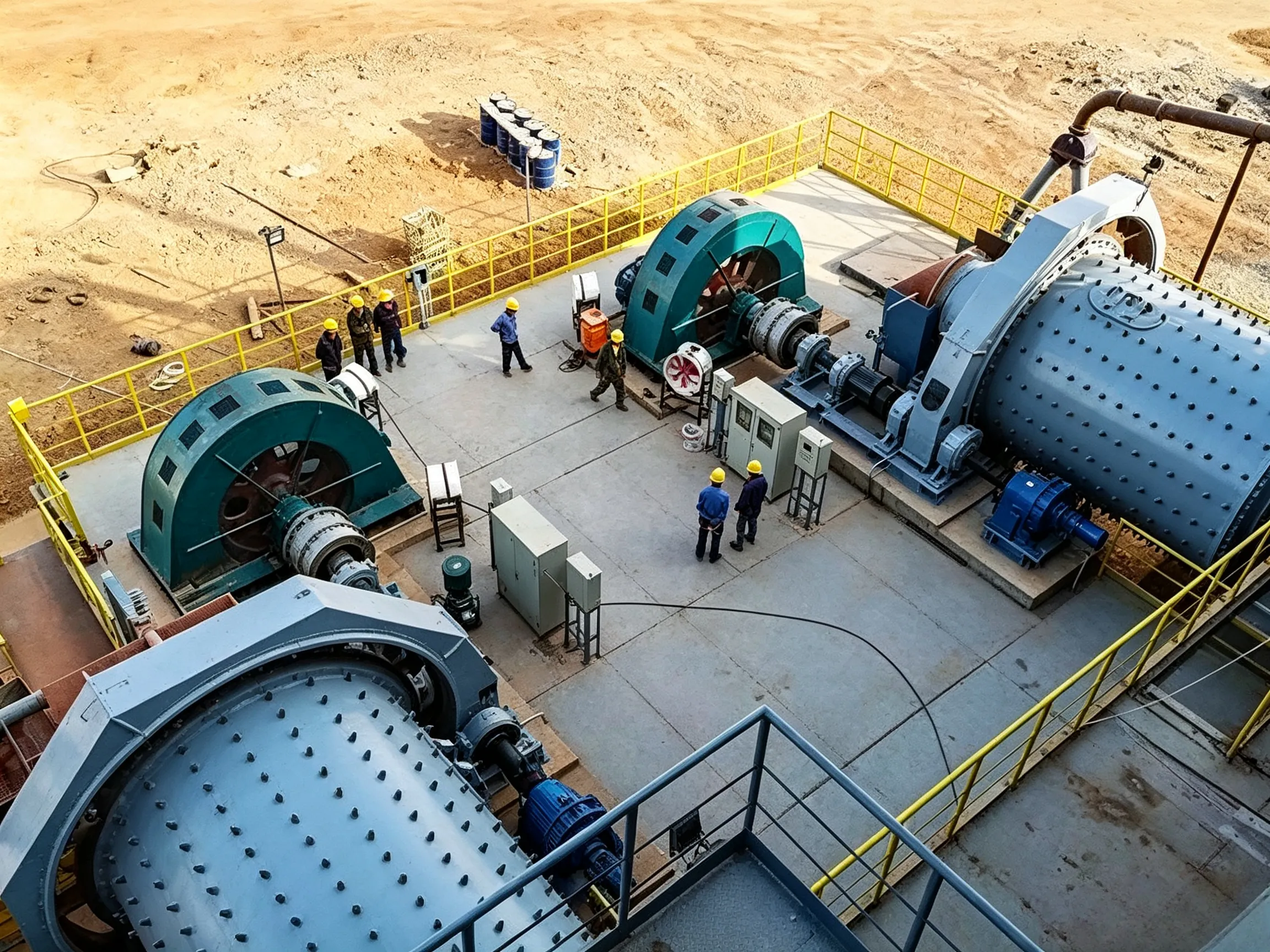
A ball mill is a grinding device that uses grinding media (typically steel or ceramic balls) rotating inside a cylindrical shell to crush and grind materials. It is widely used in mineral processing, cement production, ceramic manufacturing, and chemical raw material processing. It is the key equipment for reducing material particle size from millimeters down to microns.
The ball mill is known as the “heart” of a concentrator—upstream processes (blasting, crushing, screening) all prepare feed for the ball mill, while downstream processes (flotation, magnetic separation, leaching) all depend on the quality of the ball mill’s output.
The core working principle of a ball mill is based on the synergy of two physical forces: 影響 そして Attrition.
As the shell rotates, centrifugal force lifts the grinding balls up the shell wall to a certain height. When gravity overcomes centrifugal force, the balls fall freely, striking the material below with tremendous kinetic energy. This “hammering” effect is similar to smashing rocks with a hammer and is the primary force for breaking down larger particles.
At the same time, the grinding balls tumble and slide against each other and the shell liners, generating continuous friction and shear forces. This “sandpaper polishing” effect gradually wears down particle surfaces and is the key mechanism for producing ultra-fine, uniform powder.
Impact and attrition do not occur in isolation—they happen simultaneously in varying proportions:
This dual mechanism enables ball mills to handle a wide range of materials, from brittle ores to tough substances.
To understand the ball mill working principle, you must first be familiar with its structural components:

The above images show the 3D structure of a ball mill, which mainly consists of the following components:
| いいえ。. | コンポーネント | 機能 |
|---|---|---|
| 1 | Cylinder (Shell) | The core working chamber containing grinding balls and material |
| 2 | Lining Board (Liners) | Protects the inner shell wall and helps lift grinding balls |
| 3 | Big Gear (Ring Gear) | Meshes with the pinion from the reducer to drive shell rotation |
| 4 | Feeding Device | Evenly feeds material into the cylinder |
| 5 | Discharging Device | Discharges the ground finished product |
| 6 | Main Bearing | Supports both ends of the cylinder to ensure stable rotation |
| 7 | Transmission System | Power transmission chain: Motor → Reducer → Pinion → Big Gear |
| 8 | モーター | Provides rotational power |
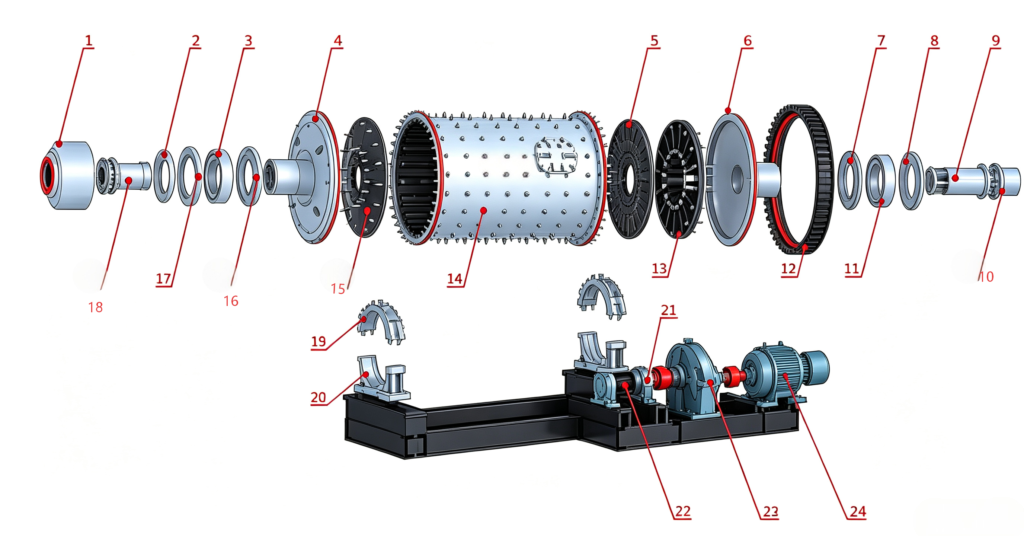
1.Feeder 2. Sealed cap 3. Bearing 4. Feed end cap 5. Grid plate 6. Feed outlet cap 7. Gland 8. Gland 9. Grid discharging hole 10. Discharging connector 11. Bearing 12. Big gear wheel 13. Feed steel plate 14. Grid cylinder 15. End lining plate 16. Gland 17. Gland 18. Feed inlet 19. Bearing cap 20. Bearing seat 21. Pinion bearing seat 22. Pinion 23. Reducer 24. Motor
Wet ball mills additionally include:
The rotational speed of the shell directly determines the motion pattern of the grinding media, which in turn affects grinding efficiency:

At lower speeds, grinding balls are not lifted very high. Instead, they slowly roll down the shell wall, rubbing against each other. This state prioritizes attrition and is suitable for producing ultra-fine powder.

As speed increases, grinding balls are carried to higher positions before falling freely, creating a “waterfall” effect. This state delivers strong impact force and is suitable for rapidly breaking large chunks of material.
When the speed reaches the critical speed, centrifugal force completely overcomes gravity, and the grinding balls cling to the shell wall without falling. At this point, no grinding occurs at all—this is a forbidden operating zone.
Most ball mills operate at approximately 75% of critical speed as the optimal working point.
Speed determines the ratio of impact to attrition:
表格
| Media Type | 密度 | 用途 |
|---|---|---|
| Steel Balls | 高い | Hard materials, high impact force required |
| Ceramic Balls | 中 | Avoiding metal contamination (food, pharmaceuticals) |
| Flint Pebbles | Low | Low-cost general grinding |
Liners not only protect the shell but also help lift grinding balls through their shape (e.g., stepped, wave-shaped), directly affecting impact height and grinding efficiency.
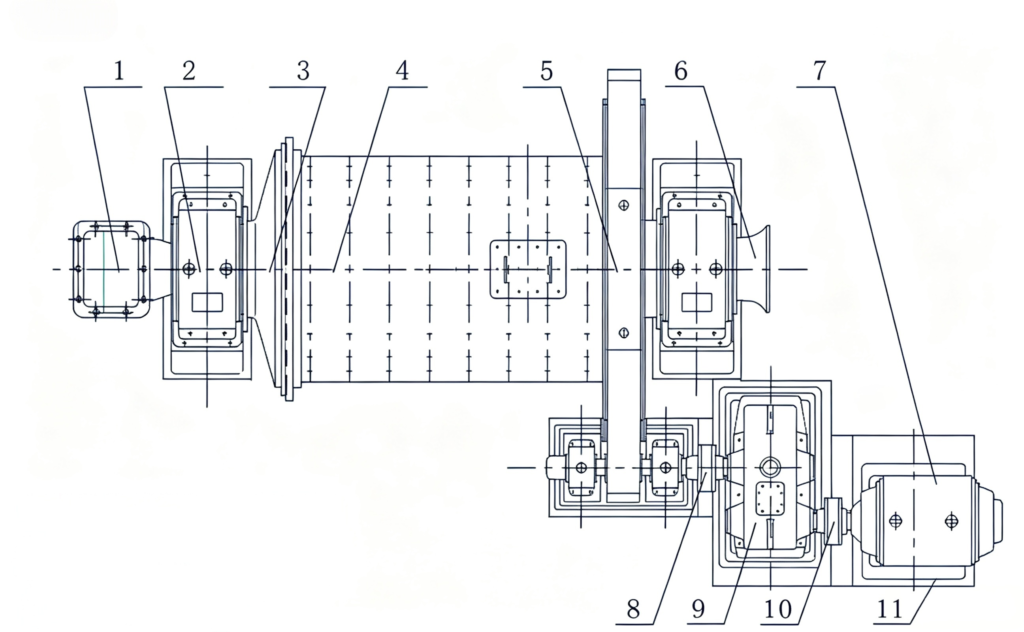
1 Feeding Section 2 Main Bearing Section 3 Feed End Section 4 Cylinder Body 5 Transmission Part 6 Discharge End Section 7 Motor 8 Coupling 9 Reducer 10 Coupling 11 Foundation Base
Wet ball mills additionally add water or other liquids to form a slurry. After grinding, fine particles flow out with the slurry, while coarse particles are retained by the grate plate for further grinding.
Modern concentrators typically use a closed-circuit system: Ball mill discharge enters a classification device (such as a hydrocyclone), coarse particles are returned to the ball mill for regrinding, and fine particles proceed to downstream processes. A typical closed-circuit system will grind the material 2-3 times.
Due to their strong versatility and large processing capacity, ball mills are widely used in:
| Industry | Typical Applications |
|---|---|
| Mining & Mineral Processing | Grinding gold, copper, and iron ores to achieve mineral liberation |
| Cement Industry | Grinding clinker, limestone, and gypsum |
| Chemical Industry | Ultra-fine grinding of catalysts, pigments, and coatings |
| Ceramic Manufacturing | Fine preparation of ceramic raw materials and glazes |
| Pharmaceutical Industry | Crushing and mixing of drug raw materials |
| New Energy | Grinding lithium battery cathode materials and silicon-carbon anodes |
| Goal | Recommended Parameters |
|---|---|
| Breaking large chunks | High speed + large-diameter steel balls |
| Producing ultra-fine powder | Low speed + small-diameter grinding media |
| Avoiding product contamination | Use ceramic balls or natural pebbles |


 English English
 Spanish
 Russian
 Arabic
 Swahili
 French
 Turkish
 Portuguese
 Korean
 Japanese
 German
 Italian