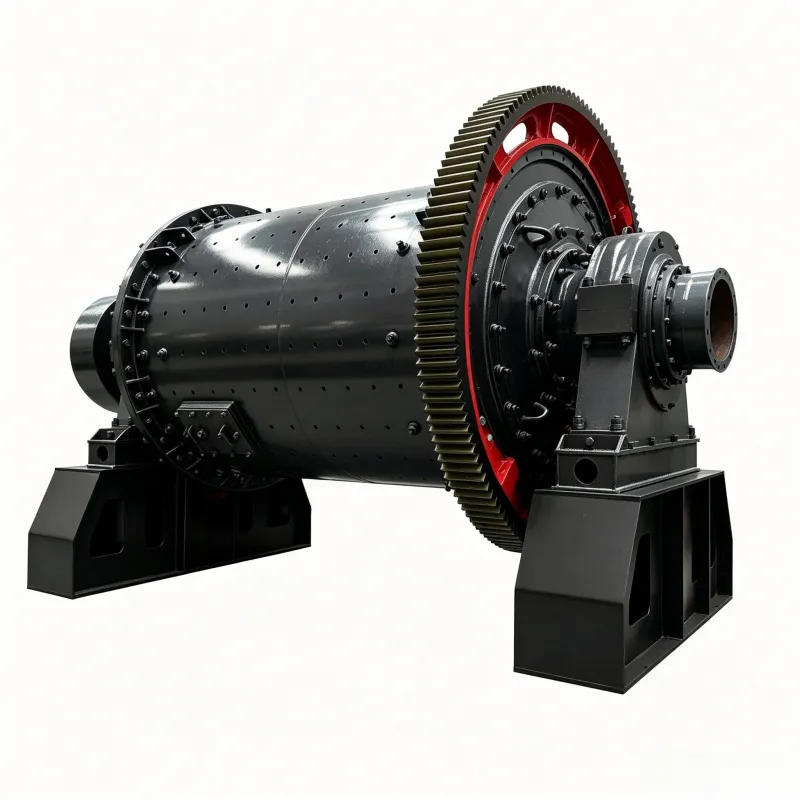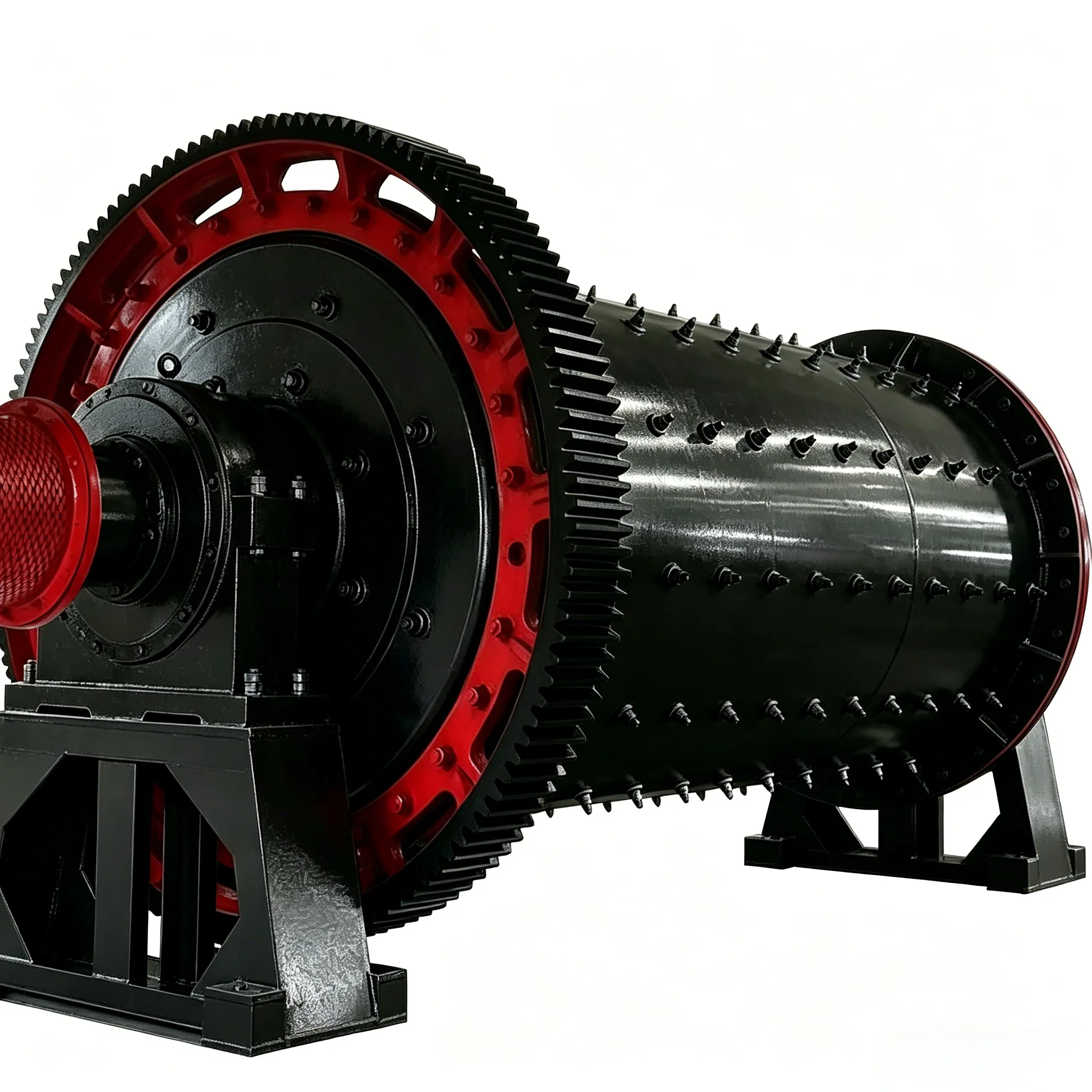
그레이트 배출식 볼 밀
그리드 배출식 볼 밀의 구조. 그리드…의 차이점은…

기술 분야
The present invention belongs to the field of heap leaching beneficiation processes, and in particular relates to a heap leaching beneficiation production process for clay-type gold ore.
배경 아트
Heap leaching beneficiation is a relatively new gold extraction process developed in the early 1970s. This process has the advantages of simple technology, low investment, low cost, and flexible production scale, and is suitable for treating low-grade gold-bearing oxidized ores, tailings, slag, etc. Clay-type (lateritic, black-soil) gold deposits have large reserves but low grades, and other beneficiation methods have poor economic returns. When heap leaching is used, if the ore is not crushed or is crushed to a coarse size, the leaching solution cannot easily penetrate into the ore particles; if the ore is finely crushed, the heap tends to become compacted during spraying, making it difficult for the leaching solution to penetrate to the lower part of the heap. Americans have used cement as a binder to agglomerate loose fine ore particles to solve the above contradiction. Its shortcomings are: when the cement content is low, the agglomerates easily disintegrate and pulverize, affecting the overall permeability of the heap; when the cement content is high, production costs increase; moreover, the heap permeability is poor and the gold leaching rate is not high.
발명의 개요
The object of the present invention is to provide a heap leaching beneficiation production process for clay-type gold ore with good permeability, high gold leaching rate, and low production cost, which can also improve the working environment.
In order to achieve the above object, the technical solution of the present invention is: a heap leaching beneficiation production process for clay-type gold ore, comprising the following steps: 1) crushing the raw ore; 2) agglomeration; 3) heap building; 4) spraying, characterized in that in the agglomeration step: ① a loose and permeable material (such as straw) and the crushed clay-type gold ore are added together to a granulator and thoroughly mixed uniformly; the straw should be chopped to a length of 8-12 cm, and the addition amount should be 2-5 kg per tonne of ore, with a larger value taken when clay content is higher than gravel content, and a smaller value taken when clay content is lower than gravel content; ② sufficient water should also be added during agglomeration, with the water addition amount being 15-25% of the dry material weight; visually, the limit is that the agglomerates do not seriously stick to the belt; in the heap building step: during heap building, the heap should be leveled promptly in stages before the agglomerates dry out, and immediately covered with a layer of straw to keep the agglomerates moist; to ensure uniform solution distribution, the straw should be chopped to a length of 18-22 cm.
The above raw ore crushing step: the clay-type (lateritic or black-soil) gold ore is crushed to a particle size < 5 cm, with an optimal value of < 3 cm.
The above spraying step: the spraying intensity is 20-40 L/m²·h; a smaller value should be taken in the early stage of heap leaching to prevent premature compaction of the heap, and a larger value can be taken in the later stage to penetrate dead zones; the intermittent spraying interval should preferably be no less than 1.5 h.
The above loose and permeable material may also be wheat straw.
The present invention replaces cement with a loose and permeable material (such as straw) as an auxiliary material, which can significantly improve the heap permeability and leaching rate, significantly reduce production costs, and also improve the working environment.
The purpose of adding cement during agglomeration is to improve the heap permeability. The present invention replaces cement with a loose and permeable material (such as straw) as the auxiliary material for agglomeration. To verify the feasibility of the present invention, two column leaching tests were conducted, and the test results are listed in Table 1.
Table 1: Parameters of small-scale column leaching tests
| Test conditions and items | Column 1 | Column 2 |
|---|---|---|
| Sample weight (kg) | 9 | 11.5 |
| Sample particle size (mm) | 5-20 | 0.1-10 (unagglomerated) |
| Straw (g) | 45 | 45 |
| Sodium cyanide concentration (%) | 0.1-0.03 | 0.1-0.03 |
| Feed gold grade (g/t) | 2.26 | 1.04 |
| Spraying intensity (L/m²·h) | early 20, later 40 | early 20, later 40 |
| Spraying time (h) | 1 | 1 |
| Intermittent time (h) | 1 | 0.5 |
| Tailings gold grade (g/t) | 0.06 | 0.06 |
| Gold leaching rate (%) | 97.345 | 94.23 |
| Leaching cycle (d) | 5 | 5 |
| Washing time (h) | 8 | 8 |
In order to test the permeability of this material from the worst-case angle, for Column 2 the ore was only hammer-crushed to a particle size < 10 mm without agglomeration. The test results were satisfactory. On the last day of Column 1, the spraying intensity was increased to 80 L/m²·h and still no water accumulation occurred; on the last day of Column 2, the spraying intensity was increased to 60 L/m²·h and still no water accumulation occurred. This indicates that the permeability of this material is good. However, in production the heap material is not mixed very uniformly, so agglomeration is definitely required.
Based on test research, it is considered that this production process has the following advantages:
① It can significantly improve the heap permeability and gold leaching rate. During the tests, drainage rate (return water flow per unit time after stopping spraying) was also observed, as listed in Table 2.
Table 2: Comparison of drainage rate between this test and conventional production heaps
| Before stopping spraying | After stopping for half an hour | After 1 hour | After stopping for 1.5 hours | Stop for 2 hours | After 3 hours | After 24 hours | ||
| conventionalMine pile | Displacement (liters/second) | 20.3 | 8.3 | 5.0 | 2.9 | micro | ||
| % | 100 | 41 | 25 | 14 | ||||
| No. 1 column | Displacement (g/min) | 4.7 | 2.3 | 0.5 | 0 | |||
| % | 100 | 49 | 11 | |||||
| No. 2 column | Displacement (g/min) | 4.4 | 1.8 | 1.2 | 0.6 | 0.1 | 0 | |
| % | 100 | 41 | 27 | 14 | 2 |
The drainage rate reflects the permeability of the ore heap. If the permeability resistance of Column 2 is comparable to that of a conventional production heap, then using this production process can double the permeability and achieve a very high leaching rate.
② Reduction in production costs. The auxiliary materials used are abundant in resources, and the type of material is not limited to a single kind, so it can be replaced as needed. Its dosage is only about 1/4 of that of cement, and its unit price is only about 1/2 of that of cement. For a production line processing 100,000 tonnes of ore per year, nearly 300,000 RMB can be saved annually in material costs.
③ Improvement of the working environment. Cement generates a large amount of dust, which affects the health of operators, whereas the material used in this method produces very little dust.
실시예에 대한 상세한 설명
The heap leaching beneficiation production process for clay‑type gold ore is implemented by the following steps:
 English English
 Spanish
 Russian
 Arabic
 Swahili
 French
 Turkish
 Portuguese
 Korean
 Japanese
 German
 Italian