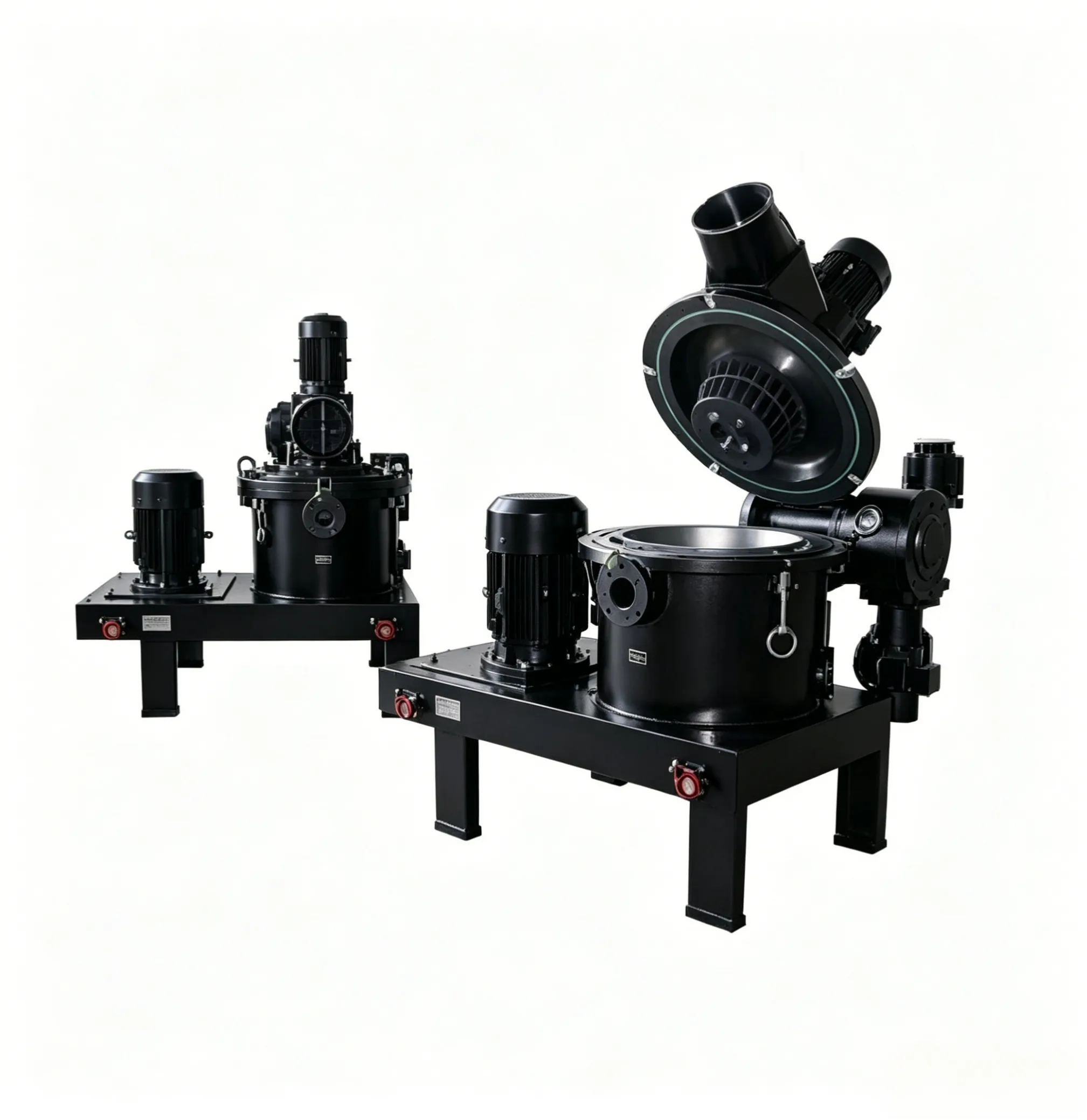
Triturador Mecânico SAM
Triturador Mecânico SAM Triturador Mecânico SAM, que incorpora tecnologia do Japão e da Alemanha,…

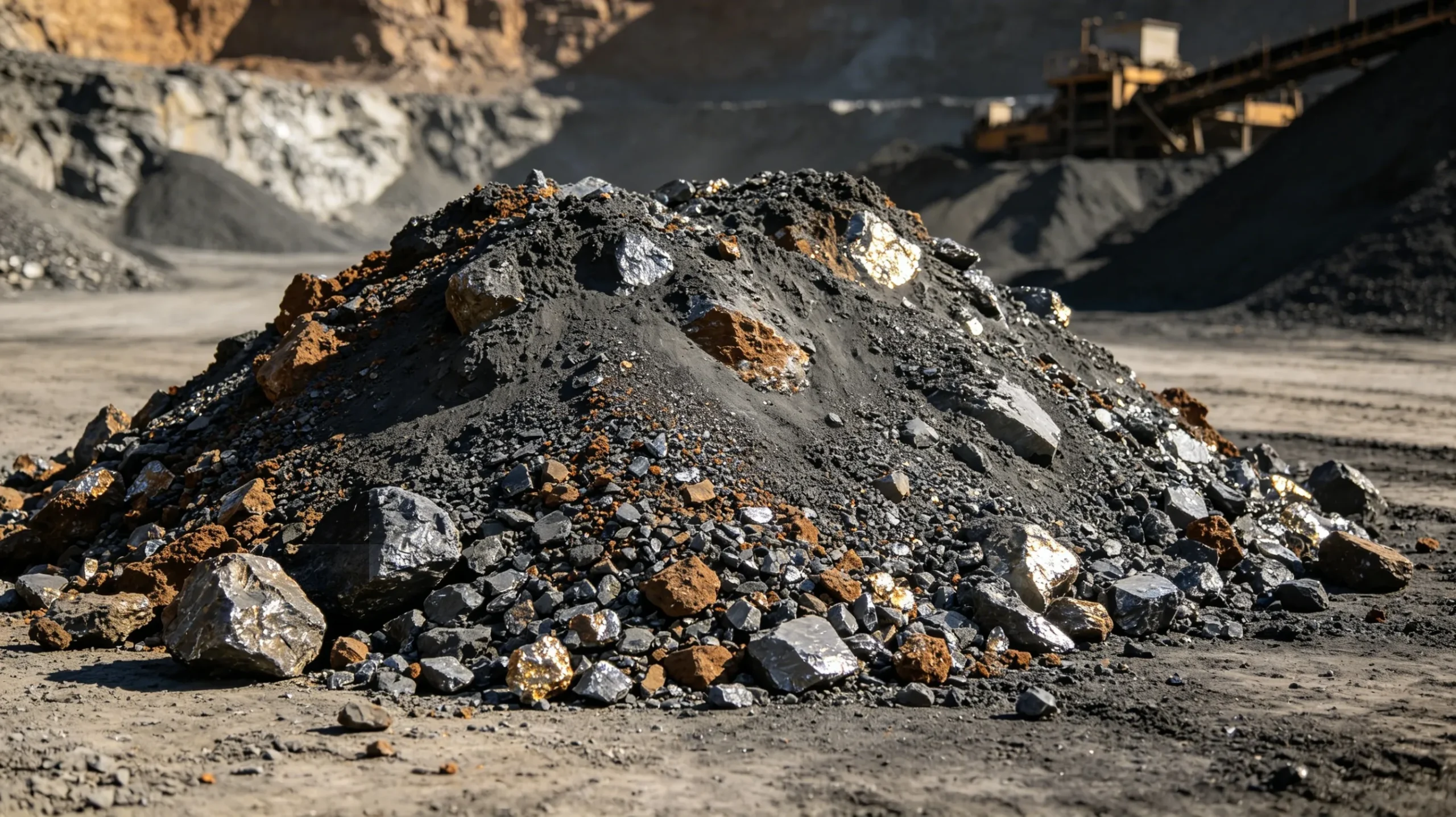
A mina de chumbo, zinco e prata de Baoshan é um depósito complexo. O minério processado pelo concentrador provém tanto de corpos minerais primários quanto de corpos minerais intemperizados. Os principais minerais valiosos presentes no minério são calcopirita, molibdenita, galena, esfalerita, bismutinita, pirita, scheelita e volframita. Os principais minerais de ganga são grossular, andradita, quartzo, calcita, piroxênio, hornblenda, caulinita, etc. Os rejeitos de flotação dos minérios sulfurosos no concentrador contêm minerais de tungstênio de baixo teor, principalmente scheelita. Os rejeitos do minério primário após a flotação de chumbo-zinco contêm 0,127% de WO₃, dos quais a scheelita representa cerca de 81%, a wolframita 16% e a tungstita 3%. O tamanho das partículas da scheelita é de 80%, concentrado na faixa de -0,074 mm +0,037 mm; o tamanho das partículas da volframita é de 65%, concentrado na faixa de -0,037 mm a +0,019 mm. O principal teor mineral e a composição granulométrica dos rejeitos de flotação do minério primário são apresentados na Tabela 4-53 e na Tabela 4-54, respectivamente.
Tabela 4-53 Teor dos principais minerais nos rejeitos de flotação de minério primário (%)
| Mineral | Grossular | Andradita | Hedenbergita | Calcita | muscovita | Quartzo | Limonita | Marcasita | Hematita | Outros |
|---|---|---|---|---|---|---|---|---|---|---|
| Fração mássica | 39.2 | 7.1 | 13.1 | 12.5 | 11.4 | 8.2 | 3.2 | 0.06 | 0.3 | 4.98 |
Tabela 4-54 Composição granulométrica e distribuição de metais nos rejeitos de flotação de minério primário
| Tamanho das partículas / mm | Rendimento / % | Grau WO₃ / % | Distribuição de WO₃ / % |
|---|---|---|---|
| +0.074 | 31.74 | 0.12 | 30.23 |
| -0.074+0.037 | 22.61 | 0.13 | 23.32 |
| -0.037+0.019 | 8.34 | 0.13 | 8.60 |
| -0.019+0.010 | 12.97 | 0.12 | 12.35 |
| -0.010 | 24.34 | 0.13 | 25.50 |
| Total | 100.00 | 0.126 | 100.00 |
As propriedades dos rejeitos de flotação do minério intemperizado são semelhantes às do minério primário, com uma fração mássica de WO₃ de 0,134%, mas a fração mássica de wolframita é ligeiramente superior à do minério primário, representando cerca de 25%. O tamanho das partículas de scheelita é relativamente fino, com a maioria concentrada na faixa de -0,074 mm a +0,019 mm. Os minerais de ganga são principalmente hedenbergita, juntamente com quantidades consideráveis de feldspato e minerais de ferro.
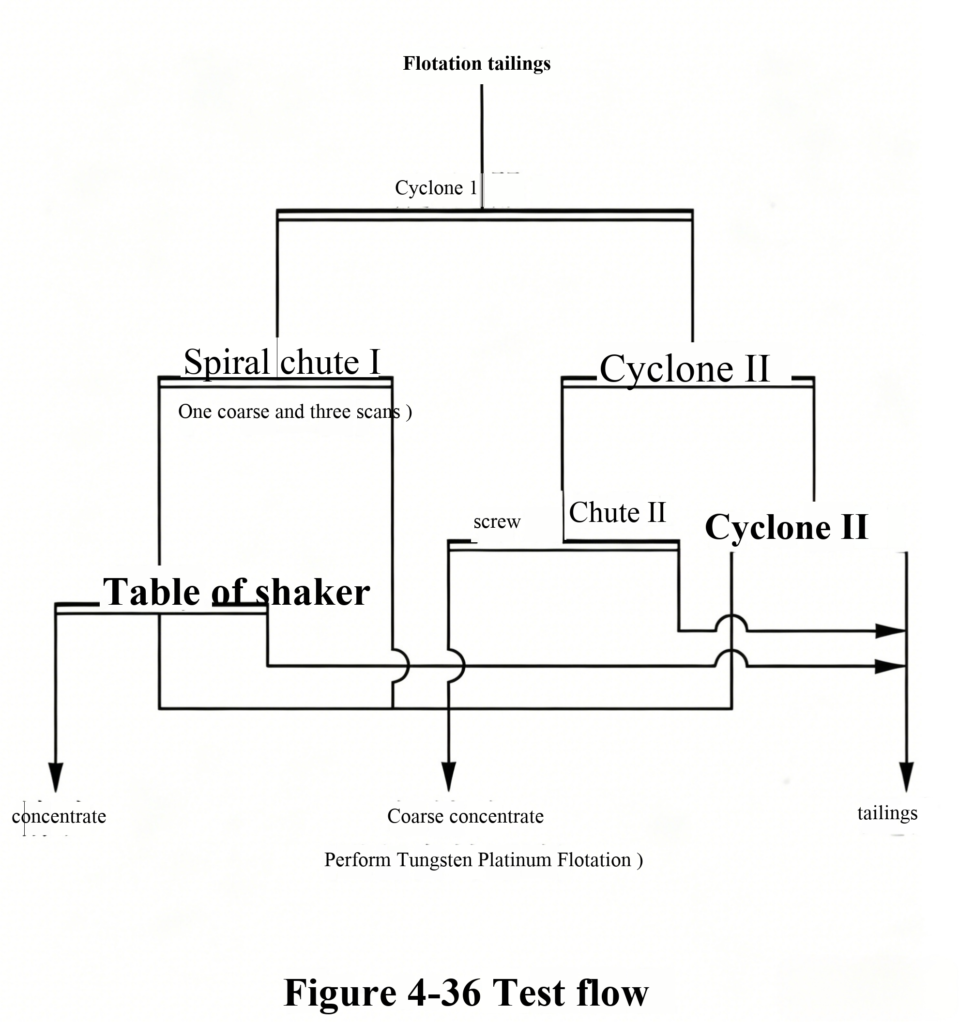
Pesquisas experimentais mostram que o uso de um hidrociclone, uma rampa espiral e uma mesa vibratória para pré-concentrar os minerais de tungstênio nos rejeitos de flotação pode reduzir o consumo de reagentes na flotação da scheelita e permitir a recuperação antecipada da wolframita. Especificamente, os rejeitos são primeiro classificados por meio de um hidrociclone de cone curto; em seguida, o material classificado é processado em uma calha espiral para produzir um concentrado bruto. O concentrado bruto é então tratado em uma mesa vibratória para recuperar a volframita, seguido pela flotação da scheelita (ver Figura 4-36). Esse processo produz um concentrado com teor de WO₃ de 47,29%–50,56% e uma recuperação de 18,62%–20,18%. Ao mesmo tempo, produz-se um concentrado bruto (rendimento de 26,95%–34,02%) que requer uma nova etapa de flotação de scheelita. Em comparação com a flotação única, a quantidade de material que requer flotação de scheelita é reduzida em 73,05%–65,97%, o que economiza significativamente no consumo de reagentes e reduz os custos de beneficiamento.
 English English
  Spanish
 Russian
 Arabic
 Swahili
 French
 Turkish
 Portuguese
 Korean
 Japanese
 German
 Italian