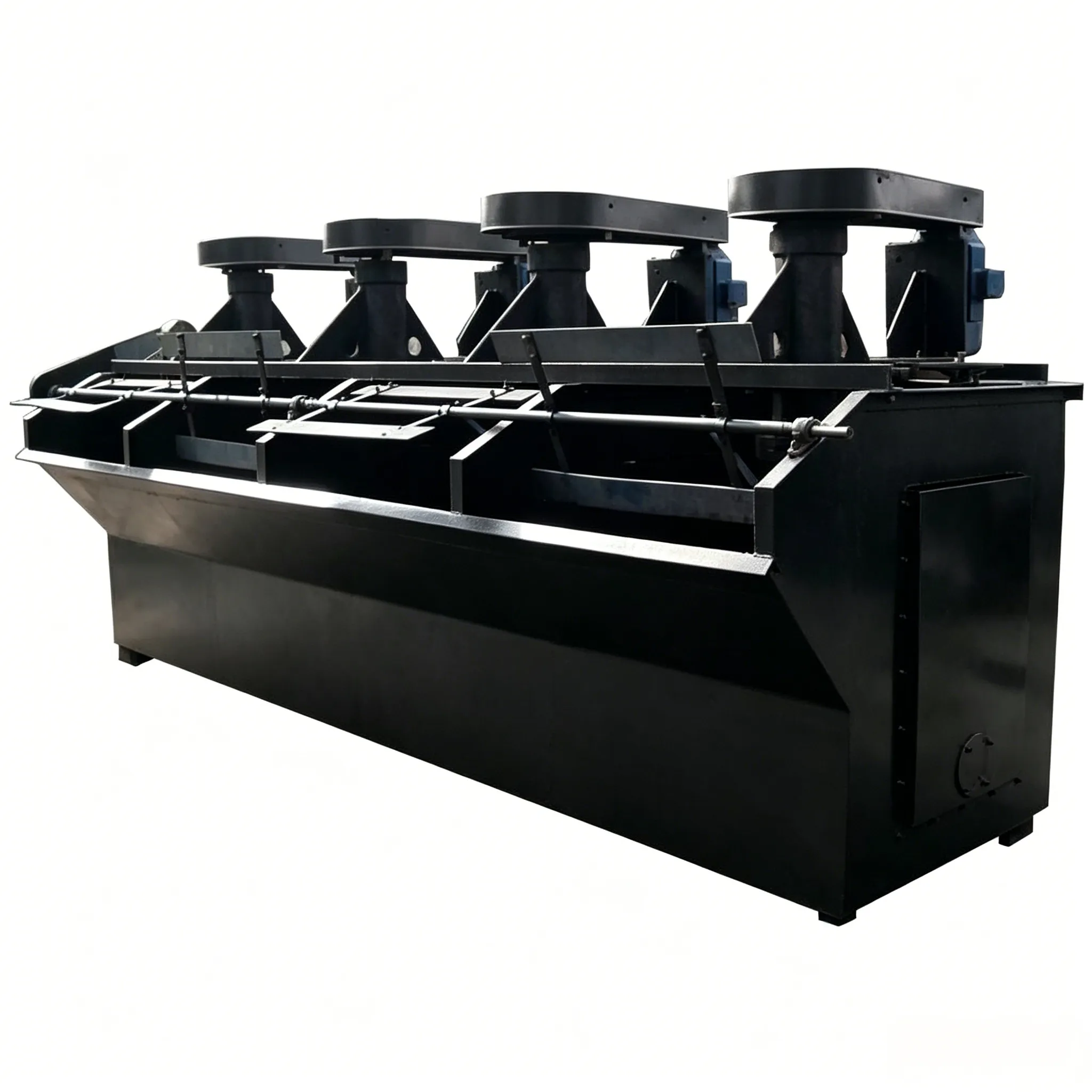
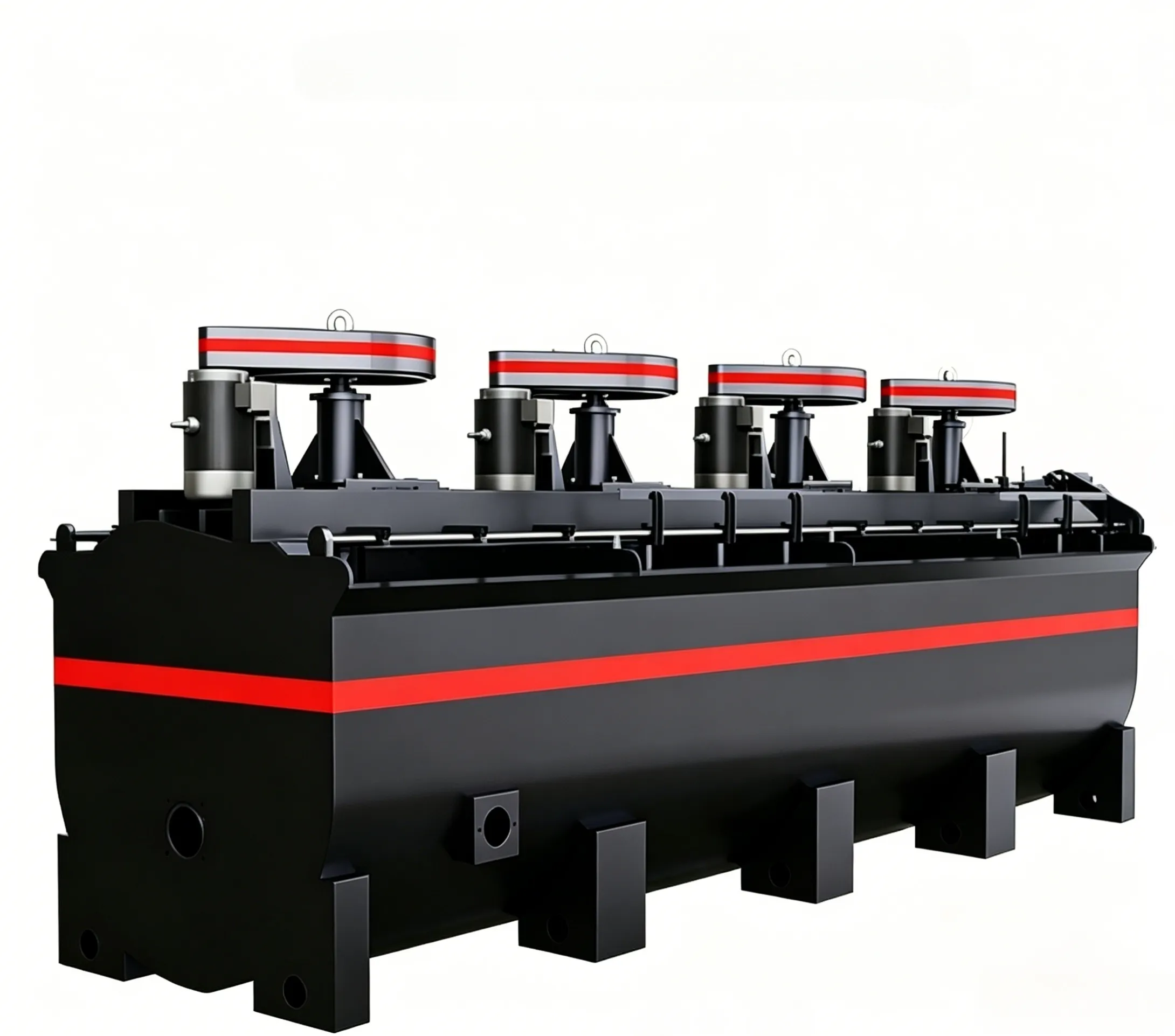
XJ Flotation Machine
XJ Flotation Machine (also known as Type A or XJK) This machine…

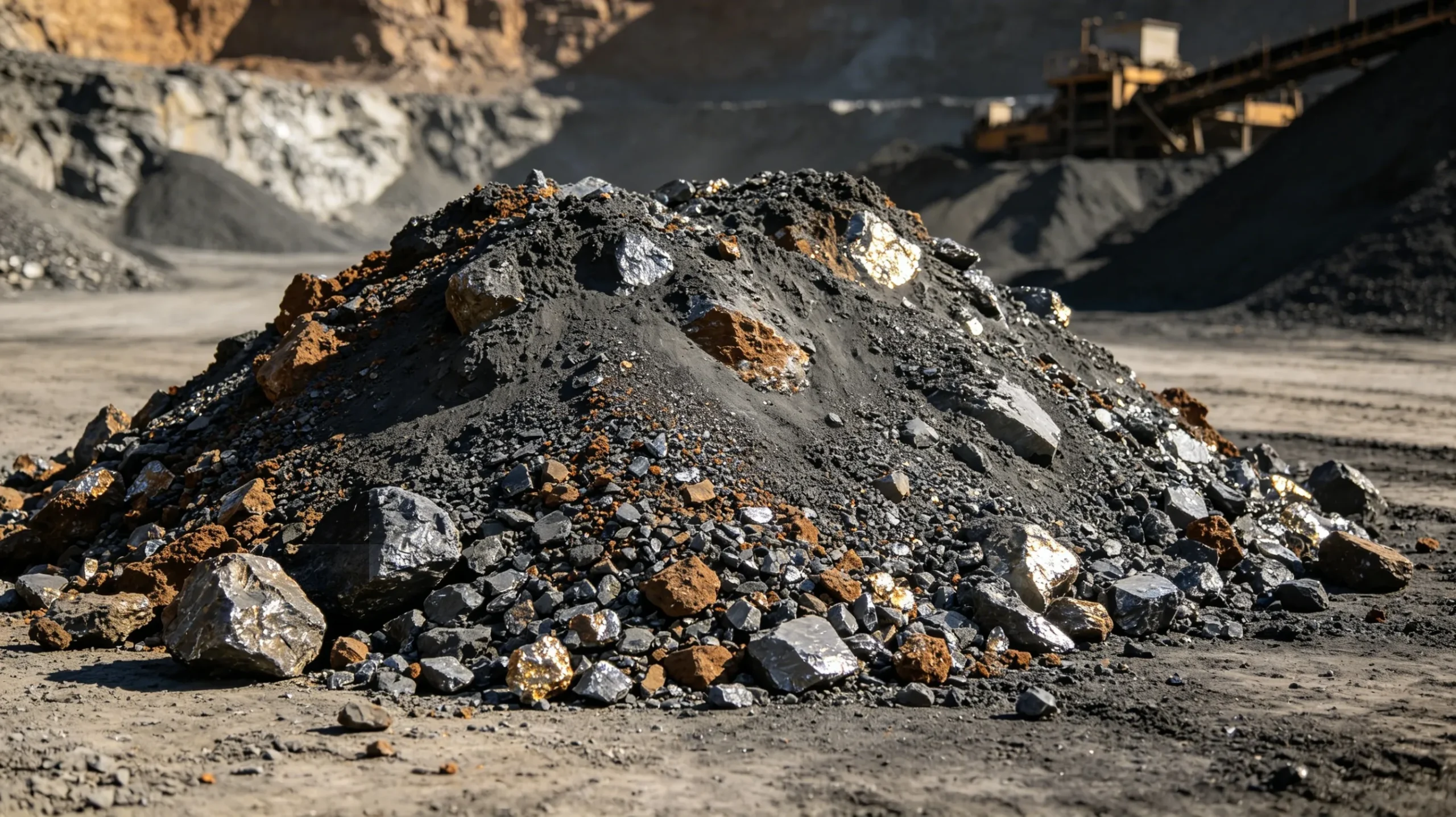
The Baoshan Lead‑Zinc‑Silver Mine is a complex deposit. The ore processed by the concentrator comes from both primary ore bodies and weathered ore bodies. The main valuable minerals in the ore are chalcopyrite, molybdenite, galena, sphalerite, bismuthinite, pyrite, scheelite, and wolframite. The main gangue minerals are grossular, andradite, quartz, calcite, pyroxene, hornblende, kaolinite, etc. The flotation tailings of sulfide ores in the concentrator contain low‑grade tungsten minerals, mainly scheelite. The tailings from the primary ore after lead‑zinc flotation contain 0.127% WO₃, of which scheelite accounts for about 81%, wolframite 16%, and tungstite 3%. The particle size of scheelite is 80% concentrated in the range of -0.074 mm +0.037 mm; the particle size of wolframite is 65% concentrated in the range of -0.037 mm +0.019 mm. The main mineral content and particle size composition of the primary ore flotation tailings are shown in Table 4‑53 and Table 4‑54, respectively.
Table 4‑53 Main mineral content of primary ore flotation tailings (%)
| Mineral | Grossular | Andradite | Hedenbergite | Calcite | Muscovite | Quartz | Limonite | Marcasite | Hematite | Others |
|---|---|---|---|---|---|---|---|---|---|---|
| Mass fraction | 39.2 | 7.1 | 13.1 | 12.5 | 11.4 | 8.2 | 3.2 | 0.06 | 0.3 | 4.98 |
Table 4‑54 Particle size composition and metal distribution of primary ore flotation tailings
| Particle size / mm | Yield / % | WO₃ grade / % | WO₃ distribution / % |
|---|---|---|---|
| +0.074 | 31.74 | 0.12 | 30.23 |
| -0.074+0.037 | 22.61 | 0.13 | 23.32 |
| -0.037+0.019 | 8.34 | 0.13 | 8.60 |
| -0.019+0.010 | 12.97 | 0.12 | 12.35 |
| -0.010 | 24.34 | 0.13 | 25.50 |
| Total | 100.00 | 0.126 | 100.00 |
The properties of the weathered ore flotation tailings are similar to those of the primary ore, with a WO₃ mass fraction of 0.134%, but the mass fraction of wolframite is slightly higher than that in the primary ore, accounting for about 25%. The particle size of scheelite is relatively fine, with most concentrated in the range of -0.074 mm to +0.019 mm. The gangue minerals are mainly hedenbergite, along with considerable amounts of feldspar and iron minerals.
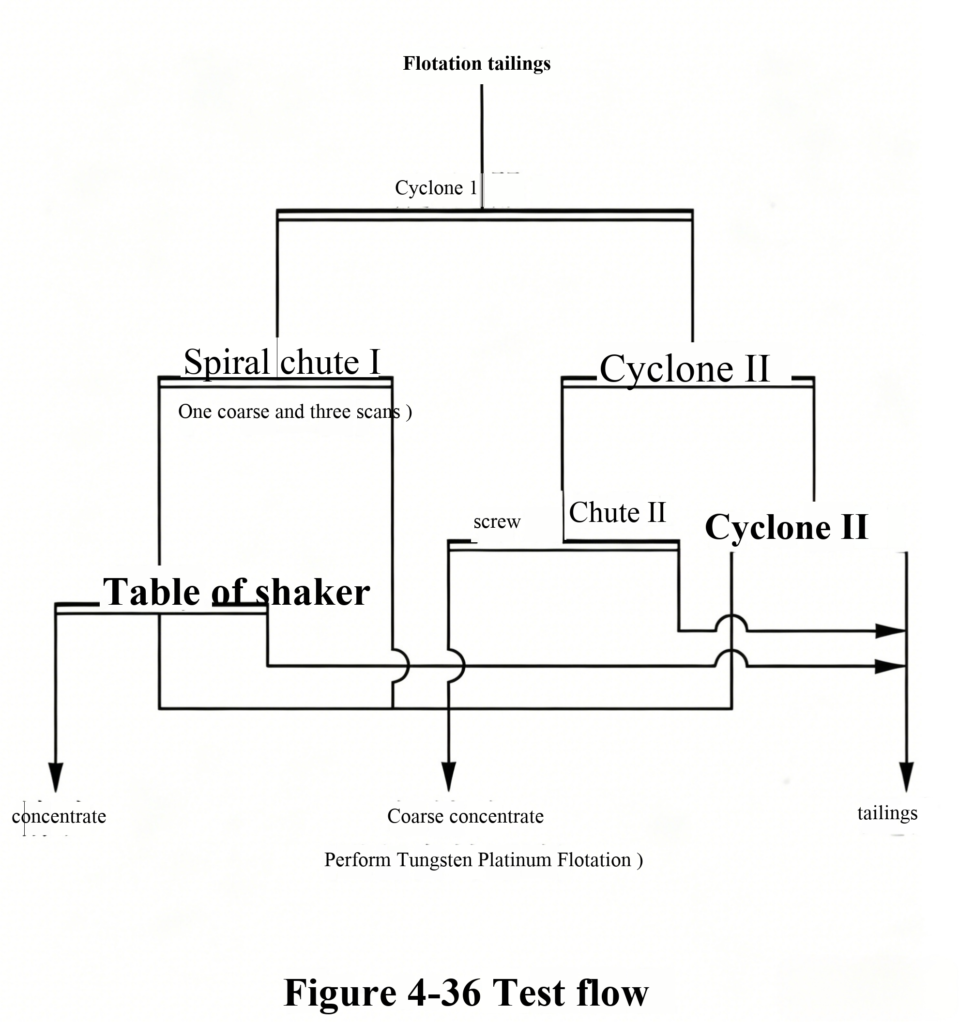
Experimental research shows that using a hydrocyclone, spiral chute, and shaking table to preconcentrate the tungsten minerals in the flotation tailings can reduce the reagent consumption for scheelite flotation and enable early recovery of wolframite. Specifically, the tailings are first classified using a short‑cone hydrocyclone, then the classified material is processed through a spiral chute to produce a rough concentrate. The rough concentrate is then treated on a shaking table to recover wolframite, followed by scheelite flotation (see Figure 4‑36). This process yields a concentrate with a WO₃ grade of 47.29%–50.56% and a recovery of 18.62%–20.18%. At the same time, it produces a rough concentrate (yield 26.95%–34.02%) that requires further scheelite flotation. Compared with single flotation, the amount of material requiring scheelite flotation is reduced by 73.05%–65.97%, thereby significantly saving reagent consumption and lowering beneficiation costs.
 English English
  Spanish
 Russian
 Arabic
 Swahili
 French
 Turkish
 Portuguese
 Korean
 Japanese
 German
 Italian