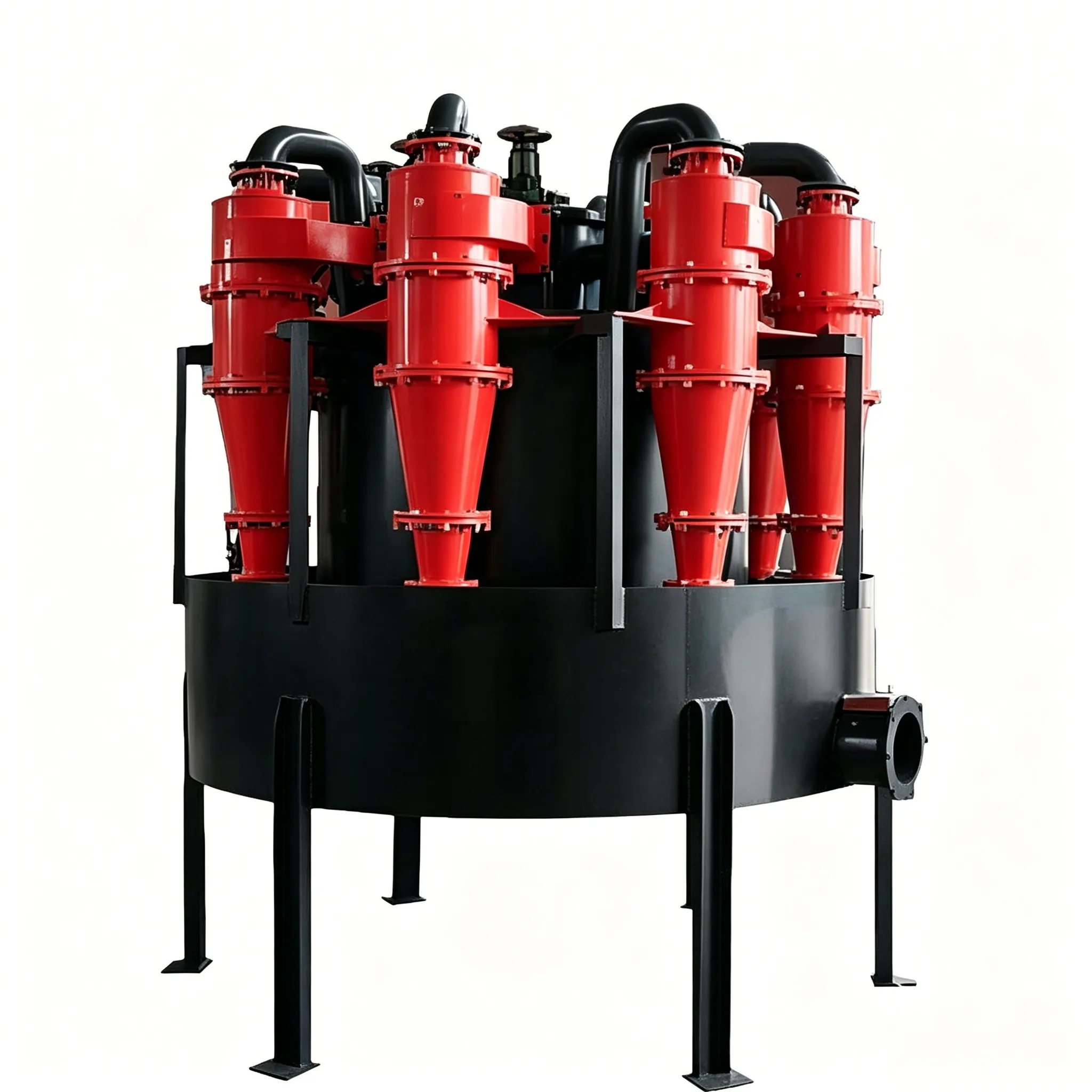
Idrociclone
Idrociclone L'idrociclone è un dispositivo che sfrutta la forza centrifuga per classificare…


First, analyze the applicability ranges of fully autogenous (AG) and semi-autogenous (SAG) grinding processes, using the classical Bond ball mill work index as a reference indicator for a preliminary assessment.
(1) When the Bond ball mill work index is less than 5–8 kWh/t, the ore is too soft to serve as an effective grinding media. In principle, neither AG nor SAG grinding is suitable. The appropriate grinding process should be a rod milling circuit or conventional ball milling. It should be noted, however, that if the ore components vary greatly in hardness—i.e., if a small fraction of the ore is very hard and can act as grinding media—this should be considered as an exception. In addition, SAG mills can be operated in a “ROM (run-of-mine) ball mill” mode. In practice, SAG milling is still often used, but under operating conditions different from normal, such as smaller grate apertures and smaller ball diameters.
(2) When the Bond mulino a sfere work index exceeds 20 kWh/t, the ore is too hard. AG/SAG circuits face serious problems such as critical particle accumulation, low grinding rates, and excessively fine products. The most suitable circuit is high-pressure grinding rolls (HPGR), followed by conventional crushing–ball milling.
(3) The suitable range for SAG circuits is: Bond mulino a sfere work index from 8–10 kWh/t to 20–22 kWh/t.
(4) AG circuits are generally only suitable for ores of medium hardness, for example, with a Bond ball mill work index of 12–20 kWh/t.
The above are the principles for process selection during concentrator design. In industrial practice, however, the applicability of AG grinding is somewhat narrower, while SAG grinding covers almost all ore hardness ranges. AG and SAG circuits have been applied over a wide range of Bond ball mill work index values, as illustrated by the following examples:
(1) Cannington silver–lead–zinc mine: Single-stage AG circuit, Bond ball mill work index 17–19 kWh/t.
(2) Sino Iron (China–Australia iron ore mine): Single-stage AG circuit, Bond ball mill work index 14–19 kWh/t.
(3) Palabora copper mine: Single-stage AG circuit, Bond ball mill work index 12–14 kWh/t.
(4) LKAB magnetite mine: AG–pebble milling circuit; the ore has an A×b value around 100 (very soft), while its quartzite has an A×b around 37 (relatively hard).
(5) Porgera gold mine: Classic SABC (SAG–ball–crushing) circuit, Bond ball mill work index 18–20 kWh/t.
(6) Similco concentrator: SAG milling; the ore has a Bond ball mill work index as high as 22 kWh/t and an A×b around 22, classifying it as extremely hard ore.
(7) Palabora mine: SAG milling; the ore has a Bond ball mill work index of 12.1 kWh/t and an A×b around 110, belonging to medium-hard ore that is easy to impact-break.
(8) Cadia Hill gold mine: Classic SABC circuit, but expansion added pre-crushing (secondary) and HPGR; the ore has a Bond ball mill work index as high as 19–23 kWh/t and an A×b around 35, classifying it as ultra-hard ore that is difficult to impact-break.
Many new concentrators first trial AG grinding during commissioning; if unsuccessful, they switch to SAG. This fully demonstrates that AG and SAG are interchangeable to a certain extent. Therefore, the above analysis based on ore comminution properties should only serve as a reference for circuit selection. When choosing an AG circuit, the availability of experienced AG mill operators and technical personnel must also be considered. Another factor is the sensitivity of downstream operations to particle size fluctuations, etc.
Compared with AG circuits, the advantages of SAG circuits are:
(1) Better ore adaptability.
(2) More stable and easier operation.
(3) Higher throughput for the same mill size.
(4) Slightly lower capital investment.
The disadvantages are:
(1) Consumption of metallic grinding media.
(2) Shorter mill liner life.
(3) Sometimes slightly higher operating costs.
(4) Higher consumption of metallic materials (including balls and liners).
As mentioned earlier, AG circuits are particularly sensitive to the following two factors:
(1) Ore hardness.
(2) Feed size.
Variations in these two factors greatly affect the stability of grinding media and critical particle accumulation, leading to unstable AG mill operation and changes in grinding efficiency. From a production perspective, this causes fluctuations in AG mill throughput and product size, with throughput variations as high as 25%–50%. For example, at the Sino Iron mine, AG mill throughput can fluctuate from about 1000 t/h to about 1600 t/h, and the primary grind P80 can vary from 150 μm to about 60 μm. For conventional flotation plants, fluctuations in throughput and grind size have a critical impact on flotation performance.
For AG milling, the key points are:
(1) The relationship between the above two factors and grinding efficiency is not monotonic in either direction. If blending is employed, it is not that harder ore is better, nor that softer ore is better. At the same time, ore hardness cannot be measured quickly, so it can only be estimated empirically and optimized accordingly. Similar considerations apply to feed size: it must be neither too coarse nor too fine. In practice, only a rough range exists—for example, the new feed P80 is typically around 200 mm, but for a specific case it may range from 150 mm to 250 mm, and may change depending on the condition of the AG mill liners and the pebble crusher. Therefore, the optimum parameters can only be defined qualitatively or semi-quantitatively, and this also depends on the experience and skills of production personnel and engineers.
(2) The optimal values of the above two factors are not independent but interact with each other. Generally speaking, the harder the ore, the smaller the feed size should be, especially by reducing the amount of intermediate size fractions (the critical particle size range). Conversely, if the ore is soft and brittle, a coarser feed size is preferable.
For this reason, some mines, in order to eliminate the instability of AG circuits or to meet production increase requirements, add steel balls to AG mills to improve grinding efficiency. This greatly reduces the operational instability caused by relying solely on ore as grinding media, thus giving rise to the concept and process of SAG milling.
Although SAG mills are derived from AG mills by adding an appropriate amount of steel balls, SAG circuits differ from AG circuits in the following aspects:
(1) Mill design. AG mills are designed (mechanical structure, strength calculation, power configuration, etc.) solely based on the properties of the ore to be ground (hardness, density, maximum feed size, load, etc.). SAG mills, in addition to ore properties, must also consider the maximum ball diameter and maximum ball charge. Therefore, SAG mills are designed with higher mechanical strength and power ratings. As a result, for the same nominal size, SAG mills have much greater mechanical strength and drive power than AG mills.
(2) Ore preparation. When higher throughput is required, SAG circuits typically call for finer blasting and finer primary/secondary crushing or pre-crushing, whereas AG circuits generally require coarser new feed.
(3) Operation. Daily operation of SAG mills is closer to that of ball mills, especially when the ball charge exceeds 8%–10%. AG mill operation is more complex, which is one reason why AG circuits are less common. In simple terms, the core of SAG operation is to eliminate critical particles from the new feed and the circuit, while the key to AG operation is how to maintain the grinding media (note: not only coarse media, but sometimes medium-sized media, depending on the grinding circuit).
2.2 Selection between AG and SAG circuits
Based on the above analysis, when choosing an AG circuit, consider the following factors:
(1) Whether downstream operations are highly sensitive to throughput and particle size. To reduce the impact of throughput fluctuations on downstream operations, large surge bins can be installed ahead of them—for example, the Olympic Dam copper–uranium flotation circuit has a very large conditioning tank with a surge capacity of several hours. Some separation methods are insensitive to feed size, such as magnetic separation, gravity concentration, and some bulk flotation circuits.
(2) The ore grindability is relatively stable, or can be stabilized by blending.
(3) Mining and primary crushing can produce coarse ore (potentially P80 = 200–250 mm) and the conveying system (belt) allows its passage. Due to the limitations of primary crusher closed-side settings and the requirement for choke feeding, gyratory crushers may not effectively produce sufficient coarse material while simultaneously avoiding oversized particles (>350–400 mm). At the same time, coarser ore will (greatly) accelerate wear on conveyor belts and chutes, thereby affecting equipment availability.
(4) The requirement for new feed P80 for effective AG grinding. Studies and reports indicate that for Olympic Dam ore, the optimum new feed P80 is 140–160 mm, while production practice at Sino Iron shows that at a P80 of 180 mm, throughput is still not at its optimum, and there remains room to increase throughput by further increasing new feed size.
(5) AG circuits have high power consumption, so local power supply capacity must be considered.
(6) AG circuits have low steel ball and liner consumption, making them a good choice in areas remote from steel ball and liner markets or with difficult transportation.
(7) Since AG operation requires greater competence and experience, the quality of production and technical personnel should be considered when selecting an AG circuit.
(8) When secondary grinding uses a pebble mill, the primary AG circuit must produce more pebbles.
2.3 Economic comparison
In the mining industry, steel (or alloy steel) grinding media are currently widely used. Except for AG mills, all other tumbling mills in primary grinding applications use steel grinding media. AG mills use ore itself instead of steel grinding media, incurring no additional cost. In comparison, typical SAG grinding to P80 = 105–150 μm has a steel media cost of about 1 AUD/t (data reported in 2002). AG milling is very popular in iron ore operations in North America, and is also common in Europe and Africa, sometimes used for gold, copper, and other non-ferrous metal ores. In many of these AG operations, secondary grinding uses pebble milling. The economics of AG milling in the mining industry also depend on the circuit configuration, including mill size, aspect ratio, ore size, and the circuit layout of screening, crushing, and fine classification.
Compared with SAG mills or the more conventional 2–3 stage crushing–ball milling circuits, AG mill circuits undoubtedly present more technical challenges in both design and operation. There have been several reported failures of past AG mill projects, which have limited the adoption of AG circuits as the final design choice. This phenomenon once occurred in most major North American mining companies and continues to have an impact to this day. Some North American concentrators were built with AG circuits and later converted to SAG circuits, raising doubts about the functionality of AG milling. The main concerns are whether AG milling can achieve the designed plant throughput, whether particle size can be controlled (particularly important for downstream flotation plants), and the operational difficulty (e.g., maintaining mill load and power, as well as pebble size and quantity). When using SAG or ball mills, the steel grinding media inside the mill stabilizes the grinding action and overrides fluctuations caused by ore variations, helping operators achieve production targets.
From an economic perspective, the advantages of AG milling are:
(1) No need to purchase and transport steel grinding media.
(2) Can provide pebble grinding media for secondary grinding—for example, at Aitik Boliden and LKAB in Sweden. Generally, grinding media costs account for a high proportion of total processing costs, up to 25%.
(3) Longer mill liner life, which also improves overall circuit availability. Since ore is used as grinding media, harder liner materials can be employed. For SAG mills, ball mills, or rod mills using steel media, the use of hard liners is limited because they are more susceptible to impact damage from steel balls. AG mill liner life is generally 4–6 months or even longer, whereas SAG mill liner life is typically only about 3 months.
(4) Compared with SAG circuits, AG circuits produce a finer product. It is even possible to achieve single-stage grinding to the final size required for separation, or to significantly reduce the capacity required for secondary grinding (lower secondary grinding load), and to quickly control mill power. When mill power is controlled by steel grinding media, it may take days or even weeks to reduce mill power because of the long life of steel media. This is particularly important for remote areas with limited power supply capacity.
(5) Compared with conventional ball mill circuits, there is no secondary or tertiary crushing stage.
(6) The grinding process produces virtually no contamination, which is sometimes extremely important for sulfide flotation. Iron oxidized from steel grinding media can transfer to mineral surfaces. Iron oxides or hydroxides contaminating the mineral surfaces tend to reduce the floatability and flotation kinetics of sulfide minerals, thereby lowering recovery. Additional reagents are often required to offset this effect.
The disadvantages of AG milling include:
(1) For the same circuit throughput, AG mills are larger than SAG mills. To achieve throughput equivalent to a SAG mill with 15% ball charge, 20 MW power, and 40 ft (12.19 m) diameter, an AG mill would need to be as large as 44 ft (13.41 m) in diameter, with greater length and higher filling [8]. This is because ore grinding media are lighter than steel media (typically ore specific gravity 2.7–3.5, while steel media specific gravity is 7.5–7.8). Therefore, a larger mill is needed to generate the same power, leading to higher capital investment. It has been reported that in many cases the difference is 10%–15% [7].
(2) Sensitive to ore impact breakage characteristics. This includes both the particle size and the impact breakage resistance of components in the new feed. This poses challenges to both short-term and long-term mining production and planning, and may cause a series of problems for primary crushing and subsequent ore conveying systems, such as impact damage to conveyor belts and chutes from coarse rocks. This requires a deeper understanding of the geological–metallurgical properties of the deposit, and the control of blending or balanced ore feed types/properties throughout the mine life.
(3) Limited adjustability for increasing mill throughput. This is because large rocks must be retained in the mill as grinding media, which restricts the size of the pebble ports and limits the mill’s throughput capacity.
(4) In some industrial applications, the design using secondary pebble mills instead of ball mills has resulted in some degree of cost increase.
(5) A high-capacity pebble crushing system is required to handle fluctuations in pebble recirculating load. This is caused by variations in new feed size and ore grindability. Otherwise, the crusher discharge setting must be increased to boost crusher capacity to handle high pebble returns, but this reduces pebble crushing efficiency, which in turn lowers AG mill throughput and further increases pebble recirculation. Recirculating pebble rates of 100%–150% (relative to new feed) have been observed in production.
(6) AG circuits have poor automatic control capability. Especially in today’s world, automatic control is widely recognized as an important means of reducing production costs, improving production stability, and maintaining product quality. In other words, operating AG circuits requires or depends more on experienced and capable production operators to maintain and optimize throughput and mill power. When continuous improvement in grinding performance (throughput, particle size, energy consumption, etc.) is required, research on rational mill filling levels is necessary.
In summary, although AG milling eliminates steel grinding media, and using AG mills in primary grinding can reduce the cost of that stage by 30%–40% [9], the ore properties must be suitable for AG milling. In practice, AG circuits are often equipped with pebble crushing, which improves circuit energy efficiency. Pebbles are also ideal grinding media for secondary grinding, and many successful industrial cases exist. However, due to poor production control performance, low energy efficiency, or throughput increase requirements, some AG circuits have been converted to SAG circuits with steel grinding media.
Case Study Analysis of Industrial Grinding Circuit Selection
At the 2001 SME Annual Meeting, Levanaho et al. [7] published a paper titled “Economics of Autogenous Grinding,” which reported comparisons of capital investment and operating costs for several crushing–grinding circuits in industrial projects. The case examples reported by the authors are as follows.
Case 1: Pyhäsalmi mine production example. The mine was originally designed in 1962 with a rod mill–ball mill circuit, but was converted to an AG circuit in 1992. The operating cost of the AG circuit was US$1.95/t lower than that of the original rod mill–ball mill circuit, including the economic benefits from increased concentrator throughput.
Case 2: The above authors also reported an economic analysis for another project, with data listed in Table 2‑1. Compared with the SAG circuit, the AG circuit had a total capital investment increase of approximately 1.5%, while operating costs were reduced by 4.4%. The payback period for the AG circuit was only about 2.5 years.
Table 2-1 Cost Comparison of Semi-Autogenous Grinding, Fully Autogenous Grinding, and OG Grinding Processes (7
| progetto | unit | Semi-autogenous grinding process | Fully autogenous grinding process | O G process | |||||||
| grinding machine | Initial grinding mill model | mm | 6097×3049 | 6710×2440 | 4878×6097 | ||||||
| ft | 20×10 | 22×8 | 16×20 | ||||||||
| Initial grinding mill power | kW | 1100 | 1100 | 1000 | |||||||
| Secondary mill model | mm | 4268×7165 | 6097×8536 | 6097×7012 | |||||||
| ft | 14×23.5 | 20×28 | 20×23 | ||||||||
| Second-stage mill power | kW | 1860 | 1860 | 2000 | |||||||
| progetto | unit | Semi-autogenous grinding process | Fully autogenous grinding process | OG process | |||||||
| grinding machine cost | Initial grinding mill | dollar | 1263620 | 1621400 | 1262950 | ||||||
| Second-stage mill | dollar | 1061280 | 3027730 | 2839460 | |||||||
| Other costs | dollar | 2540066 | 2314802 | ||||||||
| difference | dollar | 4864296 | 4092312 | ||||||||
| total investment | dollar | 336000000 | 340900000 | 340100000 | |||||||
| Total investment variance | % | 1.5 | 1.2 | ||||||||
| “Semi-autogenous grinding”Compared to life”Production cost reduction”Low quantity | grinding media | USD | 1.03 | ||||||||
| liner | 0.14 | ||||||||||
| Transportation of grinding media | 0.94 | ||||||||||
| Cost of transportation | 0.027 | ||||||||||
| Total cost savings | 2.13 | ||||||||||
| %/ ore dressing plant | 13 | ||||||||||
| Project production cost | USD | 50.9 | 48.8 | 18.8 | |||||||
| Project production cost variance | % | 4.4 | 4.4 | ||||||||
| Compared with the semi-autogenous grinding process(12-year mine life) | Investment difference | dollar | 4864296 | 4092312 | |||||||
| NPV @6% | dollar | 9754000 | 10482000 | ||||||||
| IRR | % | 38 | 45 | ||||||||
| Repayment period | year | 2.6 | 2.2 | ||||||||
In 2006, Putland10 presented the economic selection of crushing-grinding processes for three projects at the semi-autogenous grinding conference of that year. The economic analysis of the processes is summarized as follows. The ore properties of these three projects are shown in Table 2-2.
Table 2-2 Ore Grindability Testing and Design Criteria
| Indicator(s) | progetto | |||||
| A | B | C | ||||
| Core ore crushing parameters | Annual processing capacity | Mt | 3.65 | 12.00 | 7.00 | |
| Ore properties | CWi | kW ·h/t | 18.4 | 18.6 | uno | |
| RWi | kW ·h/t | 12.6 | 26.3 | 29.5 | ||
| BWi | kW ·h/t | 15.5 | 23.3 | 24.9 | ||
| Ai | g | 0.46 | 0.44 | 0.07 | ||
| Ore specific gravity | 2.68 | 2.77 | 2.7 | |||
| The average of A multiplied by b | 60 | 27 | 45 | |||
| great changes | Small change | Little change | ||||
| 35~108 | ||||||
| Indicator(s) | progetto | ||||
| A | B | C | |||
| Other factors | Product particle size P80 | μm | 100 | 280 | 150 |
| Mine life | year | 9 | +20 | uno | |
| geology | Metamorphic granite +Oxidation zone | Primary mafic basalt + felsic dacite | Ultra-mafic rock, partially weathered | ||
| Mining method | open-air | open-air | open-air | ||
| Downstream process | Flotation-leaching | flotation | flotation | ||
Case 3: Project A deals with metamorphic granite ore, with the upper part of the deposit being an oxidation zone. The main ore exhibits medium impact resistance, medium grinding work index, but high abrasion resistance. When processing the ore from the upper oxidation zone, although the ore ball mill work index remains relatively stable and the processing capacity is slightly lower, the grinding particle size is fine. Table 2-3 lists the main equipment selected and the financial analysis. The financial analysis of various processes is compared based on the semi-autogenous grinding (SABC) process.
Table 2-3 Economic Comparison of Different Process Structures [10]
| Indicator(s) | unit | Process (or Procedure) | |||||
| SABC | ABC | High-pressure grinding roll -ball milling | High-pressure grinding roll – pebble mill | ||||
| Specific energy consumption | kW ·h/t | 18.4 | 19.2 | 12.7 | 14.7 | ||
| Main consumables | Australian dollar/t | 1.77 | 1.12 | 1.47 | 0.84 | ||
| Main equipment | Initial crusher | 42/65 gyratory crusher | |||||
| Secondary crusher | kind | frantoio a cono | frantoio a cono | ||||
| quantity | 1 | 1 | |||||
| power | kW | 375 | 375 | ||||
| Second-stage screening | kind | DD banana sieve | DD banana sieve | ||||
| quantity | 2 | 2 | |||||
| Size W×L | m | 2.1×4.9 | 2.1×4.9 | ||||
| rock breaker | kind | frantoio a cono | frantoio a cono | ||||
| quantity | 1 | 1 | |||||
| power | kW | 375 | 375 | ||||
| Initial grinding mill | kind | Semi-autogenous grinding | Fully automatic grinding | High-pressure grinding roll | High-pressure grinding roll | ||
| quantity | 1 | 1 | 1 | 1 | |||
| Size D×L | m | 8.53×4.35 | 9.75×4.95 | 1.85×1.3 | 1.85×1.3 | ||
| power | MW | 6.0 | 8.0 | 2.0 | 2.0 | ||
| Indicator/Metric | unit | process | |||||
| SABC | ABC | High-pressure grinding roll -ball milling | High-pressure grinding roll – pebble mill | ||||
| Main equipment | High-pressure grinding roller screen | kind | DD banana sieve | DD banana sieve | |||
| quantity | 1 | 1 | |||||
| Size W×L | m | 3.0×7.3 | 3.0×7.3 | ||||
| Ball milling/hard rock grinding | quantity | 1 | 1 | 1 | 1 | ||
| Size D×L | m | 5.5×9.5 | 5.2×9.3 | 5.5×9.5 | 7.92×11.25 | ||
| power | MW | 5.0 | 4.0 | 5.0 | 7.0 | ||
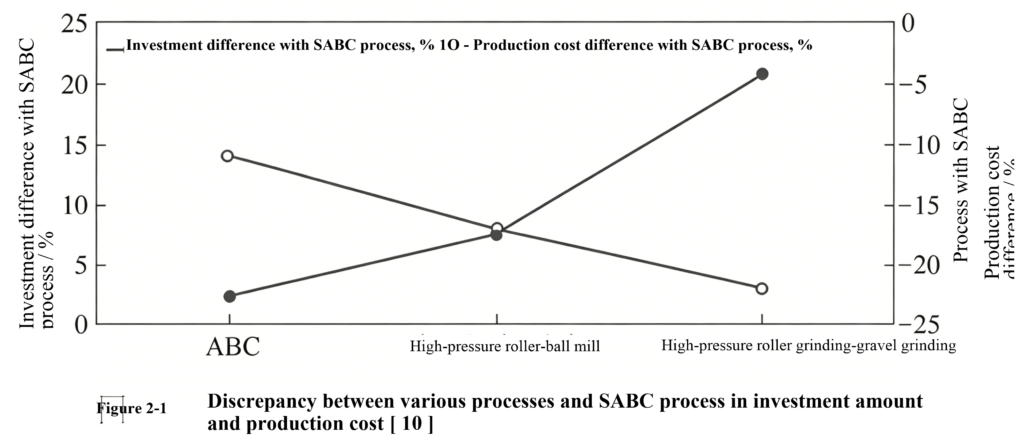
| Economics | Difference in investment amount | One million Australian dollars | +1.7 | +5.6 | +15.5 | ||
| % | +2.3 | +7.5 | +20.7 | ||||
| Production cost variance | Australian dollar/t | -0.53 | -0.81 | -1.08 | |||
| % | -11 | -17 | -22 | ||||
| Internal rate of return difference | % | 107 | 42 | 17 | |||
| Net present value difference (10%) | One million Australian dollars | +8.2 | +7.8 | +4.0 | |||
Figure 2-1 illustrates the differences in investment and production costs among various processes compared to the SABC process. The high-pressure grinding roll-gravel mill process has the lowest production operation cost, followed by the high-pressure grinding roll-ball mill process and the ABC process in that order. The SABC process has the highest production cost, but the investment amount is just the opposite. When comprehensively analyzing the impact of investment and production costs, the ABC and high-pressure grinding roll-ball mill processes exhibit the best project economics. The ABC process has the highest internal rate of return and the shortest repayment period. However, the difference with the high-pressure grinding roll-ball mill process is not significant. For the ABC process, fluctuations in ore properties should be considered, as this process is relatively difficult to operate and optimize.
Case Study Analysis of Industrial Grinding Circuit Selection (continued)
For Projects B and C, the authors considered the ore’s impact breakage resistance to be too high for AG milling. Therefore, the circuit options were limited to SAG, ball milling, or HPGR.
The Bong concentrator in Liberia originally treated magnetite ore using wet AG mills and spiral classifiers. Later, due to a finer liberation size of the ore, the AG mill throughput decreased by 10%–15%. Industrial SAG trials were then conducted using 100 mm steel balls with a Rockwell hardness of 43–60, at a ball charge of 5%. The industrial results showed that after switching to SAG, throughput increased by 32.4% and power consumption decreased by 27.5%. However, because the SAG product became coarser, the concentrate grade dropped by 3.5%. The main reason for the lower unit operating cost of the SAG circuit was that its higher throughput—achieved by adding a suitable proportion of steel balls—resulted in lower operating costs per tonne of ore.
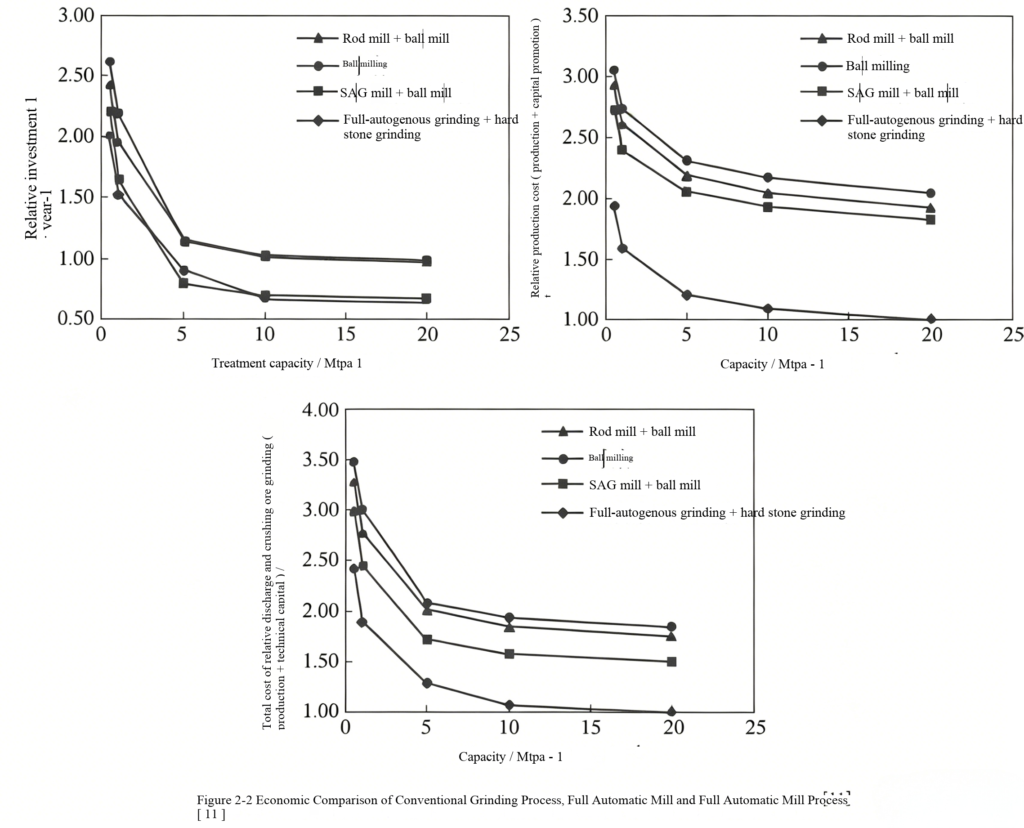
In 1989, Koivistoinen et al. presented an economic comparison between conventional grinding circuits and AG/SAG circuits at the 1989 SAG Conference, with results shown in Figure 2‑2. The authors concluded that:
(1) In terms of capital investment, the decisive factor is whether fine crushing is included in the circuit.
(2) Capital costs account for 30%–50% of total production costs.
(3) Unit production costs decrease with increasing plant throughput, but the reduction becomes very small when annual throughput exceeds 5–10 million tonnes.
(4) Single‑stage ball milling has the highest operating cost, while AG + pebble milling has the lowest.
(5) The reason for the lowest cost of AG + pebble milling is the grinding media.
However, it should be noted that this comparison case dates from nearly 30 years ago, and the relative proportions of various costs may have changed since then.

 English English
 Spanish
 Russian
 Arabic
 Swahili
 French
 Turkish
 Portuguese
 Korean
 Japanese
 German
 Italian