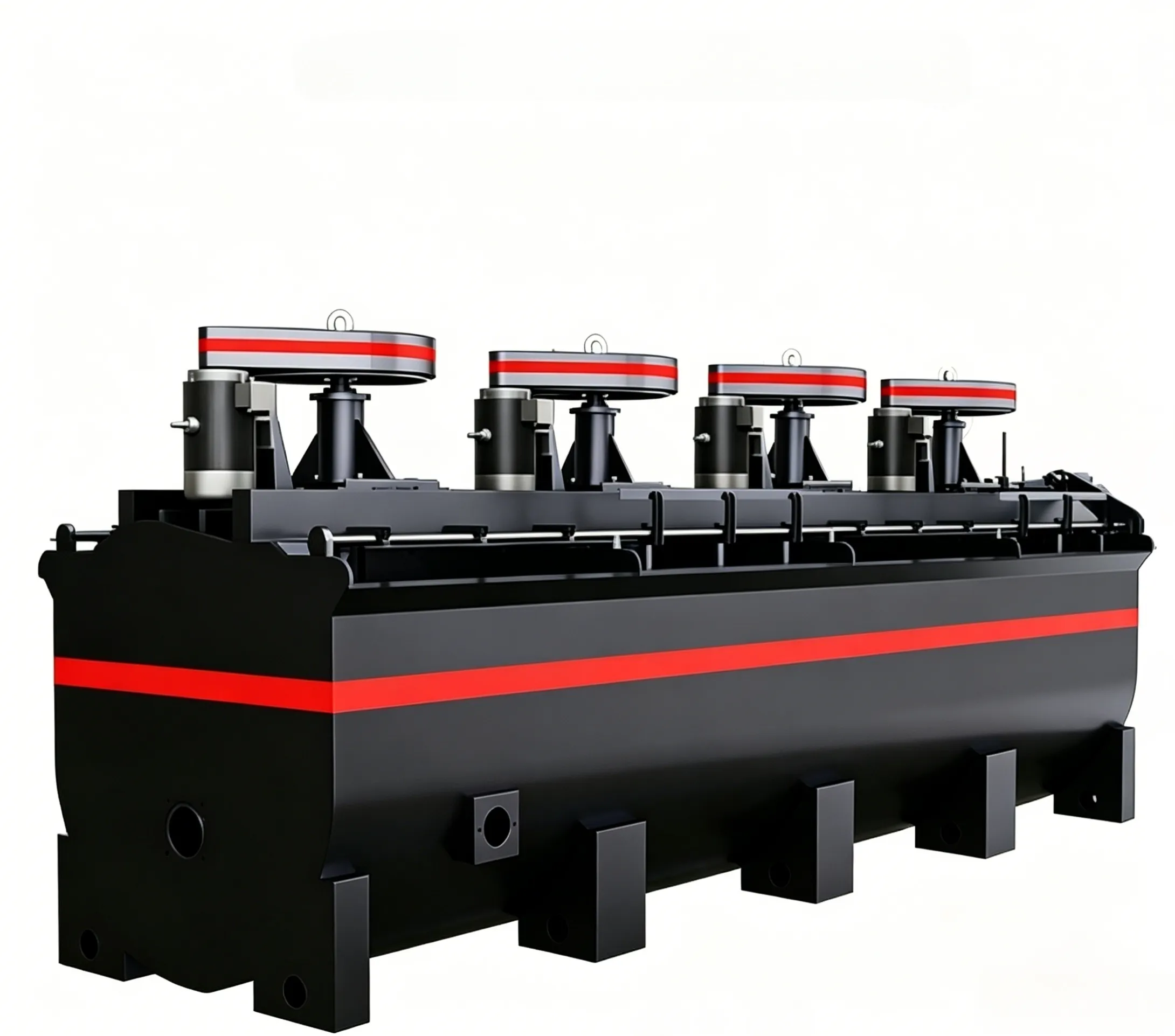
GF flotation machine
GF flotation machine This flotation machine is designed for coarse particles and…


When using cyanide for mineral separation, the following specific issues should be noted:
(1) Based on the different inhibitory effects on different sulfide minerals, cyanide can be divided into three categories: The first category has virtually no inhibitory effect on lead, bismuth, tin, antimony, and arsenic sulfide minerals; the second category has inhibitory effect on mercury, cadmium, silver, and copper sulfide minerals, but the inhibitory effect is not very strong, and a large amount of cyanide is needed when using cyanide to inhibit these minerals; the third category has strong inhibitory effect on zinc, nickel, gold, and iron sulfide minerals, and a small amount of cyanide is sufficient for inhibition. Therefore, when separating the first and third categories, a small amount of cyanide is needed for separation, resulting in the best effect. For example, cyanide is used to inhibit sphalerite when separating lead and zinc. Cyanide can also be used when separating the first and second categories, but a larger amount is required. For example, cyanide is used to inhibit copper minerals when separating copper-lead mixed concentrates. When separating the second and third categories of minerals, if cyanide is used, the amount of cyanide used must be strictly controlled. If the amount is too large, both minerals will be inhibited, for example, in the separation of copper and zinc. Cyanide is used to inhibit copper minerals.
(2) Production practice shows that the inhibitory effect of cyanide on a certain mineral is related to the mineral’s composition, crystal structure, and genesis. For example, pyrite in high-temperature and medium-temperature hydrothermal deposits, when the sulfur-to-iron ratio is close to 2, is easily inhibited by cyanide. Pyrite in low-temperature hydrothermal deposits, when the sulfur-to-iron ratio deviates from 2, is not easily inhibited by cyanide, and sometimes it even has an activating effect.
(3) Potassium ferrocyanide (purine) and potassium ferricyanide (yellow purine) are inhibitors of secondary copper sulfide minerals. They can be used to inhibit copper and float molybdenum in the separation of copper-molybdenum mixed concentrates. During copper-zinc separation, when sphalerite is activated by copper ions produced by secondary copper minerals, and potassium cyanide (sodium) is ineffective in inhibiting its activity, potassium ferrocyanide can be used in a slurry with a pH of 6–8 to suppress copper and float zinc. Its inhibitory effect is achieved by the formation of copper ferrocyanide (or copper ferrocyanide) complex colloids on the surface of the secondary copper ore by ferrocyanide (or ferrocyanide), making the copper mineral surface hydrophilic and thus inhibiting its activity.