Espesador de placas inclinadas tipo caja
Espesador de placas inclinadas convencional El espesador de placas inclinadas (clarificador) de la serie KMIZ(Y) es un...

As is well known, cement is produced through a “two grinding and one burning” process (raw meal → clinker → cement). The quality of cement, i.e., its strength, depends on the clinker burning conditions and the mineral composition of the clinker. Clinker is generally composed of four main minerals: tricalcium silicate (C₃S), dicalcium silicate (C₂S), tricalcium aluminate (C₃A), and tetracalcium aluminoferrite (Ca₄AlFe). Among these, C₃S and C₃A contribute to the early strength of cement, while C₂S, Ca₄AlFe, and C₃S contribute to the later strength.
C₃S is the main mineral in cement clinker (accounting for about 40%–60%).
Using tailings to produce cement means utilizing certain trace elements in the tailings to influence clinker formation and mineral composition. A large amount of tailings is added to the cement raw mix, and the cement is produced following the normal cement manufacturing process to meet national standards. Since tailings are generally already ground to a certain fineness, the process can differ somewhat from the normal production process. One possible process flow is shown in Figure 5-7.
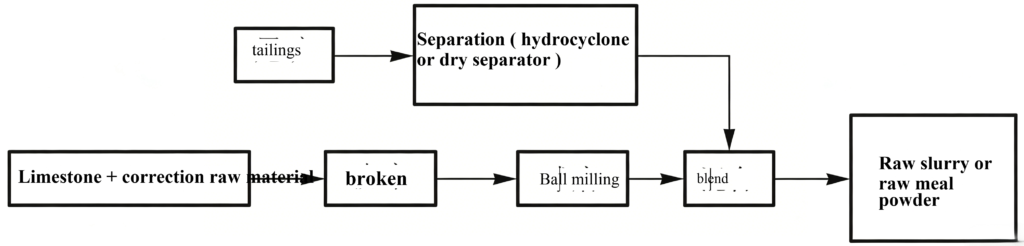
Figure 5-7 Process flow diagram for producing cement from tailings
Generally speaking, low‑silica tailings are more suitable for cement production, because a high quartz content would require large amounts of corrective materials, defeating the purpose of using large quantities of waste. The type of cement produced from tailings depends on the tailings’ compositional characteristics and process conditions.
On the 2500 t/d new dry process clinker production line of Liaoning Gongyuan Cement Group, iron tailings are used as a siliceous raw material, utilising about 100,000 tonnes of iron tailings per year. At the end of 2004, the 2500 t/d new dry process clinker production line entered trial production and commissioning. In the initial stage, the raw mix was designed with four components: limestone, iron tailings, fly ash, and pyrite cinder. The raw material proportions and theoretical material consumption are shown in Table 5‑11. When the Fe₂O₃ content of the iron tailings is relatively high, the original iron‑corrective material (pyrite cinder) can be omitted, and a three‑component mix of limestone, iron tailings, and fly ash can be used. Tests have proven that with appropriate measures, a precalciner kiln can completely replace traditional siliceous and ferrous materials with iron tailings to produce good‑quality clinker, allowing stable production of high‑grade cement such as ordinary 52.5 grade, while significantly reducing raw material costs. During use, attention must be paid to the high moisture content of iron tailings powder – forced feeding should be adopted to ensure smooth material flow. Slight build‑up may occur with iron tailings配料; anti‑blocking measures should be strengthened in the precalcining system at the kiln inlet, more air cannons should be installed, and the calcination system should be stabilised. Using iron tailings waste rock in winter gives even better results.
Table 5‑11 Raw material proportions and theoretical material consumption
| Raw material | Limestone | Iron tailings | Fly ash | Pyrite cinder | Material consumption |
|---|---|---|---|---|---|
| Proportion | 85.25% | 8.42% | 6.03% | 0.30% | 1.4953 t/t |
Wang Jinzhong et al. conducted experimental research on calcining ordinary Portland cement using iron tailings as a raw material. Their thermal analysis of the cement raw meal showed that an appropriate amount of iron tailings lowers the carbonate decomposition temperature by 10–30°C and reduces the starting crystallisation temperature of clinker minerals by 10–25°C. The combined use of an appropriate amount of iron tailings and a mineraliser allows the burning temperature to be controlled in the range of 1300–1450°C.
The Xianlinbu Molybdenum‑Iron Mine in Hangzhou studied the production technology of burning cement by partially replacing cement raw materials with molybdenum‑iron tailings. A successful industrial trial was carried out at the Hemu Cement Plant in Yuhang County, yielding significant economic benefits. Based on the plant’s annual cement output of 35,000 tonnes, savings in production costs alone amount to 248,000 RMB per year, while cement production increases by more than 4,600 tonnes annually. In addition to large amounts of oxides such as SiO₂, Fe₂O₃, Al₂O₃ and CaO, the tailings from this area also contain trace elements (e.g., Mo). When used as raw material for cement production, they not only replace part of the limestone, clay, and all of the ferrous raw material, but the trace element molybdenum also promotes clinker formation, achieving energy savings and consumption reduction, thus providing an effective way for comprehensive utilisation of these tailings.
The mechanism by which the introduced trace element molybdenum promotes cement clinker formation is as follows: it promotes the decomposition of calcium carbonate, lowering the starting decomposition temperature and the endothermic valley temperature by 10°C and 20°C respectively; by changing the migration speed of particles in the melt, it promotes the formation of C₃A and the reaction in which C₂S absorbs free CaO to form C₃S, making clinker formation easier; it has no adverse effect on the clinker mineral composition, can reduce free CaO in the clinker, and improves the early strength of the clinker.
Adding copper or lead‑zinc tailings in cement calcination mainly uses the trace elements in the tailings to improve the formation conditions of silicate minerals and flux minerals during clinker calcination, accelerate the crystal growth of tricalcium silicate, stabilise the structural transformation of the β‑type dicalcium silicate crystal, thereby lowering the temperature at which the liquid phase forms, forming a small amount of early‑strength minerals, and resulting in a marked improvement in clinker quality, especially early strength.
There have been many studies domestically and internationally on calcining cement using lead‑zinc tailings and copper tailings. These two types of tailings can not only replace part of the cement raw materials but also act as mineralisers, effectively increasing clinker output and quality while reducing coal consumption. The main components of lead‑zinc tailings are SiO₂, Al₂O₃, Fe₂O₃ and CaO, plus trace elements such as Ba, Ti and Mn. Experiments show that using lead‑zinc tailings and fluorite as a composite mineraliser for burning cement clinker is more effective than using gypsum and fluorite as a composite mineraliser, lowering the liquid phase temperature to about 1130°C and the clinker calcination temperature to 1250–1300°C.
For copper and lead‑zinc tailings, when the CaO content in the tailings is relatively high and the MgO content is low, they can be used as cement raw materials. The specific requirements are:
Tests have shown that for tailings meeting the above technical requirements, when used as a cement admixture, the dosage can reach 15%–55%. When 15% tailings clinker is added as a cement admixture, the cement grade reaches 600; with 30% addition, the grade reaches 500; with 50% addition, the grade reaches 400. The cement exhibits good performance, with normal setting and soundness.
Henan Xiangshan Cement Group used lead‑zinc tailings slag from Yichuan County to replace pyrite cinder, and calcined quartz tailings from near the plant to replace clay, as ferrous and siliceous raw materials respectively for cement raw meal, to produce cement clinker. To meet the Al₂O₃ requirement in the raw meal, fly ash was added. The chemical compositions of the raw materials are shown in Table 5‑12. The proportioning scheme was: limestone 90%, calcined quartz tailings 6.5%, lead‑zinc tailings slag 2.0%, fly ash 1.5%. Trial production was carried out on a φ3.6m × 70m semi‑dry long kiln with waste heat power generation, following the proportioning scheme. After nearly 20 days of trial production, it was proven that using lead‑zinc tailings slag instead of pyrite cinder and calcined quartz tailings instead of clay for proportioning can produce clinker meeting requirements. The trace elements Pb, Zn, etc. in the lead‑zinc tailings slag act as mineralisers during clinker calcination, promoting the burning reaction; clinker output increased from 18.5 t/h to 19.5 t/h. Replacing pyrite cinder with lead‑zinc tailings slag also solved the problem of raw meal blocking during feeding, stabilising the raw meal composition. Over 20,000 tonnes of lead‑zinc tailings slag are utilised annually; this alone saves about 35 RMB per tonne of clinker in material costs. In 2003 alone, material cost savings amounted to nearly 250,000 RMB, demonstrating significant economic benefits.
Table 5‑12 Chemical composition of raw materials (mass fraction / %)
| Nombre | Loss on ignition | SiO₂ | Al₂O₃ | Fe₂O₃ | CaO | MgO | Total |
|---|---|---|---|---|---|---|---|
| Limestone | 40.16 | 5.62 | 1.86 | 1.05 | 48.36 | 2.05 | 99.10 |
| Lead‑zinc tailings slag | -6.96 | 30.17 | 2.04 | 36.53 | 14.39 | 7.49 | 83.66 |
| Calcined quartz tailings | 1.97 | 79.83 | 3.16 | 1.64 | 3.82 | 1.47 | 91.89 |
| Fly ash | 2.58 | 58.53 | 22.90 | 5.62 | 4.75 | 1.67 | 96.05 |
After proportioning with 5.32% copper tailings, the Changle County Special Cement Plant in Shandong Province achieved improved clinker quality that met the requirements for high‑grade cement production. Coal consumption per tonne of clinker decreased by 15.7% compared to the target index, and by replacing the composite mineraliser, production costs were reduced by 12%. Another successful example of using lead‑zinc tailings to replace part of the raw materials for cement production is the Forestry Cement Plant in Huludao City, Liaoning Province. Production practice has proven that using lead‑zinc tailings in the mix significantly improves raw meal burnability, reduces clinker heat consumption, and increases shaft kiln output. A 100,000 t/a shaft kiln plant can utilise more than 10,000 tonnes of lead‑zinc tailings annually, generating economic benefits of over 1 million RMB.
Shaanxi Yaobai Xiushan Cement Co., Ltd. used lead‑zinc tailings slag to produce low‑alkali, high‑quality Portland cement. Trace elements such as lead, zinc and copper in the tailings catalyse the clinker burning process, lowering the burning temperature and significantly reducing coal consumption per unit product. The combined savings in coal and electricity alone amount to over 5 million RMB per year for the company. In addition, 120,000 tonnes of clay are saved annually, equivalent to more than 100 mu (about 6.7 hectares) of farmland. Practice has proven that cement produced from lead‑zinc tailings exhibits high strength, good workability, corrosion resistance, and good impermeability. Together with its low‑alkali characteristics, the reliability and durability of concrete are ensured, giving the product broad market prospects. The total investment for this technology was 25 million RMB, with annual benefits reaching 13 million RMB; the company recouped the investment in just two years, achieving substantial profits. Using tailings to produce cement not only reduces the land occupation and eliminates the environmental and safety hazards caused by large stockpiles of tailings, but also turns waste resources into valuable materials, creating enormous economic benefits.
Xuan Qingqing et al. studied the burnability of high‑C₃S Portland cement raw meals prepared with lead‑zinc tailings and shale, as well as the properties of the resulting clinkers. They designed 18 clinker compositions and calcined them at 1350°C, 1400°C, 1450°C and 1500°C. The clinkers were tested for free lime and by X‑ray diffraction. The results showed that at 1500°C, a clinker with a C₃S content of 74.52% could be prepared; at the normal calcination temperature of an industrial rotary kiln, a clinker with a C₃S content of 70.71% was obtained. Cement made by adding 4% gypsum to some clinkers met the requirements of 52.5R Portland cement. After adding 20% tailings powder, the strength requirements of 42.5R ordinary cement were met; with 30% tailings powder, the cement met the 32.5R ordinary cement strength requirements.
The use of other tailings for cement production has also attracted considerable attention from researchers. For example, Shandong Yinan Leijin Co., Ltd. used gold tailings to produce high‑quality road cement that is grinding by molino de bolas and sulfate‑resistant cement. Practice shows that gold tailings with high iron and low aluminium content are suitable not only for ordinary Portland cement but especially for road cement and sulfate‑resistant cement. According to tests, the amount of gold tailings used per tonne of cement is 360–400 kg.