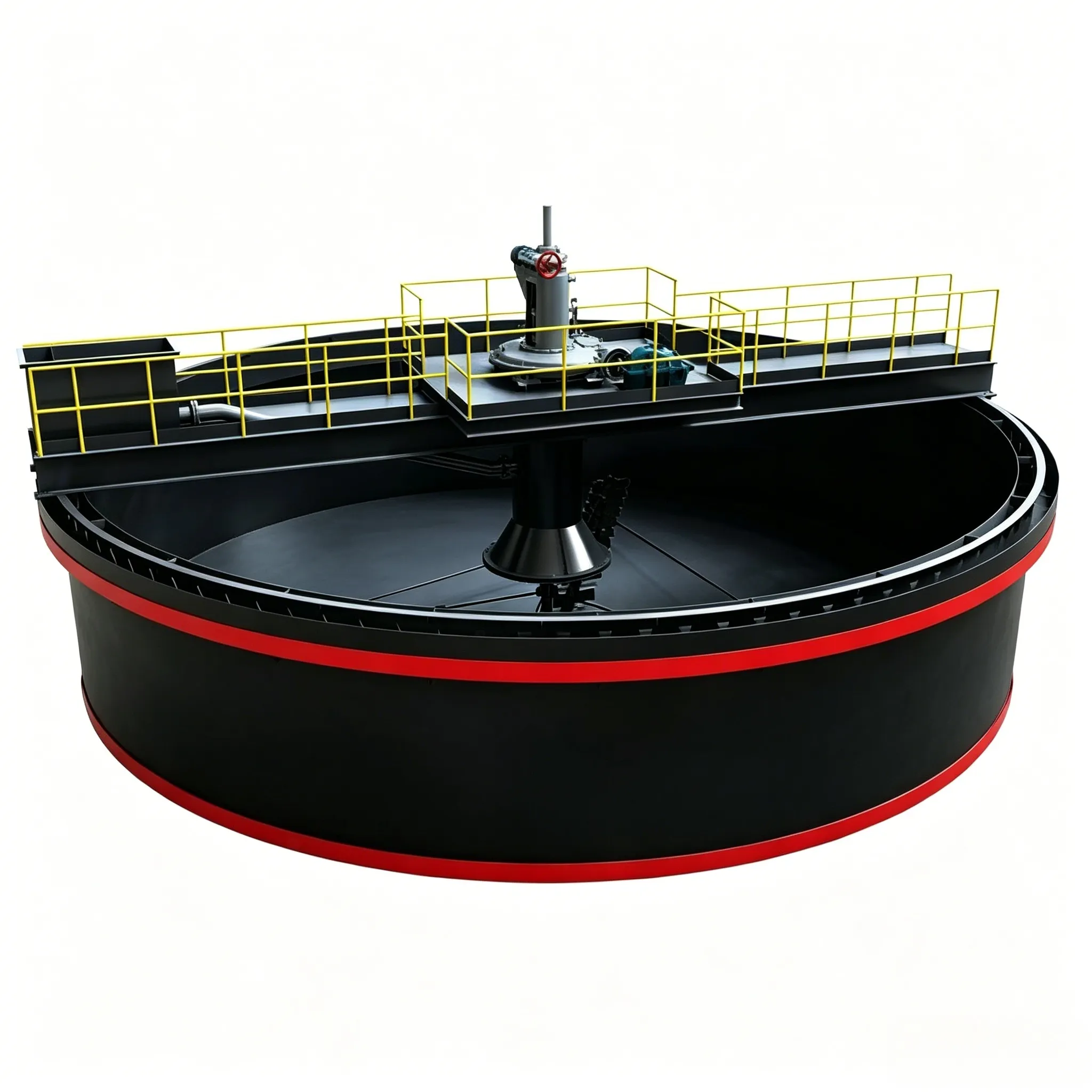
Addensatore ad alta efficienza
Addensatore ad alta efficienza L'addensatore ad alta efficienza è un nuovo tipo di impianto di addensamento…


Feed Chute Liners
In terms of plant availability, the mill feed chute is as critical as the primary crusher, because all the material must pass through it to enter the primary grinding mill. Since the feed chute of SAG/AG mills generally has no spare, once the feed chute wears out (as shown in Figure 5‑84), the mill must be shut down for replacement, resulting in substantial downtime. The design of the mill feed chute and its liners must take the following factors into account:
(1) Grinding make‑up water should be introduced from the back side of the chute, aligned with or parallel to the mill axis, so that fine material is flushed into the mill.
(2) The structural design should avoid localised high wear caused by sudden changes in the direction of ore or slurry flow, or by circulating loads returning to the mill feed inlet.
(3) When designing the feed chute, its cross‑section should meet the maximum flow rate requirements, including new feed, circulating load, and water.
(4) The number of liner types and shapes should be kept as few as possible.
(5) The strength differences between the liners, bolts, and chute structure should be rationally designed to avoid damage to the chute connection points under overload conditions.
(6) The feed chute should be extended as far as possible, even directly into the mill, to prevent material from falling onto or directly impacting the inner liner of the mill trunnion (as shown in the upper left of Figure 5‑80), which often causes accelerated wear.
(7) For high‑wear conditions, consideration should be given to purchasing a spare feed chute fully assembled with liners, so that once the operating chute is worn out, it can be removed and the spare installed to quickly resume operation.
The service life of chute liners directly affects the mill availability. To ensure the normal and stable operation of the entire grinding system, a reasonable service life for the chute liners must be designed. Common methods to extend the life of chute liners include:
(1) Increasing liner thickness. Typically, chute liners have a thickness of 80–140 mm; to extend their service life, the thickness can be increased to 100–180 mm.
(2) Adopting an ore‑box design. In this approach, the feed material first falls from the belt conveyor onto a deflector ore box, then travels downward along a series of ore boxes, and finally enters the mill through a smooth liner. This arrangement absorbs the impact energy of the material as it leaves the feed belt.
(3) Material selection. Feed chute liners can generally be made of thickened martensitic chromium‑molybdenum cast iron or manganese steel, depending on the chute geometry and the impact forces. It has been reported that BBT‑KMC‑3 modified steel can significantly improve the service life of chute liners.
(4) Geometric design. Improving the material trajectory inside the chute: a combination of sliding and bouncing motion of the ore is more beneficial for extending liner life. Appropriate longitudinal baffles or obstructions can be added to the chute liners to create collisions, causing the ore to bounce away from the liner surface. In this way, the ore moves in both sliding and bouncing modes, reducing sliding wear and further improving liner life.

Figure 5‑84 Worn feed chute liners

 English English
 Spanish
 Russian
 Arabic
 Swahili
 French
 Turkish
 Portuguese
 Korean
 Japanese
 German
 Italian