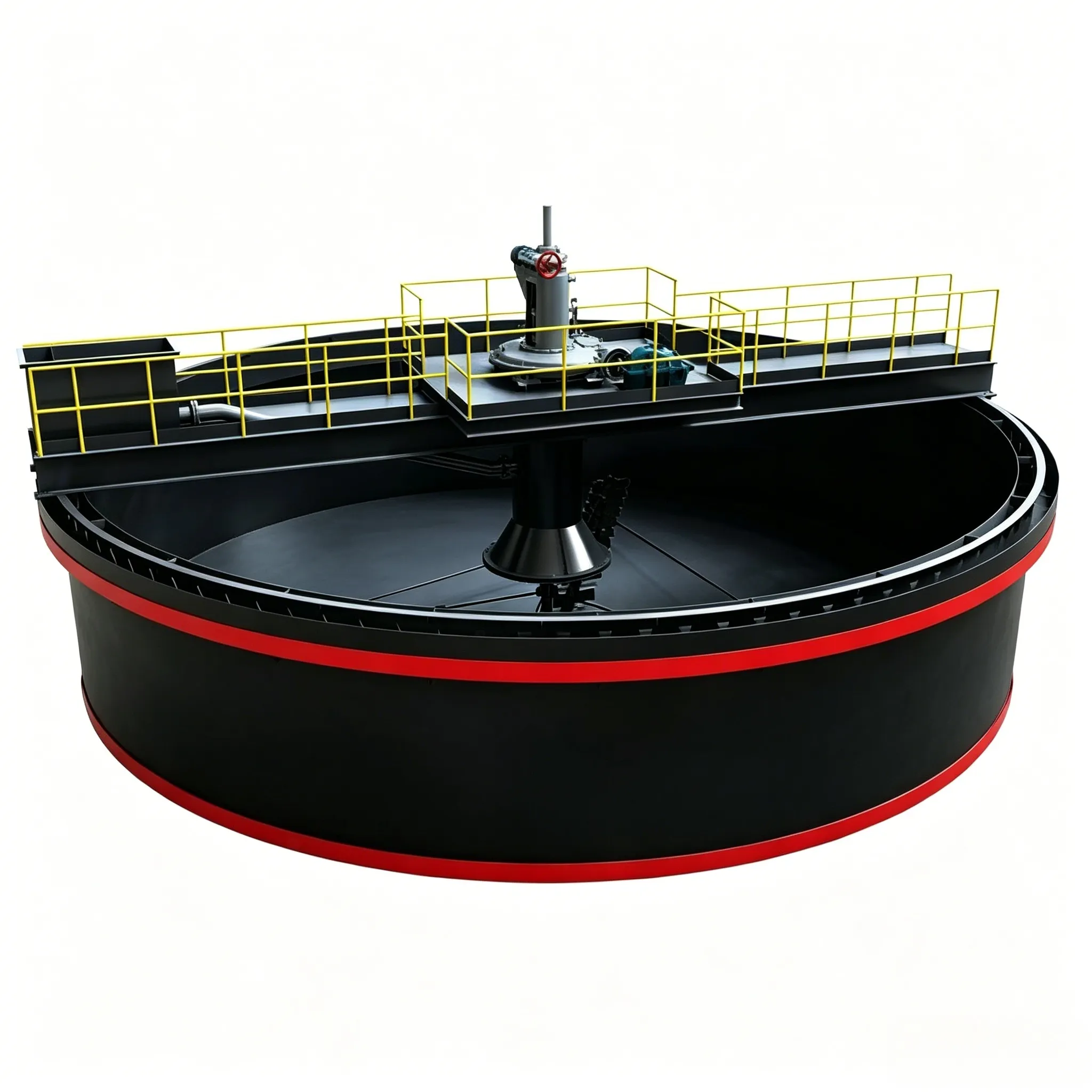
Épaississeur à haut rendement
Épaississeur à haut rendement L'épaississeur à haut rendement est un nouveau type d'équipement d'épaississement…


1. A dry high‑intensity magnetic separation process for non‑metallic minerals, suitable for the removal of weakly magnetic materials with a specific magnetic susceptibility χ > 12.6 × 10⁻⁷ m³/kg, comprising raw ore coarse crushing, medium crushing, fine crushing, drying, re‑crushing, classification, low‑intensity magnetic separation, high‑intensity magnetic separation, and classification, caractérisé en ce que: before entering magnetic separation, the particle size of the raw ore is 80 mesh to 200 mesh > 90%, and the moisture content of the raw ore before separation is ≤ 1%; during the magnetic separation process, dry gradient high‑intensity magnetic separation is employed, with the magnetic field intensity for low‑intensity magnetic separation being 7,500 Oersted and the magnetic field intensity for high‑intensity magnetic separation being 20,000 Oersted.
2. The dry high‑intensity magnetic separation process for non‑metallic minerals according to claim 1, caractérisé en ce que: the raw ore coarse crushing and medium crushing use a jaw crusher; fine crushing uses a cone crusher; drying uses a rotary dryer; re‑crushing uses a double‑roll crusher; low‑intensity magnetic separation uses a drum‑type low‑intensity magnetic separator; high‑intensity magnetic separation uses a dry high‑intensity magnetic separator; and classification uses vibrating screens and classifiers.
The present invention relates to the field of deep processing of non-metallic minerals, and in particular to a dry high-intensity magnetic separation process for weakly magnetic minerals with a specific magnetic susceptibility χ > 12.6 × 10⁻⁷ m³/kg.
Existing non-metallic mineral magnetic separation processes abroad include: three-stage crushing, one-stage separation, re-crushing and re-separation; pebble milling, air classification, re-grinding; three-stage crushing, three-stage separation, classification and re-grinding; three-stage crushing, two-stage grinding, classification magnetic separation, air classification and re-pebble milling. The common problems are that the process is complicated, the equipment is numerous, and the investment is too large. Even when using domestic equipment according to these processes, it is difficult to produce qualified products. In China, widely used processes include: two-stage crushing, one-stage grinding, one low-intensity and two high-intensity wet magnetic separation; three-stage crushing, one-stage grinding, one roughing and two cleaning stages, with middlings re-separation; wet low-intensity and high-intensity magnetic separation semi-industrial tests; and dry high-intensity magnetic separation laboratory processes with two-stage crushing and two-stage separation. Although some basic data have been obtained and the processes are becoming increasingly sophisticated, the construction investment is high, production costs are high, and product quality is difficult to meet industry standards. In particular, production costs and product quality are hardly acceptable in both domestic and international markets.
The object of the present invention is to provide a dry high-intensity magnetic separation process for weakly magnetic minerals with a specific magnetic susceptibility χ > 12.6 × 10⁻⁷ m³/kg, which achieves low construction investment, low production costs, and stable product quality.
The object of the present invention is achieved as follows: The process flow of the present invention comprises: raw ore coarse crushing, medium crushing, fine crushing, drying, re-crushing, classification, low-intensity magnetic separation, high-intensity magnetic separation, and classification. The working principles are as follows:
A. In the raw ore pulverization stage before “low-intensity magnetic separation,” a crushing-only or more-crushing-less-grinding approach is adopted to maximize the maintenance of a uniform particle size range of the raw ore, with 80 mesh to 200 mesh > 90%. This fully liberates dark-colored minerals firmly attached to mineral cleavage planes or occurring as tiny inclusions from non-magnetic minerals, while avoiding over-grinding, so as to achieve the optimum operating conditions for the magnetic separator, obtain a leaner non-magnetic product, and improve the recovery rate of magnetic minerals in the magnetic product.
B. In the “low-intensity magnetic separation” stage, a drum-type low-intensity magnetic separator is used; in the “high-intensity magnetic separation” stage, a dry high-intensity magnetic separator is used. The moisture content of the feed ore before separation is controlled at ≤ 1%, because as the moisture content increases, the cohesion between ore particles increases, which adversely affects the magnetic separation process. During magnetic separation, strongly magnetic materials are removed from the raw materials to prevent them from accumulating at the feed port, on the rollers, and on the magnetic shoes, which would disrupt the separation process.
C. In the magnetic separation process, dry gradient high-intensity magnetic separation is employed. The magnetic field intensity for low-intensity magnetic separation is 7,500 Oersted, and that for high-intensity magnetic separation is 20,000 Oersted, directly producing a non-magnetic product containing only trace amounts of light-colored minerals.
In the present invention, the raw ore coarse crushing and medium crushing use a jaw crusher; fine crushing uses a cone crusher; drying uses a rotary dryer; re-crushing uses a double-roll crusher; and classification uses vibrating screens and classifiers.
In the present invention, the raw ore coarse crushing, medium crushing, fine crushing, and re-crushing may be replaced by raw ore coarse crushing, fine crushing, and pebble milling.
The present invention has the features of low investment, short construction period, high recovery rate, stable product quality, and excellent quality, with low production costs. The investment is 40% of that of a wet processing plant of the same capacity; the recovery rate is > 78.8%; the direct production cost is 50% of that of a wet processing plant; and the product quality achieved is four grades higher than that of a wet processing plant.
The present invention is further described in detail below with reference to an embodiment.
In the Nanjiang nepheline syenite beneficiation tests, the feed moisture content was 1%. After coarse crushing, medium crushing, fine crushing, and re-crushing, the feed particle size was 80 mesh to 200 mesh > 90%. Using a drum-type low-intensity magnetic separator with a magnetic field intensity of 7,500 Oersted and a dry high-intensity magnetic separator with a magnetic field intensity of 20,000 Oersted, after one stage of low-intensity and one stage of high-intensity dry magnetic separation, a product with Fe₂O₃ < 0.07% was directly obtained, and the product quality reached the world advanced level.
The present invention employs scientific and rational process equipment, and the process is easy to control, simple to operate, low in cost, stable in product quality, low in investment, short in construction period, and highly adaptable.
 English English
 Spanish
 Russian
 Arabic
 Swahili
 French
 Turkish
 Portuguese
 Korean
 Japanese
 German
 Italian