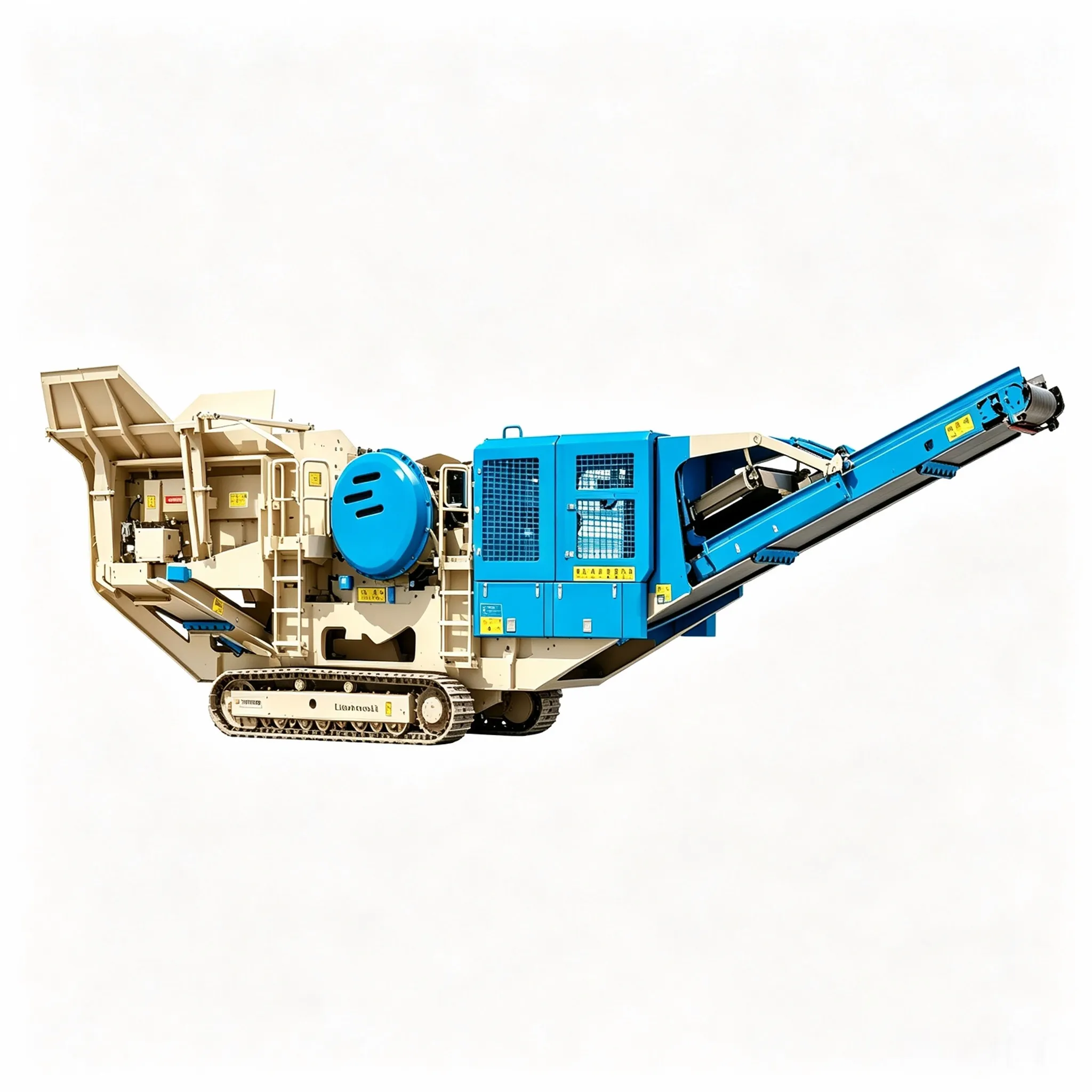
Trituradora de piedra móvil sobre orugas
Estación trituradora de mandíbulas móvil. Serie: Estándar. Modelo: Equipo a bordo. Capacidad de procesamiento (t/h). Dimensiones de transporte (mm)…

Copper and cobalt are important strategic metal resources, widely used in new‑energy batteries, aerospace, cemented carbides, and electrical/electronic applications. As one of the main sources of cobalt, copper‑cobalt ore beneficiation is critical for ensuring national strategic resource supply security. Among the various beneficiation methods for copper‑cobalt ores, flotación is the most widely applied technique due to its strong adaptability, large throughput, and high separation efficiency. This article systematically analyses the flotation process flowsheets, key technologies, and latest production practices for copper‑cobalt ores, providing a useful reference for industry practitioners.
The flotation separation of copper‑cobalt ores faces many challenges, mainly as follows:
1. Complex mineral composition and highly variable oxidation rate
Copper and cobalt minerals in copper‑cobalt ores commonly exist as both sulphides and oxides, with highly variable oxidation rates. For example, the SICOMINES copper‑cobalt ore in the DRC has an oxidation rate of about 70%, making it a typical high‑oxidation copper‑cobalt ore. Sulphide minerals are relatively floatable, whereas oxide minerals are poorly floatable, requiring different flotation strategies.
2. High slime content, deteriorating the flotation environment
Some copper‑cobalt ores contain large amounts of carbonaceous slime and fine mud, which coat the surface of valuable minerals, consume large quantities of flotation reagents, and seriously degrade flotation performance. A certain sulphide‑oxide mixed copper‑cobalt ore contains up to 6.63% carbon, making it difficult to achieve good overall recovery by conventional flotation alone.
3. Difficulty in copper‑cobalt separation
Copper minerals and cobalt minerals have similar floatability, so achieving their efficient separation is the core challenge of the flotation process. Cobalt minerals are usually finely disseminated, further increasing separation difficulty.
Depending on ore properties and separation objectives, copper‑cobalt ore flotation processes are mainly classified into three types: bulk flotation‑separation flotation, selective flotation, y asynchronous flotation.
This is the most widely used flotation route for copper‑cobalt ores. The core concept is first obtaining a copper‑cobalt bulk concentrate by bulk flotation, then producing separate copper and cobalt concentrates by separation flotation.
Process flowsheet:
Typical performance:
Using this process, a copper‑cobalt sulphide ore can produce a copper concentrate grading 29%–35% Cu with 90%–94% Cu recovery, and a cobalt concentrate grading 2%–4% Co with 55%–65% Co recovery. For a copper‑cobalt ore in Hainan, under optimised conditions, the bulk‑flotation‑separation route achieved a copper concentrate with 24.90% Cu grade and 83.83% recovery, and a cobalt concentrate with 1.11% Co grade and 88.28% recovery.
This route has strong adaptability and is also applicable to low‑grade, finely disseminated copper‑cobalt ores, but the copper‑cobalt separation efficiency of flotation alone is limited.
The selective flotation route follows a “copper first, cobalt later” sequence, producing separate copper and cobalt concentrates.
Process flowsheet:
In a Zambian copper‑cobalt ore, a selective flotation flowsheet of “one roughing, one scavenging, three cleanings” for copper, followed by “one roughing, one scavenging, two cleanings” for cobalt from the copper tailings, produced a copper concentrate grading 31.76% Cu with 94.03% recovery, and a cobalt concentrate grading 3.25% Co with 55.29% recovery.
Para mixed copper‑cobalt ores containing both sulphides and oxides, asynchronous flotation (also called “sulphide‑first, oxide‑later” flotation) is currently the most effective technical route.
Process flowsheet:
Typical performance:
For a sulphide‑oxide mixed copper‑cobalt ore (2.63% Cu, 0.04% Co, 6.63% C), after pre‑flotation desliming to remove carbonaceous slime and then asynchronous flotation, a copper‑cobalt concentrate with 21.12% Cu grade and a high Cu recovery of 88.55% was achieved. Studies show that sodium hydrosulphide (NaHS) is more effective than sodium sulphide (Na₂S) for sulphidisation flotation of oxide copper‑cobalt minerals.
For a copper‑cobalt ore in the DRC (1.70% Cu, 0.70% Co, Cu oxidation rate 35%–40%), a two‑stage flotation process (sulphide first, oxide later) produced a sulphide concentrate grading 21.91% Cu and 7.70% Co (Cu recovery 71.96%, Co recovery 66.17%) and an oxide concentrate grading 20.42% Cu and 18.10% Co (Cu recovery 11.60%, Co recovery 15.29%). The total Cu recovery from the two stages was 83.56%, and total Co recovery was 81.46%.
Latest breakthrough:
Huagang Mining, in collaboration with Central South University and the Hunan Research Institute of Nonferrous Metals, has successfully developed a novel organic amine‑hydroxamic acid/xanthate assembled collector specifically for oxide copper‑cobalt ores, and innovatively proposed a “sulphide‑first, oxide‑later” asynchronous flotation process. This technology has been industrially applied at the SICOMINES copper‑cobalt mine, achieving a flotation copper recovery of 86%, with improvements of 12% and 20% for copper and cobalt recoveries respectively compared to similar resources. This project was awarded the Second Prize of the National Science and Technology Progress Award in 2024.
The reagent regime for copper‑cobalt ore flotation varies with ore type and mainly includes the following categories:
Lima is the most commonly used pH modifier and depressant, typically dosed at 400–1000 g/t, to adjust pulp pH to an alkaline range. For carbonaceous slime‑bearing ores, specialised modifiers such as BK‑530 can be used to depress carbonaceous matter.
The key to oxide copper‑cobalt flotation is sulphidisation flotation. Commonly used sulphidising agents include:
Aceite de pino (also called 2# oil) is commonly used, typically at 20–30 g/t.
When the copper‑cobalt ore has complex mineralogy and flotation alone cannot effectively recover cobalt, magnetic separation can be combined for further recovery. Cobalt is weakly magnetic, making this suitable for oxide ores containing appreciable magnetic minerals.
Process flowsheet: Flotation tailings are reground and fed to a high‑intensity magnetic separator for roughing → cleaning → regrinding → low‑intensity magnetic separation, finally yielding a magnetic concentrate.
Application case: Huagang Mining’s “cascade flotation + high‑intensity magnetic separation” technology has been included in the Ministry of Natural Resources’ catalogue of advanced applicable technologies. It is suitable for beneficiation of refractory copper‑cobalt ores with high oxidation rates, effectively improving overall recovery of copper and cobalt while significantly reducing production costs.
At the SCM mining area in the DRC, a low‑grade high‑oxidation copper‑cobalt ore using a combined flotation‑magnetic separation process achieved total copper recovery (including sulphide concentrate, oxide concentrate, flotation cobalt concentrate and magnetic concentrate) of 85.17% and total cobalt recovery of 46.96%.
For refractory copper‑cobalt ores with high oxidation rates, high association, severe slime formation, or high Ca/Mg content, a beneficiation‑metallurgy combined process can be adopted. The concept is flotation for pre‑concentration and waste rejection, followed by leaching. The pre‑flotation step removes acid‑consuming gangue, reducing acid consumption in subsequent agitation leaching while producing a flotation concentrate with higher Cu and Co grades. This process is suitable for low‑grade, high‑acid‑consuming oxide copper‑cobalt ores and effectively reduces cobalt production costs.
The combination of sodium hydrosulphide and ammonium sulphide (1:1) can produce synergistic effects, improving the sulphidisation flotation performance of oxide copper‑cobalt ores.
For flotation tailings that still contain some refractory copper minerals, a combination of gravity, magnetic, and flotation methods can be employed for re‑treatment.
Zhejiang Huayou Cobalt has filed a patent for “method and system for controlling copper‑cobalt ore flotation process”, achieving precise control over flotation reagent addition to improve process parameter accuracy.
The selection of a flotation process flowsheet for copper‑cobalt ores should be tailored to the ore properties. For ores dominated by sulphides, the bulk flotation‑separation process is a mature and reliable choice; for high‑oxidation ores, asynchronous flotation (sulphide‑first, oxide‑later) is the most effective route; for complex ores, flotation‑magnetic separation o beneficiation‑metallurgy combined processes are effective means to improve overall recovery.
With the continuous emergence of novel collectors, combined sulphidising agents, and the promotion of innovative technologies such as “cascade flotation + high‑intensity magnetic separation”, copper‑cobalt flotation technology is moving towards higher efficiency, intelligent control, and greener operation. These technological breakthroughs will provide solid support for the efficient development and utilisation of complex, refractory ores in the world’s largest copper‑cobalt metallogenic belt.

 English English
 Spanish
 Russian
 Arabic
 Swahili
 French
 Turkish
 Portuguese
 Korean
 Japanese
 German
 Italian