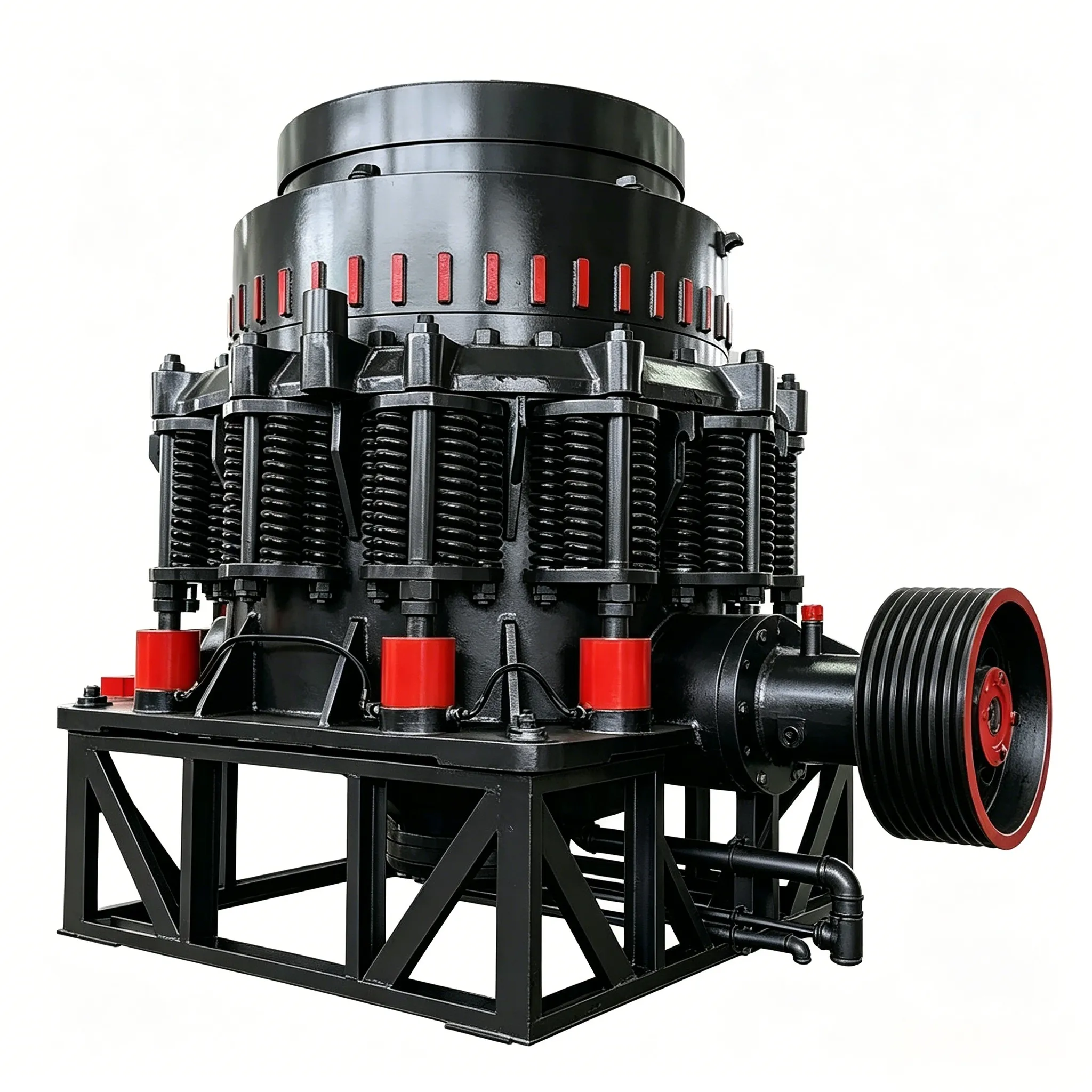
Trituradoras de cono
Tipos de trituradoras de cono Las trituradoras de cono se conocen en todo el mundo como...


In the grinding and classification process of a mineral processing plant, a common problem is often encountered: the cyclone feed pressure appears normal, and the pressure gauge reading is within the process requirement range, but sampling and testing reveal that the overflow particle size is still too coarse, or even exhibits coarse particle overflow.
At this point, if one only stares at the pressure gauge, it is easy to fall into a misunderstanding: assuming the cyclone is working normally just because the pressure is normal.
In reality, normal cyclone pressure only indicates that one operating parameter is within the normal range; it cannot prove that the classification performance is definitely normal. The overflow particle size is also affected by multiple factors such as feed density, ore properties, cyclone wear, feed distribution, and testing methods.
1. Changes in Feed Density May Be the Cause of Normal Pressure but Coarse Overflow
Normal cyclone feed pressure does not mean that the feed density is also normal.
When the mill discharge density increases, or the pump sump water addition is insufficient, the pulp entering the cyclone may become too dense. The pulp viscosity and the interactions between particles will also change, affecting the separation process of particles inside the cyclone.
Under certain operating conditions, the separation effect between fine and coarse particles will deteriorate, causing some coarse particles that should have entered the underflow to enter the overflow.
However, the feed density is not the lower the better. If the density is too low, it may also affect the processing capacity and classification conditions. The appropriate range needs to be determined based on ore properties, cyclone specifications, and on-site tests.
Therefore, when the pressure is normal, the feed density, pulp flow rate, and pump sump level should be checked simultaneously; one cannot only look at the pressure gauge.
2. Changes in Ore Properties May Make the Original Parameters No Longer Applicable
The same ball mill and the same set of cyclones may have different classification performance under different ore conditions.
For example, changes in raw ore hardness will affect the particle size of the grinding product; changes in mineral composition, degree of sliming, and fine particle content may also alter the rheological properties of the pulp and the particle separation behavior.
When the ore becomes harder and the grinding capacity is insufficient, even if the cyclone pressure remains stable, the coarse particles entering the classification system may still increase, resulting in a coarser overflow particle size.
It should be noted here that: coarse overflow is not necessarily entirely caused by the cyclone; it may also be that the upstream grinding has not provided a sufficiently fine product.
Therefore, during troubleshooting, the mill load, feed rate, grinding fineness, and cyclone overflow particle size should be analyzed together to distinguish whether it is insufficient grinding capacity or a decrease in classification efficiency.
3. Cyclone Wear May Alter the Actual Classification Performance
After long-term operation of the cyclone, the apex (spigot), vortex finder, and internal liners may experience wear.
Among these, wear on the apex will change the underflow discharge conditions; wear or dimensional changes in the vortex finder may also affect the internal flow field and classification performance.
This type of problem has a characteristic: the pressure displayed by the control system may not show obvious abnormalities, but the actual working state of the equipment has already changed.
If the overflow particle size is found to be continuously too coarse, and the changes in feed density, ore properties, and pressure are not sufficient to explain the problem, the wear conditions of the apex, vortex finder, and the interior of the cyclone should be checked, and it should be observed whether the underflow shape is abnormal.
Equipment failure cannot be ruled out simply because the pressure is normal.
4. Uneven Feed Distribution Will Cause Some Cyclones to Fail in Classification
When multiple cyclones are operated in parallel, a normal reading on the main pressure header does not mean that the actual feed rate of each cyclone is the same.
If there is blockage, wear, or resistance differences in the distribution box, branch pipes, valves, or pipelines, situations such as insufficient feed to some cyclones or excessive load on others may occur.
At this time, the main header pressure may appear normal, but there may be significant differences in the classification performance of individual cyclones. If the classification performance of a few cyclones deteriorates, it may affect the overflow particle size of the entire system.
On site, the underflow shape of each cyclone can be observed one by one, the status of branch pipes and valves can be checked, and when conditions permit, samples can be taken separately to compare the overflow particle sizes of different cyclones.
Normal main header pressure does not mean that every cyclone is in normal operating condition.
5. It Is Also Necessary to Confirm: Is the Overflow Particle Size Test Result Reliable?
Sometimes, process personnel believe that the overflow is too coarse, but the problem may not necessarily lie entirely with the equipment.
If the sampling time is inconsistent, the sample is not sufficiently representative, the sampling point is inappropriate, or there are problems with the particle size testing method and instrument status, the test results may not truly reflect the actual working conditions.
Especially when the grinding system is in a fluctuating state, a single sampling may not represent the continuous production situation.
Therefore, the sampling location and sampling time should be unified as much as possible, the trend should be judged based on continuous or multiple test results, and the testing method, sample processing procedure, and instrument status should be checked.
The judgment of whether the overflow is too coarse should ultimately be based on reliable overflow particle size test results, rather than merely observing the appearance of the pulp with the naked eye.
6. Automation Systems Should Not Only Control Pressure but Also Focus on Classification Results
Traditional control systems often focus on monitoring cyclone feed pressure, pump sump level, and pump operating status. These parameters are important, but they mostly reflect the equipment operating conditions and cannot directly represent the final classification effect.
To improve the stability of grinding and classification, efforts can be made from three levels:
Stabilize operating conditions: Monitor feed pressure, pump sump level, pulp flow rate, and feed density to reduce unnecessary fluctuations.
Focus on equipment and distribution status: Compare the operating status of multiple cyclones to promptly detect problems such as blockage, wear, and uneven feed distribution.
Establish result feedback: Correlate the overflow particle size test results with the feed rate, mill load, pulp density, and pressure trends to analyze which parameter changes have a stable corresponding relationship with coarse particle overflow.
If online particle size detection conditions are available, control strategies based on particle size feedback can be further studied; if manual sampling and assaying are still the main method, the key variables affecting classification performance can also be gradually identified through data recording and trend analysis.
It should be emphasized that one cannot simply set a fixed pressure value and assume that the cyclone classification performance is definitely qualified. The control objectives should be determined in combination with actual process requirements.
 English English
 Spanish
 Russian
 Arabic
 Swahili
 French
 Turkish
 Portuguese
 Korean
 Japanese
 German
 Italian