Box‑type inclined‑plate thickener
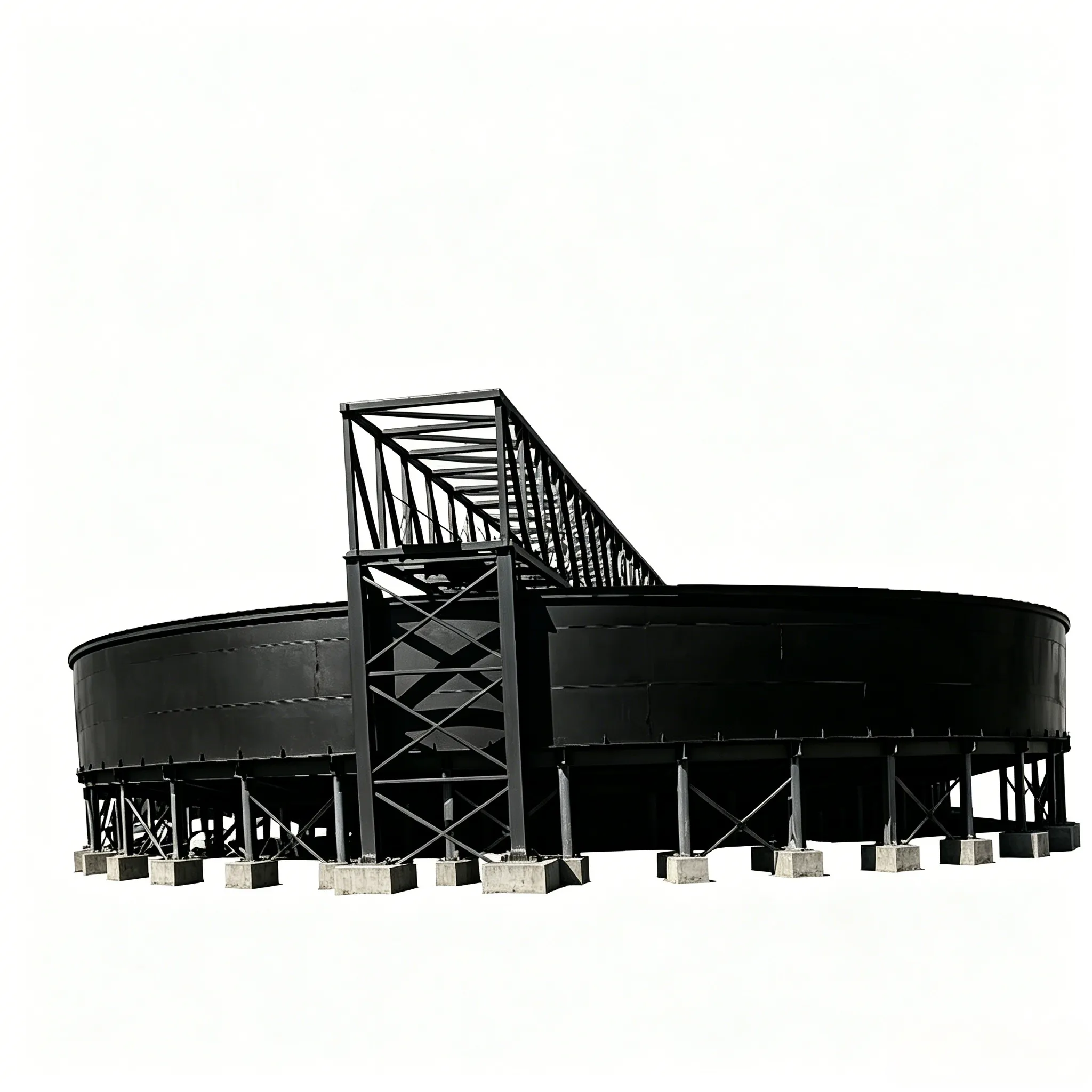
Conventional Inclined‑Plate Thickener The KMIZ(Y) series inclined‑plate thickener (clarifier) is a new…

The Yue River in southern Shaanxi flows through Ankang and Hanyin cities and counties. Along the river, there are four placer gold mines (Wuli, Ankang, Hengkou, Hanyin), nine dredges, and three onshore beneficiation plants. The tailings from the dredges and onshore plants of the Yue River placer gold mines contain 21 types of minerals. The minerals are predominantly strongly magnetic, supplemented by weakly magnetic minerals, with trace amounts of non‑magnetic minerals. Currently, only four minerals are recoverable: magnetite (42%), hematite (18%), ilmenite (18%), and garnet (17%), among which the garnet is predominantly almandine. The iron concentrate, dominated by magnetite as a strongly magnetic mineral, is the most abundant in the placer gold tailings, generally accounting for 60%, with over 90% in the <1 mm size fraction.
Considering that the dust in the tailings has already been washed by water (the medium used in the gravity separation process, which is adopted by all placer gold mines), a dry separation process can be used to recover the iron concentrate. This simplifies the process equipment, reduces dewatering, thickening, and filtration operations, and minimizes the plant footprint and process water consumption.
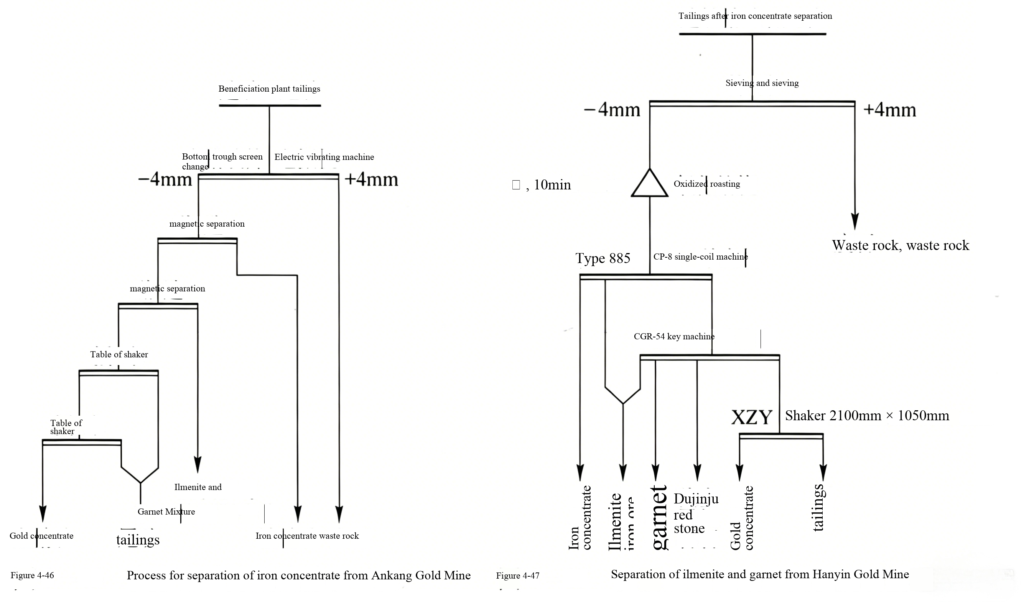
Based on the characteristics of the tailings, the Ankang Gold Mine adopted a two‑stage dry magnetic separation process (see Figure 4‑46) consisting of a φ600 mm × 600 mm (214.97 kA/m) permanent magnet single‑roll dry separator and a CGR‑54 (1592.36 kA/m) permanent magnet double‑roll high‑intensity dry separator in series to recover magnetite, hematite (collectively referred to as iron concentrate), and ilmenite‑garnet intergrowths from the tailings. Two XZY‑2100 mm × 1050 mm shaking tables were added at the end of the process to recover gold from the waste rock and slime. Using this process, the Ankang Gold Mine recovers 1,700 t of iron concentrate and 2.187 kg of placer gold from the tailings each year.
The Hengkou Gold Mine in southern Shaanxi uses a single φ600 mm × 600 mm (87.58 kA/m) permanent magnet single‑roll dry separator to recover iron concentrate from its tailings. The concentrate yield is 31.2%, the grade of the iron concentrate is 65%–68%, and the annual production of iron concentrate from the tailings is 1,100 t. Additionally, 1.5309 kg of placer gold is recovered using a shaking table.
4.3.1.2 Magnetic Separation – Roasting – Magnetic Separation Recovery Process
Based on the tailings characteristics, the Hanyin Gold Mine uses a wet magnetic separator with a field intensity of 135.35 kA/m to recover iron concentrate from the tailings. The tailings after iron recovery are then subjected to a roasting‑magnetic separation process to recover ilmenite and garnet. The production process is shown in Figure 4‑47. Preliminary estimates indicate an annual output of 1,700 t of iron concentrate, 360 t of ilmenite, 468 t of garnet, and 216 t of magnetite not fully recovered during the iron separation step, along with 1.218 kg of gold.